Opening: When Time Becomes a Hidden Ingredient
Rice changes even when nothing is done to it.
Time alone alters how rice behaves, tastes, cooks, and is valued.
Yet most consumers believe rice freshness is visible.
They assume newer-looking rice is newer rice.
That assumption is wrong.
In modern supply chains, ageing and polishing work together to control how rice looks—regardless of its actual age.
What Rice Ageing Really Means
Rice ageing is not spoilage.
It is controlled storage over time, during which internal moisture and starch structures change.
As rice ages:
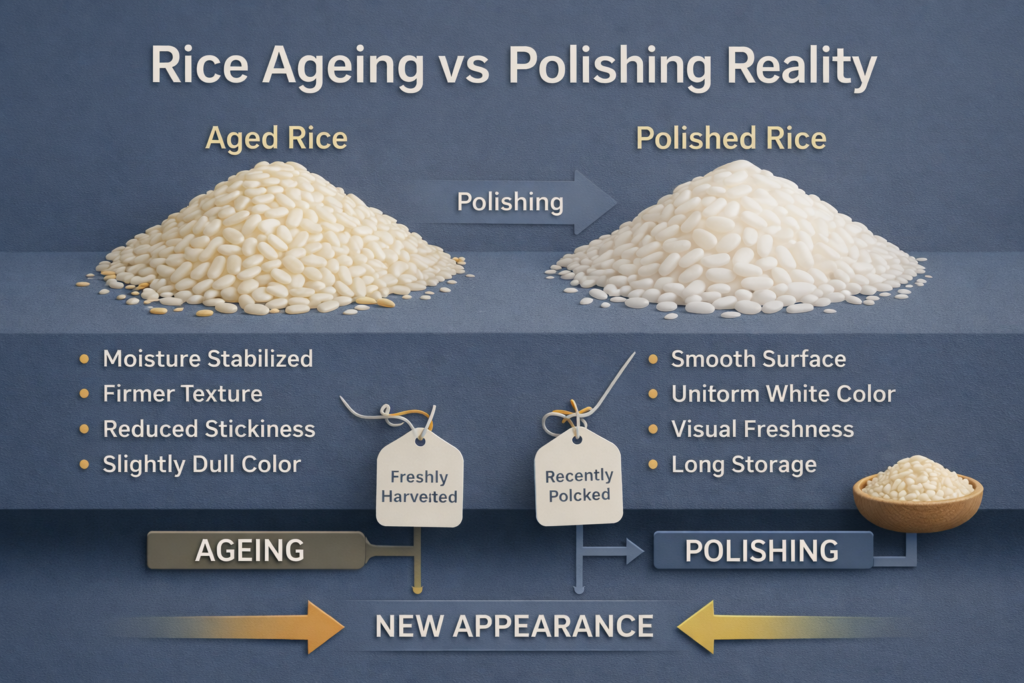
Moisture stabilizes
Cooking texture becomes firmer
Grain separation improves
Stickiness reduces
Ageing happens naturally.
No machine is required.
But ageing also creates problems.
The Natural Signs of Aged Rice
Unprocessed aged rice shows visible and functional signs:
Slight color dullness
Reduced surface shine
Harder grain feel
Less aroma volatility
These signs are harmless, but markets dislike them.
This is where polishing enters.
How Polishing Masks Rice Age
Polishing does not reverse ageing.
It hides it.
Through polishing:
Dull surfaces become glossy
Micro-cracks are smoothed
Color becomes uniform
Age-related visual cues disappear
An aged grain can be made to look freshly milled.
This is not deception by law.
But it is misleading by perception.
Why Old Rice Is Preferred by Many Processors
From a processing perspective, aged rice offers advantages:
Less breakage during milling
More predictable cooking behavior
Better grain separation after cooking
Lower moisture-related losses
Because of this:
Processors often prefer aged stock
Freshly harvested rice is sometimes stored intentionally
Age is not a flaw.
It is a tool.
The Consumer Confusion: Fresh vs New vs Polished
Consumers mix three different concepts:
Freshly harvested
Recently polished
Recently packed
Polishing allows old rice to be sold as “fresh-looking.”
Packing date hides storage duration.
What looks new may only be newly polished.
Why Age Disclosure Rarely Exists
Age transparency creates problems:
Older rice sounds inferior
Consumers fear staleness
Retailers fear rejection
As a result:
Age is hidden
Shine is emphasized
Language replaces facts
Words like:
Premium
Refined
Select
describe appearance, not time.
Farmer Perspective: Where Time Adds No Value
Farmers are paid at harvest.
Ageing benefits:
Mills
Processors
Large traders
But farmers do not receive ageing premiums.
Once rice leaves the farm, time becomes a profit lever for others.
How Ageing and Polishing Work Together
Ageing improves internal performance.
Polishing improves external appearance.
Together they allow:
Long storage
Visual freshness
Market flexibility
Price optimization
This combination is powerful—and invisible.
Is Aged Rice Better or Worse?
Aged rice is not worse.
It is different.
It can:
Cook better
Separate more cleanly
Suit certain cuisines and uses
But consumers should know what they are eating.
The issue is not ageing.
It is undisclosed ageing combined with cosmetic polishing.
Can Transparency Exist in This System?
Only in short supply chains:
Direct selling
Transparent labeling
Educated buyers
In long global systems, time remains hidden.
Final Conclusion: Time Changes Rice, Polishing Hides It
Rice ageing is natural and often beneficial.
Polishing is mechanical and visually powerful.
Together, they allow rice to travel long distances, survive long storage, and appear unchanged.
But this comes at the cost of transparency.
Rice does not lie.
Systems lie by omission.
Understanding ageing versus polishing reveals why rice looks newer than it is—and why appearance is a poor measure of truth.
✍️Farming Writers Team
Love farming Love Farmers.
Read A Next Post 👇