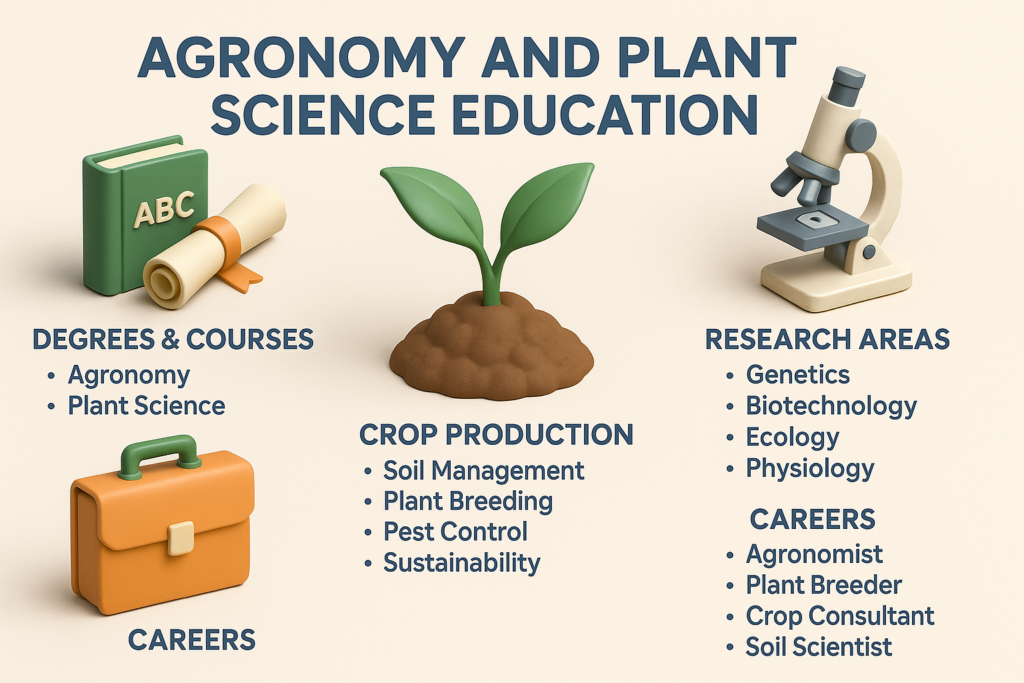
Agronomy and Plant Science form the scientific foundation of modern American agriculture. These disciplines focus on crop production, soil management, plant genetics, breeding, biotechnology, climate interaction, field management and sustainable agricultural systems. In the United States, agronomy is not taught as a simple farming practice; it is a highly technical and research-driven field integrated with biology, chemistry, data science, engineering and environmental systems.
This article provides a comprehensive and deeply structured study of how agronomy and plant sciences are taught, researched and practiced across the United States. It also explains the major degree programs, research strengths, laboratory systems, universities, career paths and job prospects available in the field.
- Meaning and Scope of Agronomy and Plant Science
Agronomy in the United States covers the full spectrum of scientific crop production. It includes understanding:
Soil structure and fertility
Crop physiology
Plant breeding and genetics
Nutrient management
Crop protection
Irrigation and water science
Farm technology
Precision agriculture
Climate effects
Data-based crop modeling
Plant science is a broader field that includes:
Plant biology
Plant biotechnology
Plant pathology
Plant breeding and genomics
Seed science
Controlled-environment agriculture
Photosynthesis research
Plant-environment interactions
Together these fields build the backbone of American crop production, helping farmers produce high yields using scientific and sustainable methods.
- Structure of Agronomy and Plant Science Education in the USA
Agronomy and Plant Science education in the United States follows a structured pathway:
a) Undergraduate Level (BS Programs)
A typical agronomy or plant science bachelor’s program lasts four years. The curriculum includes:
Crop production systems
Soil science
Plant genetics
Plant physiology
Seed science
Weed science
Plant pathology
Pest management
Irrigation and drainage
Greenhouse operations
Precision farming technologies
Climate and environment studies
Field crop laboratories
Students spend a significant amount of time in field plots, greenhouses, nurseries, labs and internships.
b) Graduate Programs (MS and MPS)
Master’s degrees in agronomy or plant science focus on specialization. Students can choose:
Crop breeding
Plant molecular biology
Soil fertility
Crop modeling
Sustainable agriculture
Greenhouse management
Precision agriculture
Seed technology
Horticultural science
These programs include research projects, thesis work, internships and academic papers.
c) Doctoral Programs (PhD)
PhD programs emphasize high-level research. Subjects include:
Genomics and DNA analysis
Plant breeding for climate adaptation
Disease resistance
Water efficiency
Carbon farming
Crop engineering
Plant–microbe interactions
Agricultural robotics
Greenhouse automation
PhD graduates often enter research organizations, extension networks, universities, biotech firms and global agriculture institutes.
- Top Universities for Agronomy and Plant Science
Several American universities are global leaders in crop and plant sciences:
- University of California, Davis
- Iowa State University
- Cornell University
- University of Florida (IFAS)
- Kansas State University
- Purdue University
- Texas A&M University
- North Carolina State University
- Michigan State University
- Ohio State University
These universities maintain advanced labs, experimental fields, greenhouses, climate chambers, seed laboratories and industry partnerships.
- Major Research Areas in Agronomy and Plant Science in the USA
Agronomy and plant science departments in the USA work on:
Crop Genetics and Breeding
Development of disease-resistant, climate-resilient and high-yield crop varieties.
Soil Health and Fertility
Studies on soil microbiology, carbon sequestration, nutrient cycling and organic matter management.
Precision Agriculture
Use of drones, sensors, satellite data, machine learning and GIS tools to optimize field management.
Plant Pathology and Protection
Identifying diseases, pests and weeds; developing biological and chemical control strategies.
Seed Science and Technology
Seed purity, quality testing, hybrid seed development and seed biotechnology.
Climate Smart Agriculture
Adapting crops to rising temperatures, drought, floods and changing weather patterns.
Greenhouse and Controlled-Environment Agriculture
Vertical farming, hydroponics, aeroponics and automated greenhouse systems.
These research fields have global impact.
- Internships and Practical Training
Every student in agronomy and plant science must complete hands-on training. Typical internships include:
Crop research stations
Seed production companies
Greenhouse and nursery units
Precision agriculture service firms
Soil testing laboratories
Agronomy field trials
Government extension offices
This ensures that graduates are industry-ready.
- Career Opportunities in Agronomy and Plant Science
Graduates can work in:
Seed companies
Fertilizer companies
Crop protection companies
Precision agriculture firms
Research institutes
Government agriculture agencies
Environmental agencies
Greenhouse/hydroponic farms
Food processing companies
International agriculture organizations
Key roles include:
Agronomist
Plant scientist
Crop consultant
Seed production manager
Soil scientist
Plant breeder
Product development specialist
Greenhouse manager
Research associate
Extension specialist
- Salary Scope in the United States
Salary ranges vary depending on the region and specialization.
However, many roles offer strong income potential due to high demand.
Examples:
Agronomist: medium-to-high salary potential
Plant breeder: high salary due to advanced skills
Soil scientist: stable and consistent earnings
Greenhouse manager: moderate salary with growth
Precision agriculture technician: growing salary demand
Seed production manager: competitive salary
Agronomy careers are considered stable long-term careers in the USA.
- Opportunities for International Students
International students are welcomed in US agronomy and plant science programs.
Benefits include:
advanced laboratory exposure
strong internship networks
wide scholarship options
high employability
opportunities for research grants
access to global agriculture conferences
International graduates often work in agriculture firms, research institutions, development organizations or return to their home countries to lead modern farming systems.
- Admission Requirements for International Students
Common requirements:
High school biology/chemistry background (for BS)
Bachelor’s degree in agriculture/biology/etc. (for MS/PhD)
English proficiency (TOEFL/IELTS)
Academic transcripts
Statement of Purpose
Recommendation letters
Some programs may require research experience for graduate-level entry.
- Why Agronomy and Plant Science in the USA Are Highly Respected
The United States maintains:
strong research funding
global faculty experts
modern labs
advanced greenhouse systems
industry collaboration
integration between universities and farmers
strong government support
This makes USA agriculture education a world leader in scientific farming.
Asked Questions
- Is agronomy a good career in the USA?
Yes. Agronomy is one of the strongest and most stable agriculture careers due to demand in seed, fertilizer, research and precision agriculture industries.
- Do agronomy graduates get jobs easily?
Most graduates find jobs quickly due to industry partnerships and field-based training.
- What degree is best for plant science?
A BS in Plant Science or BS in Agronomy, followed by MS or PhD for specialization.
- Can international students get scholarships?
Yes. Many universities offer partial or full scholarships based on merit and research potential.
- Is fieldwork included in agronomy programs?
Field labs, greenhouse work, internships and on-farm training are compulsory.
- What is the difference between agronomy and horticulture?
Agronomy focuses on field crops; horticulture focuses on fruits, vegetables, ornamentals and greenhouse crops.
- Are plant science graduates hired by private companies?
Yes. Seed companies, biotech firms, greenhouse companies and crop technology firms employ plant scientists.
- What research areas are trending in the USA?
Climate adaptation, genomics, precision farming and controlled-environment agriculture.
- Can agronomy be studied without a farming background?
Yes. Practical training is provided, so no prior farming experience is required.
- What is the future of agronomy?
The future lies in climate-smart farming, digital agriculture, automation, seed technology and sustainability.
Conclusion
Agronomy and Plant Science are core pillars of agriculture education in the United States. These fields combine biological science, data science, engineering and environmental management to create a highly effective crop production system. Students gain deep knowledge, strong practical experience and access to advanced technologies. The career opportunities in this field continue to grow due to increasing demand for food, sustainability and scientific innovation.
✍️Farming Writers Team
Love farming Love farmers
Read A Next Post 👇
https://farmingwriters.com/intensive-farming-complete-guide/
Leave a ReplyShare your thoughts: We’d love to hear your farming ideas or experiences!