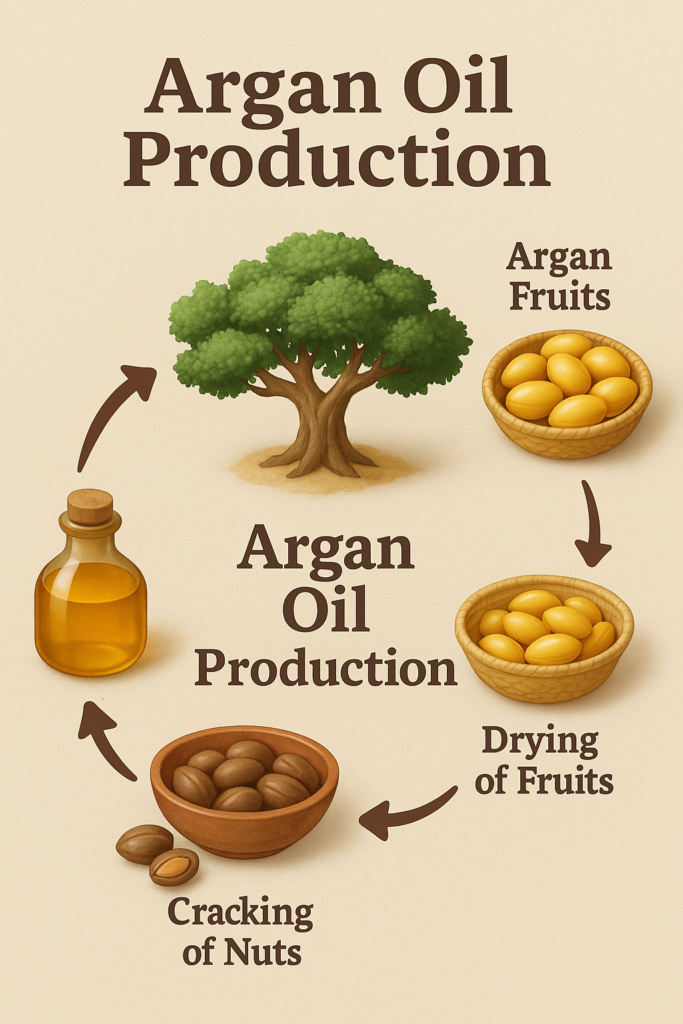
Argan oil cannot be understood by looking at the oil alone. To understand it, one has to understand a landscape where trees survive against odds that would kill most cultivated crops, a society where women preserved agricultural knowledge without written manuals, and an ecosystem where goats, soil, climate, and human labor exist in fragile balance. The argan tree does not grow where rain is plentiful or where soil is generous. It grows in western Morocco, in a territory shaped by heat, wind, salt air from the Atlantic, and long periods of drought. The fact that this tree produces one of the world’s most valuable natural oils is not an accident of biology; it is the result of centuries of adaptation between land and people.
The argan tree is slow growing and stubborn. It sinks its roots deep into rocky ground, drawing moisture from soil layers far below the surface. Its trunk is twisted, its branches uneven, as if shaped by resistance more than by design. Farmers do not plant argan trees in straight, orderly lines. They inherit them. Many argan trees alive today were already standing centuries ago. This permanence changes how agriculture around them is practiced. Fields are not cleared of argan trees; crops are grown around them. Barley, wheat, and legumes share space with these trees, and grazing animals move under their shade. The tree belongs to the land in a way that no annual crop ever could.
Argan oil production originated as a household activity rather than a commercial one. For generations, Amazigh (Berber) women collected fallen fruits, dried them, cracked the hard shells by hand, roasted kernels lightly when producing culinary oil, and pressed them to extract a thick, golden oil with a nutty scent. This oil was not wasted on vanity. It was consumed as food, used to treat dry skin cracked by desert wind, applied to hair damaged by sun exposure, and stored as a form of nutritional security. In a climate where crops fail unpredictably, argan oil provided concentrated energy and nourishment that lasted.
What modern markets later labeled as “premium” beauty oil was, for these communities, everyday life. The oil’s richness in oleic and linoleic acids kept skin supple. Its natural antioxidants slowed rancidity even in warm climates. Without knowing chemical names, the women knew when oil was good and when it was spoiling. They learned this not from laboratories, but from smell, color, and texture.
The argan tree’s ecology is inseparable from animals, particularly goats, which famously climb into its branches to eat the fruit pulp. While this image often appears in tourism material, the reality is more complex. Goat grazing can both help and harm argan regeneration. Traditional systems allowed limited grazing, ensuring seed dispersal without destroying young saplings. Once grazing pressure increased beyond balance, regeneration suffered. This fragile equilibrium led to international recognition of the argan forest as a protected biosphere. It also forced a rethinking of how economic demand for argan oil could coexist with ecological survival.
Oil extraction moved from household use to global commerce only in recent decades. As cosmetic science began searching for plant oils that were both stable and deeply nourishing, argan oil stood out. Chemically, it is not exotic in composition, but its balance is exceptional. It contains high oleic acid, which supports skin barrier function, combined with linoleic acid that aids repair and flexibility. Tocopherols provide antioxidant protection, slowing oxidation and extending shelf life. This made argan oil ideal for creams, serums, hair treatments, and massage oils.
Culinary argan oil followed a different path. Produced from roasted kernels, it carries a deeper aroma and is traditionally mixed with honey and almonds to create amlou, a paste eaten with bread. Its flavor is strong, nutty, and warm. As global chefs discovered it, argan oil remained niche, not because of limited appeal, but because production is inherently limited. Scaling up argan oil is not simply a matter of planting more trees. Argan trees mature slowly. New plantations take decades to reach full productivity. This time factor protects the oil’s value and prevents market flooding.
The international argan oil trade transformed women’s roles in rural Morocco. Cooperatives formed, reorganizing production from isolated households into structured units. These cooperatives brought income, literacy, and social independence to women who had historically worked invisible labor. At the same time, commercialization introduced challenges: pressure to produce quickly, temptation to shortcut traditional methods, and the emergence of counterfeit or diluted oils in global markets. Authentic argan oil remains traceable not just to a region, but to a method and a community.
From an agricultural standpoint, argan oil challenges modern ideas of efficiency. Yield per tree is low. Labor per liter is high. Yet ecological value is immense. Argan trees stabilize soil against desertification. Their canopies reduce evaporation. Their roots prevent erosion. They represent a form of agriculture that prioritizes landscape survival over maximum output. In a warming world, such systems gain importance.
Argan oil’s health implications extend beyond skincare. Nutritionally, it supports cardiovascular health when used in moderation. Its fatty acid composition aligns with diets focused on metabolic balance. Traditional Moroccan diets relied on argan oil as a daily fat source, contributing to long-term heart health observed in those populations before dietary globalization introduced refined oils.
One of argan oil’s most misunderstood aspects is its shelf stability. True cold-pressed cosmetic argan oil remains stable for long periods if protected from light and heat. Adulterated oil, however, oxidizes quickly. As demand grew, so did the importance of certification, origin labeling, and controlled extraction. The oil’s future depends on maintaining trust as much as supply.
Climate change introduces uncertainty. Rainfall patterns in Morocco are shifting. Extended droughts stress even deep-rooted argan trees. Research now focuses on protecting existing forests, improving seedling survival, and maintaining genetic diversity rather than aggressive expansion. Argan’s strength lies in endurance, not speed.
Argan oil ultimately represents an agricultural philosophy rooted in patience, community knowledge, and ecological restraint. It is not simply a commodity extracted from a plant. It is the expression of a living system where trees, women, soil, animals, and climate interact over centuries. This is what gives argan oil its depth not just in texture, but in meaning.
In a global market dominated by fast cycles and short-term yields, argan oil stands as evidence that some of the world’s most valuable resources come not from acceleration, but from continuity.
✍️Farming Writers Team
Love farming Love farmers
Read A Next Post 👇
https://farmingwriters.com/macadamia-nut-oil-global-tree-oil-study/
Leave a ReplyShare your thoughts: We’d love to hear your farming ideas or experiences!