INTRODUCTION
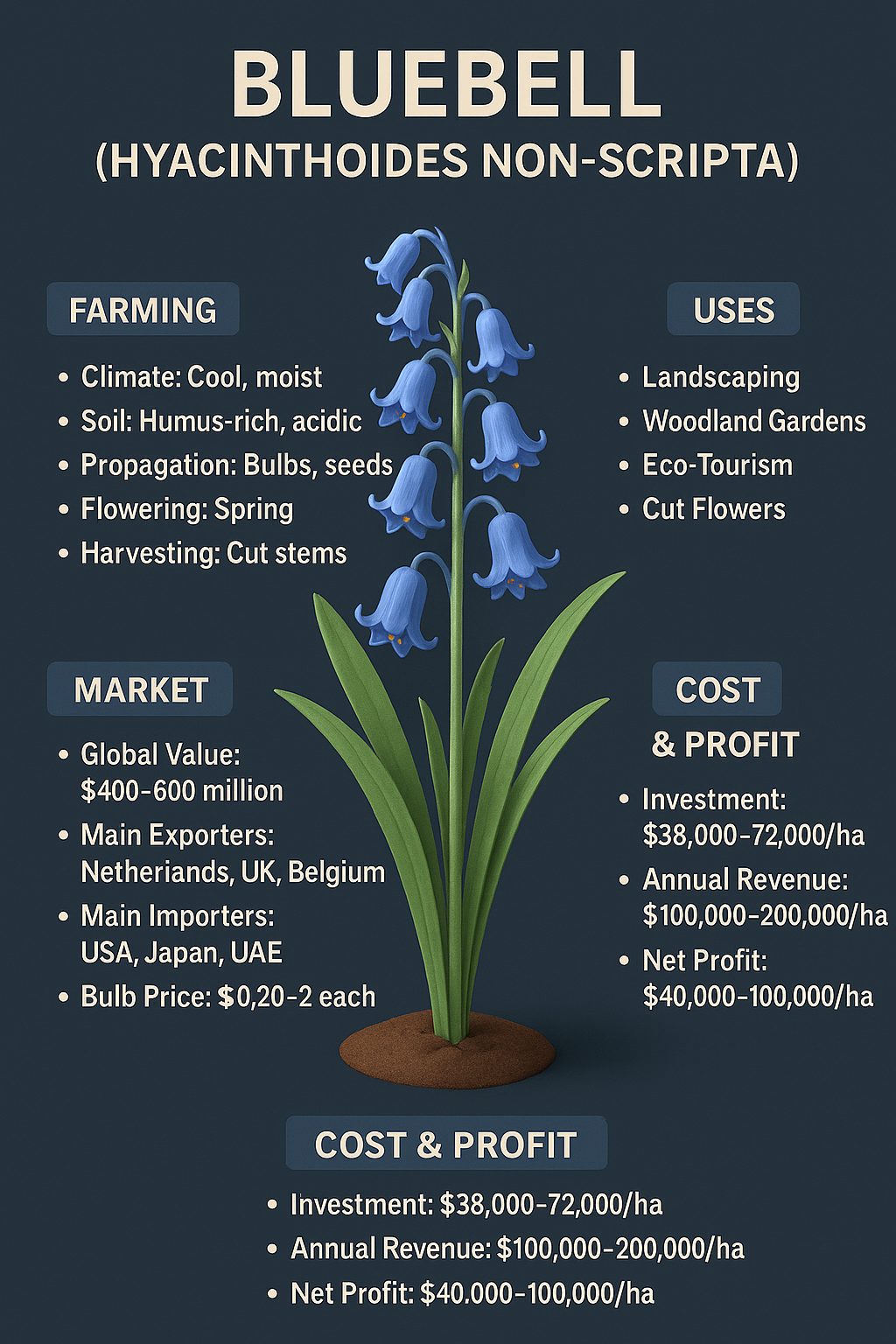
Bluebell (Hyacinthoides non-scripta) is one of the world’s most iconic spring-blooming wildflowers, famous for its deep violet-blue bell-shaped flowers and strong sweet fragrance. It is a symbol of spring in the UK, Ireland, France, Belgium, Spain, USA temperate regions, Netherlands, and Northern Europe. The beauty of Bluebell woodlands attracts millions of tourists every year and plays a major role in eco-tourism, natural park management, landscaping, botanical gardens, and cut-flower trade.
Bluebells naturally grow in deciduous forests, shaded meadows, temperate woodlands, and moist fertile soils. They form dense carpets that turn entire forests blue during peak blooming season. Because of their ecological importance and strong ornamental value, Bluebells have become a commercial crop in temperate regions and greenhouse-controlled environments across the world.
Commercial Bluebell farming is based on bulb propagation, shade-loving cultivation, and cool-climate greenhouses. These flowers are widely used for botanical landscaping, naturalistic gardens, spring parks, luxury resorts, memorial gardens, eco-sensitive landscapes, cut-flower arrangements, and European-style floral gifting.
Their fragrance and color make them suitable for:
Spring bouquet markets
Natural perfumery (light extraction uses)
Herbal infusions (limited)
Decorative gardens
Woodland-style landscaping
Eco-tourism zones
Wedding spring themes
Bluebells are protected in many countries, meaning wild Bluebells cannot be harvested, but commercially grown Bluebells are 100% legal. This creates strong demand for nursery-raised Bluebell bulbs and potted plants.
Countries like the Netherlands, UK, Germany, Belgium, France, USA (Oregon/Washington), Japan, and New Zealand lead the Bluebell nursery and bulb market.
This guide provides a complete A–Z 4000-word global farming blueprint, including climate, soil, bulbs, propagation, greenhouse systems, disease control, harvest models, USD-based market analytics, business opportunities, and 20 FAQs with full answers.
SCIENTIFIC CLASSIFICATION & ORIGIN
Common Name: Bluebell
Scientific Name: Hyacinthoides non-scripta (English Bluebell)
Other Commercial Species: Hyacinthoides hispanica (Spanish Bluebell), Mertensia virginica (Virginia Bluebell)
Family: Asparagaceae
Origin: Western Europe, British Isles, USA woodlands
Plant Type: Perennial bulbous flower
Flowering Season: Early to late spring
Commercial Form: Bulbs, potted plants, rhizome divisions
Virginia Bluebell is native to North America, while English Bluebell dominates Europe. Spanish Bluebell is larger, easier to cultivate, and the main commercial species.
COMPLETE BLUEBELL CULTIVATION GUIDE
CLIMATE REQUIREMENTS
Bluebells are primarily cool-season flowers.
Ideal Conditions:
Temperature: 10–20°C
Humidity: 40–70%
Sunlight: Dappled shade / partial shade
Rainfall: 600–1500 mm
Frost: Tolerable to –8°C depending on species
Dormancy: Summer dormancy period required
Bluebells thrive in woodland-style environments but can be grown in controlled shade houses in warm countries.
SOIL REQUIREMENTS
Bluebells need forest-like soil conditions.
Ideal Soil Composition:
Organic matter: High
Drainage: Excellent
Texture: Loamy, slightly sandy
pH: 5.5–6.8
Premium Commercial Mix:
40% garden loam
30% leaf mold
20% compost
10% sand
Avoid clay soil. Bulbs rot in waterlogged media.
PROPAGATION METHODS
1. Bulbs (Commercial Standard)
Bluebells multiply through bulbs.
Planting depth: 8–10 cm
Spacing: 10 x 10 cm
2. Offsets (Baby Bulbs)
Mother bulbs produce small offsets each year.
Offsets take 2–3 years to flower.
3. Seed Propagation
Used for large-scale woodland restoration.
Takes 4–5 years to flower.
4. Rhizome Division (Virginia Bluebell)
Only for the American species.
PLANTING & SPACING
Plant bulbs in autumn for spring blooming
Spacing varies by species
For Spanish Bluebell (commercial):
10–12 cm spacing
100,000–120,000 bulbs per hectare
IRRIGATION MANAGEMENT
Bluebells require consistent moisture.
During active season: Moist but not wet
Dormant season: Minimal watering
Drip irrigation recommended
Avoid overhead spraying in warm climates
FERTILIZATION
Low fertilizer requirement.
Base Application:
Compost: 5 tons per hectare
Bone meal: 250 kg per hectare
Seasonal Feeding:
NPK 5:10:10 at sprouting
Calcium and magnesium for root strength
No high nitrogen
GREENHOUSE & SHADE-HOUSE SYSTEM
Commercial Bluebells are grown in:
Cold greenhouses
Shade tunnels (50–60% shade)
Polyhouses in highland climates
Controlled chilling rooms for bulb dormancy
Temperature and humidity management are critical.
PEST & DISEASE CONTROL
Pests
Slugs
Snails
Aphids
Cutworms
Diseases
Grey mold (Botrytis)
Bulb rot
Downy mildew
Rust
Controls:
Good ventilation
Fungicide rotation
Neem cake in soil
Avoid high moisture during dormancy
FLOWERING & HARVESTING
Flowering Season: March–May
Harvesting:
Early morning
Stems cut at base
Store at 1–3°C
Bluebells have short vase life (3–7 days) but are valued for spring-themed décor.
GLOBAL MARKET ANALYSIS (USD)
Global Bluebell Market (2024): 400–600 million USD
Bulb trade dominates global value
Europe is the largest consumer and exporter
Exporters
Netherlands (largest)
UK
Belgium
France
Importers
USA
Japan
Singapore
UAE
Prices
Bulbs: 0.20–0.80 USD each
Premium bulbs: 1–2 USD
Potted plant: 8–20 USD
Landscape-grade batch: 50–140 USD per square meter
BUSINESS OPPORTUNITIES
Bulb sales
Landscaping supply
Botanical gardens
Eco-tourism woodland trails
Potted plant sales
Spring bouquet supply
Rewilding projects
HEALTH & AROMA USES
Mild calming fragrance
Traditional herbal use (Virginia Bluebell)
Not used for strong medicinal applications
Used in aromatherapy gardens
PRECAUTIONS
Some species mildly toxic if eaten
Keep away from pets
Waterlogging kills bulbs
Avoid excessive fertilizer
COST & PROFIT ANALYSIS (USD)
Investment per hectare:
Bulbs: 20,000–40,000 USD
Shade structures: 10,000–20,000 USD
Labour + soil amendments: 8,000–12,000 USD
Total: 38,000–72,000 USD
Returns:
Bulb sales: 60,000–120,000 USD
Potted plants: 40,000–80,000 USD
Net profit: 40,000–100,000 USD annually
FAQS
1. What climate do Bluebells need?
Cool, moist temperate climates with partial shade.
2. Can Bluebells grow in India?
Yes, in hill regions (Himalayas, Nilgiris, NE states) or controlled greenhouses.
3. How deep should bulbs be planted?
8–10 cm.
4. How long do Bluebells take to flower?
Bulbs flower next season; seeds take 4–5 years.
5. Do Bluebells need direct sun?
No, they need shade or filtered light.
6. Are Bluebells poisonous?
Mildly toxic if consumed.
7. Which country leads Bluebell bulb export?
Netherlands.
8. When do Bluebells bloom?
March to May.
9. How many bulbs per hectare?
100,000–120,000 bulbs.
10. How much water is needed?
Moist conditions during growth; dry during dormancy.
11. Are Bluebells profitable?
Yes—40,000–100,000 USD annual net profit.
12. Can Bluebells be grown indoors?
Preferably outdoors, but potted forms can grow indoors briefly.
13. What type of soil do they need?
Humus-rich acidic loam.
14. Can Bluebells tolerate frost?
Yes, moderate frost.
15. How to increase flowering?
Cold winter, proper dormancy, low nitrogen fertilizer.
16. Do Bluebells naturalize easily?
Yes—spreads quickly in suitable climates.
17. Why are my Bluebells not blooming?
Warm winters or insufficient shade.
18. Can Bluebells be exported?
Yes—bulbs and potted plants both.
19. What is the lifespan of a Bluebell bulb?
10–15 years.
20. What is the price of Bluebell bulbs?
0.20–2 USD depending on grade.
CONCLUSION
Bluebell farming is a unique, profitable, and globally demanded floriculture business centered around spring landscaping, bulb sales, and woodland-style ornamental gardening. With proper shade, soil, and cool-season management, Bluebells offer excellent returns and stable, long-term commercial value.
Bluebell farming, Bluebell cultivation, Hyacinthoides non-scripta farming, wildflower business, spring flowers, bulb flower farming
✍️Farming Writers
Leave a ReplyShare your thoughts: We’d love to hear your farming ideas or experiences!