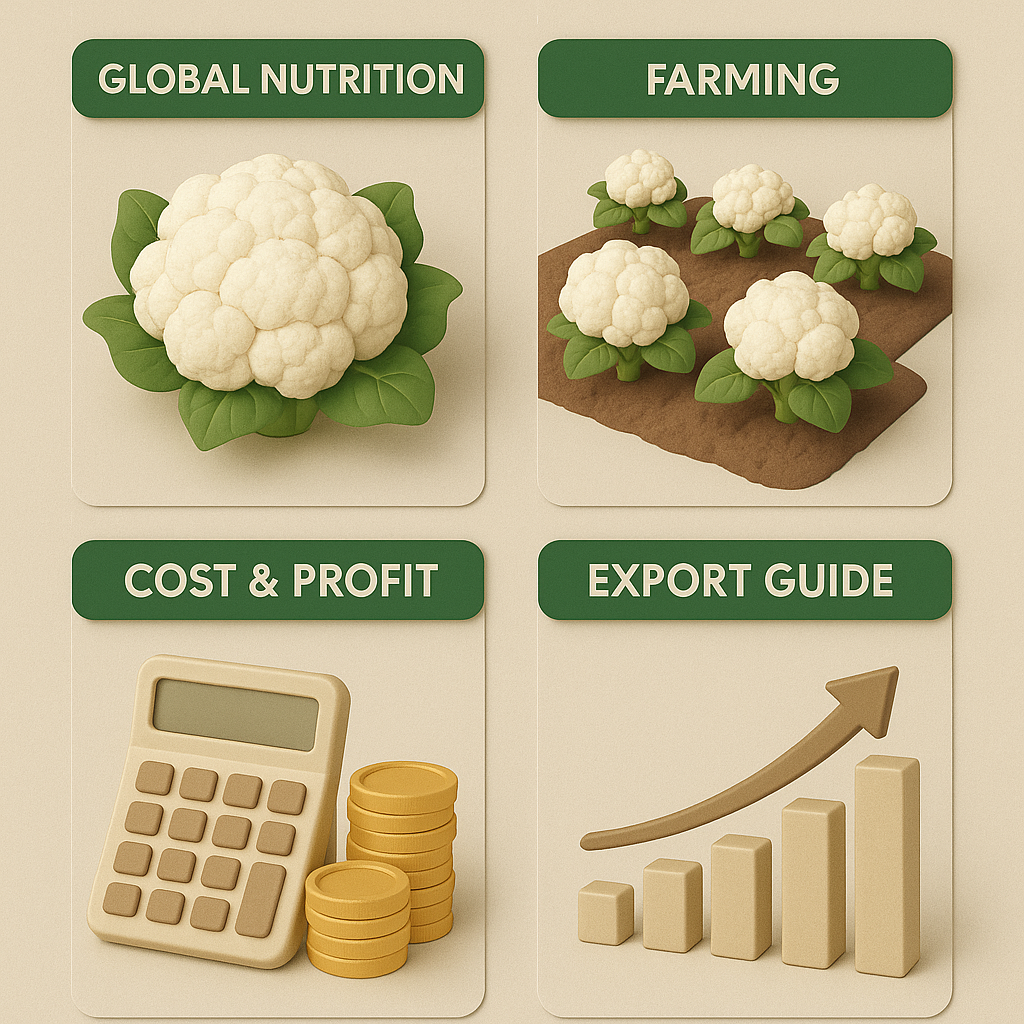
1. Introduction (Global Vegetable Overview)
Cauliflower (Brassica oleracea var. botrytis) is one of the most commercially important vegetables in the world. Cultivated across Asia, Europe, Africa, and North America, cauliflower is considered a premium vegetable due to its high nutritional value, long shelf life, suitability for export, and excellent profitability.
It is a cool-season crop, highly responsive to fertilizers, irrigation management, and modern agriculture technologies such as mulching, drip irrigation, fertigation, and controlled environment farming.
Global demand for cauliflower is increasing sharply due to rising consumption of healthy foods, keto diets, and cauliflower-based processed products such as cauliflower rice, pizza crust, pasta alternatives, and frozen cuts.
2. Botanical Details
Botanical Name: Brassica oleracea var. botrytis
Family: Brassicaceae
Plant Type: Cool-season, annual vegetable
Edible Part: Curd (flower head)
Origin: Mediterranean region
Pollination: Mostly cross-pollinated
Chromosome: 2n = 18
3. Nutrition Profile (per 100 g raw cauliflower)
NutrientAmountHealth BenefitCalories25 kcalLow-calorie foodProtein1.9 gMuscle repairCarbohydrates5 gEnergyFiber2 gDigestionVitamin C48 mgImmunity boosterVitamin K15 µgBone healthFolate57 µgCell growthPotassium300 mgHeart healthAntioxidantsHighAnti-cancer properties
Cauliflower contains glucosinolates, known to reduce risk of cancer and inflammation.
4. Global Culinary Uses
Cauliflower is used in over 120 countries in:
Curries, soups, stir-fries
Cauliflower rice, pizza crust
Pickles, roasted cauliflower
Kimchi, fermented foods
Frozen vegetable mixes
Baby food puree products
Premium hotel & restaurant menus
5. Seed Requirement (Worldwide Standard)
Per Acre
250–350 grams
Per Hectare
1–1.5 kg
Hybrid varieties need slightly higher seed quality for uniform curd formation.
6. Soil Science
Ideal soil for cauliflower:
Loamy or sandy-loam soil
pH 6.0–7.0
Rich in organic matter
High calcium and boron availability
Deep, well-drained soil (to avoid root rot)
7. Climate Requirement (Country-wise)
India
Best season: October–February
Temperature: 15–25°C
USA
California, Arizona – winter crop
Temperature: 10–22°C
Europe
UK, Spain, Italy – cool moist climate
Temperature: 8–20°C
China
Grown year-round in controlled environments
Middle East
Winter-only crop
Requires irrigation management due to heat
8. Irrigation Schedule
First irrigation immediately after transplanting
Next irrigation after 4 days
Then every 7–10 days
Avoid water logging
Maintain uniform moisture during curd formation
Drip irrigation recommended for highest yield
9. Fertilizer Schedule (Global Standard)
Basal Dose
20–25 tons FYM per hectare
NPK 60:40:40 kg per hectare
Top Dressing
Nitrogen split into 2–3 doses
Boron + Calcium essential for curd quality
Micronutrient sprays increase yield
Organic Farming
Vermicompost
Fish amino acid
Seaweed extract
Trichoderma for soil health
10. Pests & Disease Management (Scientific Names Included)
Major pests
Cabbage worm (Pieris brassicae)
Aphids (Brevicoryne brassicae)
Diamondback moth (Plutella xylostella)
Diseases
Black rot (Xanthomonas campestris)
Downy mildew (Peronospora parasitica)
Clubroot (Plasmodiophora brassicae)
Controls
Neem oil
Bacillus thuringiensis (BT)
Copper oxychloride
Crop rotation (3 years)
Drip fertigation to reduce humidity
11. Crop Duration (Country-wise)
India: 90–120 days
USA: 80–110 days
Europe: 100–130 days
Cold regions: 140 days
Hybrid fast-maturing: 75–90 days
12. Yield (Worldwide Data)
Normal Yield: 25–30 tons per hectare
Hybrid Yield: 35–50 tons per hectare
Controlled environment: Up to 60 tons/ha
13. Cost of Cultivation (USD Only)
ExpenseUSD (Per Hectare)Seeds$120Nursery Preparation$80Manure & Fertilizers$250Irrigation$110Labor$350Pesticides & Fungicides$120Mulching + Drip System$220Harvesting + Packaging$150Transport$90Miscellaneous$100Total Cost$1,590
14. Profit Analysis (USD Only)
Market Prices
Local wholesale: $0.40–0.70 per kg
Export grade: $1.00–1.70 per kg
Revenue Calculation
Hybrid yield = 40,000 kg
Case 1: Local Market
40,000 × $0.50 = $20,000
Profit = $20,000 – $1,590 = $18,410
Case 2: Export Market
40,000 × $1.50 = $60,000
Profit = $60,000 – $1,590 = $58,410
Cauliflower is one of the highest-profit vegetables worldwide.
15. Post-Harvest Technology
Precooling at 0–2°C
Grading by size & color
Modified atmosphere packaging (MAP)
Cold storage life: 3–4 weeks
Export requires strict quality grading
16. Global Selling Channels
Wholesale markets
Supermarkets
Hotels & restaurants
Frozen food processors
Exporters
Online grocery platforms
17. Loans & Insurance (Worldwide)
Agriculture Loans
Equipment loan
Crop loan
Greenhouse loan
Drip/mulching subsidy loan
Crop Insurance
Covers:
Drought
Flood
Disease outbreak
Cyclone
Market crash
18. FAQs (With Consion Added)
1. What is the global cost of cauliflower farming per hectare?
Around $1,500–$1,700 depending on country.
2. How much profit can farmers earn?
$18,000–$58,000 per hectare depending on market and export price.
3. How many seeds are required?
1–1.5 kg per hectare.
4. Which fertilizers give maximum yield?
NPK + boron + calcium + organic manure.
5. How long does cauliflower take to mature?
75–130 days depending on climate.
6. What is the ideal irrigation schedule?
Every 7–10 days with drip irrigation recommended.
7. What diseases affect cauliflower?
Black rot, downy mildew, clubroot.
8. Which countries export most cauliflower?
China, India, Spain, USA, Netherlands.
9. What is the best temperature for curd formation?
15–20°C.
10. How to increase curd size?
Balanced nitrogen + boron + calcium + uniform watering.
11. What are the top hybrid varieties?
Snowball, White Freedom, Amazing, Hybrid 60.
12. What is the shelf life?
3–4 weeks in cold storage.
13. Is cauliflower profitable worldwide?
Yes, extremely profitable due to high demand.
14. Can it be grown organically?
Yes, yields slightly lower but price higher.
15. How to sell cauliflower for export?
Need grading, cold chain, export certification.
19. Conclusion (Consion)
Cauliflower stands as one of the most reliable, profitable, and globally demanded vegetables. Its strong export market, high nutritional value, and suitability for modern technologies make it an ideal commercial crop for any country. With properly managed seeds, irrigation, fertilization, pest control, and global marketing channels, farmers can earn exceptional profits in USD.
Cauliflower is a world market vegetable with the capability to give 10–40× returns. For global farmers, it remains one of the best vegetables for sustainable, high-income agriculture.
✍️Farming Writers
Love farming love farmers
Read A next Post 👇
Leave a ReplyShare your thoughts: We’d love to hear your farming ideas or experiences!