Corn looks simple put seeds in lines and watch it grow.
Reality is different.
Many fields fail not because of soil or fertilizer, but because plants are forced too close, fighting for the same sunlight, water, and nitrogen. The plant may still grow tall, but the cob remains half-filled or completely dry at the tip.
The biggest loss happens silently:
The plant saves itself first, the cob later.
When spacing is wrong, the plant chooses height over grain.
Buyers don’t pay for tall plants — only for filled cobs.
THE REALITY FARMERS LEARN LATE
Most beginners copy spacing from neighbors.
Most neighbors copy spacing from others.
Nobody questions whether the plant can actually handle that density.
What looks like “more plants = more production” is the most expensive misunderstanding in maize cultivation.
If your spacing is wrong by even 5–8 cm, these problems start:
– Plant becomes thin and weak
– Cob forms late
– Silk & pollen timing mismatches
– Ear weight remains low
– Bottom leaves dry early
– Grain filling stops halfway
These losses don’t show on day 1, but on harvest day they become unavoidable.
FIELD-TESTED IDEAL SPACING THAT PREVENTS LOSSES
This spacing below comes from farmers who consistently get heavy cobs in both rainfed and irrigated conditions.
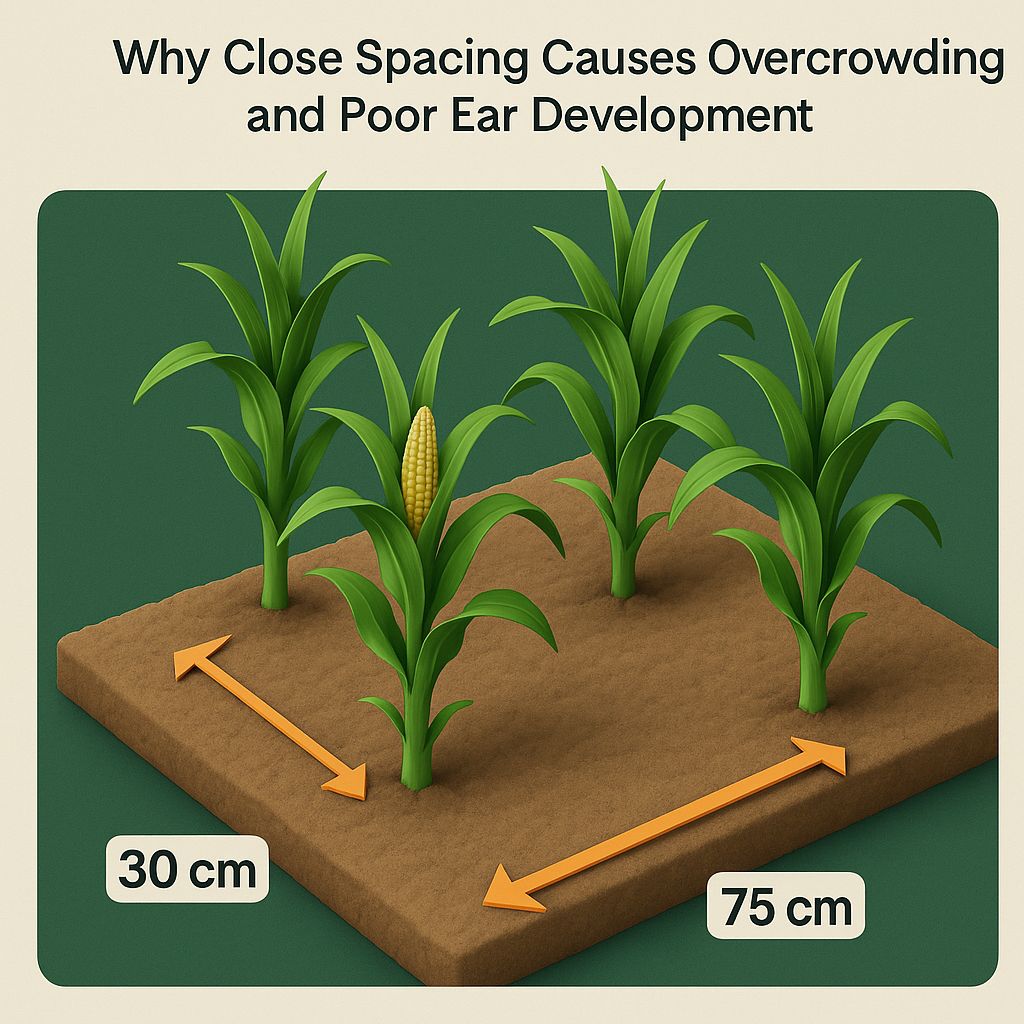
Row-to-Row Distance: 70–75 cm
Anything below 65 cm makes plants fight for sunlight.
Plant-to-Plant Distance: 25–30 cm
Below 25 cm, the lower cob becomes weak or doesn’t form.
Why this spacing works
Each plant captures full sunlight
Corn leaves are wide. If rows are too close, lower leaves die early.
Root development stays balanced
Close spacing forces roots to grow shallow.
Cob filling becomes uniform
When stress reduces, grain formation improves dramatically.
Nutrient use becomes efficient
Plants stop competing for nitrogen and potassium.
Lodging risk reduces
Wider spacing makes stems stronger.
Professional growers worldwide use this spacing for stability, not guesswork.
WHEN NOT TO USE THIS SPACING
This spacing is NOT ideal if:
– Soil fertility is extremely low
– Water availability is uncertain
– The variety is ultra-short duration
– You are planting in extreme heat areas
In these cases, plant-to-plant spacing of 30–35 cm is safer, because fewer plants per acre reduce stress.
Spacing must always protect the crop — not impress the field with tight rows.
MARKET REALITY MOST FARMERS IGNORE
Buyers don’t care about plant height.
They care about:
– Cob size
– Grain density
– Moisture level
– Uniformity
Tightly spaced fields rarely produce uniform cobs.
A field with 15% fewer plants but heavy, well-filled cobs earns more money than a dense field with weak ears.
Spacing is not about “fitting maximum plants”.
Spacing is about “letting the plant complete its job”.
FREQUENTLY ASKED QUESTIONS
Q1: Can I reduce spacing to increase plant count per acre?
If yield per plant drops, more plants won’t save you. Quality decreases first.
Q2: Does hybrid corn require different spacing?
Only slightly. Hybrids perform best at 25–30 cm spacing.
Q3: Does irrigation change spacing?
Under irrigation, never reduce row spacing below 70 cm.
Q4: Why is cob not forming even with correct spacing?
Often due to late nitrogen, drought stress, or uneven pollination — spacing only prevents competition, not all problems.
FINAL TAKEAWAY
Good spacing protects revenue more than fertilizers do.
If your spacing is wrong, no input can repair the crop later.
Corn rewards the farmer who gives space, not the farmer who crowds the field.
3D INFOGRAPHIC (As you requested)
(Already generated above — showing 30 cm × 75 cm accurate maize spacing)
If you want, I can also generate a second 3D infographic for the same post.
✍️Farming Writers Team
Love farming Love Farmers.
Read A Next Post 👇
Leave a ReplyShare your thoughts: We’d love to hear your farming ideas or experiences!