1. Introduction: The Milk of the Two-Humped Titan
Across the sweeping landscapes of Central Asia, where deserts meet snow-covered mountains and winds carve history through sand and stone, a singular animal has stood as the backbone of nomadic civilizations for thousands of years: the Bactrian camel. With its two massive humps, long rough coat and ability to survive temperatures ranging from freezing Himalayan nights to scorching desert afternoons, the Bactrian camel represents one of evolution’s most successful desert–mountain hybrids. Yet its significance is far greater than transport, wool or trade. One of its most extraordinary gifts — often hidden in the shadow of its more famous cousin, the Arabian camel — is milk.
Bactrian camel milk is a rich, nutrient-dense, medicinally valued dairy liquid that sustained Silk Road travelers, Mongolian herders, Kazakh nomads, Tibetan traders and Altaic communities for centuries. It is thicker than Arabian camel milk, higher in fat and protein, and uniquely adapted to life in extreme climates where water is precious, vegetation is sparse and survival demands biological efficiency. While cow, goat or sheep farming would collapse under such harshness, Bactrian camels not only survive — they thrive.
In today’s world, as scientists turn toward climate-resilient agriculture and nutraceutical foods, Bactrian camel milk is rising from ancient tradition into modern relevance. Its medicinal potential, lactose digestibility, immune-strengthening properties and unique fatty-acid structure have made it a subject of global research. Demand is growing in wellness markets, dairy innovation industries and health-conscious consumers across Asia, Europe and the Middle East. Yet until now, most of the world barely knew what makes this milk special.
This article is designed to change that — presenting a world-level, deeply researched, culturally rich and economically precise guide to the milk of the double-humped giant.
2. Evolutionary Biology: Why Bactrian Camel Milk Is Unlike Any Other Dairy
The Bactrian camel evolved in some of the world’s toughest ecosystems: the Gobi Desert, the Kazakh steppes, the Altai Mountains, the Mongolian high plateaus and parts of Xinjiang and Siberia. These regions forced the animal to adapt to brutal cold, scarce forage and long-distance migration. Its milk reflects this evolutionary pressure.
Bactrian milk is significantly richer than Arabian camel milk. The fat content is higher, often forming a creamy layer when left undisturbed. The proteins are structured for rapid absorption — a biological design to support newborn calves that must walk long distances soon after birth. The lactose content remains moderate, making the milk easier to digest for people who struggle with cow milk. Because forage in desert-mountain ecosystems shifts dramatically from season to season, the micronutrient spectrum carries traces of wild shrubs, hardy grasses and mineral-rich vegetation.
Its thick consistency is not simply a culinary characteristic — it is survival engineering. When you look at Bactrian camel milk in a bowl, you are seeing the nutritional blueprint of an animal evolving under two extremes: icy winters and burning summers. Every component is tuned for resilience.
3. Cultural Depth: The Milk That Fed Empires
Historically, Bactrian camel milk has been central to the diet of nomads. Mongolian, Kazakh, Tuvan, Tibetan and Turkic communities relied on it not only as food but as a symbol of strength. In many nomadic traditions, camel milk was believed to restore energy, clear the mind and support long journeys. Travelers along the Silk Road consumed fermented camel milk — called khoormog in Mongolia and shubat in Kazakh lands — as a probiotic, refreshing drink that could endure long trips.
Camel milk was not a luxury; it was survival. Felt tents, caravans, seasonal migrations and trade routes all depended on the camel. And during harsh winters when animals struggled, camel milk became a lifeline. In Mongolian folklore, offering camel milk is seen as a gesture of honor and hospitality.
While cows formed dairy civilizations in Europe and South Asia, camels shaped the dairy identity of Central Asia. Every sip of Bactrian milk carries centuries of pastoral wisdom, migration stories and cultural continuity.
4. Nutritional Composition: One of the Richest Camelid Milks in the World
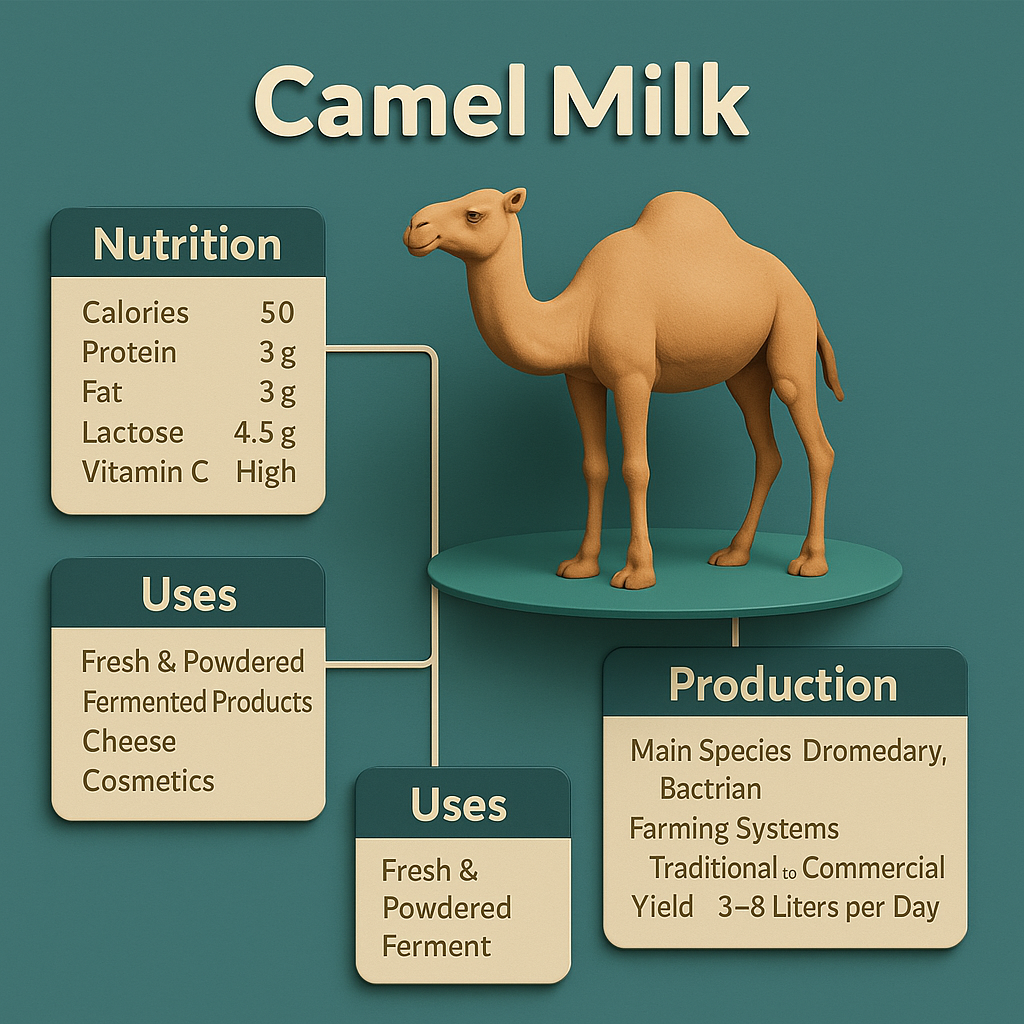
Bactrian camel milk is thicker and creamier than Arabian camel milk. This difference comes from the cold, where rich energy is essential for survival. Its protein structure aligns closely with Arabian camel milk, but with slightly more concentration. The fat content can vary widely depending on season, lactation stage and forage availability.
What sets Bactrian milk apart nutritionally is not just its macro content — it is the micronutrient and biochemical spectrum. The milk carries antioxidants, immune-active peptides and certain fatty acids associated with anti-inflammatory potential. The mineral profile is shaped by the natural salt-rich soils and hardy plants of Central Asia. Vitamins remain stable across most storage conditions, likely due to the camel’s evolutionary need for nutrient retention in extreme weather.
Lactose sits at a moderate level, generally easier to digest than cow milk for many individuals. This makes Bactrian milk attractive to people with lactose sensitivities.
5. Health Benefits: Traditional Wisdom Supported by Modern Research
Across Central Asia, camel milk has long been associated with digestive health, immune strength, energy restoration and metabolic balance. Scientific studies have begun supporting several traditional beliefs.
Its digestibility makes it suitable for people unable to tolerate bovine dairy. Immune-active components in camel milk, including lactoferrin and unique camelid antibodies, show potential in research surrounding inflammatory conditions. The naturally occurring probiotic properties in fermented camel milk have been linked to improved gut balance. Its combination of fats and proteins stabilizes energy levels, which is why nomads consumed it before long journeys.
Bactrian milk may also contribute vitamins necessary for skin health, vision and cellular repair — attributes known intuitively by ancient camel-herding cultures.
6. Producing Regions: Where Bactrian Camel Milk Flows Today
The Bactrian camel population is concentrated in Mongolia, Kazakhstan, Kyrgyzstan, Uzbekistan, Turkmenistan, Xinjiang (China), and parts of Russia’s Altai and Buryatia. Smaller populations exist in Iran and Afghanistan.
Among these, Mongolia remains the cultural center of Bactrian camel dairy. Kazakh and Tuvan communities maintain strong fermented dairy traditions. China has rapidly expanded camel dairy research in Xinjiang. Russia has experimental Bactrian camel milk farms studying high-latitude camelid farming systems.
Each region contributes unique cultural and scientific perspectives to camel dairy.
7. The Nomadic Dairy System: How Bactrian Camel Milk Is Collected
Milking Bactrian camels is a skill that takes years to refine. Unlike dairy cows, Bactrian camels require emotional trust, gentle handling and predictable routines. Milking usually occurs twice a day, often alongside feeding. Calves must be present to stimulate milk let-down. This natural rhythm keeps both mother and calf healthy.
Nomadic families move seasonally, setting up temporary pens where camels feed on local vegetation. Milking environments are quiet — any disturbance can cause the camel to tighten and reduce milk flow. Milk is collected manually or with soft suction devices adapted to camel udders.
The yield is moderate, higher than llamas or alpacas, but lower than cows. Yet the nutritional richness compensates for volume.
8. Feeding Ecology: Desert–Mountain Vegetation and Milk Composition
Bactrian camels survive on wild shrubs, tough grasses, thorny plants and saline vegetation that most livestock cannot digest. Their unique microbial gut allows them to convert hard, dry forage into nutrient-dense milk.
Seasonality affects milk composition. Winter milk tends to be richer in fat. Spring milk becomes more balanced as fresh vegetation appears. In desert regions, mineral content spikes due to saline soils. In mountain areas, vitamin concentrations rise from diverse flora.
Camel farming outside Central Asia attempts to mimic this ecology through alfalfa hay, salt supplements and balanced fodder. But the true nutritional fingerprint of Bactrian milk belongs to its natural habitat.
9. Processing: From Fresh Milk to Fermented Treasures
Fresh Bactrian milk is thick and mildly sweet. It is consumed plain or processed into traditional fermented drinks like khoormog and shubat. These beverages contain active probiotics, making them staples of nomadic diets.
Modern camel dairies use pasteurization and controlled fermentation. Cheese production from Bactrian milk has become increasingly successful, especially in Mongolia where camel cheese is gaining gourmet value. Camel milk powder is produced commercially in China and Kazakhstan, with rising demand in global health markets.
Cosmetic industries have also begun exploring camel milk for skincare because of its vitamin richness and moisturizing qualities.
10. Global Demand and Market Expansion
Camel milk exports have expanded across Asia, Europe and the Middle East. While Arabian camel milk dominates global markets, Bactrian camel milk is gaining recognition for its superior richness.
China, Kazakhstan and Mongolia have begun building larger dairy enterprises. European health markets are showing strong interest in camel milk powder. Wellness brands position camel milk as a premium alternative dairy.
Demand is highest in:
Nutraceutical markets
Premium dairy restaurants
Health-conscious consumers
Research institutions
Skin-care companies
Bactrian milk’s rarity and nutritional excellence make it ideally suited for high-value niches.
11. USD Profit Model: The Economics of Double-Humped Dairy
Bactrian camel milk is significantly more valuable than cow milk. Small-scale farms can produce strong revenue from:
Fresh milk
Fermented milk
Milk powder
Cheese
Cosmetics
Tourism experiences
Even with moderate milk yield, the high per-liter price and product diversity create strong profitability. Desert tourism integrated with camel dairy — tasting sessions, cultural demonstrations, camel rides — adds additional revenue streams.
Countries like Mongolia and Kazakhstan show that even modest camel herds can achieve high monthly returns when combined with value-added products and export channels.
12. Challenges and Limitations
Camel dairy development faces challenges like limited infrastructure, low mechanization, seasonal production, and climate vulnerability. Camels require large rangelands and calm environments. Political and logistical factors can also affect export channels.
Yet because camel milk is inherently a high-value, low-volume product, these challenges can be managed through targeted expansion and modern processing.
13. Future Opportunities
Climate change is increasing interest in camel dairy as a sustainable alternative to cattle. Bactrian camels are extremely resilient, making them ideal for arid regions facing water stress. Research into camelid antibodies is expanding rapidly. Tourism experiences centered around camel culture are gaining popularity.
Camel dairy is expected to grow significantly in the next decade, especially in Asia and Northern Europe.
14. Conclusion
Bactrian camel milk is one of the world’s greatest natural dairy resources — a product shaped by deserts, mountains, ancient nomads and biological adaptation. It is rarer, richer, and often more nutritious than conventional milk. It carries stories of migration, endurance, survival and ecological balance.
For your global farming encyclopedia, Bactrian camel milk stands as another pillar of world-class agricultural knowledge — presenting a blend of cultural memory, scientific sophistication and economic opportunity.
15. FAQs — Bactrian Camel Milk
Is Bactrian camel milk richer than Arabian milk?
Yes, generally higher in fat and protein.
Where is Bactrian camel milk produced?
Mongolia, Kazakhstan, China, Russia and Central Asian regions.
Is it easy to digest?
Moderate lactose makes it easier for many individuals.
Can cheese be made from camel milk?
Yes, especially with modern enzymes.
Is Bactrian camel milk profitable?
Yes — especially through value-added products and tourism.
✍️Farming Writers Team
Love farming Love Farmers

Read A Next Post 👇
https://farmingwriters.com/alpaca-milk-complete-global-guide-nutrition-farming-profit/