• The Long Road Home: Why Farmers Keep Going Despite Uncertainty

    The Long Road Home

    There is a road every farmer knows, even if it never appears on a map. It begins at the edge of the village, cuts through familiar fields, bends around irrigation channels, and leads straight into uncertainty. Farmers walk this road daily, not because it always rewards them, but because it is the only road that moves life forward.

    Most people measure progress in milestones.
    Farmers measure it in seasons.

    A season does not ask whether you are ready.
    It arrives when it chooses.
    And when it arrives, a farmer must respond — tired or fresh, confident or doubtful, hopeful or discouraged.

    That response is where the true strength of farming lives.

    In cities, when plans fail, people redesign schedules.
    On farms, when plans fail, people redesign themselves.

    A farmer’s mind is constantly adjusting — sometimes hourly, sometimes silently. He revises expectations without announcing them. He absorbs disappointment without public display. He continues without applause. This quiet adjustment is not weakness; it is intelligence shaped by necessity.

    Farming has never been about certainty.
    It has always been about commitment.

    The soil never promises success.
    The sky never guarantees fairness.
    The market never assures stability.

    Yet farmers plant anyway.

    It takes a certain kind of courage to place seeds into the ground knowing full well that the future may erase months of effort without explanation. That courage doesn’t come from optimism. It comes from responsibility. Someone must take the risk, or everyone suffers.

    Farmers become risk-takers not for profit, but for survival.

    There is a myth that farmers live simple lives. In reality, they live exposed lives. Every decision is visible to nature. Every mistake is answered honestly. You cannot hide poor judgment from soil. You cannot negotiate with drought. You cannot argue with frost.

    This exposure builds a specific kind of character.

    A farmer learns early that control is an illusion. What matters is response. How quickly you adapt. How calmly you recover. How courageously you begin again.

    Beginning again is the backbone of agriculture.

    Some restarts are gentle — a change in crop, a shift in timing, a different fertilizer.
    Some restarts are painful — after floods, droughts, disease, or financial loss.
    But restarting always happens, because the land does not pause life.

    What separates farmers from others is not how often they fail, but how naturally they refuse to stay defeated.

    A farmer’s emotional strength is rarely visible. It shows up behind closed doors, during early mornings, and inside thoughts never spoken aloud. Worry is not optional in farming; it is part of the job. But worry does not stop work. It walks beside it.

    That is the difference.

    People often search for balance between life and work.
    Farmers live where life is the work.

    Their children grow up surrounded by conversations about weather, water, soil, and timing. Their understanding of life begins with interdependence — how everything affects everything else. Nothing is isolated on a farm. A mistake in one corner reaches another. A success in one patch gives hope to the rest.

    Farming builds holistic thinking.
    And holistic thinking builds resilient minds.

    There is also something deeply humbling about working in an environment where effort does not guarantee reward. It teaches farmers to respect outcomes without entitlement. They celebrate harvest not as a victory, but as gratitude — gratitude that conditions aligned long enough for effort to matter.

    That humility changes how farmers view life.

    They do not chase perfection.
    They chase improvement.

    They do not demand fairness.
    They demand opportunity.

    They do not expect ease.
    They expect movement.

    Every farmer has walked through days when continuing felt heavier than quitting. Those days do not look dramatic from the outside. They look ordinary. But internally, those are the days when character is forged.

    The farmer still wakes up.
    Still walks to the field.
    Still checks the soil.
    Still does the work.

    Not because he feels brave, but because responsibility outweighs emotion.

    This is why farming produces some of the most grounded people on earth. They learn to live with incomplete information. They act despite doubt. They adapt without panic. They accept loss without hatred. They respect nature without fear.

    If the world wants to understand resilience, it should not look to motivational speeches. It should observe a farmer who lost a crop last year and still prepares the land this year.

    That single act explains everything.

    Farming is proof that hope does not require guarantees. It requires effort. And effort, repeated over time, becomes strength.

    Farmers do not keep going because they are blind to reality.
    They keep going because they understand it better than anyone else.

    They know that stopping helps no one.

    And so they walk the long road home — day after day, season after season — carrying uncertainty in their pockets and responsibility in their hands, shaping the future of people they will never meet.

    Quietly.
    Consistently.
    Honestly.

    That is the work behind the world.

    ✍️Farming Writers Team

    Love Farming Love Farmers

    Read A Next Post 👇

    https://farmingwriters.com/where-the-heart-learns-to-work-farmer-strength/

  • Where the Heart Learns to Work: The Invisible Strength of Farmers

    Farming Writers Motivation Quotes 

    If you wake before dawn in a farming village, before the sky has even chosen a color, you will notice something unusual about the silence. It is not empty. It is full of expectation. The land waits, the air waits, the morning waits — but the farmer never waits. He steps into the world at an hour when most people would still be dreaming, because his dreams are not made of imagination; they are made of responsibility.

    There is a rhythm in farming that does not follow the clock. It follows life. The beating of a farmer’s heart is often steadier than the movement of the seasons around him. And yet, he accepts that every day will test him in ways he cannot predict.

    The world believes strength is loud.
    Farmers know strength is quiet.

    A farmer does not wake with motivation.
    He wakes with purpose.

    The difference is subtle but powerful. Motivation rises and falls with emotion. Purpose rises even when emotion collapses. A farmer’s purpose is older than fear, deeper than exhaustion, and gentler than the storms that try to erase it.

    In cities, problems arrive through messages and meetings.
    On farms, problems arrive through silence.

    A leaf curling in the wrong direction.
    A patch of soil staying wet when it should be drying.
    An insect that appears earlier than it should.
    A wind that changes temperature at sunset.
    A bird that flies lower than usual.

    Farmers read these signs not because someone taught them, but because survival depends on seeing what others miss. Their intelligence is not written on certificates; it is written on the land itself.

    People say farming is simple.
    But nothing teaches complexity like a field where one mistake can rewrite the entire season.

    A farmer’s day is divided into moments that rarely gain attention. The world sees work; farmers see meaning. When a farmer bends to touch the soil, the world sees a posture. But the farmer is not just checking moisture — he is listening to the earth’s memory. Soil carries stories: of last year’s disappointment, of monsoons that came too early, of winds that shifted at the wrong hour, of hopes planted deeper than any root.

    Farmers live with the past beneath their feet and the future in their hands.

    There is something extraordinary about how they carry both without losing balance.

    Sometimes, standing in the middle of a field, a farmer feels the weight of everything he cannot control. Weather, pests, prices, global markets, government decisions, climate shifts — forces that are bigger than any individual. But he also feels something else: a stubborn belief that trying still matters.

    Trying is the only constant in a world where nothing else is promised.

    The truth is, a farmer gets stronger not by lifting loads but by lifting uncertainty. He carries doubts like the rest of us carry tools — close, necessary, familiar. But he does not let doubts define him. He lets discipline define him.

    When a season collapses, people imagine grief. Farmers imagine recovery.

    They do not ask, “Why did this happen to me?”
    They ask, “What do I do next?”

    That shift in thinking is the foundation of true resilience.

    The farmer walks the same land that has broken his heart before — but he walks it with new seeds in his hands. This ability to plant again after failure is not optimism; it is an act of courage deeper than anything the modern world understands.

    There is a moment every farmer experiences — the moment when the field looks back at him.
    The wind pauses.
    The soil seems still.
    The horizon stretches without hinting whether the future will be kind or cruel.
    And in that moment, the farmer realizes something profound: he is not working on the land — he is working with it.

    This partnership is older than civilization.
    Older than markets.
    Older than governments.
    Older than technology.

    Farming is the first story humanity ever lived.
    And farmers still carry that story.

    The world says farmers are poor.
    But they are rich in ways the world has forgotten.

    Rich in patience.
    Rich in awareness.
    Rich in endurance.
    Rich in emotional intelligence.
    Rich in the ability to remain steady in a life where nothing is steady.

    A farmer’s life is not built on guarantees.
    It is built on attempts.
    Repeated attempts.
    Exhausting attempts.
    Hopeful attempts.

    Attempts that shape character more than success ever could.

    There is beauty in the way farmers forgive nature.
    Storms destroy their work — but they do not hate the sky.
    Pests consume their fields — but they do not curse the land.
    Heat burns their crops — but they do not turn away from sunlight.

    They understand that life itself behaves like climate — unpredictable, uncontrollable, but still worth working with.

    Every harvest tells a story.
    Not of abundance, but of survival.
    Not of perfection, but of patience.
    Not of luck, but of labor.

    A farmer does not celebrate harvest because the crops look beautiful.
    He celebrates because he remembers the days when nothing seemed possible.

    He celebrates the mornings when rain betrayed him.
    The afternoons when soil felt tired.
    The evenings when doubt whispered loudly.
    The nights when fear sat beside him at the edge of the field.

    Harvest is not the reward for seeds.
    It is the reward for perseverance.

    In the quietest corners of farmland, a truth lives that the world often forgets:
    Human hope did not begin in temples or palaces or universities.
    It began in fields.

    It began the first time someone planted a seed and waited.
    It began in the uncertainty of that wait.
    It began in the courage to trust the unseen.

    Farmers still live that truth every day.

    When the world feels lost, it should look toward the people who continue even when everything tells them to stop. People who teach us that strength is not about never breaking, but about rebuilding yourself every time you do.

    Farmers do not rise because life is easy.
    They rise because life is necessary.

    They do not stand tall because seasons are kind.
    They stand tall because the earth belongs to those who refuse to give up on it.

    In the end, farming is not the act of growing crops.
    It is the act of growing courage.

    And the world survives because farmers practice courage when no one is watching.

    ✍️Farming Writers Team
    Love Farming Love Farmers

    Read A Next Post 👇

    https://farmingwriters.com/the-quiet-work-behind-the-world-farmer-strength/

  • The Quiet Work Behind the World: The Strength Farmers Carry Alone

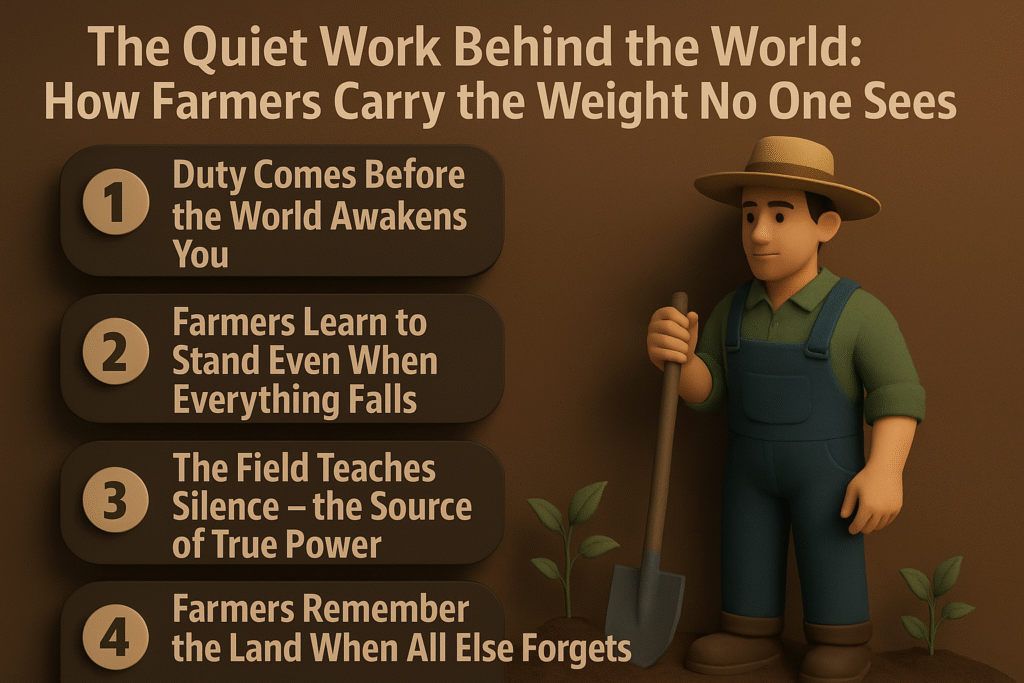
    The Quiet Work Behind the World

    There are moments in life when the world feels loud, rushed, chaotic — but a farm never moves at the world’s speed. It moves at the speed of nature, the speed of responsibility, the speed of a heartbeat that refuses to lose rhythm even when everything else becomes uncertain. A farmer lives inside this rhythm, guided by a kind of discipline that does not come from rules or routines but from the simple truth that someone has to keep going.

    Long before the first door opens in any town, a farmer has already stepped outside. The light has not returned yet. The air is still half-asleep. Even the birds haven’t decided if they want to start their morning chorus. But the farmer walks toward his fields, not out of habit, but out of duty. The world depends on what he is about to do, even though the world rarely realizes it.

    There is a loneliness to farming that outsiders cannot understand. Not the loneliness of being alone — but the loneliness of carrying something that no one else can carry with you. A farmer stands between nature and survival. He negotiates with seasons, argues with rains, bargains with soil, pleads with sunlight, and accepts whatever answer nature chooses to give.

    Most people live in a world built by human decisions.
    Farmers live in a world shaped by forces they cannot control.

    And yet, they show up every day.

    There is a strength in farmers that does not roar. It does not announce itself. It does not need appreciation. It grows quietly, the same way roots grow beneath the soil — hidden, unnoticed, essential. A farmer is strong because he does not allow uncertainty to weaken him. He acknowledges fear but does not bow to it. He feels pressure but does not allow it to paralyze him. His courage is not dramatic; it is practical.

    He walks into the field with a mind full of unanswered questions but hands full of work that must be done anyway.

    Most people quit when effort begins to feel like suffering.
    Farmers continue even when suffering becomes part of the effort.

    There are days when crops fail for no reason.
    Days when rain falls too early or too late.
    Days when the market collapses because of issues thousands of miles away.
    Days when pests destroy what hands carefully protected for months.
    Days when life feels unfair in a way that words cannot capture.

    But farmers still wake up the next morning and repeat the cycle.

    It is not stubbornness.
    It is resilience built from generations of experience.

    Every field has witnessed victories it cannot repeat and losses it cannot forget.
    Every farmer has walked through seasons that tested more than skill — they tested faith.

    Faith not in luck,
    not in fate,
    not in miracles,
    but in effort.

    Farmers believe effort is a form of survival.
    Even when nothing is guaranteed, effort is still worth offering.

    When a farmer stands in his field after a hard season, he does not see failure.
    He sees information.
    Clues.
    Lessons.
    Patterns.
    Possibilities.

    The world may think he is simply staring at land.
    But he is actually rewriting the future inside his mind.

    He adjusts his approach without announcing it.
    He changes his timing without debating it.
    He shifts his expectations without complaining about it.

    This adaptability is what makes farmers some of the strongest people in the world.
    Not physically, but mentally — emotionally — spiritually.

    A farmer’s patience is not passive.
    It is active, alert, observant.
    He listens to the weather, studies the soil, reads the wind, interprets silence.
    He trusts signs that others ignore.
    He recognizes voices that others cannot hear — the warning of insects, the discomfort of leaves, the restlessness of air before a storm.

    His knowledge is not downloaded; it is inherited.
    Not memorized; it is lived.
    Not taught; it is absorbed.

    And he carries this knowledge into every decision he makes.

    People search for motivation through speeches and books.
    But farmers find motivation through necessity.
    If they stop, the world suffers.
    If they continue, life continues.

    That truth alone is enough to keep them moving.

    There is something deeply human about the way farmers handle disappointment.
    They do not pretend it doesn’t hurt.
    They do not deny their feelings.
    But they also do not let emotions stop them.

    When a crop dies, a farmer mourns — silently.
    When a storm destroys months of work, a farmer grieves — quietly.
    When yields shrink and debts rise, a farmer feels the pressure — intensely.

    But the land does not wait for him to recover emotionally.
    So he learns to recover while working.
    He learns to heal without stopping.
    He learns to rise without applause.

    This is the kind of strength the world rarely recognizes.

    A farmer’s life is a series of invisible victories.
    The world only sees the harvest.
    It never sees the nights he didn’t sleep.
    It never sees the moments when he doubted himself.
    It never sees the sacrifices he quietly endured.
    It never sees the pain he hid from his family.
    It never sees the calculations he made while pretending everything was fine.

    But the soil sees it.
    And that is enough.

    Farmers have a relationship with land that is older than language.
    The soil remembers every footprint.
    Every seed remembers the hand that planted it.
    Every harvest remembers the season that created it.
    Every farmer remembers the lesson life etched into him.

    This memory is what allows farmers to continue,
    even when everything else tells them to quit.

    Farming is not just a profession.
    It is a promise.

    A promise to the land.
    A promise to the future.
    A promise to the people who rely on the unseen work of farmers every day.

    Farmers are not heroes because they succeed.
    They are heroes because they continue.

    Even when the world looks away,
    the farmer looks toward the next sunrise.

    Because he knows the earth waits for him —
    and he refuses to let it stand alone.

    ✍️Farming Writers Team

    Love Farming Love Farmers

    Read A Next Post 👇

    https://farmingwriters.com/the-season-that-watches-you-back-farmer-courage/

  • The Season That Watches You Back: The Hidden Courage of Farmers

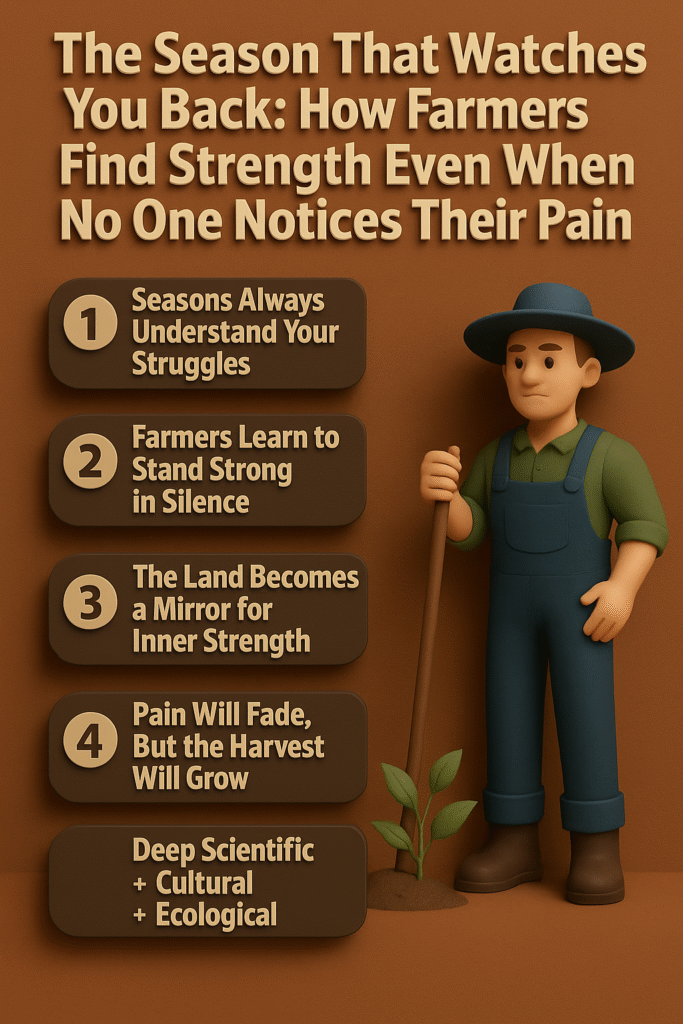
    There are days in a farmer’s life when the field feels like the only place that understands him.
    Not because it answers his questions,
    but because it holds his silence without judgment.

    When a farmer stands alone among crops in the early morning,
    before the noise of the world begins,
    the land watches him the way an old friend watches someone who is hurting but trying to stay strong.
    There is something ancient, almost spiritual, in this exchange.
    The farmer does not speak; the land does not reply.
    Yet both understand each other perfectly.

    Most people think strength comes from confidence.
    Farmers know strength is born out of uncertainty.

    A farmer wakes up with a thousand unknowns.
    He does not know if the weather will honor his decisions.
    He does not know if the soil still remembers last season’s struggle.
    He does not know if the seeds will respond to care or choose their own fate.
    He does not know whether the market will respect his months of effort.
    But he moves forward anyway,
    and that movement is where his courage hides.

    There is a strange honesty in farming —
    life does not pretend to be fair here.
    If you make a mistake, the land shows it.
    If you skip a responsibility, the crop remembers it.
    If you delay effort, the season doesn’t wait for you to catch up.

    And still, farmers don’t hate the land for being honest.
    They trust it more because of that honesty.

    Every season becomes a teacher.
    Not through lectures or instructions,
    but through consequences.
    Farmers don’t learn from success; they learn from the things that go wrong.
    Failure on a farm isn’t the end;
    it is simply part of the conversation between a human being and nature.

    Farming does something to a person’s heart over time.
    It removes illusions.
    It strips away arrogance.
    It reveals the difference between what is important and what is noise.
    A farmer cannot afford emotional drama; the field does not tolerate it.
    So he becomes quieter, deeper, sharper —
    not because life is calm,
    but because calmness is the only way to survive a life so unpredictable.

    People often imagine farmers as strong because of their physical work.
    But their true strength is emotional.
    Imagine caring for something for months,
    giving it everything you have,
    and still knowing you may lose it all to a weather change that lasted less than an hour.

    Farmers live with this reality daily —
    yet they plant again.
    That is not just resilience.
    That is a form of faith the world rarely recognises.

    Standing in a recovering field after a damaging season teaches a farmer something profound:
    effort is not a guarantee,
    but surrender is a loss before the failure even arrives.

    So he chooses effort.

    Sometimes effort feels like hope.
    Sometimes effort feels like desperation.
    Sometimes effort feels like responsibility.
    Sometimes effort feels like the only thing left to hold on to.

    But effort always feels human.

    Farmers often carry burdens they don’t speak about.
    The health of their animals.
    The future of their children.
    The debts that don’t sleep at night.
    The soil that is slowly losing strength because the world demands more than it replenishes.
    The climate that shifts faster than their training ever prepared them for.
    And yet, they continue — one season at a time.

    A farmer’s relationship with time is different.
    He cannot rush it,
    cannot slow it,
    cannot suspend it.
    He works with it.
    He listens to it.
    He respects it.

    And in return, time teaches him patience the world envies.

    Farming also forces a person to see life without filters.
    A seed never lies.
    A plant never pretends.
    The soil never praises.
    The weather never negotiates.

    In a world full of noise,
    farming is brutal honesty —
    and that honesty shapes character.

    You can tell when a farmer has lived many seasons.
    There is a certain softness in his eyes,
    but beneath that softness lives a steel that life could not bend.
    He has walked through fears that city minds cannot picture.
    He has stood in fields that felt like graveyards of effort.
    He has experienced silence that feels heavier than any human voice.
    But he has also seen life return from places that once looked dead.

    That is why farmers carry something the world desperately needs —
    wisdom born from witnessing rebirth.

    Planting seeds in a field that failed last year is not optimism.
    It is bravery.
    It is belief in possibility.
    It is proof that humans can create hope with their own hands.

    When the world looks for motivation,
    it looks outward.
    Farmers look inward.
    Because everything they need to continue lies inside them —
    the memory of the last harvest,
    the discipline of routine,
    the responsibility of land,
    the faces of their families,
    and the silent promise that tomorrow deserves another attempt.

    The farmer knows something most people don’t:
    you cannot control life,
    but you can strengthen the person who faces it.

    A seed does not grow because conditions are perfect.
    It grows because it tries.
    Farmers are the same.

    When a farmer returns to his field after a season of pain,
    he is not returning to land.
    He is returning to possibility.

    And that possibility is what keeps humanity alive.

    Farming is the only profession where giving up is more painful than trying again.
    And that is why farmers continue —
    season after season,
    storm after storm,
    loss after loss,
    hope after hope.

    They don’t stand tall because life is kind.
    They stand tall because the earth refuses to let them fall.

    And somewhere in that quiet partnership
    between human effort and soil’s memory,
    the world finds its food,
    its lessons,
    its survival,
    and its meaning.

    ✍️Farming Writers
    Love farming Love Farmers

    Read A Next Post 👇

    https://farmingwriters.com/the-day-effort-became-a-prayer-farmer-strength/

  • The Day Effort Became a Prayer: The Hidden Strength of Farmers

    The Day Effort Became a Prayer

    There comes a point in every farmer’s life when effort stops being an action and becomes something deeper — almost like a prayer. Not a religious one, but the kind of silent communication between a human being and the earth beneath him. A form of trust so ancient, so instinctive, that no modern world logic can fully explain it.

    A farmer wakes before sunrise not because he expects perfection from the day, but because the day expects effort from him.
    And effort, for farmers, is not optional.
    It is identity.

    The air before dawn feels different on farmland. It has a weight, a presence, a truth. A farmer walks through that dim light carrying concerns about soil moisture, last night’s temperature, the texture of the leaves, strange movements in the wind, the sound patterns of early insects. While the world sleeps, farmers are already in conversation with nature.

    It’s not a loud conversation.
    It’s not poetic.
    It’s not philosophical.
    It’s a conversation of survival.

    A farmer’s footsteps are not just physical movements — they are emotional commitments. Each step acknowledges one truth: nature does not wait.

    People often believe that farmers develop a strong heart from lifting heavy loads, working long hours, and tolerating climate extremes. But the truth is far more complex. What makes farmers strong is not the work they do, but the uncertainty they carry while doing it.

    Uncertainty is a storm that follows farmers silently.

    Will the rain come on time?
    Will the seedlings survive the night?
    Will pests appear without warning?
    Will the market behave fairly this year?
    Will the soil forgive last season’s mistakes?
    Will the crop understand the care it received?

    Every question is a weight.
    Every weight becomes a decision.
    And every decision becomes courage.

    Most people want clarity before they act.
    Farmers act to create clarity.

    They cannot wait for perfect conditions — because perfect conditions do not exist.
    They cannot wait for certainty — because certainty never visits their world.
    They cannot wait to feel strong — because strength is built while working, not before.

    Farmers learn this truth early:
    Life will not bend for them.
    They must bend for life — without breaking.

    This bending is what the world mistakes as simplicity or lack of ambition.
    But bending is not weakness.
    Bending is intelligence.
    Bending is adaptation.
    Bending is the only reason farming still exists.

    Every field has known farmers who bent but didn’t break.
    Every season has tested them.
    Every generation has survived only because someone continued despite every reason to stop.

    There is a story farmers rarely tell, but every farmer has lived it.
    The story of a season that took more than it gave.

    Sometimes it is a drought.
    Sometimes it is a flood.
    Sometimes it is a disease.
    Sometimes it is a market collapse.
    Sometimes it is a personal loss that arrived during the busiest week of the year.

    On such seasons, farming does not feel like work — it feels like heartbreak.

    A man standing in a field that failed him is one of the most powerful images in human history.
    He stands there not because he is defeated, but because he is gathering his scattered pieces.
    He is counting what is left.
    He is measuring the distance between what he hoped for and what reality allowed.

    But he does not abandon the field.

    He starts again.

    Starting again is not a strategy.
    Starting again is an instinct.
    It is the only way farmers know how to live — because restarts are built into their environment.

    The world sees a field as land.
    A farmer sees a field as memory.
    Memory of what worked, what failed, what surprised, what disappointed, what bloomed, what died, what healed, and what taught them something no book ever could.

    Farmers become scientists by necessity.
    They study pH values through experience, water retention through footsteps, soil fertility through smell, nutrient deficiency through leaf texture, pest activity through silence.
    They monitor humidity through the way clothes dry, wind patterns through dust movement, weather shifts through insect behavior.

    The land educates them more deeply than any institution.

    This education is relentless.
    It has no holidays, no weekends, no comfort zones.

    And yet, farmers do not complain.
    Not because their life is easy,
    but because complaining does not grow crops.

    Instead, farmers develop a kind of calmness that surprises anyone who has lived a predictable life.

    It is not a calmness of peace.
    It is a calmness of understanding.

    They understand that the earth gives and the earth takes.
    That seasons bless and seasons punish.
    That weather loves unpredictably.
    That effort does not guarantee reward.
    That life reveals itself slowly, one season at a time.

    This understanding gives farmers a wisdom that cannot be replaced by technology.

    Stand with a farmer during a difficult season and you will notice something profound.
    He does not break.
    He absorbs.
    He thinks quietly.
    He adjusts.
    He tries again.

    His strength is not visible in the arms.
    It is visible in the decisions.

    His courage is not loud.
    It is steady.

    His hope is not naive.
    It is practiced.

    Farmers do not expect miracles.
    They expect possibilities.

    Possibility is enough to keep them going.

    A seed teaches the farmer this message every year:
    “Everything important begins invisibly.”

    The world values visible achievement.
    Farmers value invisible beginnings.

    The world chases quick results.
    Farmers trust slow growth.

    The world wants perfection.
    Farmers depend on unpredictable nature.

    And yet, farmers thrive — not always financially, but emotionally, spiritually, and intellectually. Because they understand life at its rawest level.

    If the world ever wants to learn courage, it should learn from the farmer who returns to a field that broke him last year — with new seeds in his hand.

    If the world ever wants to learn patience, it should sit beside a farmer waiting for rain that refuses to come.

    If the world ever wants to learn responsibility, it should watch a farmer feeding his soil before feeding himself.

    And if the world ever wants to learn faith, it should witness a farmer planting seeds in a field where nothing grew the previous season.

    When farmers lift soil in their hands, they are not measuring moisture.
    They are measuring possibility.

    And possibility, in the hands of a farmer, becomes hope.

    Not blind hope.
    Not borrowed hope.
    Not forced hope.
    But human hope — earned through survival.

    And that is why farmers rise even when everything else falls.

    The earth refuses to let go of them.
    And they refuse to let go of the earth.

    It is the oldest partnership in the world.
    And the most unbreakable.

    ✍️Farming Writers Team
    Love Farming Love Farmers

    Read A Next Post 👇

    https://farmingwriters.com/when-the-earth-refuses-to-let-go-farmer-courage/

  • When the Earth Refuses to Let Go: The Hidden Courage of Farmers

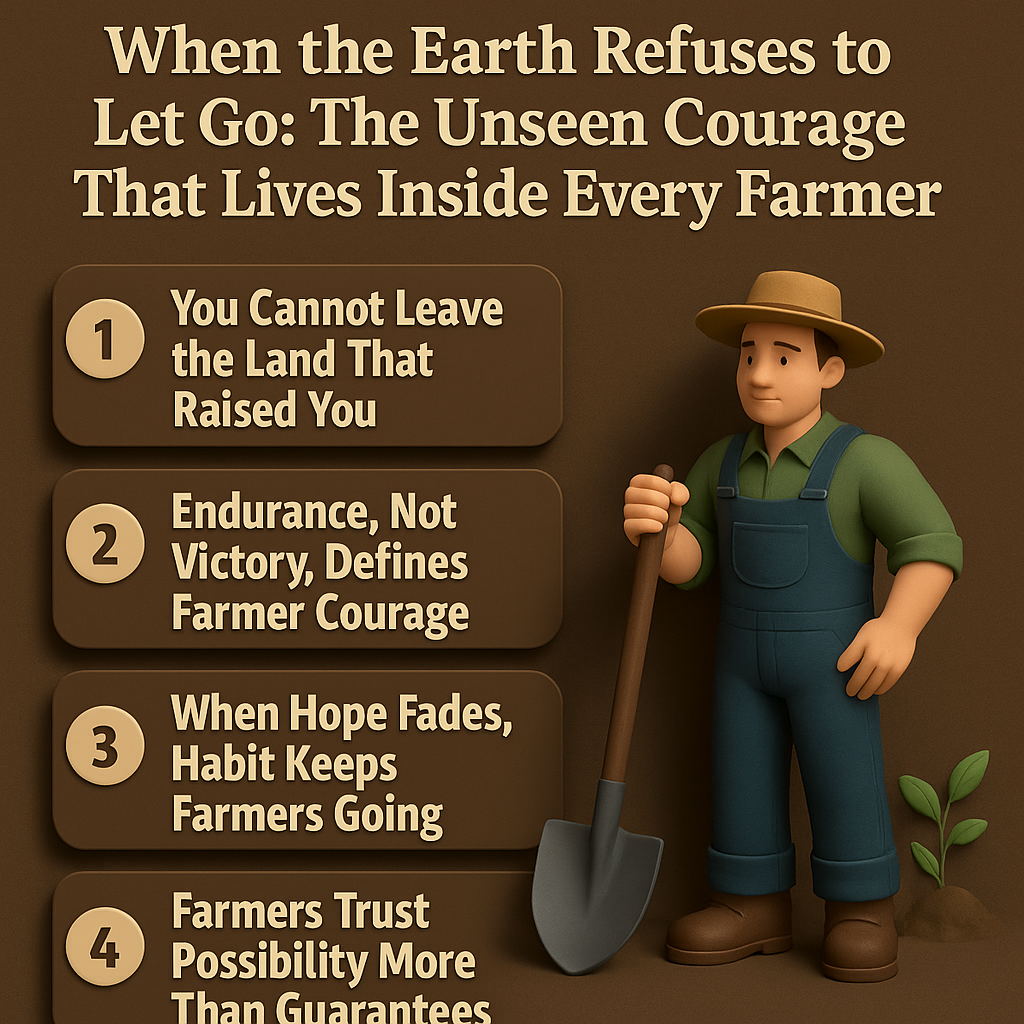
    When the Earth Refuses to Let Go

    There are places in this world where time moves differently.
    Not slowly, not quickly, but with a kind of patience that feels ancient.
    A farm is one of those places.

    A farmer walks through his field long before the sun rises, and long before the rest of the world decides what kind of day it wants to be. The air at this hour carries a weight that cannot be photographed or explained. It holds memories of yesterday’s work, predictions of tomorrow’s weather, and truths that farmers learn without words.

    People imagine farming as a profession.
    Farmers know it is an identity.

    A factory worker can leave the factory.
    A teacher can leave the classroom.
    A businessman can switch ventures.

    But you cannot leave the land that raised you.
    Not truly.
    Even if you travel far, the soil stays inside you like a stubborn heartbeat.

    Farmers carry this connection quietly.

    Not as a speech.
    Not as pride.
    Not as a statement of identity.
    But as a simple understanding:
    “I belong to this land, and this land belongs to me.”

    The courage of farmers is often misunderstood.
    It does not come from victory.
    It comes from endurance.
    Endurance built from years of uncertainty, loss, responsibility, and hope mixed together in unpredictable proportions.

    A farmer does not get stronger in the good years.
    He gets stronger in the bad ones.

    The years when rain played games.
    The years when markets betrayed expectations.
    The years when pests destroyed months of careful planning.
    The years when everything seemed to collapse at once.

    Those are the years that plant courage deeper than roots.

    Ask a farmer why he keeps going and he will rarely give a poetic answer.
    He’ll shrug.
    He’ll smile.
    He’ll say something simple like “What else can I do?”

    What he really means is:

    “Stopping would break me more than trying.”

    There are days when a farmer walks through his field and the silence feels heavier than the land itself. Not the peaceful silence of nature, but the silence of consequences — the silence that arrives after a season has gone wrong.

    A farmer stands there not as a defeated man, but as someone calculating the next step. His mind does not dwell on loss; it searches for solutions. This is not optimism. This is survival.

    Most people break when life becomes unpredictable.
    Farmers expect unpredictability.

    They don’t collapse when nature changes its mind.
    They adapt.
    They adjust the rhythm of their work.
    They change the direction of hope.
    They reimagine the coming weeks.
    They restart.

    Farming is a constant rehearsal for tomorrow.

    But it is also something deeper — a kind of agreement with the earth:

    “I will give you my effort.
    You will give me your possibility.”

    Not a guarantee.
    Not a promise.
    Just a possibility.

    And farmers accept that possibility is enough to keep going.

    There is a moment in the life of every farmer when he realises that land is not just soil — it is memory.
    Generational memory.
    Emotional memory.
    Survival memory.

    Every corner of a farm carries a story.
    Where his father planted his first crop.
    Where his grandfather stood during the monsoon of a legendary year.
    Where harvest once saved the entire household.
    Where failure taught the harshest lesson.
    Where an animal used to wait every morning.
    Where a child took its first steps.
    Where hope returned after it was almost lost.

    These memories do not fade.
    The earth doesn’t forget.

    Farmers often look like they are working the land.
    But the truth is the land is working on them too.

    It shapes their thinking.
    It teaches patience.
    It softens anger.
    It sharpens observation.
    It humbles ego.
    It deepens responsibility.
    It strengthens emotional endurance.

    Most people break under pressure because they are not used to living with the unknown.
    Farmers live with the unknown every day.

    People fear failure.
    Farmers plant in uncertainty.

    People expect comfort.
    Farmers expect challenge.

    People crumble when plans collapse.
    Farmers rebuild plans from the soil up.

    Farmers do not fear storms.
    They fear giving up.

    There is a difference between fear that stops you and fear that shapes you.
    Farmers carry the second kind.

    Stand with a farmer during sunset and you will hear the honesty of life in his voice — not bitterness, not complaint, not regret, but acceptance. Acceptance that life is unpredictable, but effort is not. The field does not need perfection; it needs participation. The land does not ask for guarantees; it asks for commitment.

    Farmers understand that you cannot control everything.
    But you can continue through anything.

    This is why the spirit of a farmer is almost unbreakable.
    Not because he has not faced suffering —
    but because suffering has taught him endurance.

    A crop may fail.
    A season may collapse.
    A storm may destroy what months built.
    But a farmer always finds a reason to return.

    Even when hope fades, habit remains.
    Even when clarity disappears, responsibility stays.
    Even when doubt grows louder, the soil remains patient.

    And that patience becomes the farmer’s motivation.

    People search for motivation in books, videos, speeches.
    Farmers find it in silence.
    In the sound of footsteps on dry soil.
    In the chill of morning air.
    In the emptiness of a field waiting to be planted.
    In the whisper of wind predicting the next change.
    In the memory of harvests that once felt impossible.

    Farming teaches a truth that the modern world forgets:

    You don’t become stronger by avoiding difficulty.
    You become stronger by walking through it.

    And farmers walk through difficulty every day.

    But the greatest strength of a farmer is not his hard work.
    It is his ability to hope again after hope has already broken.

    The world survives because farmers believe in tomorrow even when today feels like an enemy.
    They do not trust fate; they trust effort.
    They do not trust luck; they trust land.
    They do not trust guarantees; they trust possibility.

    Farmers carry humanity forward quietly, season after season, without applause, without spotlight, without reward — only responsibility.

    And perhaps that is why the earth refuses to let go of farmers.
    Because the earth knows who respects it the most.

    Farmers survive storms, losses, and impossible seasons.
    But they rise.
    They always rise.

    And when they rise, the world rises with them.

    Because farming is not the story of crops.
    It is the story of courage.

    ✍️Farming Writers Team

    Love farming Love Farmers

    Read A Next Post 👇

    https://farmingwriters.com/the-wind-remembers-everything-farmers-move-forward/

  • The Wind Remembers Everything: Farmers and the Courage to Move Forward

    The Wind Remembers Everything

    The wind behaves strangely in farming villages. Unlike cities where wind passes through without leaving memories, in rural fields the wind carries stories. It moves slowly through crops, bends lightly around old trees, brushes across the quiet roofs of small homes, and finally settles into the earth as if it has something to say. Farmers learn to read this wind—its direction, its temperature, its honesty. Not because someone taught them, but because the land teaches those who stay long enough to listen.

    A farmer doesn’t stand in the field as a worker. He stands as a witness.
    A witness to seasons that don’t keep promises, to rains that forget their timing, to sunlight that sometimes burns more than it blesses. Yet every morning, he returns to the same land with a kind of fragile hope that the world rarely understands.

    Strength in farming is not the strength of muscles or machinery.
    It’s the strength of repeating effort despite repeating uncertainty.

    Sometimes the soil looks fine but hides exhaustion.
    Sometimes the sky looks generous but holds a storm.
    Sometimes a plant looks healthy but suffers silently.
    And sometimes, despite a farmer giving everything he has, nature chooses a different plan.

    But a farmer continues, not because he is unbreakable, but because stopping is harder than trying.

    People often imagine farming as a scheduled cycle: prepare → sow → irrigate → protect → harvest.
    But farmers know that reality doesn’t follow diagrams.
    Reality comes with chaos—abrupt changes in temperature, unexpected market behaviors, invisible pests, sudden nutrient imbalances, or rainfall that apologizes by coming at the worst possible time.

    Yet farmers wake up every morning with the same discipline.
    Not because motivation magically rises every sunrise,
    but because responsibility refuses to sleep.

    Every field holds invisible memories of its farmer.
    The foot-marks formed in the same direction for years.
    The places where he stood silently when life went wrong.
    The spots where he kneeled to check the soil by touch alone.
    The corners where he stored tools, hoping next season would be kinder.
    And the small shade under which he ate lunch while weather shifted without warning.

    The field remembers everything.
    The wind carries those memories.

    A farmer grows older faster than the world notices.
    But he grows wiser in ways the world cannot measure.

    Most people think wisdom comes from books, experiences, or age.
    But farmers gain wisdom from moments that are small and unnoticed—moments that never become stories but become foundations of character.

    The moment when a seed sprouts after weeks of doubt.
    The moment when a failing crop turns green after a night of rain.
    The moment when an entire field fails but one corner still survives.
    The moment when a bird sits on a fence during a long, lonely afternoon.
    The moment when silence between two seasons becomes heavier than any workload.

    These moments don’t get recorded.
    But they shape the soul of a farmer.

    Every farmer lives with a form of courage that does not shout.
    His courage is quiet, steady, unpolished.
    It grows in the corners of his life where no one is watching.

    A farmer doesn’t show fear because fear doesn’t change the soil.
    He doesn’t show anger because anger doesn’t bring rain.
    He doesn’t show despair because despair doesn’t shape harvest.
    He chooses calm, not because he is calm, but because calmness is the only way to survive a life where nothing is guaranteed.

    One of the strangest truths in farming is that loss does not stop life—it becomes part of its rhythm.

    There have been years when farmers harvested almost nothing.
    There have been seasons when pests arrived like an army and stripped green fields into brown disappointment.
    There have been nights when storms destroyed an entire year of effort.
    And mornings when farmers stood in silence, not knowing how to begin again.

    But they begin anyway.

    Beginning again is the heart of farming.
    And beginning again is the heart of life.

    The world celebrates winners.
    Farming celebrates those who refuse to quit.

    A factory can pause.
    An office can reschedule.
    A business can reorganize.
    But a field waits for no one.

    If a farmer misses a sowing window by even a few days, the season itself collapses.
    If irrigation is delayed at the wrong time, weeks of growth can freeze.
    If a pest is ignored for a single night, the damage becomes irreversible.

    This is why farmers develop a sense of time sharper than clocks.
    They don’t measure days; they measure possibilities.

    The soil adjusts slowly.
    Plants grow silently.
    Nature heals at its own pace.
    Farmers learn patience not because they choose it but because agriculture demands it.

    A farmer’s relationship with failure is different from the world’s.
    He doesn’t fear failure; he fears stopping.
    Failure is a season.
    Stopping is the end.

    There is a dignity in farming that modern life doesn’t understand.
    It has nothing to do with wealth, status, or recognition.
    It has everything to do with purpose.

    Farmers don’t feed themselves.
    They feed everyone.
    They don’t work for applause.
    They work for continuity.
    They don’t seek perfection.
    They seek possibility.

    Standing alone in a field after sunset, a farmer often reflects on things the world considers ordinary.

    Why did the clouds move differently today?
    Why did the soil feel warmer under his feet?
    Why did the wind carry a different scent?
    Why did the evening sound quieter than usual?

    These small changes shape tomorrow.
    A farmer learns to predict life not through technology alone but through awareness—raw, honest, instinctive awareness.

    A farmer is not just working on land.
    He is working with life.

    His hands are not just holding tools.
    They are holding the future.

    His eyes are not just looking at crops.
    They are looking at survival.

    His steps are not just moving across fields.
    They are walking in the footsteps of thousands of years of human history.

    Farming is the original profession.
    The first duty.
    The first science.
    The first hope humanity ever knew.

    And yet, farmers rarely receive the respect they deserve.
    Their strength is invisible.
    Their sacrifices are silent.
    Their wisdom is unspoken.
    But without them, the world would starve—literally and spiritually.

    Every farmer carries something inside his heart that the world needs desperately:

    The ability to move forward even when nothing moves with you.

    Life tries to stop farmers.
    Weather tries.
    Markets try.
    Circumstances try.
    But they continue.

    They continue because they understand a truth the world forgets:

    “You only lose when you stop trying.”

    Farmers don’t stop.
    They bend, they struggle, they restart, they rebuild—but they don’t stop.

    This is why farming is the greatest teacher.
    Not because it grows food,
    but because it grows people.

    And those who learn farming learn life.

    ✍️Farming Writers Team

    Love Farming Love Farmers

    Read A Next Post 👇

    https://farmingwriters.com/the-day-the-soil-spoke-back-farming-strength/

  • The Day the Soil Spoke Back: What Farming Teaches the World About True Strength

    The Day the Soil Spoke Back

    There is a moment on a farm that very few people outside agriculture will ever understand.
    It’s not sunrise.
    It’s not harvest.
    It’s not the first rain.

    It is the moment when a farmer realises he must continue, even when every part of his body, his land, and sometimes his life is asking him to stop.

    That moment shapes a farmer more than any successful season.

    People outside farming imagine strength as something dramatic — like lifting heavy weights or winning something important in front of a crowd. But a farmer’s strength is different. It grows quietly, in the hours when the world is asleep and he is awake, worrying about something that isn’t even visible yet.

    Sometimes strength grows on a night when he is not sure if the crop will survive.
    Sometimes strength grows in the hour after a storm destroys weeks of work.
    Sometimes strength grows in that strange silence when he walks through his field and doesn’t know what answer nature will give tomorrow.

    These moments are not recorded anywhere.
    There are no witnesses.
    No applause.
    No recognition.
    But these are the moments that turn farmers into the strongest people on earth.

    Most professions let you plan.
    Farming does not.
    Nature does not sign contracts.
    The sky does not ask permission before changing its mood.
    And the soil responds only to one thing — effort.

    A farmer once told me something simple and true:
    “You cannot argue with the land. You learn to listen.”

    Listening to land is a skill that takes a lifetime to understand.
    The soil speaks in moisture, in texture, in weight, in warmth.
    The plants speak in color, in droop, in silence, in scent.
    The sky speaks in winds before clouds.
    And the season speaks slowly, in hints.

    Farmers don’t develop this understanding because they want to.
    They develop it because their entire life depends on it.

    People ask why farmers wake up before dawn.
    Is it discipline? Habit? Responsibility?
    The truth is simpler:
    Dawn is the only time of day when the farmer can hear the world clearly.

    When machines are silent.
    When the village is asleep.
    When even thoughts feel softer.
    That is when the soil speaks.

    And in that early morning hour, something happens inside the farmer — a kind of grounding that modern life rarely offers. He understands something the world forgets:
    that the beginning of every day is a chance to grow, even if you failed yesterday.

    Farming is not about perfect days.
    It is about dangerous days, uncertain days, long days, days that test your bones and your patience.

    People assume farmers are used to hardship.
    But no one “gets used” to failure.
    No one “gets used” to fear.
    No one “gets used” to watching months of effort destroyed in a single afternoon.

    Farmers don’t overcome struggles because they are strong.
    They become strong because they overcome struggles.

    There’s a difference.
    A profound one.

    When a season collapses, the farmer doesn’t break.
    He bends — but bending is not the same as breaking.

    Bending is survival.
    Breaking is surrender.
    Farmers bend, because they know something storms can never destroy:
    the ability to start again.

    Starting again is not easy.
    It is painful.
    It is discouraging.
    It is exhausting in a way the world cannot measure.

    But starting again is the backbone of farming.
    Some restarts happen after droughts.
    Some after floods.
    Some after market crashes.
    Some after personal tragedy.
    Some after long nights of fear.
    But restarts always happen.

    This is why farming is more than agriculture.
    It is a study of human possibility.

    A farmer’s hope is not naive.
    It is not blind.
    It is not optimistic in the usual sense.

    It is practical hope — the kind needed to plant seeds in soil that failed last year.
    The kind needed to risk money that might not return.
    The kind needed to trust nature after nature betrayed you.
    The kind needed to walk a field alone and still believe in something better.

    Hope like that cannot be taught in schools.
    It grows in the fields.

    People often imagine farming as peaceful.
    But peace is not the same as quiet.
    Farming has quiet moments — but inside those moments live thousands of concerns.

    The level of awareness a farmer carries is almost scientific.
    He reads soil structure with accuracy.
    He studies weather patterns instinctively.
    He tracks plant health with microscopic observation.
    He calculates market risk with experience.
    He memorises patterns of pests, diseases, and seasons.

    Farmers are researchers without titles, scientists without laboratories, economists without charts, and philosophers without notebooks.

    Their work transforms them.

    Many people live their lives disconnected from nature.
    Farmers live inside nature.

    That closeness does something indescribable to the human heart —
    it makes you humble.

    You cannot control everything.
    You cannot plan everything.
    You cannot win every time.
    You cannot fight nature and expect victory.

    You learn to adapt.
    To bend.
    To adjust.
    To wait.
    To trust.
    To observe.
    To try again.

    That is strength.

    Not the strength of defiance — the strength of cooperation.
    Not the strength of ego — the strength of humility.
    Not the strength of power — the strength of survival.

    Every farmer carries scars the world doesn’t see —
    scars from the seasons that disappointed,
    from the rains that never came,
    from the rains that came at the wrong time,
    from the years when prices were unfair,
    from the days when nothing made sense.

    But there is something else a farmer carries — something the world desperately needs today:
    the ability to continue.

    Continuing is not glamorous.
    Continuing is not dramatic.
    Continuing is not celebrated.
    But continuing is everything.

    And that is what farmers do better than anyone.

    They continue when others would stop.
    They continue when the world is cruel.
    They continue when conditions are wrong.
    They continue when the burden is heavy.
    They continue because someone must continue.

    The world eats because farmers continue.
    The world survives because they refuse to stop.
    Humanity depends on people who work even when hope is thin.
    Farmers are those people.

    And maybe that is why the soil stands with them —
    because the soil understands their truth.

    When the world forgets,
    the soil remembers.

    When the world ignores,
    the soil listens.

    When the world abandons,
    the soil receives.

    And when the world doubts,
    the soil grows.

    Farmers and soil share a relationship the world cannot measure.
    A relationship built on effort, trust, and renewal.
    A relationship where failure is not the end — it is the beginning of wisdom.

    This is why farmers are strong.
    Not because life is easy,
    but because life is honest on the land.

    And honesty builds character.

    Conclusion

    If the world ever wants to learn what real strength looks like,
    it should watch a farmer walking through a field that betrayed him yesterday…
    and watch him prepare it again today.

    There is no deeper courage than that.

    Farmers don’t win because they are lucky.
    They win because they don’t give up.

    And farming teaches the same lesson to humanity:
    “Strength is not avoiding struggle.
    Strength is surviving it.”

    Farmers survive.
    Farmers continue.
    Farmers rise.
    And the world rises because of them.

    ✍️Farming Writers Team

    Love Farming Love Farmers

    Read A Next Post 👇

    https://farmingwriters.com/farmer-refuses-to-break-story-strength/

  • The Hands That Refuse to Give Up: Farming’s Deep Lesson on Endurance

    The Hands That Refuse to Give Up

    Some truths in life reveal themselves slowly, the way early morning light spreads across a field. You don’t notice the moment the darkness breaks; you simply begin to feel the world returning to itself. Farmers understand this better than anyone, because their entire lives unfold in these slow, quiet transitions that the world rarely pays attention to.

    A farmer stands at the edge of his field before sunrise not because the world is watching, not because success is guaranteed, not because life is easy, but because stopping is never an option. The weight of generations rests on his shoulders — not dramatically, not loudly, but with a steady pressure that becomes part of his bones.

    There is a kind of strength that forms only in people who wake up with uncertainty every day yet move toward their work with the same determination. Farming doesn’t offer the safety of predictability, the comfort of routines that always go the same way, or the luxury of controlled environments. Instead, farmers live in the rhythm of unpredictability — where the sky decides the mood of the day, where the soil speaks through texture and silence, where seasons return but never with the exact same face.

    This unpredictability would break most people, but it shapes farmers.

    Real endurance doesn’t come from success; it comes from surviving everything that tries to stop you. And farming is exactly that — a life built inside challenges that never follow rules.

    If you ask a farmer where his strength comes from, he may shrug or smile quietly. He won’t give you a philosophical explanation. But if you watch him long enough, you will understand. His strength comes from learning to move even when fear whispers louder than hope. It comes from accepting nature instead of fighting it. It comes from rebuilding what gets destroyed. It comes from understanding that failure is not the end — it’s the beginning of the next attempt.

    A city person often imagines farming as a simple cycle. You sow, you wait, you harvest. But a farmer’s mind is filled with questions that don’t belong to textbooks or manuals. Should the soil rest this year? Will the seed survive if night temperature drops unexpectedly? Is the color of the leaves a warning or just a shift in growth? Is the breeze carrying rainfall or carrying loss? These questions form an internal conversation that continues throughout the day, even when the farmer is silent.

    Silence in farming isn’t emptiness; it is analysis.

    A journalist once wrote that you can measure a farmer’s life not in years but in sunrises. Each sunrise carries a story, a responsibility, a possibility, and a risk. The farmer walks into each day without knowing which of those he will meet. Yet he walks anyway.

    The world admires confidence, but farming admires endurance.

    Confidence may rise and fall with circumstances, but endurance remains even when the mind is exhausted. A farmer’s endurance is not a choice — it is a requirement written into the landscape of his life.

    This endurance shows itself most clearly when things fall apart. A drought that arrives without warning. Rain that comes too early or too late. A market that collapses just when the harvest is ready. Pests that destroy weeks of patient waiting. Machinery that fails in crucial moments. These are the moments that would make most people question everything.

    Farmers don’t avoid these questions — but they don’t surrender to them either.

    When something breaks, a farmer doesn’t sit and wonder why it happened. He stands up and decides what must be done next. His mind does not dwell in emotion; it moves toward action. Not because he lacks feelings, but because feelings don’t plow the field. Action does.

    There is something deeply human about this, something the world often forgets: endurance is not loud. It is silent, patient, persistent. A farmer’s hands may look rough, but his endurance is gentle — the kind that bends without breaking, the kind that adapts without losing itself, the kind that survives without hatred.

    If you walk through a village at night, you may notice something unusual. While the rest of the world slows down, a farmer’s mind does not. He remembers what the land looked like that afternoon, imagines what it will need tomorrow, senses the coming season through winds others ignore. His connection to the earth is not scientific alone; it is instinctive. A deep, almost ancestral wisdom flows through farmers — not written in books but carried through generations of observation.

    This wisdom is different from knowledge. Knowledge can be learned; wisdom must be lived.

    Farmers live wisdom every day — in the way they read the soil, the way they feel the air, the way they hear the silence between winds, the way they hold seeds like memories of the future. A seed is more than a biological unit to a farmer; it is a promise, fragile but powerful. Planting a seed is one of the most courageous acts a human can perform. You are placing hope into the earth without any guarantee. Yet farmers do it season after season.

    Why?

    Because farming is not understood through reward. It is understood through purpose.

    A farmer does not work just for income. He works for continuity. For life. For family. For community. For a future he will not see. A farmer lives in the paradox of working for tomorrow but surviving in today. And strangely, this paradox gives him more grounding than most people living in cities with predictable schedules and controlled environments.

    If you ever sit with an old farmer during dusk, you will notice something profound. He does not talk about achievements. He talks about seasons — the difficult ones, the generous ones, the strange ones, the unforgettable ones. Seasons are the calendar of a farmer’s life. They leave marks on his heart the way years leave marks on a historian’s notebook.

    A season of struggle teaches a farmer humility.
    A season of abundance teaches him gratitude.
    A season of uncertainty teaches him patience.
    A season of loss teaches him resilience.

    This constant turning of seasons creates a character that cannot be manufactured anywhere else.

    Farmers also understand something the world has forgotten — that life cannot be controlled. Life can only be cooperated with. You cannot force rain. You cannot force growth. You cannot force timing. You can only work with what arrives, prepare for what may arrive, and survive what arrives without warning.

    This acceptance does not make farmers weak. It makes them realistic. And realism is a rare strength in a world full of illusions.

    Farmers are the most emotionally honest people on earth because they do not pretend to control what they cannot. Their pride does not come from defeating nature but from understanding it. Their dignity does not come from achievement but from effort. Their self-worth does not come from validation but from contribution.

    People often wonder why farmers rarely show despair even when life treats them unkindly. The answer is simple: the soil heals them. When a farmer steps into his land, something inside him settles. The soil does not question him. The soil does not judge him. The soil does not ask for perfection. It simply says, “Try again.”

    And that is enough.

    In a world that values performance, farmers value persistence.
    In a world that wants speed, farmers trust timing.
    In a world that fears failure, farmers restart without hesitation.
    In a world that chases success, farmers chase meaning.

    This is why farming is not just an occupation.
    It is a philosophy.
    A discipline.
    A way of seeing life that is raw, honest, and profoundly human.

    And the greatest truth farming teaches is this:

    Strength is not the ability to win.
    Strength is the ability to continue.

    Farmers continue.
    Through storms,
    through loss,
    through exhaustion,
    through doubt,
    through unfairness,
    through fear,
    through everything that tries to break them.

    The world survives because farmers refuse to give up.

    ✍️Farming Writers Team

    Love farming Love farmers

    Read A Next Post 👇

    https://farmingwriters.com/farmer-refuses-to-break-story-strength/

  • When a Farmer Refuses to Break: A Human Story of Strength Beyond Struggle

    When a Farmer Refuses to Break

    There are moments in a farmer’s life when the world becomes quiet—not peacefully quiet, but the kind of silence that grows heavy inside your chest. The kind of silence that arrives when the monsoon changes its mind without warning, or when the soil cracks earlier than expected, or when the market decides to betray the very people who feed it.
    In that silence, a farmer stands alone with questions that don’t have simple answers.

    A city person might imagine farming as just a cycle of sowing and harvesting. They see photos of green fields and assume nature works like a machine—predictable, dependable, comforting. But a farmer knows better. Nothing in farming is guaranteed. Not the weather. Not the seeds. Not the price. Not even tomorrow.

    And yet, every morning, a farmer wakes up before dawn.
    Not because the sun demands it.
    Not because someone is watching.
    Not because success is assured.
    But because not waking up is not an option.

    A farmer’s day does not begin with motivation.
    It begins with responsibility—heavy, unavoidable, unromantic responsibility.
    The kind that pulls you out of bed when your legs hurt, when sleep was short, when the previous day was unfair, when life has handed you more than you can carry but expects you to carry it anyway.

    There’s a particular sound that fields make at dawn—an almost invisible whisper rising from the soil when the darkness is thin but the light isn’t fully awake yet. A journalist once described it as “the earth breathing before speaking.” Farmers hear that sound every morning. They don’t talk about it. They don’t write poems about it. But they understand it in ways the world never will.
    It is the soil reminding them: “I saw your effort yesterday. Let’s try again today.”

    People often wonder where farmers get their strength from.
    Is it inherited?
    Is it trained?
    Is it built through difficulty?
    Or is it simply the only way to survive?

    The truth is more complex.
    A farmer’s strength is not a single thing—it is a combination of scars, memories, responsibilities, and tiny pieces of courage stitched together through years of unpredictable seasons.

    A farmer becomes strong because life does not allow him the luxury of weakness.
    Weakness in other professions can be covered, postponed, restructured.
    But weakness in farming means a field left unattended, animals unfed, irrigation delayed, sowing missed, harvest threatened.
    Life in farming does not wait for emotional recovery.
    You grow strong because you have to.

    And yet, this strength is not the loud kind—the kind that shouts, or brags, or demands applause.
    Farmer strength is quiet, invisible, internal.
    It shows itself not in celebration, but in continuation.

    One of the most profound truths about farming is this:
    A farmer often continues even when hope doesn’t.

    When a crop fails, the farmer doesn’t just lose profit.
    He loses months of effort.
    He loses strength he cannot get back.
    He loses nights of sleep that no one saw.
    He loses risks that only he understood.
    He loses a part of his life that he cannot redo.

    But he does what the world rarely does—
    He starts again.

    The world might see it as stubborn persistence.
    But to a farmer, restarting is not bravery.
    It is survival.

    When a season goes wrong for a corporate worker, they feel stress.
    When a season goes wrong for a farmer, they feel fear.
    Fear not for themselves,
    but for what their land means—
    their children, their parents, their village, their history, their identity.

    The farmer’s life is not measured in months or years.
    It is measured in seasons.

    A farmer remembers the year when the rain cheated early.
    The year when the locusts came unexpectedly.
    The year when the market crashed without warning.
    The year when a field produced more than expected.
    The year when everything went wrong at once.
    And the year when a single decision saved the entire farm.

    Behind every meal, behind every grain, behind every bite of food that reaches any table in the world, there exists an invisible timeline of these seasons—each shaped by a farmer who refused to break.

    I once met an old farmer who told me something I’ve never forgotten.
    He said, “The soil doesn’t teach you how to farm. It teaches you how to live.”

    He explained that farming is simply the visible part of a much deeper emotional and psychological journey:

    “The soil tests your patience before it rewards your effort.
    The rain tests your faith before it fills your land.
    The sun tests your endurance before it gives you strength.
    The crop tests your timing before it becomes your reward.
    Nature tests you completely before it trusts you with abundance.”

    Farmers do not learn life from books.
    They learn it from watching small changes that most people never notice—
    the color of a leaf,
    the thickness of a stem,
    the smell of wet soil,
    the movement of insects,
    the temperature of the morning air,
    the silence after a long day of effort.

    These tiny observations are not part of a job.
    They are part of survival.

    A farmer’s mind is constantly occupied with quiet calculations—
    How much water does the field need today?
    Is the soil too warm to sow?
    Is the wind telling a story about tomorrow’s weather?
    Will this seed survive if the night is too cold?
    Should this land be rested this year?
    Will this crop’s demand remain stable in the coming season?

    These thoughts don’t stop.
    Not at night.
    Not during meals.
    Not even during sleep.

    But here is the extraordinary thing:
    Farmers rarely complain.
    Not because life is easy,
    but because complaining doesn’t make the field grow.

    Their silence is not weakness.
    It is wisdom.

    And in that silence, something remarkable happens—
    They grow emotionally stronger than most people will ever become.

    A farmer does not need motivational quotes,
    expensive seminars,
    or textbooks filled with life advice.
    His life IS the advice.

    The ground he walks on tells him
    that everything—no matter how broken—
    can grow again.

    The sky tells him
    that uncertainty is not a threat—
    it is simply nature’s rhythm.

    The wind tells him
    that change will always come—
    and you must bend before you break.

    The seeds tell him
    that progress begins invisibly—
    long before anyone notices it.

    Every particle of nature
    becomes a teacher to the farmer.

    And because of these teachings,
    farmers develop a strength
    that the modern world cannot manufacture.

    This strength is not visible in their arms.
    It is visible in their decisions.

    They take risks others avoid.
    They work hours others cannot.
    They stand alone where others collapse.
    They hope when others doubt.
    They rise when others surrender.

    Which brings us to the heart of this story:
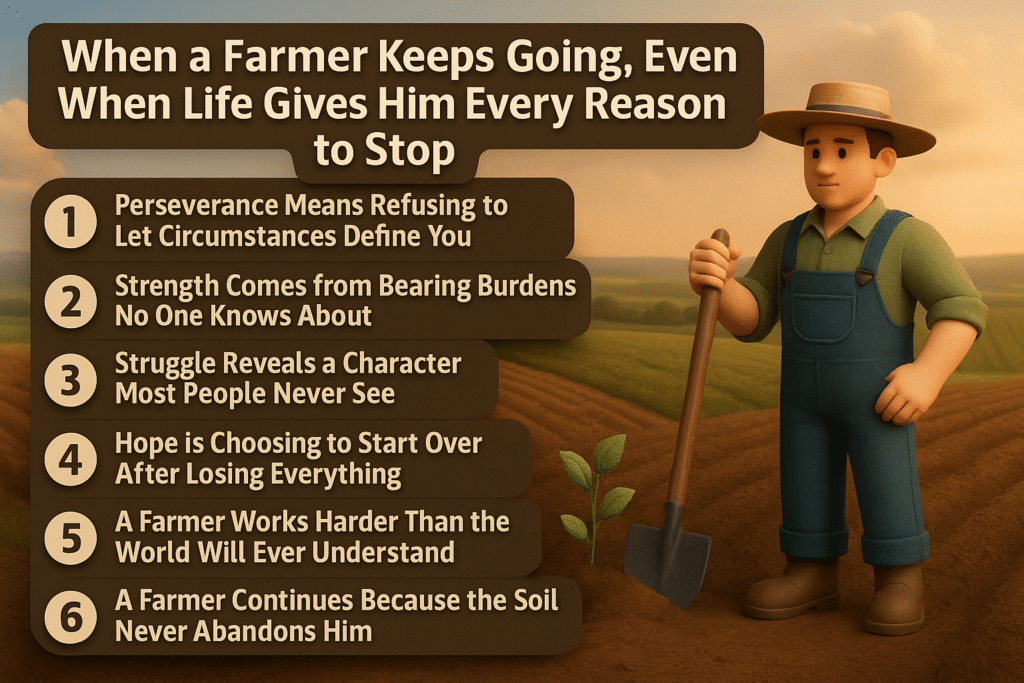
    Why does a farmer continue when life gives him every reason to stop?

    The answer is simple and profound:

    A farmer does not live only for himself.
    He lives for generations before him
    and generations after him.

    His identity is not in his name.
    It is in his land.
    His pride is not in recognition.
    It is in responsibility.
    His motivation is not achievement.
    It is continuity.

    And perhaps the most beautiful truth—

    A farmer knows that even when life turns its back,
    even when situations become unbearable,
    even when everything feels lost,
    the soil still welcomes him every morning
    as if saying:

    “I know you’re tired,
    but I’m with you.
    Let’s grow again.”

    That is why a farmer refuses to break.
    Not because he is unbreakable—
    but because his spirit heals every time
    he places his foot on the land that raised him.

    CONCLUSION

    Farmers are not symbols of struggle.
    They are symbols of courage.
    They are proof that human beings can endure,
    rebuild,
    restart,
    and rise
    again and again,
    no matter how many times life tries to stop them.

    The world survives
    because farmers persist.

    And every farmer carries a message
    that the world desperately needs to hear:

    “Strength is not about winning.
    Strength is about continuing.”

    ✍️Farming Writers Team

    Love farming Love Farmers

    Read A Next Post 👇

    https://farmingwriters.com/soil-stands-with-you-farmer-unshakeable-strength/