• Avocado Farming Complete World Guide Climate, Soil, Cultivation, Harvesting & USD Profit

    Avocado Farming

    Avocado, known scientifically as Persea americana, has become one of the most profitable fruits in the world. Once limited to Central America, avocados have now expanded into Asia, Africa, Australia, Europe and the Middle East. The fruit’s extraordinary nutrient profile, creamy texture and global culinary popularity have transformed it into a billion-dollar industry. Avocado demand continues rising every year, especially for the Hass variety which dominates global export markets. Its popularity in health foods, vegan diets, keto meals, smoothie bowls, beauty products and premium restaurants has made avocado a symbol of modern global nutrition.

    The avocado tree grows best in warm, frost-free climates with moderate humidity. Ideal temperatures range from eighteen to twenty-five degrees Celsius. Short exposure to five degrees or below damages the tree, and extreme heat above forty degrees affects fruit set. Regions with stable seasons produce consistent yields. Countries like Mexico, Peru, Chile, Kenya, Tanzania, Colombia, South Africa, Israel, Spain, Australia, New Zealand and parts of India lead global production. As climate zones shift, avocado farming has expanded into highland tropics, dry subtropics and coastal belts.

    Soil selection plays a defining role. Avocado roots require deep, well-aerated soil with excellent drainage. Loamy soil enriched with natural organic matter supports strong root expansion. The tree is extremely sensitive to waterlogging; even a few hours of standing water can cause root rot. Soil pH between five point five and seven remains ideal. Heavy clay soils must be avoided. Sandy loam with compost works exceptionally well for Hass avocado. Farmers worldwide prepare raised beds or mounds to protect roots from moisture accumulation. Organic matter, compost and well-decomposed manure enhance soil fertility.

    Land preparation begins with deep ploughing to break compact layers followed by leveling and creation of raised planting mounds. Avocado seedlings are planted on these mounds to prevent root diseases. Spacing depends on variety: Hass and similar types require six to eight meters between trees. High-density systems used in commercial orchards reduce spacing but require advanced pruning and canopy control. Before planting, fields are cleaned of perennial weeds and provided with drip irrigation channels.

    Seedlings are grafted because grafting ensures uniform fruit quality and stable yield. Hass avocado grafted onto strong rootstock remains the global standard. The rootstock provides disease resistance and tolerance to varying soil conditions. Seedlings must be healthy, green, with well-developed leaves and a balanced root-shoot ratio. Planting is done during early monsoon or mild spring when soil moisture supports establishment.

    Irrigation management defines avocado health. The tree needs consistent moisture but cannot tolerate excess water. Drip irrigation provides precise moisture control while preventing fungal problems. Over-irrigation leads to root rot, nutrient deficiency and fruit drop. Under-irrigation reduces fruit size and oil content. Farmers maintain a balanced cycle — deeper irrigation during flowering, moderate irrigation during fruit growth and controlled irrigation during ripening. Mulching with dry leaves, straw or organic compost helps lock soil moisture and protect roots from extreme temperatures.

    Nutrient management must be balanced. Avocado trees require nitrogen, potassium, calcium, magnesium and micronutrients such as boron and zinc. Excess nitrogen causes vigorous vegetative growth at the cost of fruit formation. A balanced organic-inorganic nutrition system works best. Many commercial orchards use compost, vermicompost, organic mulch, and microbial inoculants to maintain soil health. Calcium is critical for fruit firmness and post-harvest shelf life. Micronutrient sprays improve flowering and reduce fruit drop. Farmers avoid harsh fertilizers during flowering because delicate blooms respond poorly to chemical shock.

    Pruning is essential in avocado farming. Without structured pruning, trees grow excessively tall and wide, reducing fruit accessibility. Pruning during early growth shapes the canopy, improves sunlight penetration and supports balanced branching. Mature trees require regular removal of overcrowded branches to maintain air circulation. Proper pruning schedules increase fruit yield, reduce disease pressure and support high-density orchards.

    Pollination plays a unique role in avocado production. The tree exhibits “type A” and “type B” flowering cycles. Cross-pollination increases yield. In commercial farms, growers plant both types to ensure strong fruit set. Bee activity enhances pollination, so many orchards maintain beehives nearby. Stable temperatures and low wind speeds during flowering are critical for successful pollination.

    Pests and diseases in avocado farming vary globally. Root rot caused by Phytophthora cinnamomi remains the most serious threat. It spreads through poorly drained soils, contaminated tools and infected planting material. Farmers prevent root rot by maintaining excellent drainage, inoculating soil with beneficial microbes and choosing resistant rootstocks. Insect pests include mites, thrips, borers and fruit flies. These are managed through integrated pest management systems using traps, natural predators and organic sprays. Good orchard hygiene and proper canopy management reduce pest pressure significantly.

    Fruit development begins after successful pollination. Avocado fruits grow steadily over several months. Depending on variety and climate, Hass avocados take five to eight months to reach maturity. Fruits remain firm on the tree even when fully mature, allowing farmers to harvest according to market needs. Harvesting must be done carefully because immature fruits do not ripen properly. Mature fruits are harvested manually using clippers, leaving a small stem attached. Fruits are collected gently to avoid bruising and stored in shaded, cool areas immediately.

    Post-harvest handling plays a major role in avocado business success. Fruits are washed, dried, graded and packed for transport. Controlled atmosphere storage increases shelf life. Export-quality Hass avocados must meet strict skin quality, shape, oil content and maturity standards. Transporting to international markets requires cold-chain logistics. Countries such as Mexico, Peru and Chile have developed advanced supply chains to maintain global dominance.

    Processing avocado into oil has emerged as a lucrative sector. Cold-pressed avocado oil is used in skincare, nutraceuticals and culinary products. The oil’s high content of monounsaturated fat and antioxidants increase its global market demand. Avocado pulp is used in spreads, smoothies and processed foods as a natural creamy base.

    Economically, avocado farming offers one of the highest profits among fruit crops. Hass avocado earns strong prices in global markets, often between two and seven USD per kilogram depending on country and season. Organic avocados fetch premium prices. High-density orchards produce yields that compete with industrial fruit crops. With proper management, profitability increases year after year as trees mature. Many African, Latin American and Asian countries are shifting land investment toward avocado export farming because global demand remains strong and supply gaps continue expanding.

    Sustainability practices in avocado farming focus on water management, mulching, agroforestry and soil regeneration. Avocado integrates well with coffee, banana, citrus and agroforestry trees, creating multi-layered systems that improve biodiversity. Organic mulch reduces water use and supports soil health. Farmers using regenerative practices report stronger yields, better fruit quality and longer orchard lifespan.

    In conclusion, avocado farming stands as one of the world’s most profitable and future-proof agricultural ventures. Its global demand, nutritional importance, export potential and value-added product industry continue to grow rapidly. Farmers who understand climate, drainage, grafting, irrigation balance, pruning and post-harvest care can produce world-class avocados suitable for premium international markets.

    FAQ -Avocado Farming

    Growers often ask how long avocado trees take to bear fruit, and grafted varieties usually begin producing in three to four years with yields improving steadily afterward. Another common question concerns soil, and avocados require deep, well-drained soil because roots die quickly in waterlogged conditions. Many farmers ask about irrigation, and maintaining steady moisture without flooding is essential for fruit quality. Pollination doubts arise frequently, and using both type A and B varieties increases fruit set significantly. Growers also ask why fruit drops early, and temperature fluctuations, nutrient imbalance or poor pollination often cause early drop. Questions about pruning emphasize shaping the tree to maintain sunlight penetration and manageable height. Disease concerns often revolve around root rot, which is prevented through excellent drainage and strong rootstock. Farmers inquire about export potential, and Hass avocado dominates global markets with the strongest international demand. Market pricing questions arise often, and avocados fetch premium value when supplied during off-season windows. Finally, growers ask about orchard lifespan, and well-managed avocado trees produce commercially for twenty-five to forty years depending on climate and care.

    ✍️Farming Writers Team
    Love farming Love Farmers
  • One Acre Blueberry Farming High Profit, Export Oriented Complete Guide

    Blueberry Farming
    1. Introduction: Why Blueberry Is One of the Most Profitable One-Acre Crops Worldwide

    Blueberry is not just a fruit — it is a global superfood industry.
    Rich in antioxidants, vitamin K, polyphenols, and anti-aging properties, blueberry prices stay premium in every international market.

    Blueberries are massively grown in:

    USA

    Canada

    Peru

    Poland

    Netherlands

    Spain

    Japan

    China

    And now spreading to:

    India (Himachal, Uttarakhand, Kashmir)

    Middle East (Controlled farming)

    Africa (Kenya, South Africa)

    Blueberry demand > Supply
    Yeh ek ultra-premium crop hai jo 1 acre me ₹20–35 lakh yearly kama sakta hai agar scientific farming follow ki jaye.

    1. Climate Suitability for Blueberry Farming (World Regions Classification)

    Blueberries need specific climate, so regional accuracy is important.

    A. Temperate Climate (Best)

    Perfect regions:

    USA North

    Canada

    Europe North

    Himalayan belts

    Requirements:

    Winter chilling hours: 800–1200

    Summer: 18–26°C

    Frost tolerance: good

    B. Sub-tropical (Moderate)

    India Northeast

    China South

    Japan warmer zones

    Requirements:

    Winter chilling: 400–600

    Summer: <30°C

    Shade nets required

    C. Controlled Environment (Polyhouse)

    Areas:

    UAE

    Qatar

    Saudi Arabia

    Africa arid regions

    India plains (polyhouse only)

    Requirements:

    Temperature control: 18–28°C

    Soil pH adjustment

    Drip + fertigation essential

    1. Soil Requirements (MOST IMPORTANT PART)

    Blueberries have very unique soil needs:

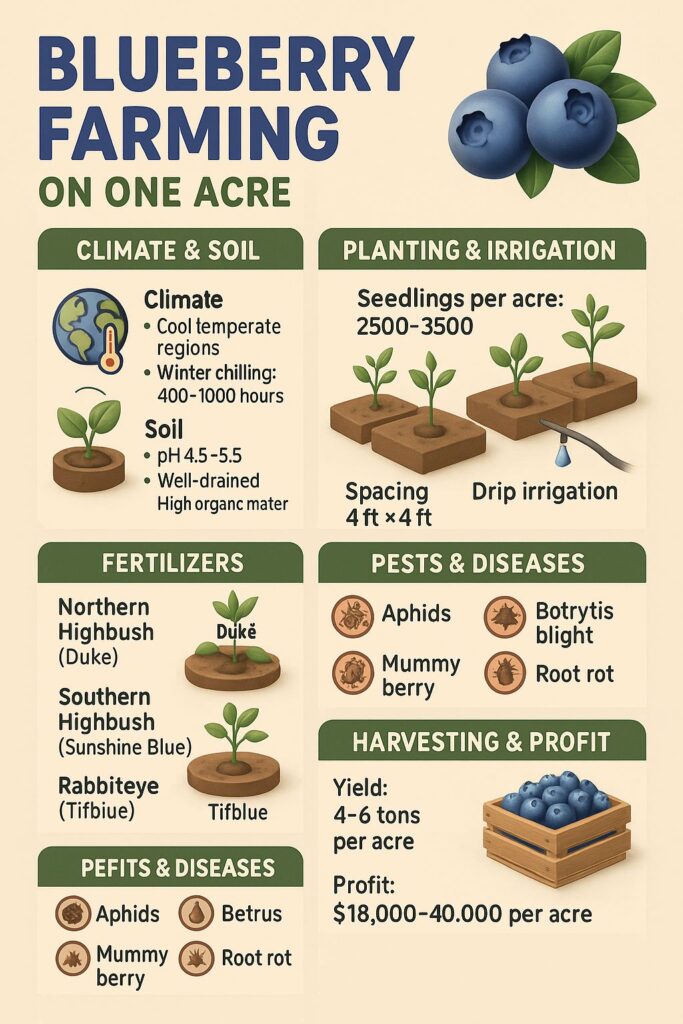
    pH = 4.5 to 5.5 only (Acidic)

    Normal soil pH = 6–8 hota hai → blueberry fail ho jata hai.

    Soil must be:

    Light sandy

    Organic-rich

    Moisture-retentive

    Well-drained

    High peat content

    Ideal Soil Mix for Blueberry Beds Per Acre

    40% Cocopeat

    30% Pine bark / sawdust

    20% Sand

    10% Compost

    Add Sulphur granules to lower pH

    Without this mix, blueberries do not grow.

    1. One-Acre Plantation Layout (Exact Professional Blueprint)

    Plant Spacing:

    4 ft × 4 ft

    OR 4 ft × 3 ft (high density)

    Plant Population in One Acre:

    Standard density → 2500 plants/acre

    High density → 3500 plants/acre

    Bed Preparation:

    Height: 18–24 inches

    Width: 3–4 ft

    Length: full row

    Mulch: pine bark, dry leaves

    Drip Irrigation Layout:

    2 lateral lines per bed

    4L/hr drippers

    Watering twice daily

    1. Blueberry Varieties (WORLDWIDE SELECTION GUIDE) Northern Highbush

    Best for cold climates
    Top varieties:

    Duke

    Bluecrop

    Chandler

    Southern Highbush

    Best for warmer regions
    Top varieties:

    Misty

    Star

    Sunshine Blue

    Legacy

    Rabbiteye Blueberries

    Best for hot climates
    Top varieties:

    Brightwell

    Tifblue

    Premier

    India Special Varieties:

    Biloxi

    Sharpblue

    Misty

    1. Exact Seedling Requirement & Nursery Guide

    One Acre Plantation Needs:

    2500–3500 tissue culture plants

    Preferably 1-year old

    Height: 6–12 inches

    Root system: must be fibrous, healthy

    Best Planting Time by Countries:

    RegionBest Planting TimeUSA/CanadaSpring (Feb–April)EuropeApril–MayIndia (Hills)Feb–MarchIndia (Plains Controlled)Anytime under polyhouseMiddle EastOctober–February

    1. One-Acre Blueberry Farming Investment Breakdown

    A) Land Preparation Cost

    Bed formation: $600

    pH adjustment chemicals: $200

    Soil mixture: $800

    B) Plant Cost

    2500 plants × $1–$2 = $2,500 – $5,000

    C) Drip Irrigation

    $350 – $450

    D) Mulching Material

    $300 – $500

    E) Fertilizers + Micro Nutrients

    $250 – $400 yearly

    F) Pest & Disease Control

    $120 – $200 yearly

    G) Labor Cost

    $300 – $500

    Total Investment (1st Year):

    $5,000 – $8,000 (₹4.1 – ₹6.8 lakh)

    From year 2, cost reduces massively.

    1. Irrigation Schedule (Exact Water Requirement)

    Blueberry roots are shallow → they need constant moisture.

    Season-wise irrigation need:

    SeasonWater RequirementSummer3–4 L per plant/dayWinter1.5–2 L per plant/dayRainyStop or reduce

    Best Techniques:

    Drip irrigation (mandatory)

    Moisture sensors

    Mulching for water retention

    1. Fertilizer Schedule (Month-by-Month FULL PROGRAM)

    Base Feeding (per plant per year)

    Vermicompost: 2 kg

    Peat moss: 500 g

    Sulphur: 30 g

    Bone meal: 100 g

    NPK Schedule (Year 1–2)

    March: NPK 12:10:10 – 40g

    April: NPK 19:19:19 – 20g

    June: NPK 0:52:34 – 30g

    August: NPK 13:00:45 – 30g

    Micro Sprays

    Boron

    Magnesium

    Zinc

    Calcium nitrate

    1. Pest & Disease Management (WORLD STANDARD)

    Common Pests:

    Aphids – Spray Neem oil 3% or Imidacloprid
    Thrips – Spinosad
    Mites – Abamectin
    Stem borer – Copper oxychloride paste

    Diseases:

    Root rot → Trichoderma
    Anthracnose → Copper fungicide
    Rust → Mancozeb
    Powdery mildew → Sulphur spray

    1. Flowering to Harvest Timeline (Exact PHASES)

    Year 1

    Vegetative growth

    No fruit

    Year 2

    Light flowering

    Harvest: 0.5–1 ton

    Year 3

    Good production

    2–3 ton

    Year 4 onwards

    Full production = 4–6 tons per acre

    1. Harvesting, Grading, Packing (Export Standard)

    Grading:

    Size 18 mm+ = Premium

    Size 14–18 mm = Standard

    Below 12 mm = Processing

    Packing

    125g clamshell

    250g premium box

    500g family pack

    Storage

    4°C for 14–21 days

    Controlled atmosphere: 30+ days

    1. Market Selling Guide (Complete World Map Strategy)

    A) Local Premium Markets

    Supermarkets

    Hotels

    Resorts

    Cafes

    Juice bars

    B) Online Selling (Direct Profit)

    Instagram store

    WhatsApp business

    Farm website

    Amazon (dehydrated)

    C) Export Markets (Highest Profit)

    Top countries buying blueberries:

    USA

    Canada

    Netherlands

    UK

    UAE

    Kuwait

    Singapore

    Japan

    Export price = $7–$14/kg

    1. Value Addition = 2X to 5X Profit

    You can create:

    Blueberry jam

    Dried blueberries

    Freeze-dried powder

    Blueberry juice

    Smoothie concentrate

    Blueberry wine (Europe/USA legal)

    1. Insurance & Loan (Worldwide Guide)

    India:

    PMFBY (Pradhan Mantri Fasal Bima Yojana)

    NABARD Horticulture Loan

    Agriculture Infrastructure Fund

    NHB Subsidy (up to 40%)

    USA:

    USDA Specialty Crop Insurance

    Europe:

    CAP Agriculture Fund

    UAE/Middle East:

    Hydroponic/greenhouse subsidies

    1. One-Acre Blueberry Profit Calculation

    Production:

    4–6 tons (4000–6000 kg)

    Average price:

    Local: $4–$6
    Export: $7–$14

    Total Revenue:

    $25,000 – $55,000 per acre
    (₹20 – ₹45 lakh)

    Net Profit:

    $18,000 – $40,000 per acre
    (₹14 – ₹32 lakh)

    1. Conclusion

    Blueberries are among the most profitable farming crops in the world.
    One-acre blueberry farming can transform youth into global agripreneurs with:

    High demand

    High market price

    Long-term income

    Export potential

    Anti-aging superfood industry

    Yeh crop future me gold mine ban sakta hai.

    1. FAQs

    Q1: Can blueberries grow in hot regions?
    Only in controlled conditions or with Rabbiteye varieties.

    Q2: How long do plants survive?
    20–25 years.

    Q3: Do blueberries need acidic soil?
    Yes — strong requirement.

    Q4: What is the best fertilizer?
    Acidic fertilizers + organic mix.

    Q5: Can beginners grow it?
    Yes, if soil pH maintained.

    Read A Next Post 👇

    https://farmingwriters.com/one-acre-stevia-farming-complete-profit-business-guide/

    ✍️Farming Writers

    Love Farming Love Farmers

  • One Acre Dragon Fruit Farming: High Profit & Export Business Guide

    Dragon Fruit Farming


    1. Introduction: Why Dragon Fruit Is the Best One-Acre Crop

    Dragon fruit is one of the world’s top high-value fruits.
    It grows in:

    India

    Vietnam

    Thailand

    Malaysia

    UAE

    South America

    Africa

    And sells at premium rates globally.

    Dragon fruit is:

    Low water crop
    Heat tolerant
    High yielding
    Grows for 20+ years
    100% export friendly

    1 acre = lifelong income if managed properly.

    2. Why Dragon Fruit Is Perfect for Youth

    Low maintenance

    Works even on poor soils

    Easy pruning

    One-time pole setup

    High profit (₹10–15 lakh per acre)

    Easy online selling

    Youth can easily convert this into a startup farming business.

    3. One-Acre Perfect Dragon Fruit Layout

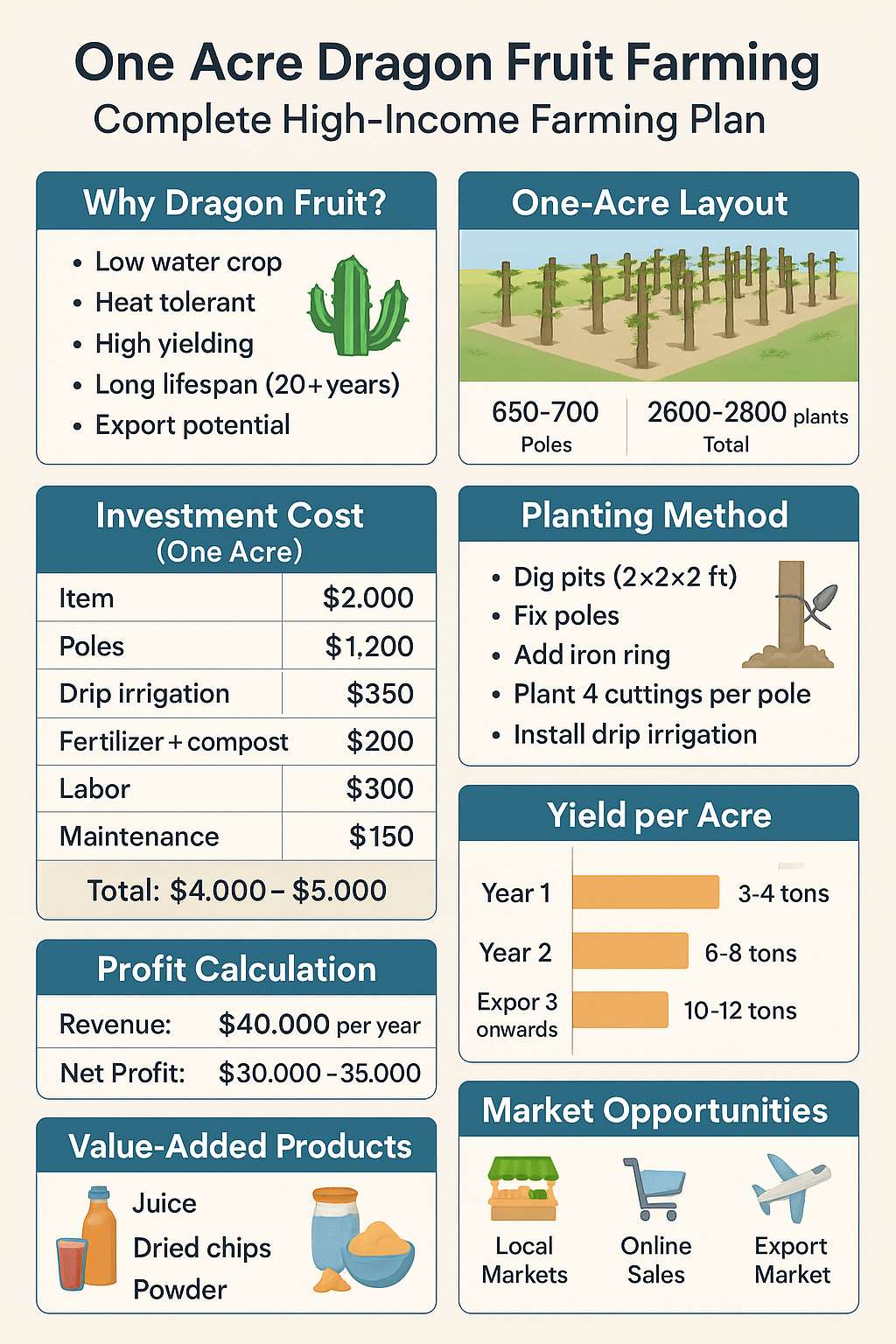
    Total poles needed: 650–700 poles
    Plants per pole: 4 cuttings

    Total plants: 2600–2800

    Spacing:

    Row: 10 ft

    Pole gap: 8 ft

    4. Climate & Soil Requirement

    Best climate:
    Hot & dry regions
    20–35°C temperature
    Full sunlight

    Soil:
    pH 6–7.5
    Well-drained

    Doesn’t need fertile soil — grows even in rocky areas.

    5. Investment Cost (One Acre)

    ItemCost (USD)Cost (INR)Poles (700)$2,000₹1,60,000Plants$1,200₹95,000Drip irrigation$350₹30,000Fertilizer + compost$200₹16,000Labor$300₹25,000Maintenance$150₹12,000

    Total Investment:

    $4,000 – $5,000
    ₹3.3 – 4.2 lakh

    One-time setup, income comes for 20 years.

    6. Planting Method

    Dig pits: 2×2×2 ft

    Add compost + sand + cow dung

    Fix cement poles (6–7 ft tall)

    Add iron ring on top

    Plant 4 cuttings per pole

    Install drip irrigation

    Mulch the area

    Growth starts within 20–25 days.

    7. Irrigation Schedule

    Summer: 20–25 minutes daily

    Winter: 10–15 minutes daily

    Rainy: Stop irrigation

    Dragon fruit hates overwatering.

    8. Manure & Fertilizer

    Apply every 45 days:

    Vermicompost

    NPK 10:10:10

    Neem cake

    Micro-nutrients

    Spray organic fungicide monthly.

    9. Flowering & Fruit Development

    First fruiting: 8–10 months

    Commercial yield: 18–20 months

    Full production: Year 2 onwards

    5–6 cycles per year

    10. Yield Calculation (1 Acre)

    Year 1:

    3–4 tons fruit

    Year 2:

    6–8 tons

    Year 3 onwards:

    10–12 tons

    11. Selling Price (Global Market)

    MarketPrice per kgIndia wholesale$2 – $3India retail$4 – $5UAE Export$6 – $7Europe$7 – $10

    12. Profit Calculation (One Acre)

    Production:

    10,000 kg (10 tons)

    Selling Price (avg): $4/kg

    Total Revenue:

    $40,000 per year
    = ₹32 lakh

    Net Profit (after expenses):

    ₹25–28 lakh per acre per year
    $30,000 – $35,000

    And income increases each year.

    13. Global Market Selling Strategy

    A. Local Market

    Fruit shops

    Hotels

    Supermarkets

    B. Online Market

    Use:

    Instagram

    Facebook

    WhatsApp

    ONDC

    Amazon (for dried dragon fruit)

    C. Export Market

    Top buyers:

    UAE

    Bahrain

    Qatar

    Singapore

    Malaysia

    Europe

    Start with:

    APEDA (India exporters)

    Farm-to-export companies

    Cold-chain logistics

    14. Value-Added Products

    You can convert unsold fruit into:

    Dragon fruit juice

    Dried chips

    Powder for smoothies

    Ice cream flavour

    Dragon fruit jam

    These earn 3× more profit.

    15. Risk Management

    Use drip irrigation

    Avoid overwatering

    Maintain pruning

    Add mulch

    Use biofencing

    Keep poles strong

    16. Conclusion

    Dragon fruit is one of the most profitable one-acre crops in the world.
    Low water + high price + long life + export demand = perfect business for youth.

    With proper market strategy, one acre can generate ₹25–30 lakh yearly, making it a global agribusiness model.

    17. FAQs

    1. Does dragon fruit need a lot of water?

    No, it is a drought-tolerant crop.

    2. Can beginners grow dragon fruit?

    Yes, it is one of the easiest fruit crops.

    3. How long does one plant survive?

    20+ years.

    4. Is export possible from one acre?

    Yes, even 4–5 tons can be exported.

    5. Is it profitable?

    Extremely — one of the highest-income crops.


    Read A Next Articals 👇

    https://farmingwriters.com/one-acre-farming-business-profit-guide/

    ✍️Farming Writers

    Love Farming Love Farmers

  • Wild Strawberry vs Garden Strawberry: Nature’s Sweet Deception Complete Comparison & Benefits

    Wild Strawberry vs Garden Strawberry

    Wild Strawberry, Garden Strawberry, Strawberry Comparison, Berry Nutrition, Foraging Tips, Gardening Tips, Health Benefits of Strawberries, Organic Farming, Antioxidants in Berries, Fruit Cultivation

    Introduction: Why People Confuse Them

    Strawberries are among the most beloved fruits worldwide, cherished for their sweet flavor, vibrant color, and aromatic fragrance. But did you know there are two main types of strawberries commonly talked about — wild strawberries and garden strawberries? While they may look similar at a glance, these two varieties are quite different in terms of origin, appearance, taste, nutrition, and cultivation.

    Many people confuse wild strawberries with garden strawberries because of their shared bright red color and juicy sweetness. However, wild strawberries are smaller, often more aromatic, and grow naturally in forests and meadows, whereas garden strawberries are larger, cultivated extensively on farms, and have a milder taste.

    This blog dives deep into the fascinating differences and similarities between wild and garden strawberries. Whether you’re a foodie, gardener, or health enthusiast, this guide will help you understand which strawberry suits your palate, your garden, or your health goals best.

    Botanical Classification

    Understanding the botanical classification helps clarify how wild and garden strawberries relate.

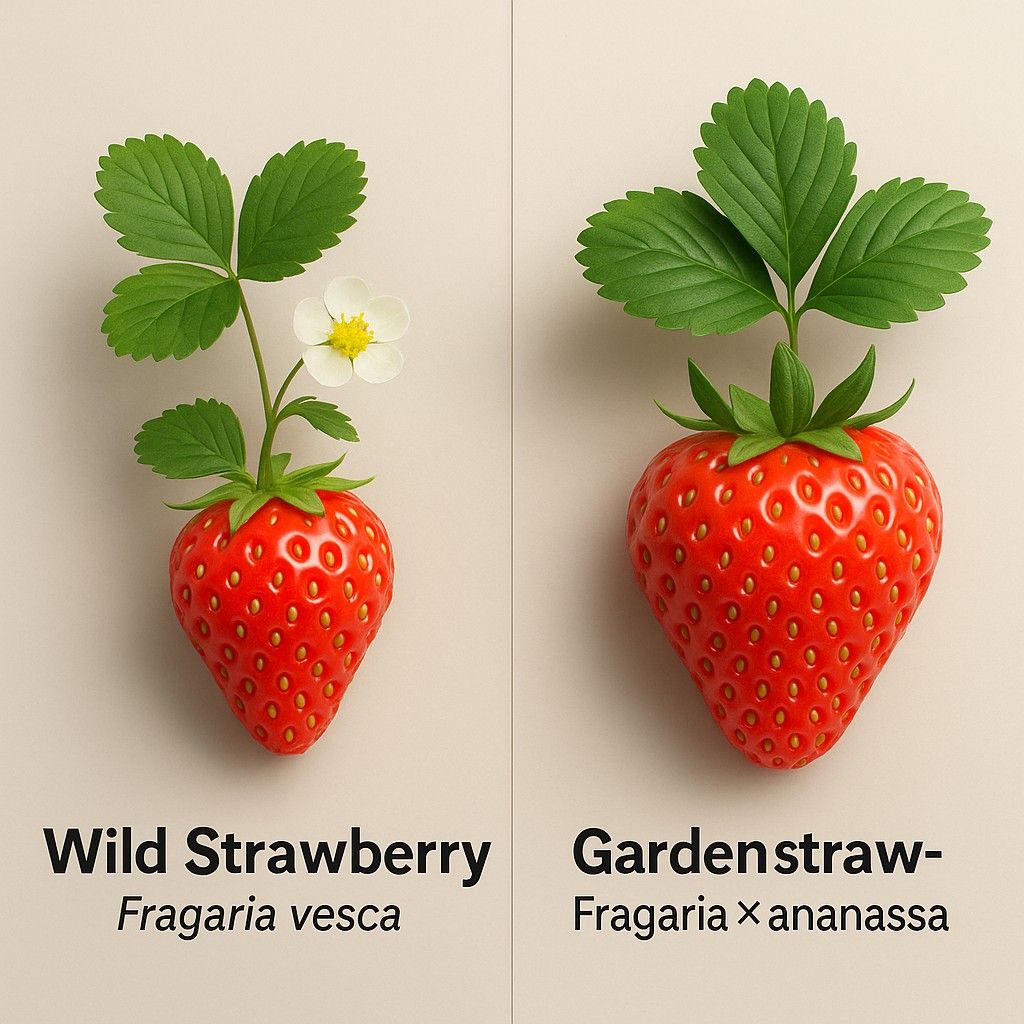
    Wild Strawberry: Scientifically known as Fragaria vesca, wild strawberries are native to Europe, Asia, and North America. They grow naturally in the wild, usually in forest floors, meadows, and undisturbed land. They are smaller and have a delicate appearance.

    Garden Strawberry: The garden strawberry (Fragaria × ananassa) is a hybrid species, developed in the 18th century by crossing North American and Chilean strawberry species. This variety is cultivated worldwide, selected for larger fruits, higher yields, and sweeter flavor.

    Origin & History

    Wild Strawberry

    Wild strawberries have been enjoyed by humans for thousands of years. They are native to temperate regions of Europe and Asia and were often foraged as a wild fruit. Their small size and intense flavor made them a prized find in forests and fields.

    Garden Strawberry

    The garden strawberry originated in the 18th century, when European horticulturists crossed Fragaria virginiana (native to North America) with Fragaria chiloensis (native to Chile). The hybrid combined hardiness and large fruit size, revolutionizing strawberry farming globally.

    Growth Habitat

    Wild Strawberry: Prefers shaded, cool environments such as forest floors, woodland edges, and meadows. They grow naturally without human intervention and thrive in nutrient-rich but undisturbed soils.

    Garden Strawberry: Grown in open fields, raised beds, and controlled environments like polyhouses and greenhouses. Farming involves irrigation, fertilization, pest control, and pruning to maximize yield and fruit quality.

    Plant Size & Shape

    Wild strawberry plants are small, low-growing, and have delicate stems. They spread through runners but generally cover less ground.

    Garden strawberry plants are larger, with sturdier, thicker stems and larger leaves. They are bred for vigorous growth and fruit production.

    Leaf Patterns & Color

    Wild strawberry leaves are small, light green with a slightly softer texture. The edges are less serrated compared to garden varieties.

    Garden strawberry leaves are broader, dark green, and have prominent serrated edges, making them easier to identify.

    Flower Differences

    Both produce white flowers, but wild strawberry flowers tend to be smaller and bloom earlier in the season. Garden strawberry flowers are larger, often producing bigger fruit.

    Fruit Size, Texture & Color

    Wild Strawberry: Small, deep red, and often more irregular in shape. The skin feels slightly rough, and seeds are prominent on the surface. The flavor is intense, tangy, and aromatic.

    Garden Strawberry: Larger, uniformly shaped, bright red with a smooth texture. Seeds are more recessed, and flavor tends to be sweeter and less tangy.

    Seed Pattern on Fruit Surface

    Wild strawberries have prominent, large seeds that stand out on the surface, contributing to the textured feel.

    Garden strawberries have smaller seeds that are more embedded in the flesh, giving the fruit a smoother appearance.

    Flavor Profile

    Wild strawberries have a rich, complex flavor with floral, tart, and sweet notes that are hard to match.

    Garden strawberries tend to be juicier and sweeter but milder in taste.

    Aroma Strength

    Wild strawberries have a strong, sweet aroma that is highly fragrant and noticeable even before tasting.

    Garden strawberries have a pleasant but comparatively milder scent.

    Use in Culinary Arts

    Wild strawberries are often used in gourmet dishes, artisanal jams, luxury desserts, and flavor infusions.

    Garden strawberries are popular in smoothies, ice creams, salads, pies, and everyday desserts.

    Nutrient Comparison Table (per 100g)

    Nutrient Wild Strawberry Garden Strawberry

    Calories 32 33
    Vitamin C 58 mg 59 mg
    Dietary Fiber 2.0 g 2.0 g
    Iron 0.4 mg 0.4 mg
    Antioxidants High (Ellagic Acid) Moderate

    Antioxidant Levels

    Wild strawberries contain higher amounts of ellagic acid and anthocyanins, powerful antioxidants that fight free radicals and support skin and heart health.

    Blood Sugar Impact (Glycemic Index)

    Both wild and garden strawberries have a low glycemic index (around 40), making them safe for diabetics when consumed in moderation.

    Anti-Inflammatory Properties

    Studies suggest wild strawberries exhibit stronger anti-inflammatory effects due to higher phenolic content, beneficial for reducing chronic inflammation.

    Wild Strawberry Leaves as Herbal Tea

    Wild strawberry leaves are traditionally used to make herbal teas believed to aid digestion, relieve inflammation, and support urinary tract health.

    Skin & Hair Health Benefits

    Strawberries’ antioxidant vitamins promote collagen production, protect skin from aging, and nourish hair follicles.

    Farming Methods

    Garden Strawberry: Grown commercially using drip irrigation, chemical fertilizers, and pesticides to boost yield and fruit quality.

    Wild Strawberry: Grows naturally without human interference, making it more sustainable but with lower yield.

    Soil & Climate Needs

    Both varieties prefer well-drained, loamy soil with moderate moisture and temperate climates but wild strawberries tolerate partial shade better.

    Yield per Plant / Acre

    Garden strawberry plants yield significantly more fruit per plant and acre compared to wild strawberries due to selective breeding.

    Cost of Cultivation

    Wild strawberry cultivation is minimal or non-existent as they grow naturally; garden strawberry farming requires investment in land, irrigation, and inputs.

    Organic vs Chemical Use

    Wild strawberries are naturally organic. Garden strawberries often rely on pesticides unless grown organically.

    Challenges in Wild Strawberry Cultivation

    Difficulty in large-scale cultivation due to smaller fruit size, low yield, and sensitivity to environmental conditions.

    Availability & Accessibility

    Garden strawberries dominate supermarkets globally. Wild strawberries are seasonal and mostly found in forests or specialty markets.

    Price in Market (Per Kg Comparison)

    Wild strawberries typically command higher prices due to rarity and intensive harvesting.

    Export & Import Demand

    Garden strawberries have robust global demand and export markets; wild strawberries have niche demand.

    Shelf Life & Transportation

    Garden strawberries have a longer shelf life when handled properly. Wild strawberries are more delicate and perish quickly.

    Environmental Impact

    Garden strawberry farming involves pesticide use, which can harm ecosystems. Wild strawberries support biodiversity and natural habitats.

    Sustainability of Foraging Practices

    Sustainable foraging of wild strawberries is crucial to prevent depletion of natural populations.

    Cultural, Mythological & Historical Importance

    Used in ancient European folk medicine and Ayurveda for healing properties.

    Symbolically linked to Venus and love myths, seen as an aphrodisiac.

    Medieval medicine used wild strawberries for treating digestive ailments.

    Practical Guide & Public Questions

    Which is healthier? Wild strawberries edge ahead due to higher antioxidants.

    Better for farming? Garden strawberries due to higher yield and ease of cultivation.

    Can you grow wild strawberries at home? Yes, but requires shaded, natural conditions.

    Can diabetics eat both? Yes, in moderation, both are low GI fruits.

    FAQs: Cover questions on storage, recipes, harvesting, and health benefits.

    Final Verdict

    Wild and garden strawberries each have their unique charm. Wild strawberries offer intense flavor and superior nutrition but limited availability. Garden strawberries are accessible, sweeter, and farm-friendly. Choose based on your taste preference, health goals, or farming capabilities.

    Conclusion: Nature’s Rare Gift vs Man’s Cultivated Sweetness

    Both wild and garden strawberries remind us of nature’s generosity—one rare and untamed, the other cultivated and widely cherished. Together, they enrich our plates, gardens, and traditions.

    ✍️Farming Writers Team

    Love farming Love Farmers
    Read A Next Post 👇

    https://farmingwriters.com/sweet-basil-vs-holy-basil-tulsi/

  • Wild Blueberries vs Bilberries vs Blueberries: What’s the Real Difference?

    wild blueberry vs bilberry, difference

    wild blueberry vs bilberry, difference between bilberry and blueberry, European blueberry vs American blueberry, bilberry health benefits, wild blueberries in Scandinavia, bilberry vs blueberry taste.                                                                                                     you’ve ever wandered through the forests of Scandinavia and picked deep-blue berries from low bushes, you probably called them “wild blueberries.” But did you know those are actually bilberries? And while they look like American blueberries, they are not the same!

    Let’s clear the confusion once and for all.

    1. Where Do They Come From?

    Bilberries (Vaccinium myrtillus):
    Native to Europe and Scandinavia, found growing wild in forests across Sweden, Norway, Finland, and other parts of Northern and Central Europe.

    Blueberries (Vaccinium corymbosum / Vaccinium angustifolium):
    Native to North America, cultivated widely in the USA, Canada, and now also in Australia and South America.

    Wild Blueberries:
    In the USA and Canada, “wild blueberries” usually refer to Vaccinium angustifolium, a low-bush variety growing in places like Maine and Nova Scotia.

    In Europe, people often call bilberries “wild blueberries,” which causes all the confusion.

    2. What’s the Difference in Taste and Appearance?

    Feature Bilberries Blueberries

    Size Small Larger
    Color (Outside) Dark blue Light blue
    Color (Inside) Dark purple throughout Pale green or white inside
    Taste Sharp, intense, slightly tangy Mild, sweet, less intense
    Juice Stains fingers and mouth purple Minimal staining

    Many people — especially from Europe — say bilberries taste better due to their stronger flavor and natural tanginess.

    3. Nutritional and Health Benefits

    Both berries are superfoods, but bilberries pack more punch per gram:

    Richer in anthocyanins (antioxidants)

    May support eye health, reduce inflammation, and improve circulation

    Traditionally used in European herbal medicine

    Blueberries are also very healthy, often linked to brain health, heart protection, and anti-aging properties, but bilberries generally contain higher antioxidant levels.

    4. How They Grow

    Bilberries:
    Grow individually or in small groups on low shrubs in the wild. They are not commonly cultivated commercially due to how delicate and slow-growing they are.

    Blueberries:
    Grow in clusters on larger bushes. Easy to cultivate, machine-harvestable, and available fresh in most supermarkets.

    5. Foraging Tradition in Scandinavia

    In countries like Sweden, Finland, and Norway, berry-picking in summer is a cultural tradition. People go out into the forest, fill baskets with bilberries, and make:

    Pies (Mustikkapiirakka in Finland)

    Jams and syrups

    Fresh juices

    Frozen snacks

    Herbal teas

    This practice has continued for thousands of years, and bilberries have fed generations of Scandinavians. So when a Swede says “blueberry,” they almost always mean bilberry!

    🇺🇸 6. Living in the US: The Surprise

    Many Europeans, when they move to the USA (like the writer of this post who moved to Texas!), are surprised to find that the “blueberries” they buy here are:

    Bigger, sweeter

    Less flavorful

    Not purple inside

    It’s because they are American cultivated blueberries, not the wild, tangy bilberries of Europe.

    7. So What Should You Call Them?

    Region Local Name Actual Berry

    Scandinavia Blueberry / Wild Blueberry Bilberry
    USA Blueberry Cultivated Blueberry
    USA (Some regions) Wild Blueberry Lowbush Blueberry (Vaccinium angustifolium)

    To be botanically correct:

    European “wild blueberry” = bilberry

    American “wild blueberry” = lowbush blueberry

    Supermarket blueberry = highbush blueberry

    But honestly? Call it whatever you want — just know what you’re eating

    Final Thoughts: Two Different Berries, Both Delicious!

    Whether you’re picking bilberries in the Nordic forests or snacking on blueberries in a Texas summer, both berries are delicious, nutritious, and part of beautiful traditions.

    But yes — they are not the same.

    Bilberries are the wild kings of Europe — dark, juicy, powerful.
    Blueberries are the gentle giants of North America — sweet, big, and friendly.

    Now that you know the difference, you’ll never be confused again — and you can help others understand too!

    Quick Summary

    Bilberries = European wild berry, darker and stronger in taste.

    Blueberries = North American cultivated berry, sweeter and milder.

    Same family, different berries.

    Both are nutritional powerhouses.

    ✍️Farming Writers

    Love farming Love farmers

    Read A Next Post 👇

    https://farmingwriters.com/wild-strawberry-vs-garden-strawberry/