Most people who enter goat farming do it because they saw someone on YouTube claiming that goats reproduce fast and need very little feed. This belief alone is the biggest reason thousands of small farmers lose money each year. A goat farm rarely fails due to disease or feed scarcity; it fails because the farmer misunderstood what the buyer values and how the market punishes one wrong step.
Goat farming looks simple from the outside. But the moment animals reach sale age, farmers discover that goats are not sold on weight alone they are sold on body condition, breed reputation, age accuracy, and how well the animal was raised. A goat that gained weight fast on high-grain diets may look impressive but often gets rejected by professional buyers who know the difference between natural growth and artificial fattening. The beginner doesn’t realize this until the truck arrives and offers half the expected price.
Another common mistake is assuming that goats thrive anywhere. They survive, yes, but survival has nothing to do with profitability. Goats raised under poor ventilation, wet floors, or inconsistent feed may stay alive but grow slowly, reproduce irregularly, and attract diseases at the exact time you hoped to sell them. Many farmers blame bad luck when the real issue is that goats only look low-maintenance; they are extremely sensitive to micro-changes in hygiene and space.
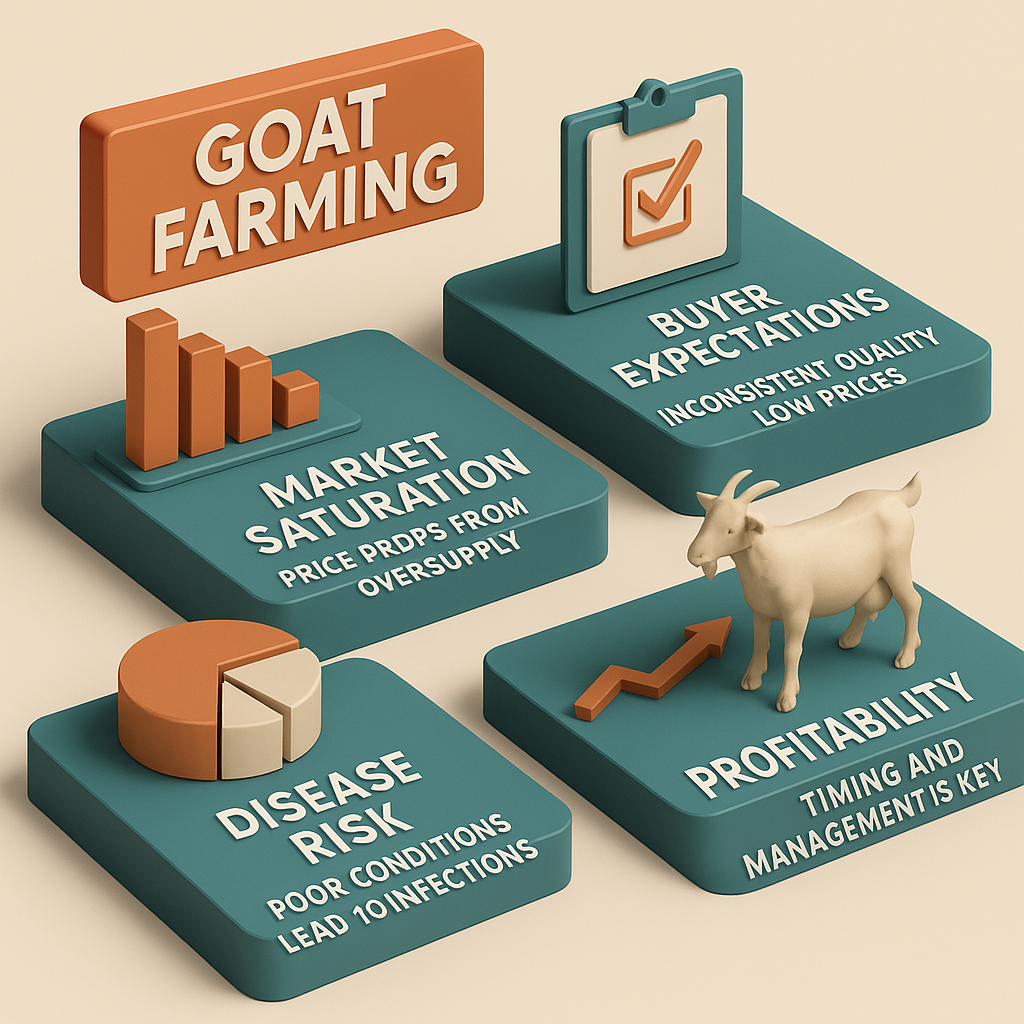
There is also a hidden challenge that few people talk about: community market saturation. In many regions, too many farmers enter goat farming at the same time. They all plan to sell during festival seasons expecting premium rates. But markets hate predictable supply peaks. Prices crash when trucks arrive full. A farmer who waited a full year suddenly discovers that a neighbor selling “just to empty shed space” reduces everyone’s price. Market timing, not production, decides most goat-farm profits.
A reality most beginners ignore is that goats do not gain weight uniformly. Even in the best-managed farms, twenty to thirty percent of goats remain slow growers. These animals consume nearly the same feed but produce much lower returns. Without culling discipline, a farm silently loses money. Successful goat farmers operate like managers, not caretakers they remove low performers early instead of sentimental keeping.
The environment where goats are raised impacts their sale quality more than genetics. A buyer can instantly recognize goats raised in cramped, dark sheds because these animals develop weak legs and poor rumen function. Even if the weight looks acceptable, buyers refuse to pay premium. This is why open paddock systems and browsing areas outperform full stall-fed systems in long-term sustainability, even though stall-feeding looks easier in the beginning.
Disease risks are another area where new farmers underestimate loss. Most goat farms do not collapse from big epidemics; they collapse from repeated small infections that never get managed properly — diarrhea in kids, pneumonia during weather shifts, parasitic load during monsoon, or foot rot in humid flooring. These are not dramatic events, but they slowly drain profit. A goat that survives disease rarely achieves market weight on time. Delay means feeding more days, and feeding more days erases the profit margin.
One of the hardest realities is understanding that goat breeding is not automatically profitable. Breeding mistakes cause long-term financial damage. If the male used for breeding is even slightly inferior, the entire next generation reflects that weakness. Farmers then assume they have poor luck or weak feed, when the problem started a year earlier with the wrong buck. Professional goat farms treat buck selection as seriously as dairy farms treat bull genetics.
Another overlooked fact is buyer psychology. Buyers want goats that look alert, walk confidently, have clean eyes, shiny coats, firm rumen fill, and correct conformation. Farmers often focus only on weight because weight is easy to measure. But buyers evaluate freshness, energy, bone development, frame length, and uniformity. A single weak goat in a group reduces the perceived value of the entire batch.
Feed economics also destroy many small farms. A common assumption is that goats eat leaves, grass, and kitchen waste, so feed cost is low. But for commercial growth, goats need a predictable diet with fiber balance and mineral mix. If the farmer can’t maintain consistency, goats start losing rumen efficiency. Recovery takes weeks, not days. These weeks often coincide with the planned sale period, causing further delay.
The most misunderstood concept in goat farming is scale. A farm of five to ten goats will almost always lose money unless feed is free and land is abundant. Profit begins only when numbers cross a certain threshold because fixed costs — shed, water, medical care, buck maintenance — spread out across more animals. Many farmers think starting small is safer, but in goat farming, starting too small can guarantee loss.
The market for goat meat is strong worldwide Africa, Asia, Middle East, Europe’s ethnic markets, and diaspora communities in the US and UK maintain steady demand. But price per kilogram fluctuates constantly. Farmers who depend entirely on local brokers rarely understand why prices shift. Brokers do not always explain that price drops are caused by disease outbreaks, festival timing changes, long-distance supply arrivals, or sudden oversupply from neighboring districts.
Another major reason farms fail is the assumption that goats reproduce twice a year. While possible under ideal management, most farms experience longer intervals. Nutrition, stress, buck-to-doe ratio, and seasonality affect breeding cycles. Beginners plan unrealistic cash flow expectations, leading to disappointment when reproduction does not match online claims.
The farms that succeed long-term follow three principles: harsh selection, strict hygiene, and market-driven selling. They avoid emotional attachment to animals, monitor health indicators daily, and sell when prices peak instead of waiting for the “perfect” weight. Their profit does not come from having goats; it comes from understanding timing, genetics and operational discipline.
FAQ
Farmers often ask whether goat farming is profitable, and profitability depends entirely on market timing and disease control rather than herd size alone. Many want to know why buyers offer low prices, and the main reason is inconsistent body condition, not weight. A frequent doubt concerns reproduction expectations, and goats rarely reproduce as quickly as online claims unless nutrition and stress conditions are ideal. People ask if stall-feeding is sufficient, and it only works when mineral balance and fiber quality are maintained consistently. Another concern is disease resistance, but goats raised in damp or dark sheds remain highly vulnerable regardless of breed. Farmers ask about breed superiority, and no breed performs well in poor management conditions. A common fear is sudden mortality, which usually results from delayed detection of small infections. Beginners ask about starting with a very small herd, but tiny herds rarely cover fixed costs. Many want to know when to sell, and selling early at stable prices often outperforms waiting for maximum weight. Another repeated question is whether goats can be fed household waste, but inconsistent diets damage rumen function and delay growth.
✍️Farming Writers Team
Love farming Love Farmers
Read A Next Post 👇
Leave a ReplyShare your thoughts: We’d love to hear your farming ideas or experiences!