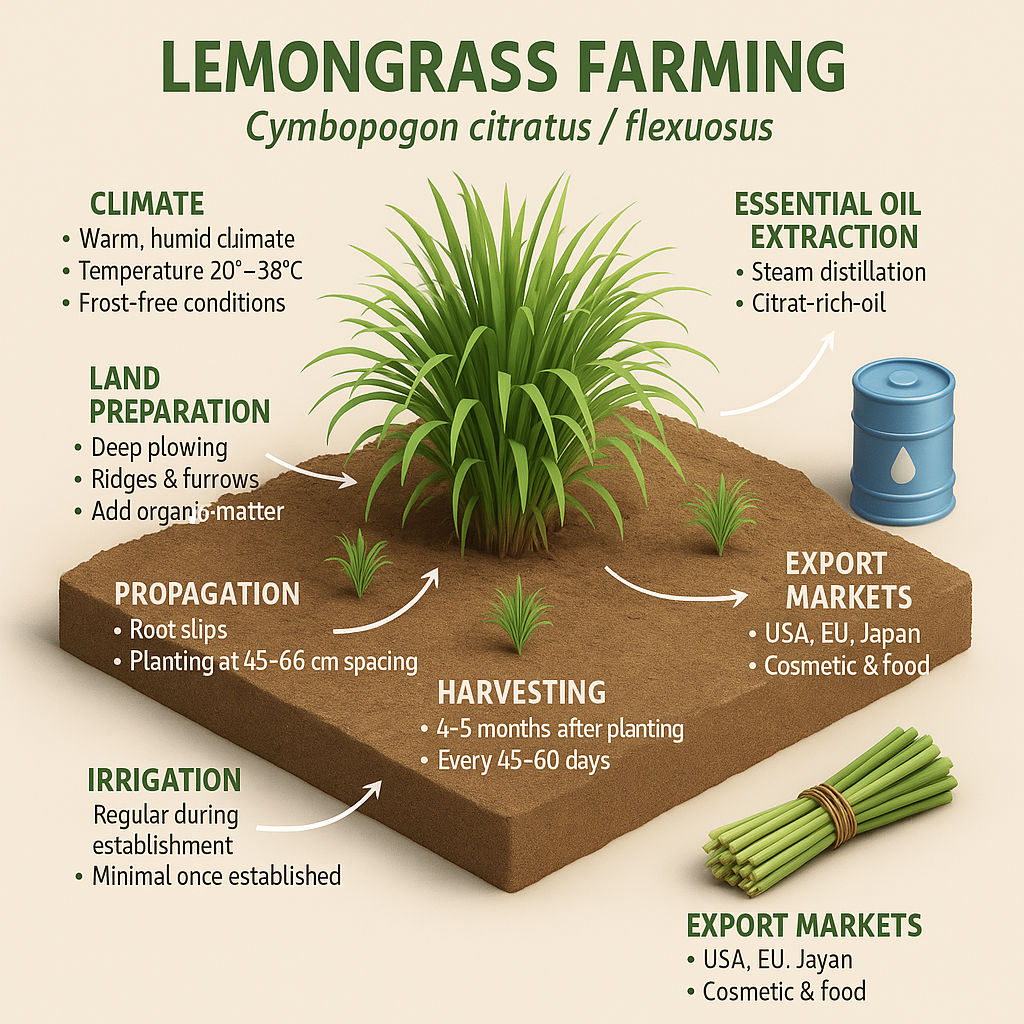
Lemongrass, known for its refreshing citrus aroma and powerful medicinal properties, has become one of the most demanded herbs in the world. Whether in essential oils, perfumes, soaps, skincare formulas, mosquito repellents, herbal teas, aromatherapy, spas or food industries, lemongrass has secured a permanent place. Even in modern pharmaceutical and nutraceutical industries, the plant has gained a firm position due to its anti-inflammatory, antibacterial, digestive and calming benefits. The driving force behind this global expansion is its aromatic compounds — primarily citral, geraniol, limonene and various aldehydes — which create a unique, high-value essential oil.
Lemongrass belongs to the genus Cymbopogon. Two main commercial species dominate global production: Cymbopogon citratus and Cymbopogon flexuosus. Both species are hardy grasses that thrive across tropical and subtropical regions. They grow as dense clumps, reaching heights of one to one and a half meters, producing long, slender leaves rich in essential oils. Lemongrass’s ability to tolerate drought, heat, heavy rainfall, poor soils and multiple harvest cycles makes it one of the easiest and most profitable essential oil crops worldwide.
The climate for lemongrass farming must provide an abundance of sunlight. The plant depends heavily on long hours of direct light for building essential oils in the leaves. Warm temperatures ranging between twenty and thirty-eight degrees Celsius create ideal conditions. Frost damages lemongrass instantly, making it unsuitable for cold climates unless grown in controlled environments. Regions with moderate humidity and seasonal rains support rapid vegetative growth. Lemongrass responds positively to monsoon cycles, producing lush green biomass during rainy seasons and concentrating essential oils during warmer dry periods.
Soil characteristics for lemongrass cultivation reflect the plant’s natural resilience. The grass thrives in almost any soil except waterlogged clay. Loamy, sandy loam and well-drained red soils are particularly suitable. Organic content in the soil enhances leaf biomass and aroma. Slightly acidic to neutral pH between five point five and seven point five ensures optimal nutrient absorption. Heavy clay soils must be avoided because stagnant water reduces root health and drastically decreases oil concentration. Proper drainage is essential for quality and yield.
Land preparation for lemongrass farming begins with deep plowing to remove compaction and open root pathways. Fields are leveled and shaped into raised beds or ridges where water stagnation is possible. Weeds must be cleared thoroughly because lemongrass seedlings require an initial weed-free environment. Organic manure such as compost or farmyard manure is mixed into the soil before planting to enrich microbial life and build humus content. Unlike delicate medicinal plants, lemongrass adapts easily once established, but early soil preparation defines long-term performance.
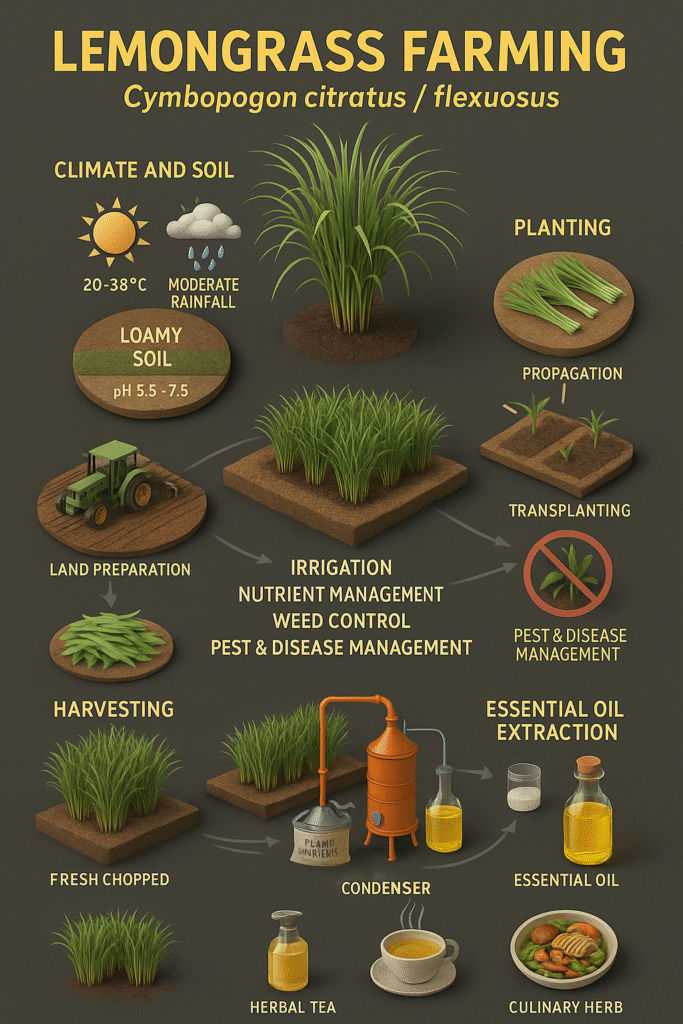
Propagation in lemongrass farming is primarily done through root slips. A mature clump is divided into smaller segments, each containing a few shoots with roots. These slips are planted directly into the field. Seed propagation is extremely rare because it produces inconsistent oil quality and slow establishment. Farmers prefer vegetative propagation for better uniformity, higher oil yield and rapid field coverage.
Transplanting of lemongrass typically occurs at the onset of monsoon or early irrigation season. Adequate soil moisture helps young slips root quickly. Farmers maintain spacing of forty-five to sixty centimeters between plants to allow proper canopy expansion. Close spacing increases biomass yield but may reduce oil concentration. Wider spacing enhances oil-rich leaf development. Optimal spacing depends on farm objectives — biomass, oil yield or leaf production for tea markets.
Irrigation plays a crucial role during the first two months of establishment. Once roots spread deeply, lemongrass becomes drought-resistant. Regular irrigation during dry seasons supports continuous leaf production. However, over-irrigation must be avoided because excess moisture reduces essential oil content. In harsh summer seasons, drip irrigation maintains ideal moisture balance and prevents water stress. Lemongrass thrives most when soil remains slightly moist but aerated.
Nutrient management for lemongrass focuses on organic inputs that gradually release nutrients. Compost, decomposed farmyard manure, neem cake and vermicompost enrich soil fertility. Nitrogen enhances leaf growth, but excessive nitrogen produces watery leaves with lower oil content. Balanced inputs ensure strong vegetative growth and high citral concentration. Micronutrients such as zinc and magnesium influence oil quality and can be supplied through organic foliar sprays. Synthetic fertilizers are used sparingly in organic-certified farms because buyers prefer chemical-free oils.
Weed control is important during the early growth stages. After two months, lemongrass forms dense clumps that naturally suppress most weeds. Manual weeding or shallow hoeing maintains field hygiene. Chemical herbicides are avoided, especially in essential oil production destined for food or cosmetic industries.
Pest and disease management in lemongrass farming is relatively simple. The plant contains natural insect-repellent compounds. This is why lemongrass acts as a natural mosquito repellent crop. However, in some regions, fungal diseases such as leaf blight may occur during excessive rains. Proper spacing, controlled irrigation and good airflow prevent most issues. Organic treatments such as neem-based sprays protect plant foliage without affecting oil quality.
As lemongrass matures, long aromatic leaves accumulate essential oils. The plant reaches its first harvest stage within four to five months of planting, depending on climate. Farmers cut the leaves ten to fifteen centimeters above the ground to protect the root zone and allow regrowth. The second harvest occurs forty-five to sixty days after the first. Under proper management, lemongrass provides six to eight harvests per year. With each cutting, the plant becomes bushier and more productive.
Harvest timing significantly influences oil quality. Leaves harvested during warm sunny days contain higher citral concentration. Early morning or late afternoon harvesting ensures freshness and reduces leaf dehydration. Leaves are transported immediately for distillation because oil content declines if biomass sits for long periods.
Processing lemongrass for essential oil involves steam distillation. Fresh leaves are chopped and placed into distillation chambers where steam passes through them, carrying aromatic compounds. The vapor condenses into a mix of oil and water, which is separated in collection units. High-quality lemongrass oil has a strong lemon-like fragrance dominated by citral. Its purity depends on distillation technique, harvest stage and leaf quality.
Beyond oil, lemongrass leaves are dried and used for herbal teas, flavoring agents and medicinal blends. Powdered lemongrass is used in skincare formulations, digestive supplements and culinary preparations. Fresh lemongrass stems are sold for culinary use, especially in Southeast Asian cuisines.
The global market for lemongrass is expanding rapidly due to increasing demand for natural products. Essential oil remains the most profitable form. The United States, Europe, Japan, South Korea, UAE and Australia import large quantities of lemongrass oil for cosmetics, aromatherapy, spa treatments and organic repellents. Citral-rich oils fetch premium prices. Bulk prices range between ten and thirty USD per kilogram depending on purity and origin. Lemongrass dried leaf sells between two and six USD per kilogram in international tea markets.
Economically, lemongrass farming offers excellent long-term profitability. Low input costs, high harvest frequency, strong global demand and multiple product forms create stable income. Farmers who cultivate lemongrass for essential oil earn significantly higher returns due to value addition. The crop adapts well to degraded or unused lands and requires minimal maintenance after establishment.
Sustainability remains one of lemongrass’s strongest advantages. The crop improves soil structure, prevents erosion and supports ecological farming. Its natural pest-repellent properties reduce chemical pesticide use. Lemongrass integrates well with agroforestry, fruit orchards and permaculture systems. Mixed cropping with turmeric, ginger or medicinal herbs increases overall farm resilience.
In conclusion, lemongrass farming is one of the most profitable, adaptable and globally demanded herbal crops. Its essential oil has created an international market that continues to grow. The crop requires minimal care, offers frequent harvests and fits well into organic farming systems. Farmers who understand lemongrass’s ecological needs, irrigation balance, soil structure and correct harvesting techniques can produce world-class oil and biomass suitable for global markets.
FAQ FOR LEMONGRASS FARMING
Farmers often ask how long lemongrass takes to mature, and the crop reaches its first harvest in four to five months. Another question concerns water, and lemongrass requires regular moisture early but becomes drought-tolerant later. Soil suitability remains a common query, and lemongrass grows best in well-drained loamy soils. Many growers wonder about oil yield, and high citral concentration depends on sunlight, timing and age of leaves. Profitability remains a major topic, and lemongrass provides strong returns due to multiple harvests and global market demand. Disease concerns usually relate to humidity-driven blight, but proper spacing and organic care prevent most issues.
✍️Farming Writers Team
Love farming Love farmers


Leave a ReplyShare your thoughts: We’d love to hear your farming ideas or experiences!