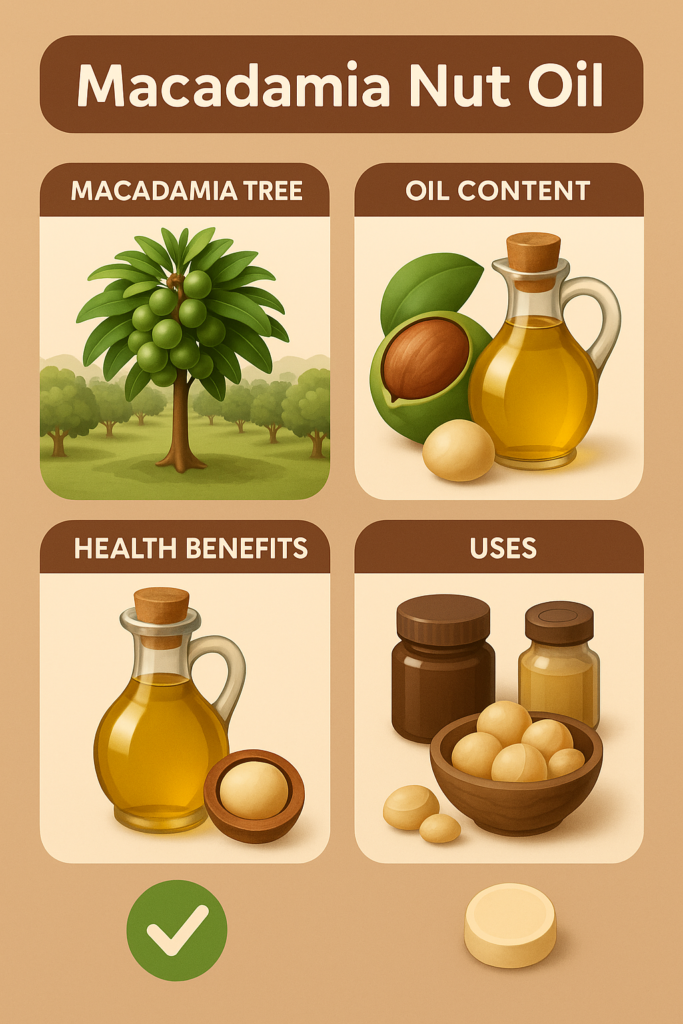
Macadamia oil does not come from fields that stretch endlessly across flat land. It comes from trees. Slow-growing, patient trees that demand time rather than speed, stability rather than exploitation. This difference alone places macadamia oil in a category separate from most edible and medicinal oils discussed in modern agriculture. Where annual oil crops follow seasonal urgency, macadamia follows a generational rhythm. Farmers who plant macadamia trees do so knowing that real rewards arrive after years, not months, and that the quality of the oil reflects the maturity of both the tree and the ecosystem surrounding it.
The macadamia tree originates from the subtropical forests of eastern Australia. Long before global markets discovered the nut, Aboriginal communities interacted with these trees in ways that were practical, respectful, and careful. The nuts were harvested when naturally fallen, cracked using stone tools, and consumed as a dense source of fat and energy. There was no concept of oil extraction in the modern sense, yet the lipid richness of the nut was already understood. What modern science later identified as monounsaturated fat dominance was, for indigenous communities, simply nourishment that sustained strength over time.
When European settlers encountered macadamia trees, they initially viewed them as botanical curiosities. It took decades before agricultural thinkers realized that the oil locked inside those extremely hard shells had exceptional properties. The tree itself demanded stable rainfall, deep soils, and protection from extreme frost. It was not forgiving. Early plantations failed repeatedly because farmers attempted to treat macadamia like an ordinary orchard crop. Only later did a clearer understanding emerge: macadamia is not aggressive; it is selective. If conditions align, it thrives. If they do not, it simply survives without yielding much at all.
This selectivity shaped its global spread. Macadamia production expanded slowly into Hawaii, South Africa, Kenya, parts of China, and Central America. Each region had to develop its own understanding of the tree’s behavior. In Kenya, macadamia trees integrated well into smallholder agroforestry systems, growing alongside coffee and bananas. In South Africa, they became part of managed orchards with irrigation control. In Hawaii, volcanic soils and steady humidity created conditions remarkably similar to eastern Australia, leading to high-quality nut yields.
Oil extraction from macadamia nuts introduced a new dimension to its value. Unlike many nut oils that carry strong flavors or oxidize quickly, macadamia oil emerged as remarkably stable. Chemically, it is dominated by oleic acid and palmitoleic acid, fats also present in human skin lipids. This unusual alignment between plant oil and human biology gave macadamia oil exceptional compatibility for both dietary and cosmetic use.
In culinary contexts, macadamia oil behaves with restraint. It does not overpower food. It supports rather than announces itself. Chefs appreciate its high smoke point and clean mouthfeel, which allows it to be used for sautéing, slow roasting, and dressings without introducing bitterness. In regions where olive oil defines taste traditions, macadamia oil quietly entered kitchens as a neutral yet refined alternative, especially in cuisines that required heat stability.
Cosmetic industries noticed something else entirely. Macadamia oil absorbs into skin quickly, leaving no heavy residue. It mimics natural sebum more closely than most plant oils, making it valuable in products designed for aging skin, dryness, and barrier repair. In Australia and later in Europe and East Asia, macadamia oil became a core ingredient in creams, hair treatments, massage oils, and therapeutic formulations. Unlike many exotic oils, it did not trigger widespread allergic reactions, adding to its appeal.
From an ecological perspective, macadamia trees represent long-term agricultural thinking. Their deep root systems stabilize soil. Their canopy moderates microclimates beneath them. When integrated into diversified farming systems, they reduce erosion and improve long-term land resilience. However, the tree’s slow maturation also limits rapid expansion. A macadamia orchard reaches full productivity only after seven to ten years. This fundamentally changes how profit is measured. It is not a seasonal gain. It is a long investment, similar to olive or date palms.
The oil yield reflects this slow build. Mature trees produce nuts with high oil content, often exceeding seventy percent lipid concentration. Once pressed, the oil requires minimal refining to achieve food-grade quality. Cold pressing preserves both nutritional value and aromatic subtlety. Refined versions exist, but premium markets consistently demand cold-pressed oil due to its natural antioxidant profile and shelf stability.
Global demand for macadamia oil continues to rise, driven by health-conscious consumers and cosmetic brands seeking clean, plant-based ingredients. Yet supply remains limited by biology and land suitability. This imbalance keeps prices relatively high compared to mainstream oils. Farmers who successfully establish macadamia orchards often discover that market volatility affects them less than annual crop producers because demand stays concentrated in premium segments.
Health research continues to explore macadamia oil’s role in metabolic balance. Its fatty acid profile supports cardiovascular health, cholesterol regulation, and anti-inflammatory responses. Unlike some seed oils high in polyunsaturated fats, macadamia oil resists oxidation during cooking, making it suitable for consistent use.
Challenges remain. Climate instability threatens flowering cycles. Extended droughts reduce nut set. Excessive rainfall disrupts pollination. Farmers increasingly rely on precise irrigation management and regional climate knowledge. Those who treat macadamia as a living system rather than a mechanical output adapt more successfully.
Macadamia oil’s future is not in mass replacement of cheaper oils. It lies in specialization. It represents an agricultural philosophy that values patience, quality, ecological fit, and long-term soil health over rapid extraction. In a world that increasingly questions the sustainability of fast agriculture, macadamia stands quietly as an alternative model.
Its oil carries the signature of that philosophy. Smooth, stable, understated, enduring.
This is why macadamia nut oil remains a tree-based oil of consequence, not only for nutrition and commerce, but for how it reflects a slower, more deliberate relationship between people, plants, and land.
✍️Farming Writers Team
Love Farming Love Farmers
Read A Next Post 👇
https://farmingwriters.com/black-seed-oil-nigella-sativa-global-study/


Leave a ReplyShare your thoughts: We’d love to hear your farming ideas or experiences!