• Cocopeat Nutrient Fertilizer & Feeding System for Global Farming Complete Guide

    Cocopeat Nutrient

    Cocopeat farming fails not because cocopeat is a poor medium, but because nutrient management is misunderstood or underestimated. Unlike soil, cocopeat does not supply nutrients on its own. It acts as a controlled root-support system, entirely dependent on what the grower provides.

    In soil farming, nutrient errors are partially buffered by soil reserves. In cocopeat farming, every nutritional mistake appears directly and quickly in plant growth. This makes nutrient management in cocopeat both a challenge and an opportunity: mistakes are costly, but correct management delivers exceptional yield consistency.

    This post explains complete nutrient science and practical application for cocopeat growers worldwide.

    Understanding Cocopeat as a Nutrient Medium

    Cocopeat is:

    Structurally supportive

    Chemically semi-inert

    Nutrient-poor by nature

    Key nutritional reality:

    Almost zero nitrogen and phosphorus

    Naturally high potassium

    Requires continuous external feeding

    Thus, cocopeat farming is essentially a fertigation-driven production system.

    Difference Between Soil Nutrition and Cocopeat Nutrition

    Soil-Based Feeding

    Nutrients stored in soil particles

    Slow release

    High margin for error

    Cocopeat-Based Feeding

    Nutrients dissolved in irrigation water

    Immediate root availability

    Low margin for error

    This difference explains why fertilizer formulas designed for soil often fail in cocopeat systems.

    The Role of Fertigation in Cocopeat

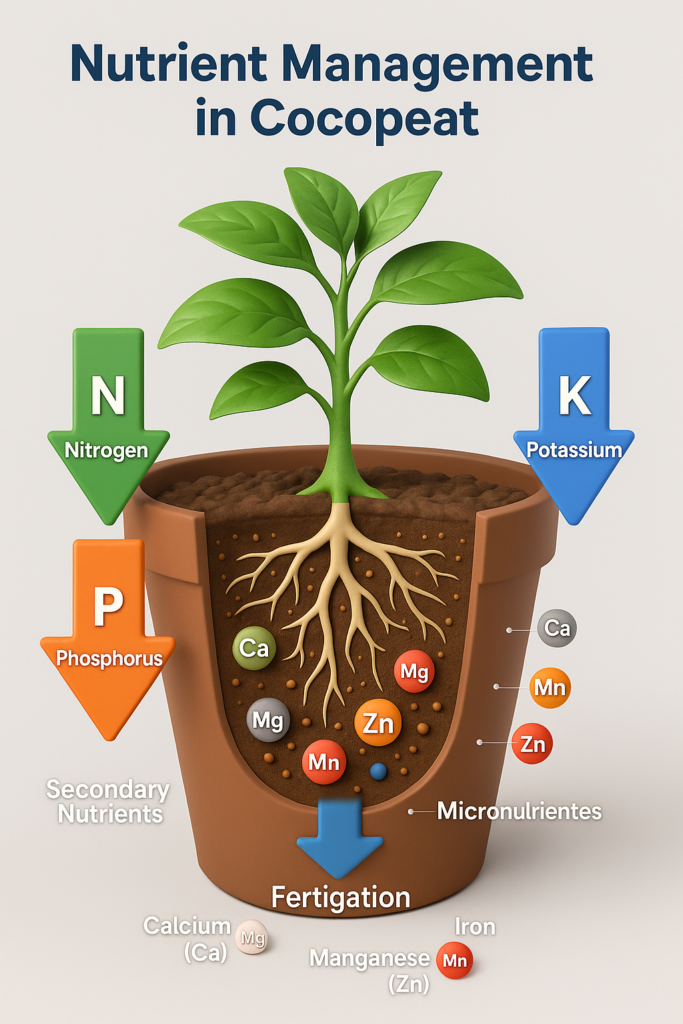
    Fertigation is the process of delivering nutrients through irrigation water. In cocopeat farming:

    All nutrients are supplied via fertigation

    Uniform distribution is essential

    EC and pH must be monitored constantly

    A stable fertigation program determines plant health, yield, and quality.

    Essential Macronutrients in Cocopeat

    Nitrogen (N)

    Function:

    Leaf growth

    Chlorophyll production

    Management:

    Supplied continuously in small doses

    Excess causes soft growth and disease sensitivity

    Phosphorus (P)

    Function:

    Root development

    Flower initiation

    Management:

    Moderate supply required

    Overuse blocks micronutrients

    Potassium (K)

    Function:

    Fruit quality

    Water regulation

    Special note:

    Cocopeat already contains potassium

    External potassium must be carefully balanced

    Secondary Nutrients: Calcium and Magnesium

    Calcium (Ca)

    Role:

    Cell wall strength

    Root tip growth

    In cocopeat:

    Most critical nutrient

    Deficiency common if buffering or supply is inadequate

    Magnesium (Mg)

    Role:

    Chlorophyll center

    Energy transfer

    Importance:

    Often suppressed by excess potassium

    Balanced Ca:Mg ratio is essential for long-term success.

    Micronutrients in Cocopeat

    Although required in small amounts, micronutrients control crop performance.

    Key micronutrients:

    Iron

    Manganese

    Zinc

    Copper

    Boron

    Molybdenum

    In cocopeat systems:

    Deficiencies appear faster

    Overdosing causes toxicity quickly

    Chelated forms are recommended for stability.

    Ideal pH and EC for Nutrient Uptake

    pH Range

    Optimal: 5.8 – 6.5

    Effects:

    Low pH locks calcium and magnesium

    High pH blocks iron and zinc

    EC Range

    Varies by crop and stage:

    Seedling stage: Low EC

    Vegetative growth: Moderate EC

    Fruiting stage: Higher EC

    Regular monitoring is mandatory.

    Designing a Cocopeat Fertigation Schedule

    Seedling Stage

    Low EC

    Balanced nutrients

    Focus on root establishment

    Vegetative Stage

    Higher nitrogen supply

    Stable calcium availability

    Strong leaf development

    Flowering and Fruiting Stage

    Reduced nitrogen

    Increased potassium

    Stable calcium for fruit quality

    Crop stage-specific feeding is non-negotiable.

    Common Nutrient Deficiencies in Cocopeat

    Calcium Deficiency

    Symptoms:

    Leaf tip burn

    Blossom-end rot

    Causes:

    Skipping buffering

    High potassium

    Magnesium Deficiency

    Symptoms:

    Yellowing between leaf veins

    Cause:

    Excess calcium or potassium

    Iron Deficiency

    Symptoms:

    Yellow new leaves

    Cause:

    High pH or poor chelation

    Understanding symptom patterns prevents panic reactions.

    Correcting Nutrient Problems

    Principles:

    Identify cause before applying fertilizer

    Correct pH before adding nutrients

    Reduce EC if stress symptoms appear

    Blind fertilizer application worsens problems in cocopeat.

    Organic Nutrient Management in Cocopeat

    Possible but challenging:

    Requires controlled liquid organic nutrients

    Solid organic matter should be minimal

    Microbial balance must be monitored

    Organic cocopeat systems demand advanced management.

    Reusing Cocopeat and Nutrient Considerations

    When reusing:

    Residual salts accumulate

    Nutrient profile shifts

    EC must be reset

    Reused cocopeat requires revised nutrient strategy.

    Economic Impact of Proper Nutrient Management

    Correct nutrient management:

    Maximizes fertilizer efficiency

    Reduces waste

    Improves uniformity

    Increases market-grade yield

    Poor management:

    Creates unseen losses

    Reduces crop lifespan

    Nutrition is the largest controllable cost in cocopeat farming.

    Global Best Practices

    Professional growers:

    Monitor EC and pH daily

    Use crop-stage-specific formulations

    Maintain detailed fertigation records

    Consistency, not complexity, defines success.

    Frequently Asked Questions

    Is general NPK enough for cocopeat?

    No. Balanced macro and micro nutrients are required.

    Can soil fertilizers be used?

    Only if fully soluble and correctly balanced.

    How often should nutrients be applied?

    With every irrigation in controlled systems.

    Is nutrient burn possible?

    Yes. Cocopeat systems react immediately to excess.

    Does buffered cocopeat eliminate calcium need?

    No. Buffering reduces loss, not supply requirement.

    Final Conclusion

    Nutrient management in cocopeat farming is not guesswork or shortcut-based agriculture. It is a precision-driven feeding system where success depends on understanding how nutrients interact with water, roots, and cocopeat chemistry.

    Growers who master nutrient management unlock:

    Higher yield

    Better quality

    Greater predictability

    Long-term system sustainability

    This post completes the nutritional foundation of cocopeat farming and prepares the ground for crop-specific and advanced system-level guides.

    ✍️Farming Writers Team
    Love farming Love Farmers.

    Read A Next Post 👇

    https://farmingwriters.com/cocopeat-block-preparation-step-by-step-guide/

  • Cocopeat Block Preparation Guide: Step-by-Step Scientific & Practical Method for Farmers

    Cocopeat Block Preparation

    Introduction

    Cocopeat blocks are widely used across the world, yet incorrect preparation is the single biggest reason for crop failure in cocopeat-based farming systems. Many growers believe that simply soaking a cocopeat block in water is enough. In reality, improper preparation leads to high salinity, nutrient lock-up, calcium deficiency, weak roots, and poor yield.

    This guide explains the correct, professional, and globally accepted method of cocopeat block preparation — from raw compressed block to crop-ready growing media. Every step in this post is written to eliminate guesswork and create a stable, repeatable, and reliable root environment.

    What Is a Cocopeat Block?

    A cocopeat block is compressed coconut coir pith dried and compacted to reduce volume for transport. When hydrated, a standard 5 kg block expands to approximately 60–70 liters of loose cocopeat.

    Characteristics of cocopeat blocks:

    Extremely compressed structure

    Very low moisture content

    Variable salt levels (depending on source)

    Not crop-ready without preparation

    Understanding this is important because compressed cocopeat behaves very differently from ready-to-use cocopeat.

    Why Proper Preparation Is Critical

    Improperly prepared cocopeat causes:

    Excess sodium and potassium in root zone

    Calcium and magnesium deficiency

    Osmotic stress on roots

    Reduced nutrient uptake

    Slow growth and yield loss

    Proper preparation ensures:

    Stable EC and pH

    Balanced cation exchange

    Maximum root oxygenation

    Efficient fertigation response

    In professional farming, cocopeat preparation is treated as root-zone engineering, not just soaking media.

    Step 1: Selecting the Right Cocopeat Block

    Before preparation begins, block quality must be verified.

    Quality Indicators Before Use

    Uniform brown color (not blackish or muddy)

    Minimal dust content

    No sour or chemical smell

    Firm compression without cracks

    Blocks sourced from coastal regions usually contain higher salts and require extra washing.

    Step 2: Initial Expansion (Hydration Stage)

    The first soaking expands the block and activates internal pore structure.

    Method

    Place block in a clean container or on raised platform

    Add clean, low-EC water gradually

    Allow expansion without pressure

    Key Points

    Never break dry block manually

    Use only clean water (EC below 0.5 mS/cm)

    Allow full expansion before mixing

    This step only opens structure; it does not make cocopeat usable yet.

    Step 3: Salt Removal (Washing Stage)

    This is the most skipped yet most important step.

    Why Washing Is Required

    Raw cocopeat naturally contains:

    Sodium salts

    Potassium

    Chlorides

    These salts increase EC and restrict root water uptake.

    Washing Process

    Saturate expanded cocopeat fully

    Allow drainage to flush soluble salts

    Repeat washing until runoff EC drops significantly

    Professional operations measure runoff EC after every wash.

    Step 4: Understanding EC and pH at This Stage

    After washing:

    EC should drop below 1.2 mS/cm

    pH usually stabilizes between 5.5–6.5

    If EC remains high:

    Additional washing cycles are mandatory

    Do not proceed to buffering

    Skipping EC correction leads to long-term stress in crops.

    Step 5: Buffering – The Most Critical Step

    What Is Buffering?

    Buffering is a controlled chemical conditioning process where calcium and magnesium ions replace excess sodium and potassium bound to cocopeat fibers.

    Unbuffered cocopeat strongly binds calcium added later through fertilizer, causing deficiency symptoms even with correct nutrient application.

    Buffering Materials

    Calcium nitrate

    Calcium chloride (professional use)

    Magnesium salts (in balanced ratio)

    Buffering Method

    Prepare calcium solution in clean water

    Saturate washed cocopeat thoroughly

    Maintain contact time of 8–24 hours

    Drain and rinse lightly afterward

    Buffering is a one-time correction process that stabilizes cocopeat for its entire usable life.

    Step 6: Final Conditioning

    After buffering:

    EC should be between 0.5–0.8 mS/cm

    pH between 5.8–6.5

    Texture should be fluffy, not compact

    At this point, cocopeat becomes:

    Nutrient-responsive

    Root-friendly

    Suitable for precision farming

    Step 7: Mixing for Crop-Specific Use

    Cocopeat is rarely used alone in commercial farming.

    Common Mixing Options

    Cocopeat + perlite for oxygen-demanding crops

    Cocopeat + vermicompost for organic systems

    Cocopeat + sand for heavy root anchoring

    Mixing improves physical structure without compromising moisture control.

    Step 8: Pre-Plant Fertigation

    Before planting:

    Apply mild nutrient solution

    Stabilize root environment

    Activate microbial balance if using biological inputs

    This prevents early-stage shock after transplanting.

    Ready-to-Use Cocopeat Characteristics

    Prepared cocopeat should:

    Drain excess water easily

    Retain moisture without sogginess

    Smell neutral and fresh

    Respond immediately to fertigation

    Only then is it considered crop-ready media.

    Common Mistakes in Cocopeat Preparation

    Using unwashed cocopeat

    Skipping buffering

    Over-saturating without drainage

    Mixing fertilizers directly in raw cocopeat

    Reusing without sanitation

    Each mistake compounds over time and reduces yield consistency.

    Reusing Prepared Cocopeat

    Cocopeat can be reused safely if:

    Old roots are removed

    Media is disinfected

    EC and pH are corrected

    Structure remains intact

    Reusing without correction causes salt accumulation.

    Economic Impact of Proper Preparation

    Correct preparation:

    Reduces fertilizer waste

    Prevents crop loss

    Improves uniform growth

    Extends media life

    Improper preparation often costs more than buying quality media.

    Environmental Considerations

    Properly prepared cocopeat:

    Reduces nutrient runoff

    Minimizes water usage

    Supports sustainable cropping cycles

    Efficiency at root zone equals sustainability at system level.

    Frequently Asked Questions

    Is soaking alone enough?

    No. Washing and buffering are essential.

    Can beginners skip buffering?

    No. Buffering is necessary at all scales.

    How long does preparation take?

    Typically 24–48 hours depending on quality.

    Can ready-to-use blocks skip these steps?

    Only certified pre-buffered cocopeat can skip buffering.

    Is buffered cocopeat reusable?

    Yes, for multiple cycles with monitoring.

    Final Conclusion

    Preparing cocopeat blocks correctly is not an optional step but a foundation practice in modern soilless farming. Cocopeat rewards growers who treat it scientifically and punishes shortcuts silently through reduced yield, nutrient imbalance, and inconsistency.

    Once prepared correctly, cocopeat becomes one of the most predictable, controllable, and sustainable growing media available globally.

    This post forms the practical backbone of all future cocopeat crop-specific guides.

    ✍️Farming Writers Team
    Love farming Love Farmers.

    Read A Next Post 👇

    https://farmingwriters.com/cocopeat-complete-scientific-practical-farming-guide/

  • Cocopeat Farming Guide: Complete Scientific & Practical Explanation for Global Growers

    Cocopeat Farming

    Introduction

    Agriculture across the world is entering a phase where precision, sustainability, and resource efficiency are more important than tradition alone. One of the most significant shifts in modern farming has been the movement away from exclusive dependence on natural soil toward engineered growing media. Among all alternatives tested globally, cocopeat, derived from coconut husk, has emerged as one of the most reliable, scalable, and environmentally responsible solutions.

    Cocopeat is no longer limited to home gardening or small nurseries. It is now widely used in commercial greenhouse operations, terrace farming systems, plant nurseries, vertical farms, and high-value vegetable and flower production units across Asia, Europe, the Middle East, and parts of North America.

    This post is written for farmers, agri-entrepreneurs, researchers, and serious growers who want a clear, complete, and practical understanding of cocopeat from the ground level to advanced farming applications.

    What Is Cocopeat?

    Cocopeat, scientifically referred to as coconut coir pith, is the fine particulate material obtained as a byproduct during the extraction of coconut fibers from coconut husks. Unlike peat moss, which comes from slow-growing wetlands, cocopeat is derived from a renewable agricultural residue, making it environmentally sustainable.

    It is composed mainly of:

    Lignocellulosic fibers

    Micro-porous organic particles

    Stable carbon-rich compounds

    Cocopeat does not decompose quickly, retains moisture exceptionally well, and provides high oxygen availability to plant roots when managed correctly.

    Raw Material Source and Global Production

    Coconut Husk as a Resource

    Coconut-growing regions produce millions of tons of husk annually. Major cocopeat-producing countries include:

    India

    Sri Lanka

    Indonesia

    Philippines

    Vietnam

    In these regions, coconut husk was traditionally considered agricultural waste. Modern processing transformed it into a globally traded growing medium.

    Manufacturing Overview

    Cocopeat production involves:

    Husk collection and aging

    Crushing and fiber separation

    Repeated washing to remove excess salts

    Drying under controlled conditions

    Screening by particle size

    Compression or slab formation

    Each step affects final quality, water retention, EC stability, and structural performance.

    Physical Properties of Cocopeat

    Water Holding Capacity

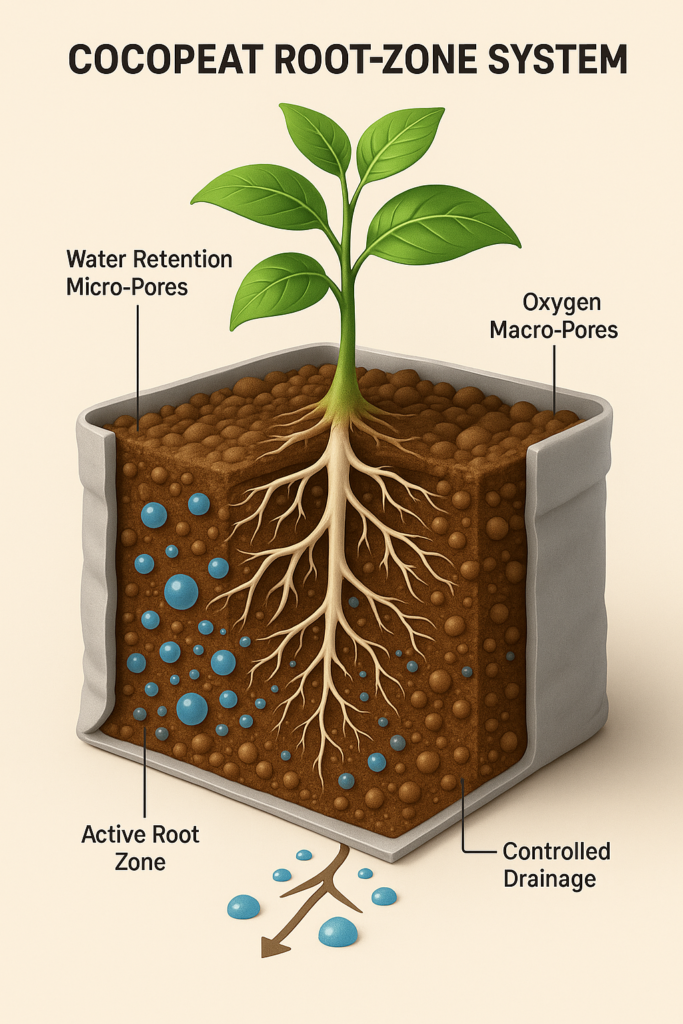
    Cocopeat can retain five to eight times its own weight in water, allowing consistent moisture supply to crops.

    Porosity and Aeration

    Its internal structure consists of macro- and micro-pores that:

    Hold water in micro-pores

    Maintain oxygen in macro-pores

    This balance supports healthy root respiration and reduces anaerobic stress.

    Bulk Density

    Cocopeat is lightweight, reducing structural load on terraces, greenhouses, and vertical systems.

    Chemical Properties of Cocopeat

    pH Range

    Typically ranges between 5.5 and 6.8, ideal for most horticultural crops.

    Electrical Conductivity (EC)

    High-quality cocopeat maintains EC below 0.6 mS/cm after proper washing and buffering.

    Cation Exchange Capacity

    Cocopeat has moderate cation exchange capacity, allowing it to:

    Hold potassium naturally

    Bind calcium and magnesium when buffered correctly

    Without buffering, calcium and magnesium imbalance can occur.

    Biological Characteristics

    Cocopeat is:

    Free from soil-borne pathogens when properly processed

    Resistant to fungal buildup compared to organic soils

    Biologically stable with slow microbial breakdown

    This stability ensures consistent root environment across cropping cycles.

    Why Cocopeat Is Preferred Over Soil in Modern Systems

    Traditional soil farming faces challenges such as inconsistent texture, compaction, pathogen load, and nutrient variability. Cocopeat addresses these issues by offering:

    Uniform structure

    Predictable root-zone conditions

    Easy nutrient management

    Compatibility with fertigation

    For high-value crops, cocopeat allows farmers to control growth variables with precision.

    Applications of Cocopeat in Farming

    Nursery and Seed Germination

    Cocopeat ensures:

    High germination rate

    Uniform seedling growth

    Easy transplanting with minimal root damage

    Greenhouse and Polyhouse Cultivation

    Widely used in grow bags and slabs for:

    Tomatoes

    Peppers

    Cucumbers

    Lettuce

    Strawberries

    Terrace and Urban Farming

    Lightweight nature prevents structural stress and enables:

    Container farming

    Rooftop gardens

    Modular grow systems

    Hydroponic and Soilless Systems

    Cocopeat acts as an inert support medium, allowing precise nutrient solution control.

    Crop Suitability

    Cocopeat is suitable for:

    Leafy vegetables

    Fruit vegetables

    Herbs

    Flowers

    Nursery plants

    It is not recommended for cereal crops or large-scale field farming without modification.

    Nutrient Reality of Cocopeat

    One of the most misunderstood aspects is nutrients.

    Cocopeat:

    Contains negligible nitrogen and phosphorus

    Naturally high in potassium

    Requires external nutrient supplementation

    Successful cocopeat farming depends on:

    Balanced nutrient solution

    Proper fertigation schedule

    Monitoring pH and EC

    Without nutrients, plants will survive briefly but fail to produce economically.

    Cocopeat Buffering Explained

    Unbuffered cocopeat binds calcium and magnesium aggressively, causing deficiency symptoms. Buffering involves:

    Treating cocopeat with calcium nitrate or calcium chloride

    Replacing excess sodium and potassium

    Stabilizing root-zone chemistry

    Buffered cocopeat ensures long-term nutrient availability.

    Cocopeat Reuse and Lifecycle

    Cocopeat can be reused for two to three crop cycles when:

    Old roots are removed

    Media is washed and disinfected

    EC and pH are corrected

    Proper reuse lowers production cost significantly.

    Environmental and Sustainability Impact

    Compared to peat moss:

    Cocopeat is renewable

    Saves wetland ecosystems

    Utilizes agricultural waste

    Its carbon footprint is lower when sourced responsibly.

    Limitations and Risk Management

    Despite benefits, cocopeat has limitations:

    Requires technical understanding

    Poor quality products cause salinity problems

    Nutrient dependency increases management responsibility

    Professional results demand discipline and consistency.

    Economic Perspective

    Cocopeat farming:

    Reduces water use by up to 60 percent

    Improves yield uniformity

    Enables off-season production

    Supports premium-quality produce

    Initial setup is higher but returns justify investment in controlled systems.

    Future of Cocopeat in Global Agriculture

    With rising urbanization and land pressure, cocopeat supports:

    Vertical farming

    Climate-resilient agriculture

    Export-quality horticulture

    It is becoming a global standard growing medium, not a temporary trend.

    Frequently Asked Questions

    Is cocopeat a complete soil replacement?

    It replaces soil structurally but requires nutrient solutions.

    Can cocopeat be mixed with soil?

    Yes, for improved aeration and moisture control.

    How long does cocopeat last?

    Two to three cropping cycles with proper handling.

    Is cocopeat organic?

    It is natural but requires nutrient inputs for farming.

    Does cocopeat attract pests?

    No, when properly processed and maintained.

    Final Conclusion

    Cocopeat is not a shortcut or miracle solution. It is a scientific growing medium that rewards growers who understand its behavior. When managed correctly, it allows farmers to move from guesswork-based agriculture to precision-driven, sustainable production.

    This foundation post sets the technical and conceptual base for all future cocopeat-focused articles. Every next post will expand on one practical dimension, building a complete global knowledge system for modern farming.

    ✍️Farming Writers Team
    Love farming Love Farmers.