There are certain oil-bearing plants whose significance cannot be measured simply by the volume of oil they produce or the revenue they generate. Some belong to a different category altogether, where their history, their ecological resilience, and their relationship with human communities across continents form a narrative much deeper than economics. Moringa is one such plant. It is not a crop that suddenly appeared with modern agriculture, nor one that depends on intensive industrial farming to justify its value. Instead, Moringa grows alongside human civilization in regions of scarcity, drought and extreme climatic swings, yet continues providing an oil that stands among the most stable and most chemically impressive natural oils known today.
When researchers study Moringa as a botanical system, they find contradictions that make it fascinating. It grows on poor soils but produces seeds rich in complex lipids; it withstands heat but delivers an oil extremely sensitive to cold-pressed purity; it is grown by some of the world’s poorest rural communities yet has a market that thrives in the most premium cosmetic sectors. These contrasts make Moringa oil a subject not only of agricultural analysis but of ecological and anthropological study.
In regions where modern edible oils dominate the market, Moringa oil has remained comparatively quiet, almost hidden in plain sight. But when you trace its migration routes — from the dry zones of India and Africa to Caribbean islands, Southeast Asia, and parts of Latin America — you begin to notice a pattern: wherever water is scarce, wherever soils degrade easily, wherever communities depend on multi-purpose plants for survival, Moringa becomes a natural choice. Not for its glamour, but for its practicality.
To understand Moringa oil deeply, one must step far beyond extraction units and profit tables. One has to begin with the environment in which this tree evolves.
The Landscape That Shapes Moringa
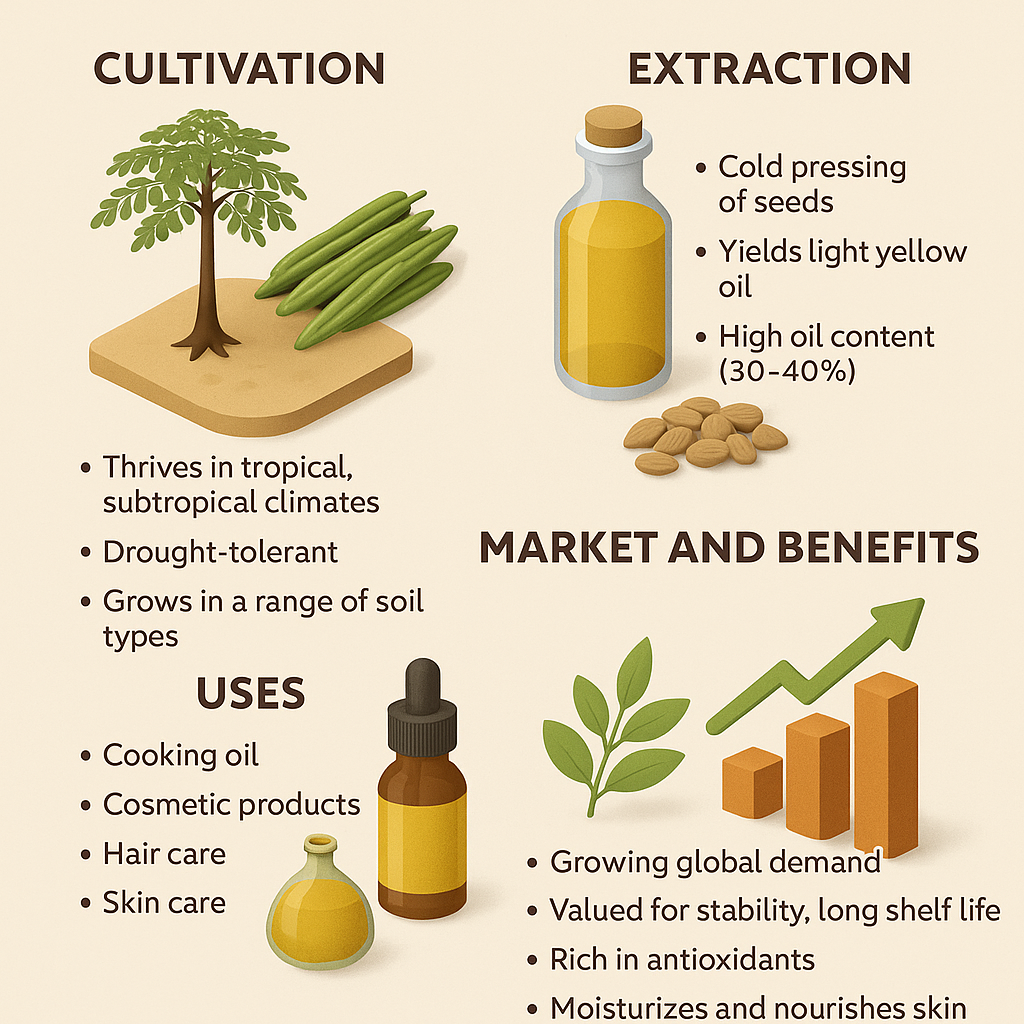
The Moringa tree flourishes in geographies that many other crops abandon. This alone tells you something about its internal architecture as a biological system. In semi-arid belts of East Africa, where long dry stretches erase vegetation and force farmers to rely on little more than native shrubs, Moringa rises as a dependable perennial. In the drier interiors of India — Rajasthan, Marathwada, Rayalaseema — it survives seasons that kill annual oil crops like sesame and groundnut. Its deep taproot system explores soil layers most crops never reach. This unique root behavior gives Moringa something rare: long-term stability in landscapes undergoing climatic unpredictability.
Because of this resilience, the seed pods mature even in rainfall-deficit years. Agricultural anthropologists frequently mention how Moringa’s oil potential was recognized not through aggressive commercial cultivation but through survival agriculture. Small communities relied on it the way desert cultures depend on date palms — a quiet companion that becomes most valuable when everything else fails.
Unlike sunflower or oilseed rape, Moringa is not grown in uniform monocultures. Instead, it appears as scattered trees in field boundaries, farm edges, home gardens and community lands. This scattered distribution has shaped the diversity of its seed genetics. In places like Ethiopia and Kenya, old seed lines carry biochemical signatures that differ significantly from Indian types. These genetic variations change the oil composition subtly, contributing to the distinct aroma and viscosity that different regions produce.
Understanding these ecological patterns is essential before discussing extraction, because the chemical character of Moringa oil begins long before the seed enters a processing unit. It begins with the stress of the environment — the heat, the soil minerals, the water scarcity — all of which influence lipid accumulation.
The Seed and Its Extraordinary Oil
A fully mature Moringa seed contains a pale kernel with a lipid profile that surprises even experienced chemists. It is unusually high in monounsaturated fats, particularly oleic acid. This immediately places it in the company of olive oil — but contrary to olive oil, Moringa seed oil maintains its structure even under warmer storage conditions. This stability is one reason ancient cultures used it for lamp oil, medicinal preparations, body moisturizers and perfumes.
The oil is extracted from the round, winged seeds that come enclosed within elongated pods. Each pod carries anywhere between 10 and 20 seeds depending on the variety. Seeds harvested from dry zones tend to have a denser kernel and slightly higher oil yield. Researchers suspect this is due to natural osmotic adjustments in the seed during development.
The extraction process changes depending on whether the oil is destined for edible purposes or cosmetic formulations. Cold pressing is the method valued for its purity. Industrial expellers increase yield but sometimes compromise the very attributes that give Moringa oil its premium identity — the clarity, the faintly nutty aroma, and the light, almost weightless texture.
Unlike certain tropical oils that solidify under lower temperatures, Moringa oil remains liquid and clear even when refrigerated. This extremely low cloud point is rare among natural oils. In practical terms, it means Moringa oil remains usable across varied climates without the need for stabilizing additives.
A Cultural Oil with Global Footprints
In many Indian villages, Moringa oil was historically used not for cooking but for wound healing, massage rituals, hair nourishment, and Ayurvedic formulations. In parts of Tamil Nadu and Karnataka, old households still keep small bottles of home-pressed Moringa oil for treating dryness, cracked heels, or skin infections. African communities use it similarly. Ethiopian herbalists apply Moringa oil in preparations meant for cracked skin caused by desert winds. In North Africa, it occasionally appears in ancient cosmetic recipes.
These scattered cultural uses show a recurring theme: Moringa oil was rarely a “mass-market” edible oil. Instead, it occupied a niche, medicinal space rooted in traditional knowledge. Only in the last two decades — with the global shift toward natural cosmetics, clean-label ingredients and plant-based oils — has Moringa oil begun climbing into international markets.
Japan and South Korea have cosmetic industries that value stability and mild odor in plant oils. European formulators appreciate its oxidative stability. In the United States, organic skincare brands promote Moringa oil as a premium alternative to argan and rosehip oil. The demand is rising, and yet global supply remains modest, because large-scale plantations are still uncommon.
This gap between growing demand and limited supply is gradually reshaping the economics of Moringa cultivation.
World Cultivation Practices and Challenges
While the tree itself requires minimal inputs, cultivating Moringa for high oil production requires targeted management. Not all Moringa trees produce seeds at the same rate. Some varieties, especially traditional Indian drumstick cultivars, prioritize pod length rather than seed density because they evolved for vegetable consumption, not oil.
Countries interested in oil production — like Kenya, Malawi, Ghana, Nicaragua and parts of Southeast Asia — are now adopting seed-specific Moringa varieties. These selections produce smaller pods but more seeds per tree. Agricultural scientists studying these lines have noticed interesting relationships between canopy shape, branch density and seed development. Trees with more lateral branching produce higher seed counts.
A challenge arises when farmers lack uniform planting material. Wild trees dominate many landscapes, creating variability in seed yield. So the shift toward organized seed orchards is still recent.
Another challenge is harvest labor. Collecting pods from tall Moringa trees requires manual effort. Mechanical harvesting is still experimental because the pods vary in maturity even on the same branch. This staggered maturity is an evolutionary adaptation that ensures survival in wild conditions but complicates commercial operations.
These challenges explain why Moringa oil remains a premium product: the plant grows easily, but seed production at commercial volumes requires thoughtful systems.
The Extraction Science and What It Reveals
When seeds are cold-pressed, the resulting oil contains an unusually high proportion of oleic acid — often between 65% and 75%. This concentration rivals high-grade olive oils. The similarity is not merely nutritional; it also influences viscosity, absorption rate, and oxidative resistance.
Chemists studying Moringa oil often highlight a few remarkable features. The presence of behenic acid, although small in percentage, gives the oil a smooth finishing texture. Small traces of sterols and plant phenols give it antioxidant properties. These biochemical compounds make Moringa oil distinctly suited for skincare, because they strengthen lipid barriers on the skin without giving a greasy feel.
Another interesting property is its ability to act as a carrier oil. Essential oil industries, especially in Europe, often look for carrier oils that do not alter the essential oil’s fragrance. Moringa oil has a near-neutral base that allows essential oils to retain their aromatic identity. This is why high-end aromatherapy brands use it.
In food applications, its smoke point is relatively high. This makes it suitable for light sautéing and salad dressings, though edible usage is still niche due to higher price compared to mainstream oils.
The Global Market Landscape
Unlike sunflower or soybean oil, Moringa oil does not trade in bulk commodity markets. It exists in premium segments. Because production volume is small globally — compared to mainstream oilseeds — prices remain relatively high.
In African export markets, small cooperatives extract oil for cosmetic buyers in Europe. The supply chain often moves through local aggregators, who sort, dry and clean seeds before sending them to small processing units. Buyers emphasize transparency because adulteration risks are high in regions where processing standards vary.
In Latin America, especially in Nicaragua, Moringa oil has emerged as a potential community development crop due to its perennial nature and minimal input requirement. Small farmers can maintain trees without purchasing expensive fertilizers.
Prices vary widely depending on region and grade. Unrefined cold-pressed oil commands the highest value. Refined or solvent-extracted versions cost less but are rarely chosen by cosmetic formulators.
Economics and Profitability
It is difficult to treat Moringa like an annual crop because one tree yields seeds for many years. So the economics must be measured differently. Initial planting and establishment costs are low, particularly when seeds are used for propagation. Land preparation is minimal. Once established, trees require little maintenance beyond occasional pruning.
Seed yield per tree varies enormously based on climate, pruning style, and genetics. In regions with good sunlight and slightly fertile soils, a mature Moringa tree can produce several kilograms of seed annually. An orchard planted at moderate density can produce a surprisingly high cumulative seed output.
But the real economic strength lies in the stability of demand. While the edible oil market fluctuates dramatically, the premium cosmetic sector maintains fairly consistent prices. This buffers farmers from volatility.
Because the oil yield from seeds is high — often near one-third of the kernel weight — farmers receive better returns than many annual oil crops with far higher cultivation costs.
Health Science Behind Moringa Oil
Researchers studying lipid metabolism highlight the oil’s high monounsaturated fat content, which makes it suitable for cardiovascular health. Its antioxidants, including tocopherols and plant sterols, support cellular repair. Moringa oil is also used for treating dry skin conditions because of its ability to mimic natural skin sebum.
Dermatologists find it helpful in formulations meant for aging skin because of its penetration depth. Unlike heavier tropical oils, Moringa manages to absorb quickly yet leaves a protective layer that reduces transepidermal water loss.
These benefits have pushed the oil into premium skincare brands globally.
Possible Side Considerations
Because Moringa oil is rarely consumed in large quantities as an edible oil, side effects are minimal. Allergic reactions are uncommon but possible. In topical applications, it generally suits most skin types. The primary concern is adulteration in low-quality supply chains. Hence consumers are advised to use certified cold-pressed oil.
Frequently Raised Questions in the Field
Researchers and farmers often ask whether Moringa can scale to meet international demand. The answer is cautiously optimistic. The tree’s biology supports large-scale orchards, but seed-specific varieties must be propagated systematically. Another common question concerns the long-term market: given Moringa oil’s integration into cosmetics and wellness industries, demand is expected to grow steadily.
Some agronomists question whether Moringa can replace mainstream oil crops. The answer leans toward “no” — not in bulk volume, but yes in premium segments where quality matters more than quantity.
✍️Farming Writers Team
Love farming Love Farmers
Read A Next Post 👇
https://farmingwriters.com/sesame-oil-farming-world-complete-guide/


Leave a ReplyShare your thoughts: We’d love to hear your farming ideas or experiences!