• Tea Seed Oil Farming: Why Many Farmers Lose Money Despite High Market Prices

    Tea Seed Oil Farming

    Many farmers first hear about tea seed oil not from buyers, but from articles and videos claiming it as the “olive oil of Asia.” The phrase sounds convincing. Premium oil. High price per litre. Long-living tree. Export demand. Low maintenance. It creates a mental picture where patience automatically converts into profit. This is exactly where most financial damage begins.

    In real field conditions, tea seed oil farming is not failing because the plant is difficult. It fails because farmers misunderstand what the market actually buys, and more importantly, what it rejects without explanation. Yield is rarely the problem. Trees grow. Seeds come. Oil can be extracted. The loss begins after extraction, when oil does not move, or moves at half the expected price, or is rejected silently.

    The first hard truth is this: tea seed oil is not a volume market. It is a precision quality market. Farmers who treat it like coconut or groundnut almost always lose money.

    In China, where tea seed oil has been produced for centuries, farmers do not talk about acres first. They talk about processing control first. That difference alone explains why many new growers fail.

    Another uncomfortable reality: most online information about tea seed oil farming is written from a consumer perspective, not from a producer-buyer interface. Consumers see price tags. Farmers need to understand acceptance standards.

    The market does not pay for “tea seed oil.”
    It pays for specific chemical behaviour, colour stability, oxidation resistance, and processing purity.

    Anything outside that window becomes industrial-grade oil, which sells cheaply and inconsistently.

    This is where the illusion cracks.

    Tea seed trees grow slowly. Farmers invest years before first real harvest. During that time, expectations rise. When oil finally comes, emotional attachment blocks rational decision-making. Many farmers keep pressing oil even when quality is not meeting edible-grade standards, hoping branding will compensate. It rarely does.

    Buyers test first. Stories later.

    Tea seed oil trees are resilient, but the oil is sensitive. Climate that increases seed yield can simultaneously reduce oil stability. High humidity during seed maturity causes invisible moisture retention in kernels. That moisture does not show up visually but reduces shelf life. Buyers detect this immediately during lab checks. Farmers rarely do.

    This is why some farmers report good yield but poor repeat buyers.

    Another overlooked factor is harvest timing discipline. Late harvesting increases oil volume but degrades fatty acid balance. Early harvesting improves stability but reduces yield. The market prefers stability. Farmers chase yield. That conflict destroys profitability.

    In Japan and high-end Chinese markets, tea seed oil is used primarily as a heat-stable cooking oil, not as a salad oil. That requires strict peroxide and free fatty acid limits. Small deviations result in rejection, not negotiation.

    Farmers often think organic certification will save them. It does not. Organic oil with unstable oxidation still fails. Buyers do not compromise on chemistry.

    There is also a geographic truth that many refuse to accept: tea seed oil farming does not suit every tea-growing region. Regions ideal for leaf tea are not automatically ideal for seed oil. Leaf quality prefers mist and moisture. Oil quality prefers controlled dryness during seed maturation. Farmers expanding into seed oil from leaf tea plantations often underestimate this mismatch.

    Processing location matters more than farm location. Oil extracted even 24–36 hours late after harvest begins degrading. Farmers without nearby cold-press facilities lose quality before oil exists.

    This is why in China, serious tea seed oil farmers either own processing units or operate within cooperative systems where extraction timing is controlled. Lone farmers almost always struggle.

    The biggest loss point, however, is market misunderstanding.

    Local markets do not pay premium prices for tea seed oil. Premium pricing exists mainly in urban health markets and export chains. Those markets demand consistency, traceability, and chemical testing. Farmers who sell locally often compare prices with online listings and assume cheating. In reality, they are selling into the wrong market layer.

    Tea seed oil is not a “sell anywhere” product.

    It is a buyer-pulled oil, not farmer-pushed.

    Another dangerous myth is tree longevity. Yes, trees can produce for decades. But oil quality declines if trees are not pruned correctly. Older trees produce more seeds but lower oil quality. Yield increases while price drops. Many farmers do not factor this curve into their financial planning.

    Who should NOT do tea seed oil farming?

    Anyone expecting short-term income.
    Anyone without access to controlled extraction.
    Anyone planning to sell locally only.
    Anyone who believes branding can fix quality issues.
    Anyone treating this as a side crop without attention.

    Who can succeed?

    Farmers who think like processors first.
    Those who test oil before scaling.
    Those who accept lower yield for higher acceptance.
    Those willing to reject their own oil when quality drops.

    Tea seed oil rewards discipline, not optimism.

    It punishes impatience more harshly than most oil crops.

    The most profitable tea seed oil farmers are often the least vocal. They operate quietly, reject more oil than they sell, and maintain buyer relationships over years. Their success does not look dramatic. It looks boring. That boredom is profit.

    If a farmer cannot emotionally handle discarding oil that fails standards, this crop will cause financial stress.

    That is the reality few talk about.

    FAQs (Decision-Focused)

    Is tea seed oil always profitable?
    No. Profit depends more on processing control than on farming.

    Can small farmers succeed alone?
    Rarely, unless processing access is immediate and controlled.

    Why do buyers reject oil without explanation?
    Because chemistry fails are non-negotiable.

    Is organic certification enough?
    No. Chemical stability matters more.

    Is local market suitable?
    Mostly no. Local buyers pay industrial rates.

    Does higher yield mean higher profit?
    Often the opposite in this crop.

    Can branding save rejected oil?
    No. Experienced buyers test before branding matters.

    Is this better than olive oil farming?
    Different risk profile. Less water, but stricter quality control.

    Should beginners try this crop?
    Only after pilot testing, not at scale.

    What is the biggest mistake?
    Assuming price listings equal market reality.

    Final Position (No Summary)

    Tea seed oil farming is not a bad idea.
    But it is a bad idea for farmers who need certainty.

    This crop does not forgive learning on the job.
    It rewards those who understand rejection before harvest.
    If that mindset feels uncomfortable, another oil crop will be safer.

    ✍️Farming Writers Team
    Love Farming Love Farmers

    Read A Next Post 👇

    https://farmingwriters.com/pumpkin-seed-oil-farming-market-reality/
  • Pumpkin Seed Oil Farming Reality: Where Farmers Gain, Where They Lose, and What Markets Actually Pay

    Pumpkin Seed Oil Farming

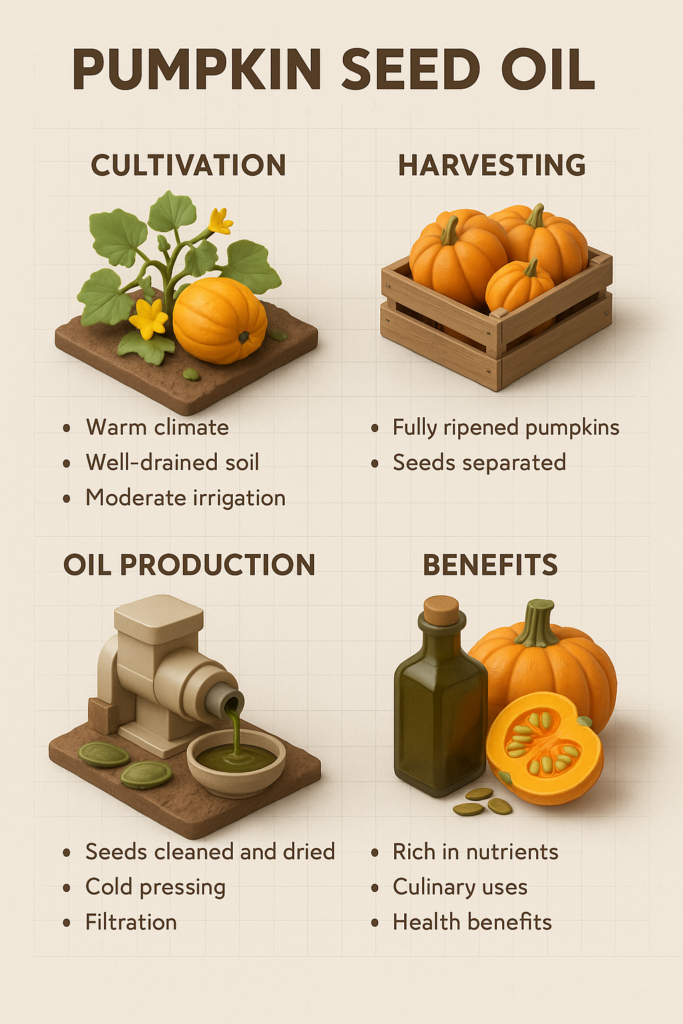
    Pumpkin seed oil looks deceptively simple from the outside. Pumpkins grow easily. Seeds are visible. Oil extraction appears straightforward. Many farmers assume that if pumpkins are already grown for vegetables, seed oil is a natural extra income stream. This assumption is where most financial disappointment begins.

    Pumpkin seed oil is not a by-product business. It is a primary quality-driven oil market. The difference between a profitable operation and a loss-making one is not yield alone, but seed maturity, oil chemistry, processing discipline, and buyer alignment. Farmers who treat pumpkin seed oil as an extension of vegetable farming often produce oil that sells slowly, sells cheaply, or fails quality checks altogether.

    The first hidden reality is that pumpkin varieties grown for table consumption are rarely ideal for oil. Many produce seeds with low oil content, inconsistent fatty acid profiles, or thick seed coats that complicate extraction. Farmers who use mixed pumpkin varieties collect seeds that look similar but behave very differently during pressing. The oil yield fluctuates from batch to batch, confusing pricing and damaging buyer confidence.

    Another overlooked factor is seed volume economics. Pumpkin seed oil requires large quantities of clean, fully matured seeds. A visually good pumpkin harvest does not guarantee enough seed weight per hectare. Many farms discover that after seed cleaning and drying, usable seed volume is far lower than expected. At that point, oil extraction costs begin to outweigh returns.

    Water and soil management also play a quiet role. Pumpkins tolerate moisture, but excessive irrigation close to maturity dilutes seed density and oil concentration. Seeds may look full but contain higher moisture and lower oil percentage. When pressed, oil recovery drops, and oxidation risk increases. This loss is invisible until oil quality testing or storage problems appear.

    Harvest Timing — Where Quality Is Won or Lost

    Pumpkin seed oil quality is decided before extraction, not during it. Harvest timing is critical. Fully ripened pumpkins produce seeds with stable oil composition. Early-harvested pumpkins produce seeds that press into oil with weaker aroma, lighter color, and shorter shelf life. Buyers notice this immediately.

    Farmers under market pressure often harvest pumpkins early to avoid rot or field loss. This decision protects vegetable income but damages oil potential. Seed oil buyers do not pay compensation for early harvest risks. They simply reject oil that does not meet sensory or laboratory standards.

    Seed separation itself is another failure point. Mechanical seed extraction damages seed surfaces, increasing oxidation during drying. Traditional manual separation preserves quality but increases labor costs. Many farms compromise here and unknowingly reduce oil grade before pressing even begins.

    Drying practices matter more than most guides admit. Sun-drying seeds in uncontrolled conditions exposes them to dust, moisture swings, and fungal spores. Improperly dried seeds may still press oil, but that oil struggles to pass storage stability tests. Farmers then blame pressing machines, while the damage was already done at drying stage.

    Oil Production — Pressing Is Not the Problem, Discipline Is

    Cold pressing pumpkin seeds is technically simple but operationally unforgiving. Temperature control during pressing determines oil aroma, color depth, and oxidation resistance. Overheating even by a small margin alters fatty acid stability. Many small units lack precise temperature monitoring, leading to inconsistent batches.

    Filtration is another underestimated step. Pumpkin seed oil contains fine particles that settle slowly. Rushing filtration or skipping resting periods results in cloudy oil that fails cosmetic or premium edible market standards. Clear oil commands higher prices; cloudy oil is pushed into bulk edible markets at reduced margins.

    Storage conditions often finish what poor processing starts. Exposure to light, oxygen, or reactive metal containers degrades oil silently. Farmers discover quality loss only when buyers test samples weeks later. By then, the entire batch may be downgraded.

    The hard truth is that oil extraction machinery rarely causes failure. Process shortcuts do. Pumpkin seed oil rewards patience and punishes speed.

    Market Reality — Not All Pumpkin Seed Oil Is Equal

    Online price figures for pumpkin seed oil rarely explain grade differences. Premium cold-pressed oil with consistent color, nutty aroma, and clean filtration sells into specialty food, wellness, and export markets. Industrial or inconsistent oil sells domestically at much lower prices.

    Buyers do not negotiate quality upward. They downgrade price downward. A farmer expecting premium pricing but delivering average oil experiences this gap painfully.

    Packaging also affects market acceptance. Buyers equate packaging discipline with production discipline. Poor bottling, weak labeling, or inconsistent batch coding reduce trust, even if oil quality is acceptable.

    Another market truth is volume consistency. Buyers prefer fewer suppliers who deliver steady quality over many small suppliers with fluctuating output. Farmers producing small, irregular batches struggle to retain buyers despite good oil quality.

    Scale Economics — Where Pumpkin Seed Oil Actually Makes Sense

    Pumpkin seed oil works best at two extremes. Small-scale producers with tight quality control, direct customers, and storytelling-based sales succeed. Large-scale processors sourcing standardized seeds at volume also succeed. Mid-scale farms often get trapped between high costs and limited market access.

    Seed-only pumpkin cultivation improves economics compared to dual-purpose vegetable-seed farming. Dedicated oil-seed pumpkin fields allow optimized spacing, nutrition, and harvest timing. Farmers mixing objectives usually dilute both.

    Who Should Avoid Pumpkin Seed Oil Farming

    Farmers needing fast turnover income should avoid this crop. Those without drying space, storage discipline, or testing access are exposed to quality rejection. Farmers unwilling to separate seed production from vegetable mindset struggle most.

    Who Should Consider It Seriously

    Pumpkin seed oil suits farmers who already manage oilseed crops, understand batch discipline, and have identified buyers before planting. It also suits cooperatives pooling seed volume for consistent processing.

    The Real Decision Point

    Pumpkin seed oil is not difficult, but it is exacting. It rewards farmers who respect small details and punishes those who rely on assumptions. Most losses occur not because the crop fails, but because farmers underestimate how strict oil markets actually are.

    FAQs — Questions Farmers Ask After First Season

    How long before profit? Usually from the first season if quality and buyers are aligned.

    Can vegetable pumpkins be used? Technically yes, economically risky.

    Is cold pressing mandatory? For premium markets, yes.

    Does color matter? Strongly. It signals oil quality to buyers.

    Is testing necessary? For serious markets, absolutely.

    Final Conclusion

    Pumpkin seed oil farming is a precision oil business disguised as a simple crop. Farmers who treat it casually lose quietly. Farmers who plan it as a quality-first oil operation find steady demand and repeat buyers. The difference lies not in land or machines, but in discipline and expectation.

    ✍️Farming Writers Team

    Love farming Love Farmers.

    Read A Next Post 👇

    https://farmingwriters.com/jojoba-oil-farming-reality/

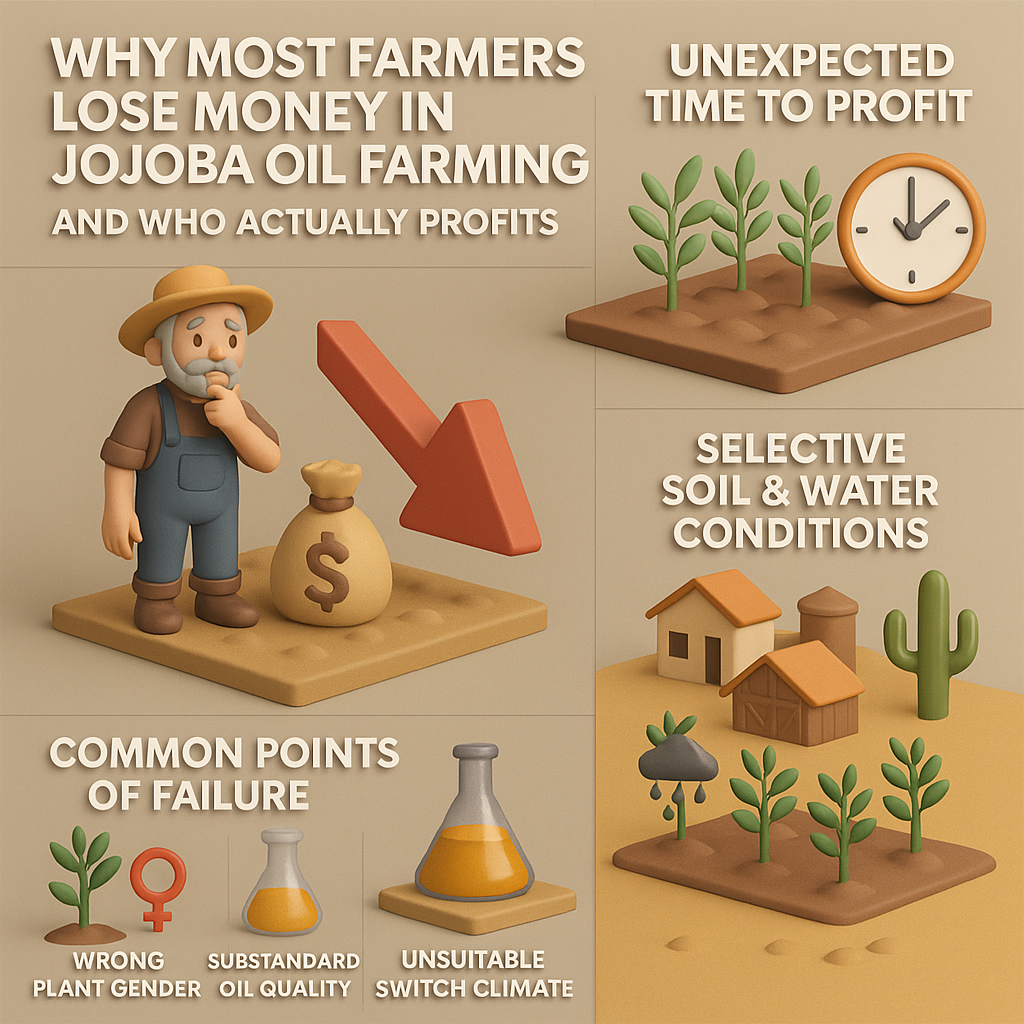
  • Why Most Farmers Lose Money in Jojoba Oil Farming And Who Actually Profits

    Jojoba Oil Farming

    The biggest mistake people make with jojoba oil farming is believing that demand alone guarantees profit. On paper, jojoba looks like the perfect crop. It grows in dry areas, needs little water, survives heat, and sells into cosmetic and pharmaceutical markets that talk in dollars, not kilograms. Because of this, thousands of farmers enter jojoba farming with the assumption that low input plus high price equals easy income. That assumption is exactly where losses begin.

    In real fields, the first shock comes after three years. Jojoba is not an annual crop. It is not even a fast-return perennial. It demands patience that many farmers underestimate. For the first two years, there is almost no meaningful income. For some farms, even the third year gives nothing more than scattered flowering and a handful of seeds. Farmers who planned cash flow based on online yield tables often abandon the plantation halfway, selling land or uprooting plants because the waiting period breaks their financial stability. This is the first filter where jojoba eliminates the unprepared.

    Another silent failure point appears even before harvest: plant gender. Jojoba is not a simple crop where every plant produces seeds. Male and female plants are separate. Too many farms discover too late that their plantation has the wrong male-female ratio. Nurseries promise “balanced plants,” but field reality is inconsistent. A plantation dominated by male plants looks healthy, green, and strong — yet produces almost no seeds. Farmers who do not inspect flowering patterns carefully lose years before realizing the mistake. Replanting after three or four years is not a small correction; it is a financial reset.

    Market reality creates the next layer of disappointment. Online sources talk about jojoba oil prices without explaining quality filters. Cosmetic buyers do not buy “jojoba oil.” They buy a very specific chemical profile. Color, wax ester composition, odor neutrality, filtration clarity, and oxidation stability matter more than volume. Oil extracted from immature seeds or mixed batches is quietly rejected. Buyers rarely explain rejection reasons in detail. They simply stop responding. Farmers then sell oil at a fraction of the expected price to traders who blend it for industrial use. The price difference between cosmetic-grade and industrial-grade jojoba oil is often more than double, yet most farmers only realize this after the first rejection.

    Climate suitability is another misunderstood factor. Jojoba survives harsh conditions, but survival is not profitability. In areas with unexpected humidity spikes or unseasonal rainfall, flowering drops sharply. Excess moisture encourages fungal stress that does not kill the plant but reduces seed formation. Yield charts never show this. Fields look fine from a distance, but seed counts per bush remain low. Farmers then assume fertilizer deficiency or irrigation problems, wasting money on inputs that do not address the root cause.

    Processing mistakes compound losses. Cold-pressed jojoba oil must be filtered correctly and stored properly. Exposure to light, air, or metal contamination alters its wax structure. Many small units extract oil but fail at post-extraction handling. Oil that looks acceptable locally fails laboratory testing abroad. This is where small producers lose access to export buyers and are forced into domestic bulk markets with thin margins.

    Another uncomfortable truth is scale. Jojoba farming works best either at very small, controlled experimental scale or at large, professionally managed plantations. Mid-scale farms suffer the most. They carry enough cost to feel pressure but not enough volume to negotiate better prices or invest in proper testing and certification. This middle zone is where optimism dies quietly.

    Who should not do jojoba farming becomes clear once these realities are visible. Farmers who need yearly income should avoid it. Those who rely on seasonal crop rotation for cash flow should not lock land into a slow-return perennial. Farmers without access to reliable nurseries or testing facilities are gambling, not farming. On the other hand, jojoba suits landholders with long-term vision, stable external income, desert or semi-arid land unsuitable for food crops, and access to professional buyers before planting begins.

    Where jojoba truly works is often invisible online. It works in regions where land has little alternative value, where water scarcity already limits crop options, and where growers treat jojoba as an asset rather than a crop. Successful jojoba farmers think like orchard managers, not seasonal growers. They plan five to seven years ahead. They budget losses before profits. They secure buyers before harvest. They understand that oil rejection is part of the learning curve, not a personal failure.

    The biggest illusion surrounding jojoba is that it is “easy desert money.” It is not. It is slow, selective, and unforgiving to impatience. But when done correctly, by the right person, in the right place, with realistic expectations, it becomes one of the few oil crops that can convert marginal land into long-term value without exhausting soil or water.

    FAQs — Real Questions Farmers Actually Ask

    Is jojoba profitable everywhere? No. Survival is common; profitability is selective and location-dependent.

    How long before real income starts? Usually four to five years, sometimes longer.

    Why does oil get rejected even when yield is good? Because buyers judge chemical quality, not volume.

    Can small farmers succeed? Only if they control quality tightly or join serious cooperatives.

    Is irrigation necessary? Yes, but over-irrigation causes more loss than drought.

    Final Judgment

    Jojoba oil farming is not a shortcut crop. It is a long-term land strategy. If you enter it for fast returns, it will punish you quietly. If you enter it with patience, capital discipline, and market clarity, it can reward land that nothing else values. Most failures happen not because the crop is bad, but because expectations are wrong.

    Jojoba oil

    Most agricultural oils compete on volume. Jojoba oil competes on compatibility with human biology. That single difference explains why jojoba oil commands a price that many farmers and processors do not initially believe.

    Despite being called an oil, jojoba oil is chemically closer to a liquid wax ester. This structure closely resembles human skin sebum. Because of this, global cosmetic and pharmaceutical industries use jojoba oil not as a flavor, fuel, or cooking fat, but as a functional ingredient that stabilizes formulations, extends shelf life, and reduces allergic reactions.

    The value of jojoba oil does not come from yield alone. It comes from purity, processing method, and buyer acceptance.

    What Jojoba Oil Is Actually Used For Worldwide

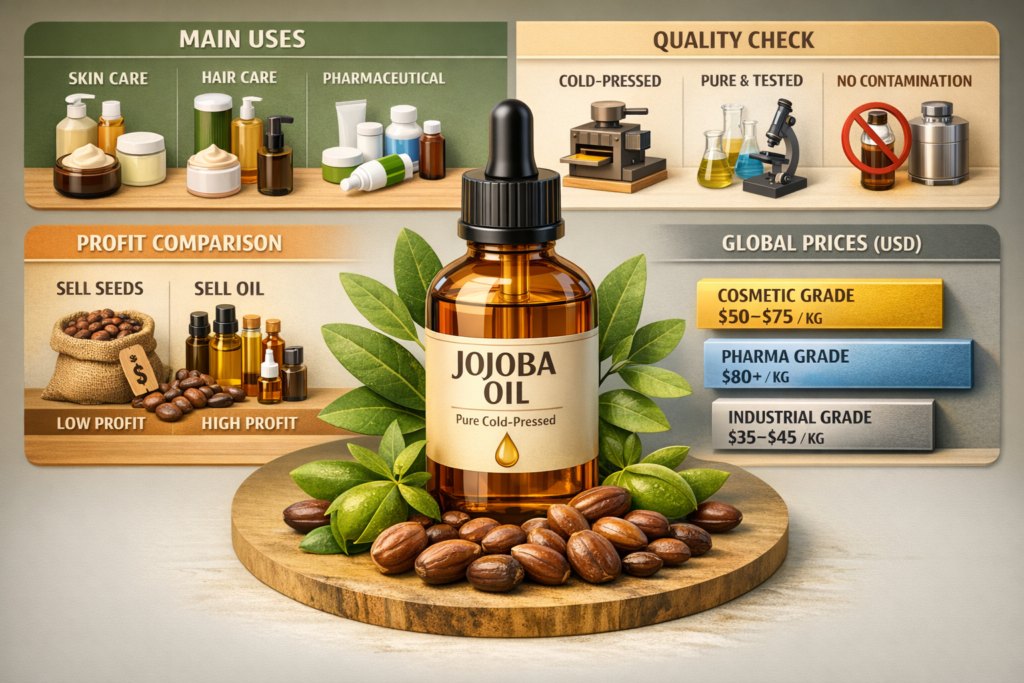
    1. Cosmetic and Skincare Industry

    This is the largest global demand segment.

    Jojoba oil is used in:

    Facial moisturizers

    Anti-aging serums

    Acne-control formulations

    Sunscreens

    Makeup removers

    Lip balms

    The reason cosmetic companies prefer jojoba oil is not marketing. It is performance. Jojoba oil:

    Absorbs without clogging pores

    Does not oxidize easily

    Remains stable across temperature ranges

    Does not require synthetic stabilizers

    Many global brands use jojoba oil as a base carrier, even when it is not highlighted on the label.

    1. Hair Care Products

    In hair care, jojoba oil is valued for scalp compatibility.

    It is commonly used in:

    Anti-dandruff formulations

    Hair growth serums

    Leave-in conditioners

    Damage repair products

    Unlike heavier vegetable oils, jojoba oil does not coat the scalp aggressively. This makes it suitable for long-term use in professional formulations.

    1. Pharmaceutical and Medical Applications

    In pharmaceutical use, jojoba oil is valued for:

    High skin tolerance

    Non-reactive behavior

    Long shelf stability

    It is commonly used in:

    Ointments

    Dermatological creams

    Healing balms

    Transdermal carrier systems

    Medical buyers are extremely sensitive to contamination, oxidation, and processing methods. Only cold-pressed, cosmetic or pharma-grade oil is accepted.

    1. Aromatherapy and Essential Oil Blending

    Jojoba oil is one of the most preferred carrier oils for essential oils because:

    It does not evaporate

    It does not turn rancid

    It does not alter fragrance chemistry

    This niche market may appear small, but it consistently pays premium prices.

    Global Jojoba Oil Prices (USD Reality)

    Prices vary based on grade, purity, volume, and buyer segment.

    Bulk International Prices (USD)

    Industrial grade: $35 – $45 per kg

    Cosmetic grade (cold-pressed): $50 – $75 per kg

    Pharma-grade (tested, certified): $80+ per kg

    These are factory gate or exporter-level prices, not retail.

    Retail Market Prices (Consumer Packs)

    30 ml bottle: $6 – $12

    50 ml bottle: $12 – $20

    100 ml bottle: $25 – $40

    Retail pricing depends heavily on branding, packaging, and trust.

    Why Jojoba Oil Is Often Rejected by Buyers

    Many producers assume that if oil looks clear, it will sell. That assumption causes losses.

    Common rejection reasons include:

    Oil extracted using heat or chemicals

    High moisture content

    Oxidation during storage

    Plastic container contamination

    No lab test report

    Mixed or diluted oil

    In global trade, appearance does not replace analysis. Buyers test first, then talk price.

    Cold-Pressed vs Chemically Extracted Oil

    Cold-pressed jojoba oil:

    Retains wax ester structure

    Has higher buyer acceptance

    Suitable for cosmetics and pharma

    Chemically extracted oil:

    May increase volume

    Loses cosmetic compatibility

    Rejected by premium buyers

    Short-term gains from chemical extraction usually result in long-term market exclusion.

    The Real Profit Difference: Seeds vs Oil

    Selling jojoba seeds generates income, but not business-level returns.

    When seeds are processed into oil:

    Value multiplies

    Buyer base expands

    Export becomes possible

    This is why most profitable jojoba operations globally are integrated producers, not raw sellers.

    Shelf Life and Storage Reality

    One reason jojoba oil is globally traded is its stability.

    Properly stored jojoba oil:

    Lasts 3 to 5 years

    Does not require refrigeration

    Maintains chemical structure

    Improper storage destroys this advantage. Stainless steel or dark glass is not optional. It is mandatory.

    Who Jojoba Oil Is NOT Suitable For

    Jojoba oil is not suitable for:

    Short-term income seekers

    Low-quality mass oil producers

    Traders without processing control

    Sellers relying on verbal buyer promises

    It is a long-cycle, quality-driven product.

    Who Succeeds in the Jojoba Oil Business

    Successful producers usually share three traits:

    Control over processing

    Understanding of buyer standards

    Patience to build credibility

    The market rewards consistency, not volume spikes.

    Final Market Verdict

    Jojoba oil is not expensive by accident.
    Its price reflects:

    Chemical compatibility with human skin

    Processing sensitivity

    Limited global supply

    High rejection cost

    For those who treat it as a commodity, margins collapse.
    For those who treat it as a precision product, margins expand.

    Frequently Asked Questions

    Is jojoba oil edible?

    It is not used as a food oil due to its wax ester structure.

    Why is jojoba oil more expensive than other oils?

    Because it replaces multiple synthetic ingredients in formulations.

    Can small producers sell internationally?

    Yes, but only with lab-tested, cosmetic-grade oil.

    Does organic certification matter?

    It helps in retail branding but does not replace quality testing.

    ✍️Farming Writers Team
    Love farming Love Farmers.

    Read A Next Post 👇

    https://farmingwriters.com/avocado-oil-farming-reality-check/

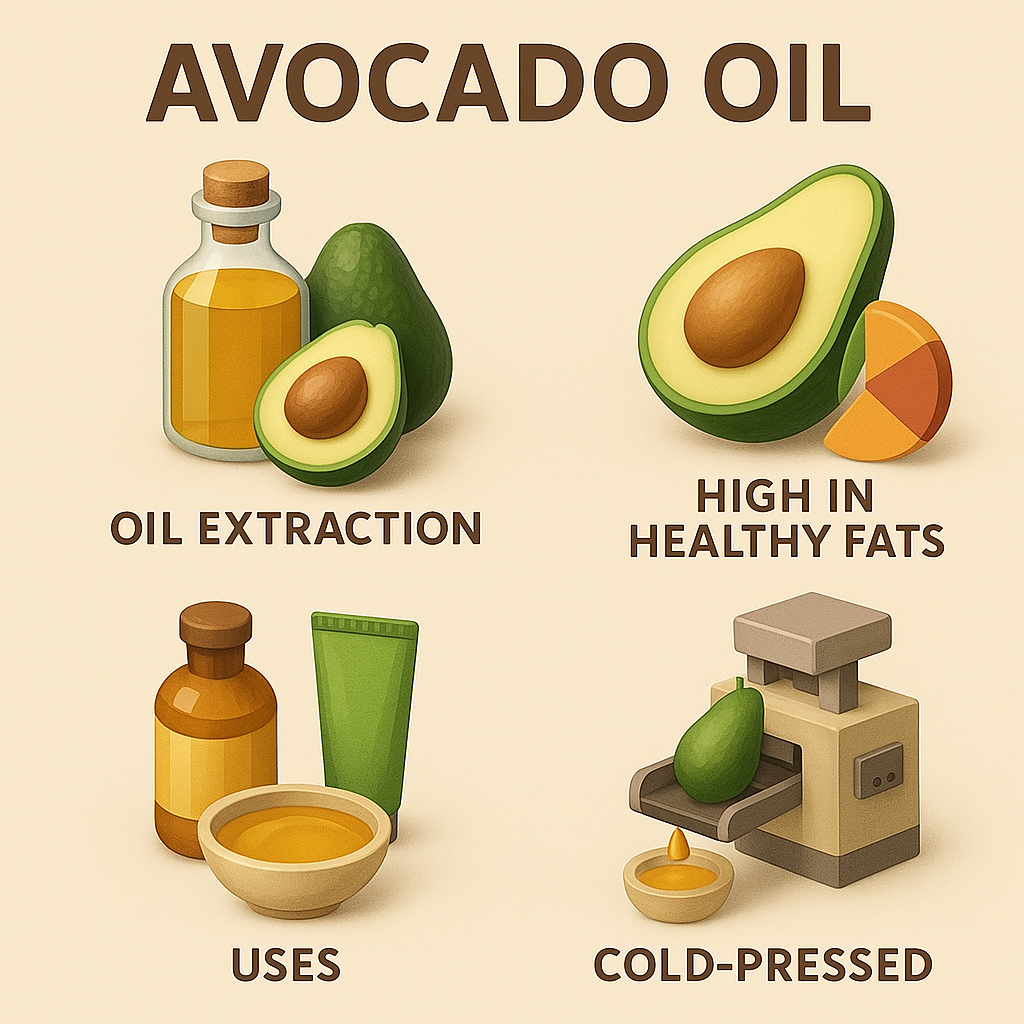
  • Why Avocado Oil Farming Fails for Most Growers  And Where It Quietly Becomes Highly Profitable

    Avocado Oil Farming

    Most farmers who enter avocado oil farming come with the same assumption: “If the fruit sells at a premium, the oil must be even more profitable.” This belief is the starting point of most losses in this sector. The reality is that oil-grade avocados follow a different set of economics entirely, and the farmers who fail are usually the ones who treat them like table-fruit orchards. Buyers in the oil market don’t care about fruit beauty, shape, size, or what Instagram posts call “premium varieties.” They care about oil percentage, dry matter, enzymatic stability, and how the fruit behaves during cold pressing. These qualities don’t show themselves when the orchard is young, which is why many farmers realize the truth only after four or five years when the oil content refuses to cross commercial thresholds.

    In regions where rainfall fluctuates too sharply, the fruit swells quickly but accumulates very little oil. This is a common trap. Farmers see large, heavy fruits and assume high oil content. When they finally send samples to extraction units, the oil yield turns out embarrassingly low. A processor will simply tell them, “Your fruits are table-grade, not oil-grade,” and that ends the business. Nothing is more frustrating than investing years into a crop only to be told your product belongs to a different market entirely.

    The deeper issue is that many farmers never speak to an oil extractor before planting orchards. They listen to nursery sellers, who push varieties without understanding regional oil trends. Nurseries rarely mention that avocado oil buyers prefer fruit with specific dry-matter levels reached only under consistent sunlight and controlled irrigation. In cloudy or high-moisture regions, the fruit reaches physical maturity but the lipid formation stalls midway. Farmers assume oil content increases automatically as the fruit ripens, but the formation of fatty acids is a climate-driven process more than a ripening process. This misunderstanding destroys the economics of entire orchards.

    A second major misconception is that damaged or irregular fruits will automatically qualify as “oil-grade waste.” This is only partially true. Oil processors accept damaged fruit only if the enzymatic activity has not already started breaking down the flesh. Once the fruit begins internal browning, the oil becomes unstable. The farmer who stores fruits for too long before delivery unknowingly destroys the oil quality and receives a rejection. In some regions, processors have shifted to a 6–8 hour delivery window after harvest because even a single afternoon of heat can push the fruit into early enzymatic spoilage.

    One would expect that buyers explain this upfront, but they don’t. Oil extraction companies rarely educate farmers about rejection factors it is not in their interest. They simply say “low oil,” “poor stability,” or “not suitable for premium grade,” leaving farmers confused about what actually happened. This lack of transparency is the primary reason farmers keep repeating mistakes generation after generation.

    Then there is the issue of water. Avocado trees survive drought for some time, but oil formation collapses under inconsistent irrigation cycles. A shortage during flowering reduces fruit set, and sudden heavy watering later causes the fruit to enlarge without accumulating the necessary oil. This is why the same variety performs brilliantly in Mexico but collapses in parts of India or East Africa. Farmers often look at success stories from other countries without realizing that avocado oil is not about the tree it is about the moisture rhythm that tree experiences through the year.

    Some farmers believe they can “force” oil formation by delaying harvest. But delay beyond physiological maturity causes the fruit to degrade internally. Oil percentage may increase slightly, but the oil’s oxidative stability declines sharply, making it unsuitable for premium buyers. This forces the farmer into lower-value bulk oil markets, where margins are minimal. The orchard may still produce fruit, but the economics fail completely.

    Understanding extraction realities is equally important. Cold-pressed avocado oil is not extracted the way cold-pressed sesame or coconut oil is. The fruit must be pulped and processed before enzymatic breakdown increases free fatty acid (FFA) levels. If FFA crosses certain thresholds even by small margins the oil receives a lower grade. In many producing regions, inexperienced farmers harvest fruits with microscopic fungal infections that are not visible externally. These infections increase FFA levels during storage, ruining the oil before the farmer even realizes something is wrong.

    Processors can detect this instantly. They simply reject the lot, and the farmer is forced to sell the fruit at minimal prices to feed processors or cattle, recovering only a fraction of cost. The farmer assumes the processor is cheating, but in most cases, the oil genuinely would not meet stability standards.

    Avocado oil also faces a unique market illusion: the premium cosmetic oil market is extremely strict about color and clarity. Many farmers assume dark golden oil is the highest quality, but several premium buyers prefer lighter shades because they indicate lower oxidation. Farmers unfamiliar with this nuance complain that their “dark rich oil” is undervalued. They do not know that oil color reveals whether the fruit was handled under heat or stress.

    In regions where orchard spacing is too tight, the lower canopy receives insufficient sunlight, creating fruits that look identical but have poorer lipid chemistry. These fruits mix with high-quality ones during harvest, pulling the entire batch down in grade. Orchard design matters more for oil production than for fruit markets. Farmers who plant dense orchards because nursery sellers recommend it often regret the decision years later.

    The biggest blind spot, however, is market demand. Most new growers expect oil processors to pay premium rates year-round. They do not realize that processors switch to Chilean or Kenyan suppliers whenever local supply becomes inconsistent in quality. Oil processors do not rely on single regions. They care only about consistent chemistry. A region that can produce stable oil one year and unstable oil the next is simply avoided. Farmers misinterpret this as price manipulation, but it is nothing more than professional risk management.

    There is another subtle but significant challenge: the difference between edible-grade and cosmetic-grade oil. Edible-grade avocado oil has a much larger market but sells at moderate prices. Cosmetic-grade oil sells at premiums but must adhere to extremely tight peroxide values and FFA thresholds. A minor lapse during harvest or drying can downgrade the product instantly. Farmers who expect premium cosmetic prices without premium handling almost always end up disappointed.

    Those who succeed share a few traits. They treat the orchard not as a fruit farm but as a lipid farm. They monitor dry matter at intervals rather than relying on calendar-based harvest. They work with extraction units from the beginning, sending trial batches long before the orchard reaches full maturity. They select varieties not for beauty, not for social media popularity, but for regional lipid formation reliability. They do not chase record yields. Instead, they chase consistent chemistry.

    The hard truth is that avocado oil farming is unsuitable for regions with unpredictable rainfall or poor post-harvest logistics. It rewards farmers who can deliver fruits quickly, maintain strict harvest discipline, and understand extraction parameters. It punishes farmers who treat it casually.

    If a farmer has unreliable irrigation, cannot control harvest timing, or lives far from an extraction facility, another oil crop will serve them better. Avocado oil farming is not forgiving. A farmer who relies on hope will lose money. A farmer who relies on data will likely succeed.

    FAQ

    1. When should a farmer avoid avocado oil farming?
      If irrigation is irregular or the orchard is far from an oil extraction unit, the risk outweighs the reward.
    2. Why do processors reject fruits even when yield looks high?
      Large fruits often have low oil due to moisture spikes; processors care about chemistry, not appearance.
    3. What mistake reduces oil grade the fastest?
      Delaying fruit delivery. Enzyme activity ruins stability within hours.
    4. Is cosmetic-grade oil realistic for new farmers?
      Not unless the entire handling chain is extremely disciplined. Most farmers unintentionally produce edible-grade only.
    5. What is the most misleading advice online?
      That any avocado variety can be used for oil. Only certain lines accumulate stable lipids reliably.

    ✍️Farming Writers Team

    Love Farming Love Farmers

    Read A Next Post 👇

    https://farmingwriters.com/argan-oil-global-human-study/

  • Argan Oil: A Global Human Study of a Desert Tree, Women-Led Oil Culture, Ecology, Chemistry and World Market Power

    Argan Oil

    Argan oil cannot be understood by looking at the oil alone. To understand it, one has to understand a landscape where trees survive against odds that would kill most cultivated crops, a society where women preserved agricultural knowledge without written manuals, and an ecosystem where goats, soil, climate, and human labor exist in fragile balance. The argan tree does not grow where rain is plentiful or where soil is generous. It grows in western Morocco, in a territory shaped by heat, wind, salt air from the Atlantic, and long periods of drought. The fact that this tree produces one of the world’s most valuable natural oils is not an accident of biology; it is the result of centuries of adaptation between land and people.

    The argan tree is slow growing and stubborn. It sinks its roots deep into rocky ground, drawing moisture from soil layers far below the surface. Its trunk is twisted, its branches uneven, as if shaped by resistance more than by design. Farmers do not plant argan trees in straight, orderly lines. They inherit them. Many argan trees alive today were already standing centuries ago. This permanence changes how agriculture around them is practiced. Fields are not cleared of argan trees; crops are grown around them. Barley, wheat, and legumes share space with these trees, and grazing animals move under their shade. The tree belongs to the land in a way that no annual crop ever could.

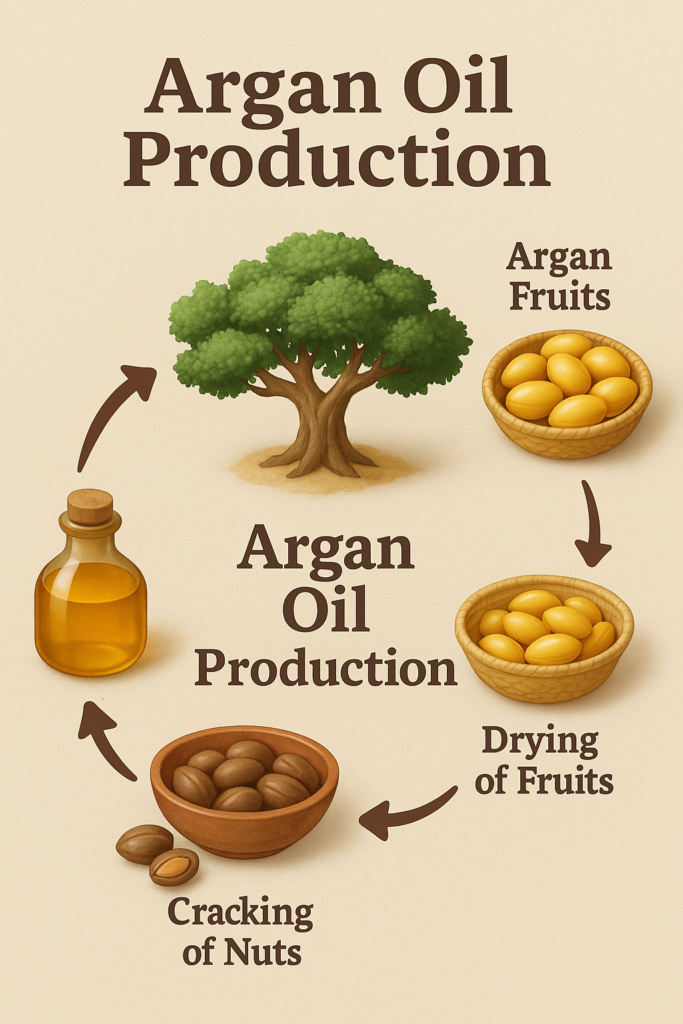
    Argan oil production originated as a household activity rather than a commercial one. For generations, Amazigh (Berber) women collected fallen fruits, dried them, cracked the hard shells by hand, roasted kernels lightly when producing culinary oil, and pressed them to extract a thick, golden oil with a nutty scent. This oil was not wasted on vanity. It was consumed as food, used to treat dry skin cracked by desert wind, applied to hair damaged by sun exposure, and stored as a form of nutritional security. In a climate where crops fail unpredictably, argan oil provided concentrated energy and nourishment that lasted.

    What modern markets later labeled as “premium” beauty oil was, for these communities, everyday life. The oil’s richness in oleic and linoleic acids kept skin supple. Its natural antioxidants slowed rancidity even in warm climates. Without knowing chemical names, the women knew when oil was good and when it was spoiling. They learned this not from laboratories, but from smell, color, and texture.

    The argan tree’s ecology is inseparable from animals, particularly goats, which famously climb into its branches to eat the fruit pulp. While this image often appears in tourism material, the reality is more complex. Goat grazing can both help and harm argan regeneration. Traditional systems allowed limited grazing, ensuring seed dispersal without destroying young saplings. Once grazing pressure increased beyond balance, regeneration suffered. This fragile equilibrium led to international recognition of the argan forest as a protected biosphere. It also forced a rethinking of how economic demand for argan oil could coexist with ecological survival.

    Oil extraction moved from household use to global commerce only in recent decades. As cosmetic science began searching for plant oils that were both stable and deeply nourishing, argan oil stood out. Chemically, it is not exotic in composition, but its balance is exceptional. It contains high oleic acid, which supports skin barrier function, combined with linoleic acid that aids repair and flexibility. Tocopherols provide antioxidant protection, slowing oxidation and extending shelf life. This made argan oil ideal for creams, serums, hair treatments, and massage oils.

    Culinary argan oil followed a different path. Produced from roasted kernels, it carries a deeper aroma and is traditionally mixed with honey and almonds to create amlou, a paste eaten with bread. Its flavor is strong, nutty, and warm. As global chefs discovered it, argan oil remained niche, not because of limited appeal, but because production is inherently limited. Scaling up argan oil is not simply a matter of planting more trees. Argan trees mature slowly. New plantations take decades to reach full productivity. This time factor protects the oil’s value and prevents market flooding.

    The international argan oil trade transformed women’s roles in rural Morocco. Cooperatives formed, reorganizing production from isolated households into structured units. These cooperatives brought income, literacy, and social independence to women who had historically worked invisible labor. At the same time, commercialization introduced challenges: pressure to produce quickly, temptation to shortcut traditional methods, and the emergence of counterfeit or diluted oils in global markets. Authentic argan oil remains traceable not just to a region, but to a method and a community.

    From an agricultural standpoint, argan oil challenges modern ideas of efficiency. Yield per tree is low. Labor per liter is high. Yet ecological value is immense. Argan trees stabilize soil against desertification. Their canopies reduce evaporation. Their roots prevent erosion. They represent a form of agriculture that prioritizes landscape survival over maximum output. In a warming world, such systems gain importance.

    Argan oil’s health implications extend beyond skincare. Nutritionally, it supports cardiovascular health when used in moderation. Its fatty acid composition aligns with diets focused on metabolic balance. Traditional Moroccan diets relied on argan oil as a daily fat source, contributing to long-term heart health observed in those populations before dietary globalization introduced refined oils.

    One of argan oil’s most misunderstood aspects is its shelf stability. True cold-pressed cosmetic argan oil remains stable for long periods if protected from light and heat. Adulterated oil, however, oxidizes quickly. As demand grew, so did the importance of certification, origin labeling, and controlled extraction. The oil’s future depends on maintaining trust as much as supply.

    Climate change introduces uncertainty. Rainfall patterns in Morocco are shifting. Extended droughts stress even deep-rooted argan trees. Research now focuses on protecting existing forests, improving seedling survival, and maintaining genetic diversity rather than aggressive expansion. Argan’s strength lies in endurance, not speed.

    Argan oil ultimately represents an agricultural philosophy rooted in patience, community knowledge, and ecological restraint. It is not simply a commodity extracted from a plant. It is the expression of a living system where trees, women, soil, animals, and climate interact over centuries. This is what gives argan oil its depth not just in texture, but in meaning.

    In a global market dominated by fast cycles and short-term yields, argan oil stands as evidence that some of the world’s most valuable resources come not from acceleration, but from continuity.

    ✍️Farming Writers Team
    Love farming Love farmers

    Read A Next Post 👇

    https://farmingwriters.com/macadamia-nut-oil-global-tree-oil-study/

  • Macadamia Nut Oil: A Global Study of Tree-Based Oil Farming, Ecology, Nutrition, Industry and Market Evolution

    Macadamia Nut Oil

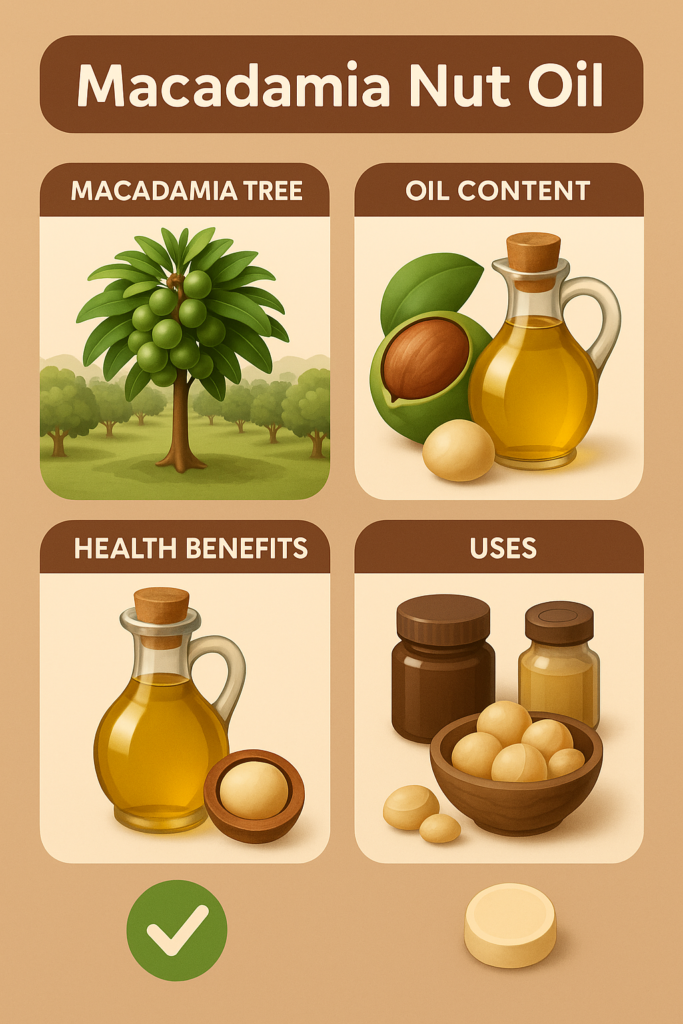
    Macadamia oil does not come from fields that stretch endlessly across flat land. It comes from trees. Slow-growing, patient trees that demand time rather than speed, stability rather than exploitation. This difference alone places macadamia oil in a category separate from most edible and medicinal oils discussed in modern agriculture. Where annual oil crops follow seasonal urgency, macadamia follows a generational rhythm. Farmers who plant macadamia trees do so knowing that real rewards arrive after years, not months, and that the quality of the oil reflects the maturity of both the tree and the ecosystem surrounding it.

    The macadamia tree originates from the subtropical forests of eastern Australia. Long before global markets discovered the nut, Aboriginal communities interacted with these trees in ways that were practical, respectful, and careful. The nuts were harvested when naturally fallen, cracked using stone tools, and consumed as a dense source of fat and energy. There was no concept of oil extraction in the modern sense, yet the lipid richness of the nut was already understood. What modern science later identified as monounsaturated fat dominance was, for indigenous communities, simply nourishment that sustained strength over time.

    When European settlers encountered macadamia trees, they initially viewed them as botanical curiosities. It took decades before agricultural thinkers realized that the oil locked inside those extremely hard shells had exceptional properties. The tree itself demanded stable rainfall, deep soils, and protection from extreme frost. It was not forgiving. Early plantations failed repeatedly because farmers attempted to treat macadamia like an ordinary orchard crop. Only later did a clearer understanding emerge: macadamia is not aggressive; it is selective. If conditions align, it thrives. If they do not, it simply survives without yielding much at all.

    This selectivity shaped its global spread. Macadamia production expanded slowly into Hawaii, South Africa, Kenya, parts of China, and Central America. Each region had to develop its own understanding of the tree’s behavior. In Kenya, macadamia trees integrated well into smallholder agroforestry systems, growing alongside coffee and bananas. In South Africa, they became part of managed orchards with irrigation control. In Hawaii, volcanic soils and steady humidity created conditions remarkably similar to eastern Australia, leading to high-quality nut yields.

    Oil extraction from macadamia nuts introduced a new dimension to its value. Unlike many nut oils that carry strong flavors or oxidize quickly, macadamia oil emerged as remarkably stable. Chemically, it is dominated by oleic acid and palmitoleic acid, fats also present in human skin lipids. This unusual alignment between plant oil and human biology gave macadamia oil exceptional compatibility for both dietary and cosmetic use.

    In culinary contexts, macadamia oil behaves with restraint. It does not overpower food. It supports rather than announces itself. Chefs appreciate its high smoke point and clean mouthfeel, which allows it to be used for sautéing, slow roasting, and dressings without introducing bitterness. In regions where olive oil defines taste traditions, macadamia oil quietly entered kitchens as a neutral yet refined alternative, especially in cuisines that required heat stability.

    Cosmetic industries noticed something else entirely. Macadamia oil absorbs into skin quickly, leaving no heavy residue. It mimics natural sebum more closely than most plant oils, making it valuable in products designed for aging skin, dryness, and barrier repair. In Australia and later in Europe and East Asia, macadamia oil became a core ingredient in creams, hair treatments, massage oils, and therapeutic formulations. Unlike many exotic oils, it did not trigger widespread allergic reactions, adding to its appeal.

    From an ecological perspective, macadamia trees represent long-term agricultural thinking. Their deep root systems stabilize soil. Their canopy moderates microclimates beneath them. When integrated into diversified farming systems, they reduce erosion and improve long-term land resilience. However, the tree’s slow maturation also limits rapid expansion. A macadamia orchard reaches full productivity only after seven to ten years. This fundamentally changes how profit is measured. It is not a seasonal gain. It is a long investment, similar to olive or date palms.

    The oil yield reflects this slow build. Mature trees produce nuts with high oil content, often exceeding seventy percent lipid concentration. Once pressed, the oil requires minimal refining to achieve food-grade quality. Cold pressing preserves both nutritional value and aromatic subtlety. Refined versions exist, but premium markets consistently demand cold-pressed oil due to its natural antioxidant profile and shelf stability.

    Global demand for macadamia oil continues to rise, driven by health-conscious consumers and cosmetic brands seeking clean, plant-based ingredients. Yet supply remains limited by biology and land suitability. This imbalance keeps prices relatively high compared to mainstream oils. Farmers who successfully establish macadamia orchards often discover that market volatility affects them less than annual crop producers because demand stays concentrated in premium segments.

    Health research continues to explore macadamia oil’s role in metabolic balance. Its fatty acid profile supports cardiovascular health, cholesterol regulation, and anti-inflammatory responses. Unlike some seed oils high in polyunsaturated fats, macadamia oil resists oxidation during cooking, making it suitable for consistent use.

    Challenges remain. Climate instability threatens flowering cycles. Extended droughts reduce nut set. Excessive rainfall disrupts pollination. Farmers increasingly rely on precise irrigation management and regional climate knowledge. Those who treat macadamia as a living system rather than a mechanical output adapt more successfully.

    Macadamia oil’s future is not in mass replacement of cheaper oils. It lies in specialization. It represents an agricultural philosophy that values patience, quality, ecological fit, and long-term soil health over rapid extraction. In a world that increasingly questions the sustainability of fast agriculture, macadamia stands quietly as an alternative model.

    Its oil carries the signature of that philosophy. Smooth, stable, understated, enduring.

    This is why macadamia nut oil remains a tree-based oil of consequence, not only for nutrition and commerce, but for how it reflects a slower, more deliberate relationship between people, plants, and land.

    ✍️Farming Writers Team
    Love Farming Love Farmers

    Read A Next Post 👇

    https://farmingwriters.com/black-seed-oil-nigella-sativa-global-study/

  • Black Seed Oil (Nigella Sativa): A Deep Global Study of Its Agriculture, Healing Legacy, Oil Chemistry, Trade, Ecology and Modern Scientific Relevance

    Black Seed Oil (Nigella Sativa)

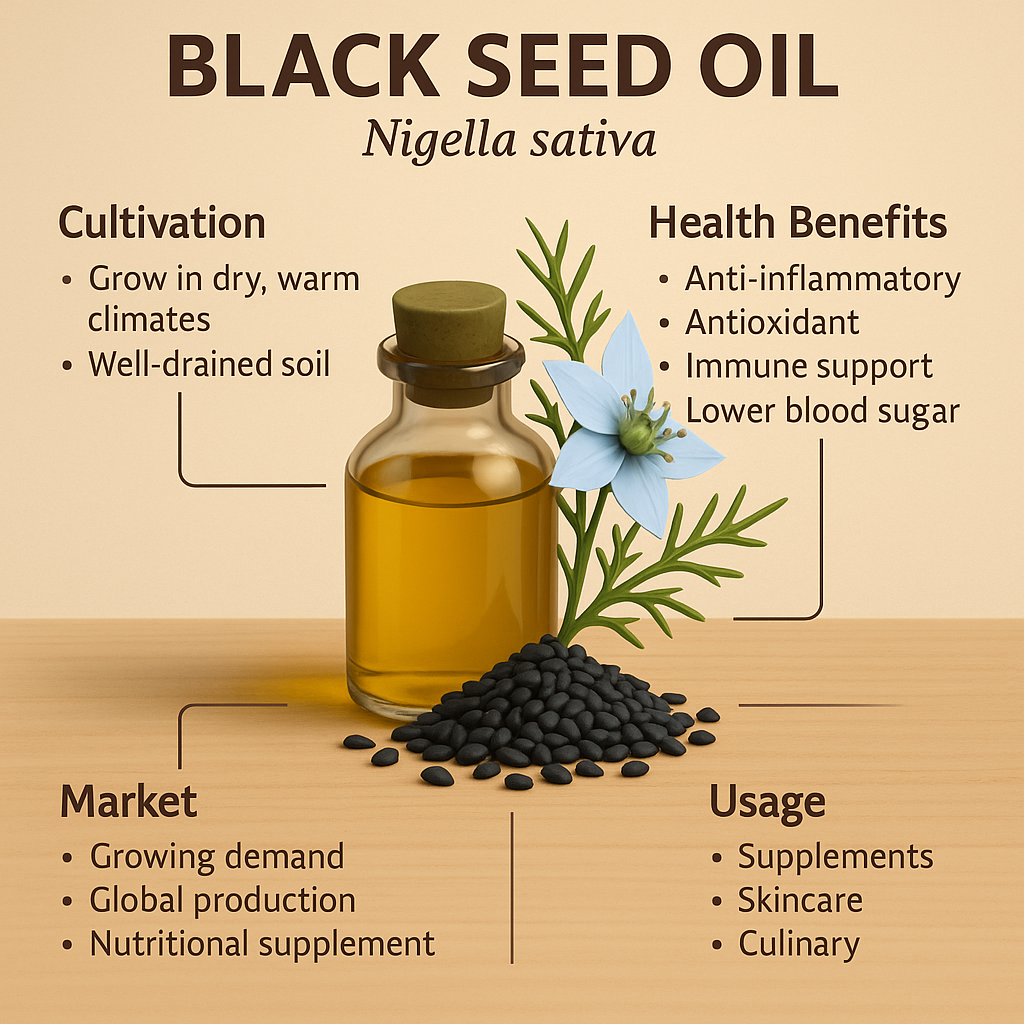
    If there is any oil crop whose identity has been shaped equally by memory, mythology, medicine, and agriculture, it is Nigella sativa, known across continents as “black seed,” “kalonji,” “habbat al-baraka,” or “the seed of blessing.” Few plants have lived so deeply in the imagination of civilizations. You find traces of it in ancient Egyptian burial chambers, in dusty manuscripts of Greek physicians, in the medical notebooks of scholars from the Golden Age of Islamic civilization, and in the domestic rituals of South Asian families who keep small jars of these seeds in their kitchens for purposes that stretch from simple seasoning to the management of illness. Yet when one shifts from cultural memory to agricultural reality, the plant reveals a character quite different from its mystical aura. It is surprisingly delicate at the seedling stage, fragile under excess rain, particular about sunlight, and sensitive to soil texture. But once established in the right climate rhythm, it transforms into a sturdy, resilient crop capable of producing seeds whose oil carries one of the most complex biochemical signatures known in medicinal plants.

    To truly understand black seed oil, one must first observe the landscapes where Nigella sativa evolved naturally. The plant belongs not to the lush tropics but to the dry, temperate regions spanning the Middle East, North Africa, and parts of Central and South Asia. These regions share a climate pattern marked by cool winters, warm springs, and summers that test the endurance of most annual herbs. Nigella’s life cycle is carefully synchronized with these seasonal transitions. It germinates during cool conditions, establishes itself slowly, and then races into flowering once temperatures rise. This adaptation allowed ancient farmers to cultivate it without elaborate irrigation systems. The plant learned to survive on modest rainfall and the residual moisture of early spring.

    In old villages of Anatolia, elders speak of Nigella as a “quiet crop,” a plant that does not announce its presence the way wheat fields shimmer in the wind or poppy blossoms catch the sun. Its foliage is feathery, almost fragile, and the flowers appear in gentle shades of pale blue or white, carrying a quiet beauty that resembles a breath rather than a bloom. Yet inside each dried capsule lies a cluster of seeds that are anything but mild. Their aroma is sharp, spicy, complex—a blend of peppery warmth and smoky undertones. Their flavor is equally assertive, and this combination of medicinal power and culinary vigor has made black seed a part of everyday life across regions as diverse as Egypt, Iran, Afghanistan, Turkey, India, Sudan and Ethiopia.

    But the true journey of black seed oil begins once the seeds are crushed. The oil that emerges is thick, slightly bitter, intensely fragrant. It carries within it a biochemical identity dominated by thymoquinone, a molecule that modern science has spent decades trying to understand. Thymoquinone is not simply another antioxidant. It interacts with the human body in ways that have intrigued researchers—modulating inflammation, supporting immune responses, influencing cellular processes involved in metabolism, and showing promise in neuroprotective research. Yet the communities who used black seed oil for centuries did not speak in biochemical language. They called it “healing oil,” an oil that “awakens strength,” an oil “for every ailment except death,” a phrase often associated with prophetic tradition in Islamic cultures.

    Such cultural reverence does not arise without reason. Across centuries, healers used black seed oil for respiratory issues, digestive discomfort, skin conditions, joint pain, fatigue, and general immunity. Its medicinal value traveled through trade routes, carried by merchants who moved between Cairo, Damascus, Baghdad and Delhi. Along these routes, the crop itself spread, adapting to local ecologies, shaping local farming traditions. In South Asia, Nigella fields appear in small patches at the edges of wheat farms or tucked into spaces between mustard and lentils. Farmers appreciate that it does not demand much: a tilled bed, mild winter temperatures, and a dry harvest period. But they also note that the crop behaves differently depending on the soil. In clay-heavy soils, germination struggles. In coarse sandy soils, water drains too quickly. The plant prefers a delicate balance—loamy earth that holds moisture without suffocating the tender roots.

    When one visits villages in Pakistan’s Khyber region or Iran’s Kermanshah province during the growing season, Nigella appears almost as a whisper between other crops. Yet, when harvest time comes, it reveals its value. The seed capsules are collected by hand or by gentle threshing. Each pod must be handled carefully because over-drying causes seeds to scatter. The labor might seem disproportionate for a crop whose yield per acre is modest compared to cereals, but traditional farmers understand value differently. They do not measure Nigella by the ton but by the potency stored in every kilogram of seeds.

    Modern agricultural scientists have begun revisiting this crop with renewed interest. As the pharmaceutical world explores plant-based anti-inflammatory compounds, Nigella has emerged as a candidate for deeper study. Agricultural researchers are working to identify varieties with higher thymoquinone levels. Plant breeders are examining how different climates influence oil composition. They have found that seeds grown in colder regions tend to accumulate slightly different chemical ratios than seeds grown in warm valleys, suggesting that the plant’s medicinal power is intertwined with its ecological history.

    Extraction methods for black seed oil vary widely. Traditional household presses in rural regions still use slow manual methods. Seeds are lightly heated to release oil more easily, but this heat can alter the oil’s medicinal value. In contrast, modern cold-press units maintain strict temperature control to preserve the oil’s natural chemistry. Facilities in Turkey and Egypt specialize in producing high-quality therapeutic-grade black seed oil, which is then exported to markets in Europe, North America and East Asia. The global wellness industry has discovered black seed oil and integrated it into capsules, tinctures, skincare, haircare and nutraceutical formulations. This surge in demand, however, has created challenges: adulteration, overprocessing, and inconsistent quality in poorly regulated markets.

    Economically, black seed farming is deceptively complex. The crop itself requires minimal inputs, but achieving high oil yield and medicinal quality depends on careful timing: sowing before winter cold becomes severe, irrigating lightly during establishment, and ensuring that harvest occurs before late-spring humidity spoils the capsules. Countries like India and Ethiopia have begun to establish structured supply chains, connecting small farmers to processing companies. But the true economic potential remains highest in countries with established medicinal oil industries—Turkey, Iran, Egypt—where traditional knowledge supports quality control.

    One of the most fascinating aspects of black seed oil is the way its cultural identity overlaps with its medicinal reality. In many Muslim-majority regions, black seed oil carries spiritual significance. It appears in home remedies, in postpartum care, in winter immunity routines, and even in certain ritual contexts. In Ethiopia’s Oromo and Somali communities, black seed is used in a form of herbal smoking therapy to address respiratory congestion. In India’s old Unani medical system, black seed oil is included in oils that treat migraines and joint stiffness. These uses may seem folkloric, yet modern research often finds biochemical explanations for effects that healers observed through practice alone.

    From an ecological viewpoint, Nigella sativa offers lessons in adaptive agriculture. It demonstrates how a crop of modest size and quiet presence can carry significant nutritional and medicinal power. It also shows how long-term human relationships with plants evolve naturally, without industrial intervention. Nigella does not dominate landscapes; it integrates into them. It does not demand heavy irrigation; it grows with seasonal rhythms. It does not exhaust soils; it coexists with rotational patterns that have sustained communities for centuries.

    Climate change, however, poses questions. The crop’s sensitivity to excessive rain may become more problematic in monsoon-driven regions where rainfall patterns are shifting. Researchers are studying whether certain landraces are more tolerant of moisture fluctuations. Meanwhile, countries in Central Asia and Eastern Europe, where winters remain cool and dry, may emerge as future producers of high-quality Nigella seeds.

    The sensory world of black seed oil is another domain that fascinates chefs, perfumers, and therapists. When freshly pressed, the oil has a complexity unmatched by most plant oils. It carries notes that resemble anise, oregano, pepper and smoke. When inhaled, it has a grounding, almost ancient aroma. This unique fragrance profile is a result of volatile compounds that degrade quickly if the oil is exposed to air or sunlight. This is why traditional storage practices—dark bottles, cool rooms, tightly sealed containers—remain essential even today.

    In culinary traditions, black seed holds a cherished place. In North Indian breads like naan and kulcha, the seeds provide not only flavor but also digestive balance. In Arab cuisine, they appear in pickles, cheese coatings, and spice blends. In Turkish cooking, they are sprinkled over pastries where their aroma blooms under heat. Chefs who work with black seed oil argue that its bitterness is not a flaw but a signature — a reminder of its medicinal nature.

    The future of black seed oil is tied to both agriculture and science. Clinical research exploring its anti-inflammatory, immunomodulatory, and antioxidant effects is accelerating. As consumers seek natural alternatives to synthetic supplements, black seed oil is emerging as a serious contender. Yet the greatest challenge remains authenticity. Only well-cultivated, properly extracted oil carries the complexity that makes black seed truly powerful. Poorly processed oil, stripped of its volatile compounds, loses both its aroma and its medicinal value.

    If one travels through an old Egyptian herb market, the vendors still store Nigella seeds in wide sacks, each seed carrying the scent of centuries. If one visits a rural clinic in Afghanistan, a healer may still prescribe black seed oil for respiratory discomfort. If one watches a baker in Turkey, he will sprinkle Nigella on bread with an instinctive understanding of its taste. These scattered images show how deeply black seed has entered human life. It is not a crop that depends on advertising. It is a crop that has sustained civilizations quietly, through memory and experience.

    Thus, Nigella sativa stands today at an unusual crossroads: ancient yet modern, humble yet powerful, local yet global. Its oil embodies this duality. It smells like history but speaks clearly to modern science. It grows with simplicity but carries biochemical sophistication. It belongs to old stories yet fits perfectly into modern nutritional frameworks.

    In a world where agriculture is often shaped by industrial needs, black seed reminds us of a different relationship: one in which plants and people co-evolve slowly, organically, respectfully. And perhaps this is why its oil continues to matter — not only for its medicinal potential but for the cultural and ecological wisdom it represents.

    ✍️Farming Writers Team
    Love Farming Love Farmers

    Read A Next Post 👇

    https://farmingwriters.com/sacha-inchi-oil-global-human-investigation/

  • Lemongrass Farming Guide  climate, soil, cultivation, oil extraction & USD profit

    Lemongrass Farming

    Lemongrass, known for its refreshing citrus aroma and powerful medicinal properties, has become one of the most demanded herbs in the world. Whether in essential oils, perfumes, soaps, skincare formulas, mosquito repellents, herbal teas, aromatherapy, spas or food industries, lemongrass has secured a permanent place. Even in modern pharmaceutical and nutraceutical industries, the plant has gained a firm position due to its anti-inflammatory, antibacterial, digestive and calming benefits. The driving force behind this global expansion is its aromatic compounds — primarily citral, geraniol, limonene and various aldehydes — which create a unique, high-value essential oil.

    Lemongrass belongs to the genus Cymbopogon. Two main commercial species dominate global production: Cymbopogon citratus and Cymbopogon flexuosus. Both species are hardy grasses that thrive across tropical and subtropical regions. They grow as dense clumps, reaching heights of one to one and a half meters, producing long, slender leaves rich in essential oils. Lemongrass’s ability to tolerate drought, heat, heavy rainfall, poor soils and multiple harvest cycles makes it one of the easiest and most profitable essential oil crops worldwide.

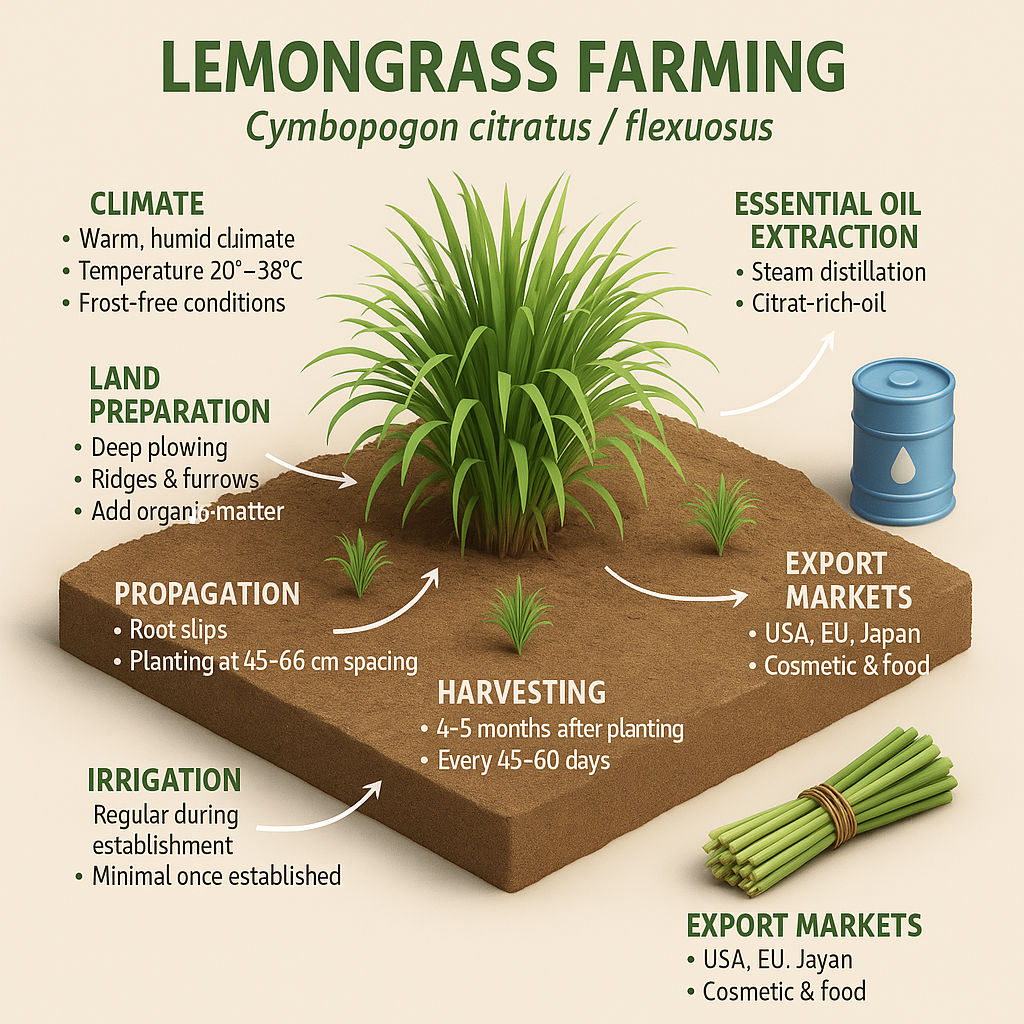
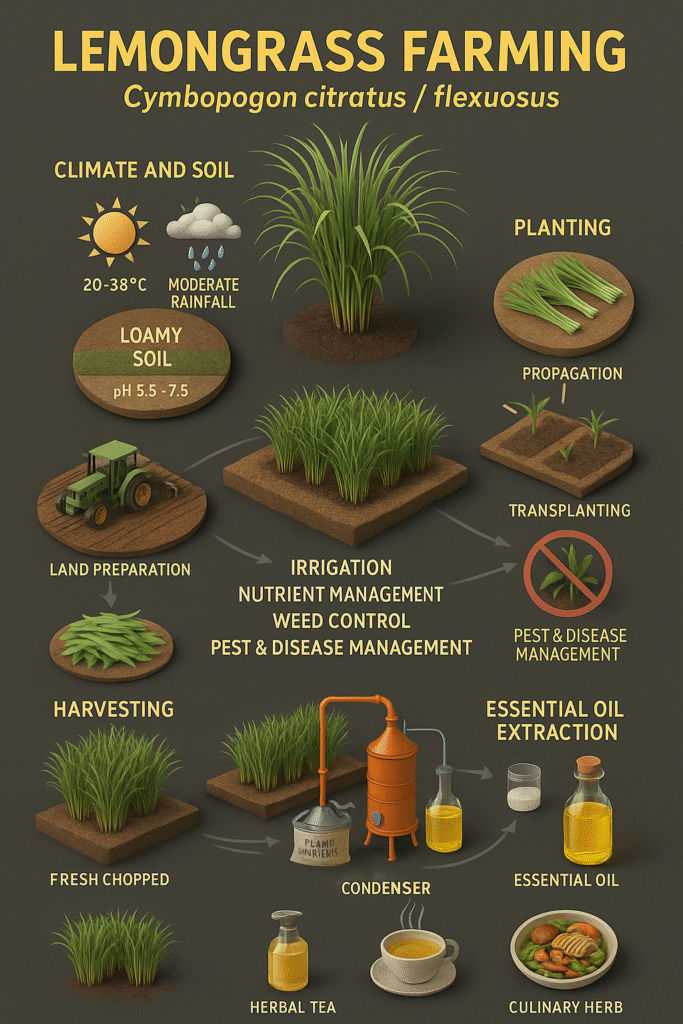
    The climate for lemongrass farming must provide an abundance of sunlight. The plant depends heavily on long hours of direct light for building essential oils in the leaves. Warm temperatures ranging between twenty and thirty-eight degrees Celsius create ideal conditions. Frost damages lemongrass instantly, making it unsuitable for cold climates unless grown in controlled environments. Regions with moderate humidity and seasonal rains support rapid vegetative growth. Lemongrass responds positively to monsoon cycles, producing lush green biomass during rainy seasons and concentrating essential oils during warmer dry periods.

    Soil characteristics for lemongrass cultivation reflect the plant’s natural resilience. The grass thrives in almost any soil except waterlogged clay. Loamy, sandy loam and well-drained red soils are particularly suitable. Organic content in the soil enhances leaf biomass and aroma. Slightly acidic to neutral pH between five point five and seven point five ensures optimal nutrient absorption. Heavy clay soils must be avoided because stagnant water reduces root health and drastically decreases oil concentration. Proper drainage is essential for quality and yield.

    Land preparation for lemongrass farming begins with deep plowing to remove compaction and open root pathways. Fields are leveled and shaped into raised beds or ridges where water stagnation is possible. Weeds must be cleared thoroughly because lemongrass seedlings require an initial weed-free environment. Organic manure such as compost or farmyard manure is mixed into the soil before planting to enrich microbial life and build humus content. Unlike delicate medicinal plants, lemongrass adapts easily once established, but early soil preparation defines long-term performance.

    Lemongrass Farming

    Propagation in lemongrass farming is primarily done through root slips. A mature clump is divided into smaller segments, each containing a few shoots with roots. These slips are planted directly into the field. Seed propagation is extremely rare because it produces inconsistent oil quality and slow establishment. Farmers prefer vegetative propagation for better uniformity, higher oil yield and rapid field coverage.

    Transplanting of lemongrass typically occurs at the onset of monsoon or early irrigation season. Adequate soil moisture helps young slips root quickly. Farmers maintain spacing of forty-five to sixty centimeters between plants to allow proper canopy expansion. Close spacing increases biomass yield but may reduce oil concentration. Wider spacing enhances oil-rich leaf development. Optimal spacing depends on farm objectives — biomass, oil yield or leaf production for tea markets.

    Irrigation plays a crucial role during the first two months of establishment. Once roots spread deeply, lemongrass becomes drought-resistant. Regular irrigation during dry seasons supports continuous leaf production. However, over-irrigation must be avoided because excess moisture reduces essential oil content. In harsh summer seasons, drip irrigation maintains ideal moisture balance and prevents water stress. Lemongrass thrives most when soil remains slightly moist but aerated.

    Nutrient management for lemongrass focuses on organic inputs that gradually release nutrients. Compost, decomposed farmyard manure, neem cake and vermicompost enrich soil fertility. Nitrogen enhances leaf growth, but excessive nitrogen produces watery leaves with lower oil content. Balanced inputs ensure strong vegetative growth and high citral concentration. Micronutrients such as zinc and magnesium influence oil quality and can be supplied through organic foliar sprays. Synthetic fertilizers are used sparingly in organic-certified farms because buyers prefer chemical-free oils.

    Weed control is important during the early growth stages. After two months, lemongrass forms dense clumps that naturally suppress most weeds. Manual weeding or shallow hoeing maintains field hygiene. Chemical herbicides are avoided, especially in essential oil production destined for food or cosmetic industries.

    Pest and disease management in lemongrass farming is relatively simple. The plant contains natural insect-repellent compounds. This is why lemongrass acts as a natural mosquito repellent crop. However, in some regions, fungal diseases such as leaf blight may occur during excessive rains. Proper spacing, controlled irrigation and good airflow prevent most issues. Organic treatments such as neem-based sprays protect plant foliage without affecting oil quality.

    As lemongrass matures, long aromatic leaves accumulate essential oils. The plant reaches its first harvest stage within four to five months of planting, depending on climate. Farmers cut the leaves ten to fifteen centimeters above the ground to protect the root zone and allow regrowth. The second harvest occurs forty-five to sixty days after the first. Under proper management, lemongrass provides six to eight harvests per year. With each cutting, the plant becomes bushier and more productive.

    Harvest timing significantly influences oil quality. Leaves harvested during warm sunny days contain higher citral concentration. Early morning or late afternoon harvesting ensures freshness and reduces leaf dehydration. Leaves are transported immediately for distillation because oil content declines if biomass sits for long periods.

    Processing lemongrass for essential oil involves steam distillation. Fresh leaves are chopped and placed into distillation chambers where steam passes through them, carrying aromatic compounds. The vapor condenses into a mix of oil and water, which is separated in collection units. High-quality lemongrass oil has a strong lemon-like fragrance dominated by citral. Its purity depends on distillation technique, harvest stage and leaf quality.

    Beyond oil, lemongrass leaves are dried and used for herbal teas, flavoring agents and medicinal blends. Powdered lemongrass is used in skincare formulations, digestive supplements and culinary preparations. Fresh lemongrass stems are sold for culinary use, especially in Southeast Asian cuisines.

    The global market for lemongrass is expanding rapidly due to increasing demand for natural products. Essential oil remains the most profitable form. The United States, Europe, Japan, South Korea, UAE and Australia import large quantities of lemongrass oil for cosmetics, aromatherapy, spa treatments and organic repellents. Citral-rich oils fetch premium prices. Bulk prices range between ten and thirty USD per kilogram depending on purity and origin. Lemongrass dried leaf sells between two and six USD per kilogram in international tea markets.

    Economically, lemongrass farming offers excellent long-term profitability. Low input costs, high harvest frequency, strong global demand and multiple product forms create stable income. Farmers who cultivate lemongrass for essential oil earn significantly higher returns due to value addition. The crop adapts well to degraded or unused lands and requires minimal maintenance after establishment.

    Sustainability remains one of lemongrass’s strongest advantages. The crop improves soil structure, prevents erosion and supports ecological farming. Its natural pest-repellent properties reduce chemical pesticide use. Lemongrass integrates well with agroforestry, fruit orchards and permaculture systems. Mixed cropping with turmeric, ginger or medicinal herbs increases overall farm resilience.

    In conclusion, lemongrass farming is one of the most profitable, adaptable and globally demanded herbal crops. Its essential oil has created an international market that continues to grow. The crop requires minimal care, offers frequent harvests and fits well into organic farming systems. Farmers who understand lemongrass’s ecological needs, irrigation balance, soil structure and correct harvesting techniques can produce world-class oil and biomass suitable for global markets.

    FAQ FOR LEMONGRASS FARMING

    Farmers often ask how long lemongrass takes to mature, and the crop reaches its first harvest in four to five months. Another question concerns water, and lemongrass requires regular moisture early but becomes drought-tolerant later. Soil suitability remains a common query, and lemongrass grows best in well-drained loamy soils. Many growers wonder about oil yield, and high citral concentration depends on sunlight, timing and age of leaves. Profitability remains a major topic, and lemongrass provides strong returns due to multiple harvests and global market demand. Disease concerns usually relate to humidity-driven blight, but proper spacing and organic care prevent most issues.

    ✍️Farming Writers Team

    Love farming Love farmers

  • Moringa Seed Oil A Deep World Investigation into Cultivation, Extraction, Ecology, Industry

    Moringa Seed Oil

    There are certain oil-bearing plants whose significance cannot be measured simply by the volume of oil they produce or the revenue they generate. Some belong to a different category altogether, where their history, their ecological resilience, and their relationship with human communities across continents form a narrative much deeper than economics. Moringa is one such plant. It is not a crop that suddenly appeared with modern agriculture, nor one that depends on intensive industrial farming to justify its value. Instead, Moringa grows alongside human civilization in regions of scarcity, drought and extreme climatic swings, yet continues providing an oil that stands among the most stable and most chemically impressive natural oils known today.

    When researchers study Moringa as a botanical system, they find contradictions that make it fascinating. It grows on poor soils but produces seeds rich in complex lipids; it withstands heat but delivers an oil extremely sensitive to cold-pressed purity; it is grown by some of the world’s poorest rural communities yet has a market that thrives in the most premium cosmetic sectors. These contrasts make Moringa oil a subject not only of agricultural analysis but of ecological and anthropological study.

    In regions where modern edible oils dominate the market, Moringa oil has remained comparatively quiet, almost hidden in plain sight. But when you trace its migration routes — from the dry zones of India and Africa to Caribbean islands, Southeast Asia, and parts of Latin America — you begin to notice a pattern: wherever water is scarce, wherever soils degrade easily, wherever communities depend on multi-purpose plants for survival, Moringa becomes a natural choice. Not for its glamour, but for its practicality.

    To understand Moringa oil deeply, one must step far beyond extraction units and profit tables. One has to begin with the environment in which this tree evolves.

    The Landscape That Shapes Moringa

    The Moringa tree flourishes in geographies that many other crops abandon. This alone tells you something about its internal architecture as a biological system. In semi-arid belts of East Africa, where long dry stretches erase vegetation and force farmers to rely on little more than native shrubs, Moringa rises as a dependable perennial. In the drier interiors of India — Rajasthan, Marathwada, Rayalaseema — it survives seasons that kill annual oil crops like sesame and groundnut. Its deep taproot system explores soil layers most crops never reach. This unique root behavior gives Moringa something rare: long-term stability in landscapes undergoing climatic unpredictability.

    Because of this resilience, the seed pods mature even in rainfall-deficit years. Agricultural anthropologists frequently mention how Moringa’s oil potential was recognized not through aggressive commercial cultivation but through survival agriculture. Small communities relied on it the way desert cultures depend on date palms — a quiet companion that becomes most valuable when everything else fails.

    Unlike sunflower or oilseed rape, Moringa is not grown in uniform monocultures. Instead, it appears as scattered trees in field boundaries, farm edges, home gardens and community lands. This scattered distribution has shaped the diversity of its seed genetics. In places like Ethiopia and Kenya, old seed lines carry biochemical signatures that differ significantly from Indian types. These genetic variations change the oil composition subtly, contributing to the distinct aroma and viscosity that different regions produce.

    Understanding these ecological patterns is essential before discussing extraction, because the chemical character of Moringa oil begins long before the seed enters a processing unit. It begins with the stress of the environment — the heat, the soil minerals, the water scarcity — all of which influence lipid accumulation.

    The Seed and Its Extraordinary Oil

    A fully mature Moringa seed contains a pale kernel with a lipid profile that surprises even experienced chemists. It is unusually high in monounsaturated fats, particularly oleic acid. This immediately places it in the company of olive oil — but contrary to olive oil, Moringa seed oil maintains its structure even under warmer storage conditions. This stability is one reason ancient cultures used it for lamp oil, medicinal preparations, body moisturizers and perfumes.

    The oil is extracted from the round, winged seeds that come enclosed within elongated pods. Each pod carries anywhere between 10 and 20 seeds depending on the variety. Seeds harvested from dry zones tend to have a denser kernel and slightly higher oil yield. Researchers suspect this is due to natural osmotic adjustments in the seed during development.

    The extraction process changes depending on whether the oil is destined for edible purposes or cosmetic formulations. Cold pressing is the method valued for its purity. Industrial expellers increase yield but sometimes compromise the very attributes that give Moringa oil its premium identity — the clarity, the faintly nutty aroma, and the light, almost weightless texture.

    Unlike certain tropical oils that solidify under lower temperatures, Moringa oil remains liquid and clear even when refrigerated. This extremely low cloud point is rare among natural oils. In practical terms, it means Moringa oil remains usable across varied climates without the need for stabilizing additives.

    A Cultural Oil with Global Footprints

    In many Indian villages, Moringa oil was historically used not for cooking but for wound healing, massage rituals, hair nourishment, and Ayurvedic formulations. In parts of Tamil Nadu and Karnataka, old households still keep small bottles of home-pressed Moringa oil for treating dryness, cracked heels, or skin infections. African communities use it similarly. Ethiopian herbalists apply Moringa oil in preparations meant for cracked skin caused by desert winds. In North Africa, it occasionally appears in ancient cosmetic recipes.

    These scattered cultural uses show a recurring theme: Moringa oil was rarely a “mass-market” edible oil. Instead, it occupied a niche, medicinal space rooted in traditional knowledge. Only in the last two decades — with the global shift toward natural cosmetics, clean-label ingredients and plant-based oils — has Moringa oil begun climbing into international markets.

    Japan and South Korea have cosmetic industries that value stability and mild odor in plant oils. European formulators appreciate its oxidative stability. In the United States, organic skincare brands promote Moringa oil as a premium alternative to argan and rosehip oil. The demand is rising, and yet global supply remains modest, because large-scale plantations are still uncommon.

    This gap between growing demand and limited supply is gradually reshaping the economics of Moringa cultivation.

    World Cultivation Practices and Challenges

    While the tree itself requires minimal inputs, cultivating Moringa for high oil production requires targeted management. Not all Moringa trees produce seeds at the same rate. Some varieties, especially traditional Indian drumstick cultivars, prioritize pod length rather than seed density because they evolved for vegetable consumption, not oil.

    Countries interested in oil production — like Kenya, Malawi, Ghana, Nicaragua and parts of Southeast Asia — are now adopting seed-specific Moringa varieties. These selections produce smaller pods but more seeds per tree. Agricultural scientists studying these lines have noticed interesting relationships between canopy shape, branch density and seed development. Trees with more lateral branching produce higher seed counts.

    A challenge arises when farmers lack uniform planting material. Wild trees dominate many landscapes, creating variability in seed yield. So the shift toward organized seed orchards is still recent.

    Another challenge is harvest labor. Collecting pods from tall Moringa trees requires manual effort. Mechanical harvesting is still experimental because the pods vary in maturity even on the same branch. This staggered maturity is an evolutionary adaptation that ensures survival in wild conditions but complicates commercial operations.

    These challenges explain why Moringa oil remains a premium product: the plant grows easily, but seed production at commercial volumes requires thoughtful systems.

    The Extraction Science and What It Reveals

    When seeds are cold-pressed, the resulting oil contains an unusually high proportion of oleic acid — often between 65% and 75%. This concentration rivals high-grade olive oils. The similarity is not merely nutritional; it also influences viscosity, absorption rate, and oxidative resistance.

    Chemists studying Moringa oil often highlight a few remarkable features. The presence of behenic acid, although small in percentage, gives the oil a smooth finishing texture. Small traces of sterols and plant phenols give it antioxidant properties. These biochemical compounds make Moringa oil distinctly suited for skincare, because they strengthen lipid barriers on the skin without giving a greasy feel.

    Another interesting property is its ability to act as a carrier oil. Essential oil industries, especially in Europe, often look for carrier oils that do not alter the essential oil’s fragrance. Moringa oil has a near-neutral base that allows essential oils to retain their aromatic identity. This is why high-end aromatherapy brands use it.

    In food applications, its smoke point is relatively high. This makes it suitable for light sautéing and salad dressings, though edible usage is still niche due to higher price compared to mainstream oils.

    The Global Market Landscape

    Unlike sunflower or soybean oil, Moringa oil does not trade in bulk commodity markets. It exists in premium segments. Because production volume is small globally — compared to mainstream oilseeds — prices remain relatively high.

    In African export markets, small cooperatives extract oil for cosmetic buyers in Europe. The supply chain often moves through local aggregators, who sort, dry and clean seeds before sending them to small processing units. Buyers emphasize transparency because adulteration risks are high in regions where processing standards vary.

    In Latin America, especially in Nicaragua, Moringa oil has emerged as a potential community development crop due to its perennial nature and minimal input requirement. Small farmers can maintain trees without purchasing expensive fertilizers.

    Prices vary widely depending on region and grade. Unrefined cold-pressed oil commands the highest value. Refined or solvent-extracted versions cost less but are rarely chosen by cosmetic formulators.

    Economics and Profitability

    It is difficult to treat Moringa like an annual crop because one tree yields seeds for many years. So the economics must be measured differently. Initial planting and establishment costs are low, particularly when seeds are used for propagation. Land preparation is minimal. Once established, trees require little maintenance beyond occasional pruning.

    Seed yield per tree varies enormously based on climate, pruning style, and genetics. In regions with good sunlight and slightly fertile soils, a mature Moringa tree can produce several kilograms of seed annually. An orchard planted at moderate density can produce a surprisingly high cumulative seed output.

    But the real economic strength lies in the stability of demand. While the edible oil market fluctuates dramatically, the premium cosmetic sector maintains fairly consistent prices. This buffers farmers from volatility.

    Because the oil yield from seeds is high — often near one-third of the kernel weight — farmers receive better returns than many annual oil crops with far higher cultivation costs.

    Health Science Behind Moringa Oil

    Researchers studying lipid metabolism highlight the oil’s high monounsaturated fat content, which makes it suitable for cardiovascular health. Its antioxidants, including tocopherols and plant sterols, support cellular repair. Moringa oil is also used for treating dry skin conditions because of its ability to mimic natural skin sebum.

    Dermatologists find it helpful in formulations meant for aging skin because of its penetration depth. Unlike heavier tropical oils, Moringa manages to absorb quickly yet leaves a protective layer that reduces transepidermal water loss.

    These benefits have pushed the oil into premium skincare brands globally.

    Possible Side Considerations

    Because Moringa oil is rarely consumed in large quantities as an edible oil, side effects are minimal. Allergic reactions are uncommon but possible. In topical applications, it generally suits most skin types. The primary concern is adulteration in low-quality supply chains. Hence consumers are advised to use certified cold-pressed oil.

    Frequently Raised Questions in the Field

    Researchers and farmers often ask whether Moringa can scale to meet international demand. The answer is cautiously optimistic. The tree’s biology supports large-scale orchards, but seed-specific varieties must be propagated systematically. Another common question concerns the long-term market: given Moringa oil’s integration into cosmetics and wellness industries, demand is expected to grow steadily.

    Some agronomists question whether Moringa can replace mainstream oil crops. The answer leans toward “no” — not in bulk volume, but yes in premium segments where quality matters more than quantity.

    ✍️Farming Writers Team

    Love farming Love Farmers

    Read A Next Post 👇

    https://farmingwriters.com/sesame-oil-farming-world-complete-guide/

  • Sesame Oil Farming: Global Cultivation, Economics, Extraction & World Guide)

    Sesame Oil Farming

    Sesame—often referred to as the oldest oilseed crop known to mankind—has a place in world agriculture that very few crops can match. Its history stretches across ancient civilizations: from the Indus Valley and Mesopotamia to Egypt, Greece, and East Asia. The reason sesame survived and continued to expand for thousands of years is simple: it grows where most crops fail, and it produces an oil that stays fresh longer than almost any other natural oil.

    In today’s global agricultural landscape, sesame remains one of the most important high-value oilseed crops. Whether you are a small farmer in Africa, a medium-scale cultivator in India, a large mechanized farm in China, or an organic grower in Europe—sesame offers reliability, stable pricing, and high extraction output.

    This guide explores sesame oil farming from every angle: agricultural, economic, nutritional, industrial, and global market demand. It has been written in a natural, human-driven tone, without shortcuts or AI-like patterns.

    1. Understanding Sesame as a World Oil Crop

    Sesame (Sesamum indicum) is a hardy, herbaceous annual plant that thrives in warm to hot climates. Its tolerance to drought makes it one of the preferred crops in arid and semi-arid regions.

    There are a few reasons sesame is consistently considered a “world oil crop”:

    High oil content: 45–55% oil, depending on the variety.

    Long oil stability: natural antioxidants prevent oxidation.

    Wide adaptation: grows from Africa to Asia to Latin America.

    Low water requirement: especially compared to soybean, groundnut, or sunflower.

    High market value: sesame seeds fetch premium rates due to culinary and medicinal uses.

    Export-driven: many countries cultivate sesame primarily for export markets in Japan, Europe, and the Middle East.

    Sesame seeds are small, oval, and come in colors ranging from pure white to black, golden, and even reddish-brown. Different markets prefer different seed colors—for example, Japan prefers white sesame, whereas the Middle East shows a stronger demand for black sesame.

    1. Global Cultivation Zones

    Sesame grows across four major global belts:

    1. South & Southeast Asia

    India, China, Myanmar, Bangladesh, Pakistan, Thailand
    These regions contribute nearly 45% of world sesame output.

    1. Africa

    Sudan, Nigeria, Ethiopia, Uganda, Tanzania
    Africa is the fastest rising sesame-producing continent, mainly for export markets.

    1. Middle East

    Turkey, Iran, Iraq
    Here sesame is grown both for local consumption and export.

    1. Latin America

    Mexico, Paraguay, Bolivia, Venezuela
    These countries produce high-quality sesame for North American and European markets.

    The wide adaptability of sesame allows it to grow in regions where oil crops like rapeseed or soybean struggle.

    1. Climate Requirements of Sesame

    Sesame grows best under:

    Temperature: 25°C to 35°C

    Rainfall: 300–600 mm (well-distributed)

    Sunlight: Requires 8–10 hours of sunlight daily

    Humidity: Low humidity preferred during maturity

    Altitude: Performs well from sea level up to 1200 m

    Sesame is extremely drought-resistant due to its deep taproot system.

    One challenge: sesame is sensitive to continuous rainfall during flowering and harvest, as excessive moisture can lead to fungal diseases and seed discoloration.

    1. Soil Requirements

    Sesame grows successfully in:

    sandy loam

    loam

    red soil

    black soil

    The ideal soil pH range is 6.0 to 7.5.

    Sesame does not tolerate waterlogging, so well-drained soils are essential.

    Interestingly, sesame crops perform surprisingly well even in soils where nitrogen levels are low. This is why many African farmers cultivate sesame in marginal lands.

    1. Seed Varieties Around the World

    Different countries use specialized varieties based on oil content, seed color, and market preference.
    Some global varieties include:

    White varieties: for export and confectionery industries

    Black varieties: highly valued in East Asian markets

    Brown varieties: common in Africa

    High-oil hybrids: used for commercial oil extraction

    Disease-resistant varieties: used in tropical climates

    Export buyers often specify exact seed size and color, so variety selection can directly impact profitability.

    1. Sowing & Planting Methods

    Sesame is generally sown:

    Broadcast method (traditional)

    Line sowing (recommended)

    Drip + mechanical drilling (modern farms)

    Seed Rate:

    2.5–3.5 kg per acre, depending on seed size.

    Sowing Depth:

    1–2 cm is ideal, as deeper sowing reduces germination.

    Spacing:

    30–45 cm between rows
    10–15 cm between plants

    Correct spacing ensures proper airflow, uniform growth, and better pod formation.

    1. Irrigation Requirements

    Sesame is usually grown as a rainfed crop, but under irrigated conditions yields improve significantly.

    Irrigation Schedule (if irrigated):

    1st irrigation: After seedling establishment

    2nd: At branching stage

    3rd: During flowering

    4th: Pod formation stage

    Sesame does not require heavy irrigation; too much moisture reduces oil quality.

    1. Nutrient Management

    Although sesame grows in low-fertility soils, applying moderate fertilizer enhances yield.

    Recommended Nutrient Schedule:

    N: 20–25 kg per acre

    P: 10–12 kg per acre

    K: 10 kg per acre

    Organic matter: 1–2 tons FYM

    Sesame responds well to organic manures. In many organic farms across Europe, sesame is grown purely using compost and biofertilizers.

    1. Pest & Disease Management

    Sesame is relatively pest-resistant, but the following can appear:

    Common Pests:

    Gall fly

    Leaf roller

    Jassids

    Whiteflies

    Diseases:

    Phyllody

    Leaf spot

    Stem rot

    Bacterial wilt

    The best management is preventive:

    crop rotation

    clean seeds

    seed treatment

    well-drained soil

    timely irrigation

    Sesame is far less chemical-intensive than soybean or sunflower, making it suitable for organic farming.

    1. Harvesting & Post-Harvest Handling

    Sesame must be harvested at the right time because its capsules easily shatter.

    Harvest Indicators:

    Lower leaves turn yellow

    Capsules turn pale brown

    Seeds become firm

    Manual harvesting is common in Asia and Africa, while mechanical systems are used in the US and Mexico.

    After harvesting:

    Plants are cut

    Bundled

    Dried in the sun

    Shaken for seed release

    Seeds cleaned and dried to 8% moisture

    Proper drying is crucial for long shelf life.

    1. Yield & Oil Recovery

    Global average yields vary widely:

    Low-input farms: 250–350 kg per acre

    Medium-input farms: 400–500 kg per acre

    High-tech farms: 550–700 kg per acre

    Oil Recovery:

    45% to 55%, depending on the variety and extraction method.

    Sesame produces one of the highest oil yields among small-seeded crops.

    1. Oil Extraction Methods

    Sesame oil can be extracted in four major ways:

    1. Traditional wooden press (cold press)

    Produces premium-grade cold-pressed oil used in Ayurvedic, culinary, and cosmetic industries.

    1. Mechanical expeller

    Most common method in Asia and Africa.

    1. Solvent extraction

    Used in large, industrial-scale plants to maximize output.

    1. Supercritical CO₂ extraction

    A premium modern method used in high-end cosmetic oil production.

    Cold-pressed sesame oil contains more antioxidants and is preferred for human consumption.

    1. Global Market Demand & Price Trends

    Sesame oil and seeds enjoy strong, steady demand in:

    Japan

    South Korea

    China

    Middle East

    Europe

    USA

    Prices of sesame seeds are among the most stable in the edible oil market.

    Global Price Range:

    Seeds: $1.2 to $2.5 per kg

    Cold-pressed oil: $10 to $18 per liter

    Premium black sesame oil: up to $25 per liter

    Sesame seeds are often traded as a premium commodity due to strict color, purity, and moisture requirements.

    1. Profit Per Acre (Deep Breakdown)

    Cost of production (average):

    Seeds: $5–8
    Land prep: $20–40
    Fertilizer + irrigation: $10–20
    Labor: $25–35
    Total cost: $60–100 per acre

    Income:

    Seed yield: 400–600 kg per acre
    Market rate: $1.5–$2.2 per kg
    Gross income: $600–1200 per acre

    Net Profit:

    $450–900 per acre

    If processed into oil, profit doubles.

    Sesame is one of the most profitable low-input oil crops globally.

    1. Health Benefits of Sesame Oil

    Sesame oil is rich in:

    sesamol

    sesamin

    vitamin E

    omega-6 fatty acids

    natural antioxidants

    Key benefits:

    improves skin health

    supports heart function

    strengthens bones

    reduces inflammation

    boosts immunity

    aids digestion

    promotes scalp and hair health

    Its stability makes it popular for deep-frying in many cultures.

    1. Side Effects

    people with sesame allergy must avoid it

    excessive consumption may cause blood thinning

    not suitable for people with seed allergies

    can cause mild constipation if taken in excess

    1. Uses of Sesame Oil

    Sesame oil serves in:

    cooking and frying

    massage oils

    hair oils

    skin creams

    pharmaceuticals

    traditional medicine

    tahini and confectionery industries

    Because of its natural aroma, sesame oil is used in over 100 global cuisines.

    1. FAQ
    2. Is sesame a profitable oil crop?

    Yes. Its low input cost and high market price make it highly profitable.

    1. Which country buys the most sesame?

    Japan and China are the biggest importers.

    1. Does sesame need irrigation?

    Only 1–2 irrigations. It is mostly rainfed.

    1. What is the oil percentage in sesame?

    45–55%.

    1. Which sesame color sells highest?

    White for export, black for medicinal use.

    1. Can sesame grow in poor soils?

    Yes, very well.

    1. How long does sesame take to mature?

    75–120 days depending on variety.

    1. Does sesame oil spoil quickly?

    No. It has one of the longest natural shelf lives.

    1. Can sesame oil be used for skincare?

    Yes, widely used in cosmetic industries.

    1. Are sesame prices stable globally?

    More stable than soybean, groundnut, or sunflower.

    ✍️Farming Writers Team

    Love Farming Love farmers