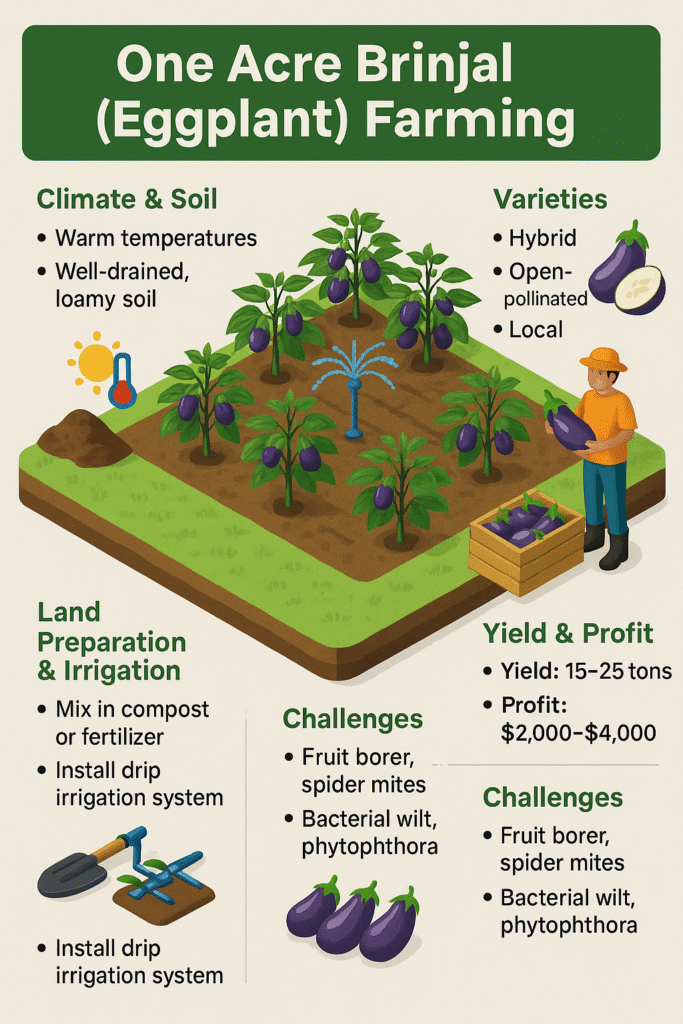
There is a special kind of calmness in a brinjal field early in the morning. The leaves are broad and velvety, their surface catching sunlight in a way few crops do. When the gentle breeze moves through the field, the plants sway slowly, and purple flowers peek through the foliage as if waking up. Eggplant, or brinjal, is a crop that carries personality. It is quiet but expressive. It withstands heat yet collapses under ignorance. It rewards attention but reacts sharply to imbalance. In many traditional farming societies across the world, eggplant is not just a vegetable—it is a presence in the field.
The story of one-acre brinjal farming begins long before seedlings touch the main soil. It begins with an understanding of how this plant behaves across continents. In Africa, eggplant grows in harsh heat yet produces reliably because locals have learned how to feed and water it. In Japan, the crop takes on delicate shapes because farmers prune and manage it like an art form. In Europe, aubergines grow in greenhouse-like environments, giving shiny deep-purple fruits that reflect sunlight like polished stones. In India and Southeast Asia, brinjal grows in open fields, adapting itself to monsoon, winter, and dry seasons with surprising flexibility.
What makes eggplant fascinating is its dual nature. It belongs to the Solanaceae family, like tomato and chilli, but it carries its own rhythm. Its leaves are larger, its root system deeper, and its flowering behaviour more forgiving. This combination gives the crop both strength and vulnerability. Strength, because it can recover quickly from mild stress. Vulnerability, because it attracts more pests than most vegetables in the world.
When a farmer prepares one acre for brinjal, he is essentially preparing a home for a long-term resident. Unlike tomatoes which finish in a few months, brinjal remains productive for six to twelve months depending on climate. This means the soil must support long-term biological activity. Farmers walk across the field, picking up handfuls of soil, feeling its temperature and texture. The soil for eggplant must be soft enough for roots to travel deeply, yet firm enough to hold moisture. Sandy soils exhaust the plant too quickly; clay soils suffocate it. The perfect soil breaks gently in the hand, crumbling like old bread.
Climate shapes the behaviour of brinjal more than many realize. In warm zones, the plant grows aggressively, producing thick branches and multiple flowering clusters. In cooler regions, it grows slowly but develops superior fruit shine and firmness. Eggplant thrives in warm temperatures but becomes stressed when heat becomes harsh. Yet, even under high temperatures, a disciplined irrigation cycle helps the crop survive.
The nursery stage lays the foundation for everything that follows. Brinjal seeds are small and light, and the seedlings grow slowly at first. Farmers must give them filtered sunlight—not harsh rays, not deep shade. Seedlings that grow in balanced conditions develop sturdy stems and compact leaves. Weak seedlings with elongated stems often lead to weak plants for the rest of the season. When these seedlings reach perfect thickness and the root ball holds shape when lifted, they are ready for transplanting.
Transplanting eggplant into the main field is a moment both hopeful and delicate. The seedlings must be spaced widely because eggplant plants eventually grow into small bushes. These bushes need air. Eggplant suffers when leaves touch the ground or walls of neighbouring plants. Poor spacing creates humid microclimates—perfect for pests like fruit borer to attack unnoticed.
As the plants adapt to the field, something magical begins. The leaves expand like giant green hands, the stems thicken, and the field transforms from lines of seedlings into a young forest. In this stage, irrigation must be gentle and rhythmic. Eggplant hates sudden changes. If the soil dries completely and then receives heavy water, the plant reacts with leaf curl or flower drop. If the soil remains too wet for too long, root rot begins silently.
One of the most beautiful stages in eggplant farming is flowering. The purple blossoms carry a softness that makes the field look almost decorative. These flowers contain pollen that moves easily, allowing natural pollination through wind and insects. When climate remains stable, flowers convert into tiny green fruits that gradually take shape. Watching a fruit grow from a flower is one of farming’s finest joys. Farmers often stop mid-field just to observe this transformation.
Nutrition plays a dramatic role in fruit quality. Eggplant demands steady nitrogen early for leaf expansion. But once flowering begins, nitrogen must soften, and potassium must rise. Potassium creates firm fruits, deep colour, and longer shelf life. Calcium strengthens fruit skin and prevents cracking. Farmers use their eyes more than any manual. They look at leaf colour, flower density, fruit shine, and plant posture to decide next actions. Brinjal farming is not a formula; it is observation.
Pests, however, tell a different story. Eggplant is the favourite target of fruit borer across the world. This pest drills small holes into developing fruits, ruining their value completely. Farmers inspect plants every morning because early detection saves half the crop. Whiteflies, aphids, mites, and leaf-eating caterpillars also appear depending on climate. But the reality is simple: a well-ventilated field with proper pruning suffers far fewer pests than dense, humid fields. Pest attacks reflect microclimate mistakes more than anything else.
Diseases appear when humidity stays high. Leaf spots, blights, and wilts creep into the field silently. But eggplant forgives quickly if conditions improve. When farmers correct irrigation timing and remove infected leaves early, the crop recovers. The biggest threats are bacterial wilt and phytophthora. These diseases destroy entire plants rapidly. Only resistant varieties and good drainage prevent this disaster.
When brinjal fruits begin appearing in bulk, the field feels alive. Fruits hang beneath leaves like ornaments. Their skin shines when sunlight brushes across them. The farmer touches them gently—testing firmness, size, and maturity. Harvesting happens frequently because brinjal grows continuously. Each picking cycle encourages the plant to produce more flowers and more fruits. A field harvested regularly looks younger, healthier, and more vibrant.
Yields vary widely. In low-input fields, one acre may give 8–12 tons. In well-managed fields, 15–25 tons. In commercial hybrid systems, 25–35 tons. Exceptional farmers achieve 40 tons or more with perfect irrigation and pruning. Eggplant is generous when cared for.
Prices shift around the world with demand cycles.
USA: $1.5–4.0/kg
Europe: $2.0–5.0/kg
Middle East: $1.0–3.0/kg
Asia: $0.2–1.0/kg
Africa: $0.1–0.5/kg
Profit per acre can be modest or incredible depending on timing.
Average profit: $2,000–$4,000
Peak season profit: $5,000–$7,000
Off-season profit (cool climates): $8,000+
But beyond money, eggplant farming teaches something rare in agriculture: patience mixed with confidence. It is a crop that keeps producing. Each harvest brings new hope. Each flowering wave re-energizes the season. Each fruit reminds the farmer that attentive farming always pays.
Standing in a mature eggplant field, you feel like you are inside a living landscape—one that talks, reacts, demands, and rewards. It is a crop that turns one acre into a season-long relationship. It needs you, listens to you, and responds to you.
And the world will always need brinjal.
Which means the world will always need the hands that farm it.
✍️Farming Writers Team
Love Farming Love Farmers
Read A Next Post 👇
https://farmingwriters.com/one-acre-tomato-farming-complete-global-guide/
Leave a ReplyShare your thoughts: We’d love to hear your farming ideas or experiences!