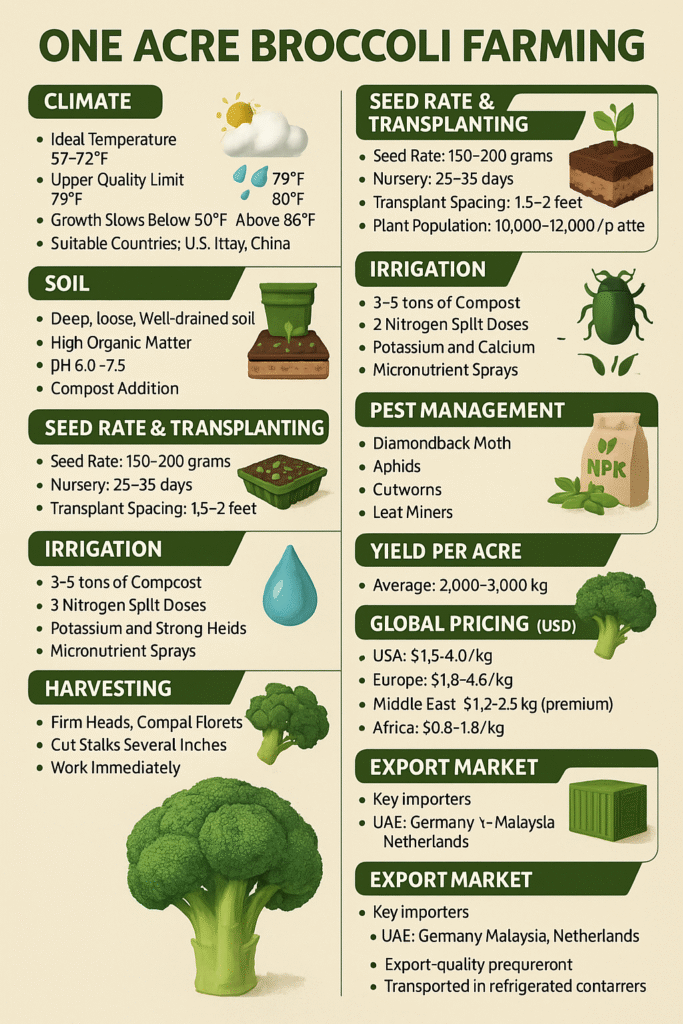
INTRODUCTION
If you have ever walked through a broccoli field in the early morning, you will remember the atmosphere forever. The air feels sharper, cooler, and more aromatic than other vegetable fields. Broccoli heads have a unique way of capturing dew, holding tiny droplets across their surface, giving them the look of frosted green domes. They appear calm and still, yet incredibly alive. Farmers often describe broccoli as a “quiet king” of winter vegetables because it grows with discipline, forms its crown steadily, and stands with a sense of structure that few crops possess.
Broccoli is more than a vegetable; it is a global nutrition powerhouse. Hospitals recommend it. Fitness industries use it. Supermarkets highlight it. Restaurants feature it in premium dishes. Export companies move it daily across borders. Its demand has expanded across continents—North America, Europe, Middle East, Asia, and Africa—making it one of the most reliable high-value crops for one-acre farming.
For youth farmers, broccoli is a gateway into modern agriculture. The crop responds to scientific precision—temperature, irrigation rhythm, soil texture, nutrition balance—and rewards farmers with solid heads that carry excellent market value. A single acre, when managed well, produces between two and four tons of premium heads, each of which carries a price several times higher than common vegetables.
This guide is written from the perspective of farmers, agronomists, exporters, and field scientists who have handled broccoli across multiple climates. You will not find robotic lines or mechanical instructions here. Every paragraph flows like a real conversation from field to market.
Let’s begin with climate.
CLIMATE REQUIREMENTS
Broccoli loves cool, steady weather.
Ideal temperature: 14–22°C
Upper limit for quality: 26°C
Below 10°C: growth slows
Above 30°C: head becomes loose and bitter
Humidity around fifty to sixty percent gives the best head formation.
Broccoli thrives in:
USA (California), Canada, Italy, Spain, Japan, China, Kenya highlands, India (winter season), Turkey, Australia.
Wherever winters are mild and stable, broccoli becomes a top-performing vegetable.
SOIL REQUIREMENTS — HUMAN FIELD VIEW
Broccoli roots go deeper than cabbage but shallower than cauliflower.
They need:
– Deep, loose soil
– High organic matter
– Perfect drainage
– pH 6.0–7.5
Soil should break softly between fingers—no clods, no stickiness.
One-acre preparation includes one deep ploughing, two harrowings, and addition of three to five tons of compost. Organic matter improves head density and flavour.
Broccoli prefers soil that stays cool. Mulching with straw or bio-mulch sheets helps reduce heat stress in tropical regions.
SEED RATE & TRANSPLANTING
Broccoli is rarely direct-seeded.
Transplanting gives more uniform heads.
– Seed rate per acre: 150–200 grams
– Nursery period: 25–35 days
– Transplant spacing: 1.5–2 feet
– Plant population: 10,000–12,000 plants per acre
Seedlings should be dark green, thick-stemmed, and short—not elongated.
IRRIGATION
Broccoli responds to water the way a sensitive instrument responds to skill—too much or too little creates immediate distortion.
Early stage: Light moisture every two or three days
Vegetative stage (day 15–35): Regular, consistent watering
Head formation: Even moisture without fluctuation
Deep cracks in soil cause “hollow stem disorder.”
Overwatering during heat causes loose heads.
Drip irrigation gives precise control.
Overhead irrigation only during cool hours.
A healthy broccoli head always feels firm, tight, and cold.
FERTILIZER MANAGEMENT — REAL AGRONOMY,
If you observe broccoli carefully during its middle growth stage, you will notice a quiet transformation. The plant begins to thicken, the leaves widen like open palms collecting sunlight, and the central stalk gradually becomes firm. At this stage, broccoli behaves like a crop that knows exactly what it wants—and when nutrition aligns with its needs, the entire field shows a uniform, bluish-green glow.
Broccoli is a heavy feeder compared to many vegetables.
Organic matter lays the foundation.
Three to five tons of compost add biological richness, improve soil structure, and stabilize moisture. Broccoli roots prefer soil that holds water gently, not aggressively.
Once the crop settles after transplanting, nitrogen becomes essential.
Farmers apply nitrogen in three small split doses, allowing steady growth rather than sudden bursts. Too much nitrogen makes the plant leafy but reduces head density. Too little nitrogen produces small, weak heads that fail to compact.
Potassium quietly shapes the personality of broccoli.
It strengthens cells, deepens colour, and enhances flavour.
Without enough potassium, heads become loose, uneven, or bitter.
Calcium is crucial for preventing hollow stem disorder, a common problem where the inner stem forms a cavity due to rapid growth. A balanced calcium-magnesium mixture brings stability to the plant’s internal structure.
Micronutrients such as boron, zinc, and molybdenum sharpen leaf texture and improve head formation.
A single boron deficiency can cause distorted heads or brown patches inside.
Regular micronutrient sprays during early vegetative stages prevent such deformities.
The farmers who grow export-grade broccoli often follow one rule:
Feed the plant steadily—not heavily.
Consistency always produces compact, beautiful heads.
WEED MANAGEMENT — REAL FIELD BEHAVIOUR
Broccoli hates competition.
Even a small weed growing close to the plant can steal nitrogen and stunt head formation.
The first twenty-five days are the most critical. Broccoli plants are still forming their canopy and cannot shade the soil enough to suppress weed growth. Farmers therefore perform hand weeding or shallow hoeing around day twelve to fifteen.
Once the leaves expand fully, the canopy naturally suppresses most weeds. In high-value fields, farmers use organic mulches or biodegradable films to maintain soil moisture and eliminate weeds simultaneously.
PEST MANAGEMENT
Broccoli attracts a specific range of pests, but the severity depends on climate and season.
Diamondback moth
This is the most persistent pest in warm regions.
The tiny caterpillars create holes in leaves and sometimes damage the forming head.
Early monitoring and biological sprays like Bt control them effectively.
Aphids
These insects cluster near young shoots, distorting growth.
Farmers detect them during cool morning hours when aphids move slowly.
Cutworms
Active at night, cutworms sever young plants at the base.
Keeping field boundaries clean and removing weeds reduces their population.
Leaf miners
They create internal tunnels inside leaves, reducing photosynthetic efficiency.
Removing infested leaves helps break their cycle.
Healthy broccoli with balanced nutrition naturally resists pests.
DISEASE MANAGEMENT
Broccoli’s biggest vulnerabilities appear when humidity rises and temperatures fluctuate.
Downy mildew
Shows as yellow patches with grey-white underside.
Cool, moist weather accelerates it.
Good airflow + copper-based sprays control it.
Black rot
A bacterial disease starting from leaf edges.
Hygiene and crop rotation are key preventive steps.
Damping-off in nursery
Occurs when seedlings sit in overly damp soil.
Well-drained nursery beds solve most problems.
Alternaria leaf spot
Circular dark spots with concentric rings.
Balanced nutrition and dry mornings prevent it.
Diseases respond strongly to microclimate.
Farmers who maintain dry foliage and good ventilation face minimal problems.
HARVESTING — THE ART OF PERFECT HEAD SELECTION
Broccoli harvesting is almost a judgement test.
Too early, and heads are small.
Too late, and florets begin to loosen or show yellowing.
Maturity arrives when the head feels firm, the dome looks tight, and the individual florets sit closely packed without any puffiness. The surface should feel cool, almost cold, even in sunlight.
Harvest is done by cutting the stalk cleanly, leaving a few inches of stem.
Farmers must work early morning to ensure freshness.
Sunlight increases respiration, making heads deteriorate faster.
After cutting, broccoli must be cooled immediately.
Hydro-cooling or cold storage at 2–4°C preserves colour and crunch for up to ten days.
YIELD PER ACRE — REAL WORLD RANGE
Broccoli yield varies significantly depending on climate and management:
Average yield: 2,000–3,000 kg/acre
High-level management: 3,500–4,000 kg/acre
Exceptional conditions (California/Spain style): 4,500+ kg/acre
The real value lies in price, not just tonnage.
GLOBAL PRICING (USD)
USA: $1.5–4.0/kg
Europe: $1.8–4.5/kg
Middle East: $2.0–3.5/kg
Asia (premium markets): $1.2–2.5/kg
Africa: $0.8–1.8/kg
Organic broccoli earns 40–90% higher prices.
PROFIT ANALYSIS — GLOBAL REAL MODEL
Yield: 3,000 kg
Average price: $1.8/kg
Total revenue: $5,400
Cost of cultivation: $1,200–$1,800
Net profit per acre: $3,500–$4,200 per cycle
Cool regions can grow two cycles per year.
Annual profit easily reaches $7,000–$9,000 per acre.
Premium export growers earn even higher margins.
EXPORT MARKET — HIGH-VALUE CARGO
Broccoli is a star in the export vegetable category.
Top importers:
UAE, Qatar, Saudi Arabia, Malaysia, Singapore, Maldives, UK, Germany, Netherlands.
Export-quality broccoli must be:
– Perfectly shaped
– Tight head
– No yellowing
– Cooled immediately
– Packed in ventilated cartons
– Transported in refrigerated containers
Air-shipped broccoli retains quality for 48–72 hours.
Export price: $2.5–4.5/kg (stable, high).
CONCLUSION
Broccoli is not a crop for careless farming.
It rewards precision, patience, and consistent management.
Every day in its field teaches something—how cool air affects head tightening, how steady moisture shapes texture, how soil softness builds strong roots, and how sunlight timing changes colour.
For youth farmers dreaming of a modern agricultural business, broccoli is a symbol of discipline and profit.
For global markets, it is a premium vegetable.
For farmers, it is a dependable, high-return companion.
One acre of broccoli, managed with care, becomes a global business model.
FAQ
- How long does broccoli take to mature?
55–95 days depending on climate and variety. - Why do broccoli heads turn yellow?
Over-maturity or high heat exposure. - Can broccoli grow in tropical countries?
Yes—in cool seasons or high-altitude regions. - Is broccoli profitable?
Very. $3,500–$4,200 per acre per cycle. - What is the biggest challenge?
Managing temperature and humidity. - Can broccoli be exported easily?
Yes—if cooled properly and shipped quickly.
✍️Farming Writers Team
Love farming Love Farmers
Read A Next Post 👇
https://farmingwriters.com/one-acre-lettuce-farming-complete-guide/
Leave a ReplyShare your thoughts: We’d love to hear your farming ideas or experiences!