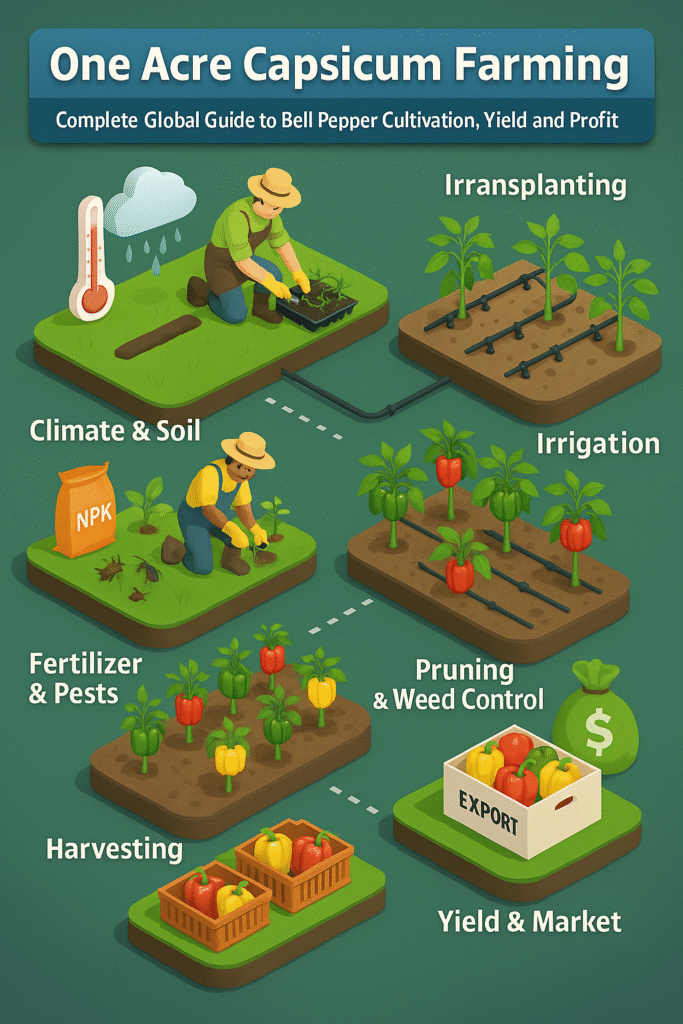
If you enter a capsicum field early in the morning, you immediately sense the crop’s unique personality. The plants stand upright, their dark green leaves shimmering softly under a thin layer of dew, and the fruits—whether green, red, or yellow—hold a glossy glow that almost looks crafted by hand. Capsicum is a crop that expresses health visually. A strong plant displays broad leaves, firm branches, and fruits that feel cool and smooth when touched.
Capsicum, or bell pepper as it is known across the world, is one of the most commercially valuable vegetables in modern agriculture. Its demand flows across hotels, supermarkets, pizza chains, fast-food restaurants, export companies, and salad industries. Unlike short-lived vegetables that fluctuate wildly in price, capsicum has a stable international market because it is used daily, and its colour varieties—red, yellow, and orange—behave like premium commodities.
For youth farmers looking to enter high-income agriculture, capsicum offers the perfect bridge between traditional farming and commercial horticulture. It responds to scientific management—temperature control, irrigation rhythm, soil structure, staking technique—and rewards discipline with glossy, high-value fruits. A single acre can generate more profit than most open-field vegetables when handled correctly.
This guide is written in a fully natural human style, merging field experience, scientific reasoning, and global agricultural understanding. Let’s begin with climate.
Capsicum is happiest in climates that feel warm but not harsh.
Ideal temperature: 18–28°C
Fruit setting: 20–25°C
Below 15°C: flowers drop
Above 32°C: fruits become small or distorted
Humidity around 50–70% supports healthy growth.
Capsicum grows exceptionally well in:
India (winter), Spain, Italy, Turkey, USA (California, Florida), Mexico, Kenya highlands, Ethiopia, Thailand, Vietnam, Australia.
Coloured capsicums require slightly cooler nights for strong pigmentation.
SOIL REQUIREMENTS — REAL FARM SENSE
Capsicum roots explore deep, requiring soil that is soft, porous, and rich in organic matter.
Ideal soil:
– Sandy loam
– Loamy soil
– Deep alluvial
pH: 6.0–7.0
The soil must drain well. Capsicum hates waterlogging; its roots suffocate quickly. Farmers prepare one acre using:
1 deep ploughing
2–3 harrowings
4–6 tons compost
Light irrigation before transplanting
Well-prepared soil ensures strong root anchoring and high fruit load.
SEED RATE, VARIETIES & TRANSPLANTING
Capsicum is always transplanted through nurseries.
Seed rate per acre: 100–150 grams
Nursery age: 25–35 days
Best seedlings:
– Thick stems
– Dark leaves
– No elongation
Transplant spacing:
– 1.5 x 2 feet
Plant population: 8,000–10,000 plants per acre
Farmers often install stakes or trellises to support branches during heavy fruiting.
IRRIGATION
Capsicum reacts instantly to moisture imbalance.
A little too much, and fruits crack.
A little too little, and fruits become thin or dull.
Early stage: light moisture daily
Vegetative stage: every 3–4 days
Flowering: even moisture, no stress
Fruit development: consistent drip irrigation
Drip irrigation is ideal because it keeps soil hydrated without wetting leaves.
Healthy capsicum plants have leaves that stay firm even during afternoon heat.
FERTILIZER MANAGEMENT
Capsicum is the kind of crop that expresses nutrition physically. When its soil is rich and balanced, the leaves take on a deep emerald colour, the branching becomes strong, and fruits develop with a glossy shine that supermarkets love. When nutrition falters, the plant immediately responds—flowers drop, leaves curl, and fruits form with thin walls. This is why farmers treat capsicum nutrition with the kind of precision normally reserved for high-value horticulture.
The foundation begins before transplanting.
Four to six tons of compost per acre create a living soil structure. In this organic matrix, moisture feels soft, roots spread easily, and beneficial microbes convert nutrients into plant-available forms. A farmer can literally feel the difference when he presses a handful of prepared soil; it neither sticks like clay nor crumbles like sand.
Once seedlings stabilize after transplanting, the vegetative stage begins.
Nitrogen becomes important at this stage, but only in controlled doses. Too much nitrogen produces lush foliage but weak fruiting. Capsicum must grow in balance—wide leaves for photosynthesis, but not so aggressive that energy shifts away from fruit setting.
Potassium is the silent architect of fruit quality.
It defines thickness, colour intensity, shine, and shelf life. When potassium is lacking, the fruits stay small or dull. With correct potassium feeding, fruits develop thick walls and strong colour pigmentation—exactly what export buyers prefer.
Calcium ensures that fruits remain firm and free from blossom-end rot, a disorder that causes soft black patches at the bottom. Calcium and boron together improve flower retention and fruit strength.
A single foliar spray at the right stage can save hundreds of fruits.
Micronutrients—especially magnesium, zinc, and iron—support leaf colour and vigour. When leaves remain dark, photosynthesis runs at full efficiency, translating directly into fruit load.
In high-value capsicum farming, nutrition is a dialogue between plant and farmer. The plant shows signs; the farmer responds.
PRUNING & TRAINING — THE SECRET BEHIND PREMIUM FRUIT LOAD
Capsicum behaves differently from other vegetables.
It forms branches aggressively, and without guidance, the canopy becomes thick, blocking airflow and reducing fruit size.
Professional farmers follow a simple principle:
Shape the plant early, and it will reward you later.
After 20–25 days, farmers remove:
– Weak side shoots
– Crisscrossing branches
– Excess inner growth
Training the plant into a two- or three-branch system improves:
– Air circulation
– Light penetration
– Fruit visibility
– Flower retention
– Disease reduction
By the time capsicum reaches mid-growth, the plant looks structured—almost like a small tree with balanced architecture.
This pruning system is the backbone of high-yield capsicum fields worldwide.
WEED MANAGEMENT
Capsicum hates weed competition.
Even a small weed patch near the root zone can rob nitrogen and stunt growth.
Farmers weed around day 12–18.
Once the canopy expands, mulching becomes extremely useful.
Organic mulches or plastic mulches both:
– Reduce weeds
– Save water
– Maintain soil temperature
– Prevent fruit-to-soil contact
Countries like Spain, Italy, and Mexico use mulching almost universally for capsicum.
PEST MANAGEMENT
Capsicum attracts a handful of persistent pests, each with its own behavioural pattern.
Thrips
These tiny insects scrape leaf surfaces, causing silvering.
They prefer hot, dry environments.
Healthy nutrition reduces severity.
Whiteflies
These pests weaken plants by sucking sap and spreading viruses.
Farmers monitor whiteflies early morning when they sit quietly under leaves.
Aphids
Small colonies appear near tender growth.
A single neem oil spray can break their cycle.
Fruit borer
Bores holes into fruits.
Early detection is key; damaged fruits must be removed.
Mites
Appear in high heat; leaves curl and become bronze.
Moisture balance controls them naturally.
Capsicum is far more pest-sensitive than crops like cabbage, but much easier to protect than crops like brinjal.
DISEASE MANAGEMENT
Most capsicum diseases start with moisture imbalance or poor ventilation.
Powdery mildew
White patches on leaves during dry, cool weather.
Improving air circulation helps tremendously.
Anthracnose
Dark patches on fruits during humid conditions.
Proper drainage reduces risk.
Bacterial leaf spot
Triggered by contaminated water.
Clean irrigation and nursery hygiene prevent 80% of cases.
Viral diseases (CMV, TMV)
Spread by whiteflies and handling.
Farmers remove infected plants early.
A capsicum field with balanced moisture and good airflow rarely develops serious disease.
FRUIT SETTING — THE MOST CRITICAL STAGE
Capsicum flowers are delicate.
Temperature fluctuations, moisture stress, or nutrient imbalance cause flower drop.
Ideal conditions for fruit setting:
– Day temperature: 20–27°C
– Night temperature: 16–20°C
– Even moisture
– Good potassium and calcium levels
Farmers lightly shake plants in the morning to help natural pollination, especially in greenhouse-like conditions.
Once fruits begin forming, the field shows a beautiful transformation—the canopy deepens in colour, small fruits appear hidden between leaves, and within days, capsicum bulbs become firm.
HARVESTING
Capsicum must be harvested based on touch and shine, not just size.
A mature fruit feels firm, glossy, and cool.
If it dents under pressure, it is overripe.
If it feels warm or thin, it needs more time.
Green capsicum is harvested earlier;
Red, yellow, and orange varieties need full colour development.
Harvesting is done early morning with clean scissors, cutting fruits along with small stems to preserve shelf life.
YIELD PER ACRE — GLOBAL RANGE
Open-field capsicum yield:
60–90 quintals (6,000–9,000 kg)
Coloured capsicum under ideal conditions:
80–120 quintals (8,000–12,000 kg)
High-performance fields:
10–14 tons per acre
This is why capsicum is considered a high-income crop.
GLOBAL PRICING (USD)
Green capsicum:
$0.8–2.0/kg (global average)
Coloured capsicum:
$1.5–4.0/kg (premium markets)
USA: $2–5/kg
Europe: $2–4.5/kg
Middle East: $1–3/kg
Asia: $0.6–2/kg
Organic bell peppers earn 40–80% premium.
PROFIT ANALYSIS — INTERNATIONAL MODEL
Let’s take a real-world example:
Yield: 9,000 kg
Average price: $1.2/kg
Revenue: $10,800
Cost of cultivation: $2,000–$3,200
Net profit: $7,000–$8,500 per acre
Coloured capsicum profit goes even higher:
$10,000–$15,000 per acre
Capsicum is truly one of the highest-paying open-field vegetables.
EXPORT MARKET — HIGH-VALUE CARGO
Export-quality capsicum must be:
– Glossy
– Firm
– Thick-walled
– Uniform size
– Perfect colour
– Free from cracks
– Cooled immediately
– Packed in ventilated trays
Top importers:
UAE, Qatar, Saudi Arabia, Singapore, Malaysia, Maldives, UK.
Export price range: $2–4/kg consistently.
CONCLUSION
Capsicum is not a crop; it is a business model.
It teaches farmers how precision transforms agriculture into profit.
Its fruits behave like premium products, its plants respond to scientific discipline, and its market is global and timeless.
For youth farmers wanting to build high-income agriculture, one acre of capsicum is a turning point.
It brings confidence, revenue, and a sense of global farming participation.
Capsicum rewards care, and punishes neglect.
But when grown right, it becomes one of the most reliable partners in a farmer’s career.
FAQ
- Why do capsicum flowers drop?
Temperature fluctuation or moisture stress. - What is the best season for capsicum?
Cool dry months or mild winter. - How much yield per acre?
6–12 tons depending on variety and care. - Why do fruits crack?
Uneven watering or sudden heavy irrigation after dryness. - Is capsicum profitable?
Yes — $7,000 to $15,000 per acre. - Can capsicum be exported?
Yes — premium varieties have strong demand.
✍️Farming Writers Team
Love farming Love Farmers
Leave a ReplyShare your thoughts: We’d love to hear your farming ideas or experiences!