• One Acre Green Peas Farming: Complete Global Guide to Climate, Cultivation, Yield and Profit

    One Acre Green Peas

    Green peas are a quiet crop.
    They don’t shout like tomatoes, they don’t spread wildly like pumpkins, and they don’t stay underground like carrots. They grow politely, climb gently, flower softly, and then suddenly fill the field with pods that feel heavier every morning. Farmers who grow peas often say the crop teaches timing more than strength. Miss the right harvest window by a few days and sweetness drops. Catch it perfectly and the market pays instantly.

    Walk into a peas field early in winter, and the air feels different. Cooler, lighter. The leaves are tender, almost fragile, and the vines hold onto their supports like fingers searching for balance. Peas are a cool-season crop by nature. They evolved to grow when heat is low and moisture stays gentle. This is why peas taste sweetest when nights are cold and days are mild.

    Across the world, peas behave with surprising consistency.
    In Europe, they are grown for freezing and processing.
    In North America, they dominate both fresh and processed vegetable markets.
    In Asia, fresh green peas command high seasonal prices.
    In Africa, peas are valued for both income and soil improvement.

    One acre of peas is not just a vegetable crop. It is also a soil-building crop, because peas belong to the legume family. Their roots host bacteria that fix nitrogen naturally. This means peas quietly improve the soil for the next crop, even while producing income.

    Soil is where peas decide their future. They prefer soil that drains well but never dries completely. Heavy clay suffocates pea roots. Loose sandy soil dries too fast. The ideal soil feels cool when touched, breaks easily in hand, and holds moisture without sticking. Farmers preparing one acre for peas often focus more on soil structure than heavy fertilization. Peas don’t like excess nitrogen; it makes vines leafy but reduces pod formation.

    Climate decides everything in peas farming.
    Ideal temperature range stays between 10–25°C.
    Above this, flowers drop.
    Below this, growth slows.

    This is why peas are typically grown in winter or early spring across most regions. In high-altitude tropical zones, peas grow almost year-round. In colder countries, peas grow in spring and early summer. Wherever nights remain cool, peas reward farmers with sweetness.

    Sowing peas feels deceptively simple. Seeds are large, round, and easy to handle. But depth matters. Too shallow and seeds dry out. Too deep and germination weakens. Farmers place seeds at a depth where moisture stays stable. Rows are kept wide enough for airflow, because peas hate stagnant humidity.

    Once seedlings emerge, the field looks gentle, almost delicate. Thin stems rise with small leaves unfolding. This is the stage where peas are most vulnerable. Strong winds, waterlogging, or heavy rain can flatten young plants. Experienced farmers install supports early—strings, nets, or thin poles—so vines learn where to climb from the beginning.

    Irrigation in peas farming is about restraint.
    Too much water causes root rot.
    Too little water makes pods small and fibrous.

    Farmers watch the soil rather than the calendar. If the soil remains cool and slightly moist below the surface, peas are comfortable. Sudden wet-dry cycles cause stress that shows later in uneven pod size.

    Nutrition for peas is surprisingly light. Because peas fix their own nitrogen, heavy nitrogen fertilizer is unnecessary and often harmful. What peas need is balanced phosphorus and potassium to support root development and pod filling. Micronutrients like molybdenum and boron quietly influence flowering and pod set. Many farmers don’t realise this until they correct deficiencies and suddenly see pod counts increase.

    Flowering in peas is subtle but beautiful. Small white or pale flowers appear along the vines. These flowers are sensitive to temperature spikes. A few hot days can reduce flowering dramatically. This is why timing of sowing matters more than anything else. Farmers who align sowing with climate windows almost always succeed.

    Once pods start forming, the field changes character. Vines feel heavier. Leaves darken slightly. Pods hide beneath foliage, filling quietly. This is the stage where peas demand consistent moisture. Any stress now reduces sweetness and size.

    Harvesting peas is all about timing, not force.
    Harvest too early and pods lack fullness.
    Harvest too late and sugars convert to starch.

    The best peas feel firm, plump, and cool to touch. Farmers often harvest early morning when pods retain maximum moisture and sweetness. In commercial fields, multiple pickings are done because pods mature in waves.

    Yield on one acre varies by management and climate.
    Low-input fields produce 3–4 tons.
    Well-managed fields produce 5–7 tons.
    High-performance systems reach 8–10 tons per acre.

    Global prices fluctuate sharply because peas are seasonal.
    Fresh green peas command premium prices in off-season windows.

    Approximate global prices (USD):
    Fresh peas: $0.8–2.5 per kg
    Processing peas: $0.3–0.8 per kg

    One acre profit ranges widely:
    Average season: $2,000–4,000
    Good timing: $5,000–7,000
    Off-season or premium market: $8,000+

    Beyond money, peas leave something behind. The soil feels softer after peas. The next crop grows better. Farmers who rotate peas with cereals or vegetables notice long-term benefits.

    Peas are not loud crops.
    They don’t demand attention every day.
    But they punish carelessness and reward precision.

    One acre of peas teaches patience, climate reading, and harvest discipline. It shows farmers that sometimes the quiet crops are the most reliable ones.

    ✍️ Farming Writers Team
    Love Farming Love Farmers

    Read A Next Post 👇

    https://farmingwriters.com/one-acre-sweet-corn-farming-global-guide/

  • One Acre Sweet Corn Farming: Complete Global Guide to Cultivation, Yield and Profit

    One Acre Sweet Corn

    Sweet corn fields sound different from other crops.
    When the wind passes through them, the leaves don’t just move  they whisper. Long, narrow leaves rub against each other and create a dry, rhythmic sound that experienced farmers instantly recognize. It is the sound of a crop that grows fast, eats fast, and sells fast.

    Sweet corn is not traditional maize. It is grown for tenderness, sugar content, and timing. Unlike grain maize that waits patiently to dry, sweet corn demands urgency. Miss the harvest window by even a few days and the sugars convert into starch, destroying market value. That single biological truth is what separates profitable sweet corn farmers from those who lose money despite good yields.

    Across the world — USA, Brazil, Thailand, China, Europe, Africa — sweet corn exists as both a fresh vegetable and an industrial raw material. It feeds street vendors, supermarkets, frozen food companies, and food processors. Because of this, one acre of sweet corn behaves more like a business cycle than a seasonal crop.

    The soil for sweet corn must feel alive but strong. Unlike carrots that want softness or onions that prefer balance, corn needs anchoring. Its roots go deep and wide, forming a strong underground network that supports tall plants and heavy cobs. Loose but well-drained loam works best. Waterlogged soil suffocates roots, while sandy soil starves them.

    Climate decides speed.
    Warm climates push rapid vegetative growth.
    Mild climates improve cob size and sugar retention.
    Excessive heat during pollination reduces kernel filling — a mistake many new farmers make without realizing why cobs stay half-empty.

    Sweet corn pollination is pure biology in action. Each tassel at the top releases pollen that must fall onto the silk of each cob. Every single silk strand represents one kernel. If moisture stress, heat stress, or wind disturbance happens at the wrong moment, kernels remain missing. Farmers who walk their fields during early mornings at tasseling stage often catch these problems before it’s too late.

    Irrigation during early growth builds plant height.
    Irrigation during tasseling builds yield.
    Irrigation during cob filling builds quality.

    Nutrition must follow the same rhythm. Early nitrogen builds foliage. Mid-stage phosphorus strengthens roots. Potassium during cob development improves size, sweetness, and shelf life. Sweet corn is greedy — but disciplined feeding keeps it profitable.

    Harvesting sweet corn is an emotional moment. You don’t cut when it looks ready; you cut when it feels right. Pressing a kernel with a fingernail should release milky juice, not water and not paste. That window is short — often just 2–4 days. Farmers who master this timing dominate markets.

    Globally, one acre sweet corn yields vary widely depending on hybrid, spacing, and season. Average production ranges from 6 to 10 tons of green cobs per acre, while high-performance farms touch even higher numbers with tight management.

    Fresh market prices fluctuate but remain attractive:
    USA & Europe often command premium prices.
    Asia and Africa benefit from volume sales.
    Processing contracts offer stability over speculation.

    Sweet corn teaches farmers speed, observation, and timing. It is not forgiving, but it is honest. When grown right, one acre becomes a fast-turnover income engine rather than a waiting game.

    ✍️Farming writers Team
    Love Farming Love Farmers                                Read A Next Post 👇

    https://farmingwriters.com/one-acre-okra-lady-finger-farming-global-guide/

  • One Acre Okra Farming: Complete Global Human Guide to Lady Finger Cultivation, Yield and Profit

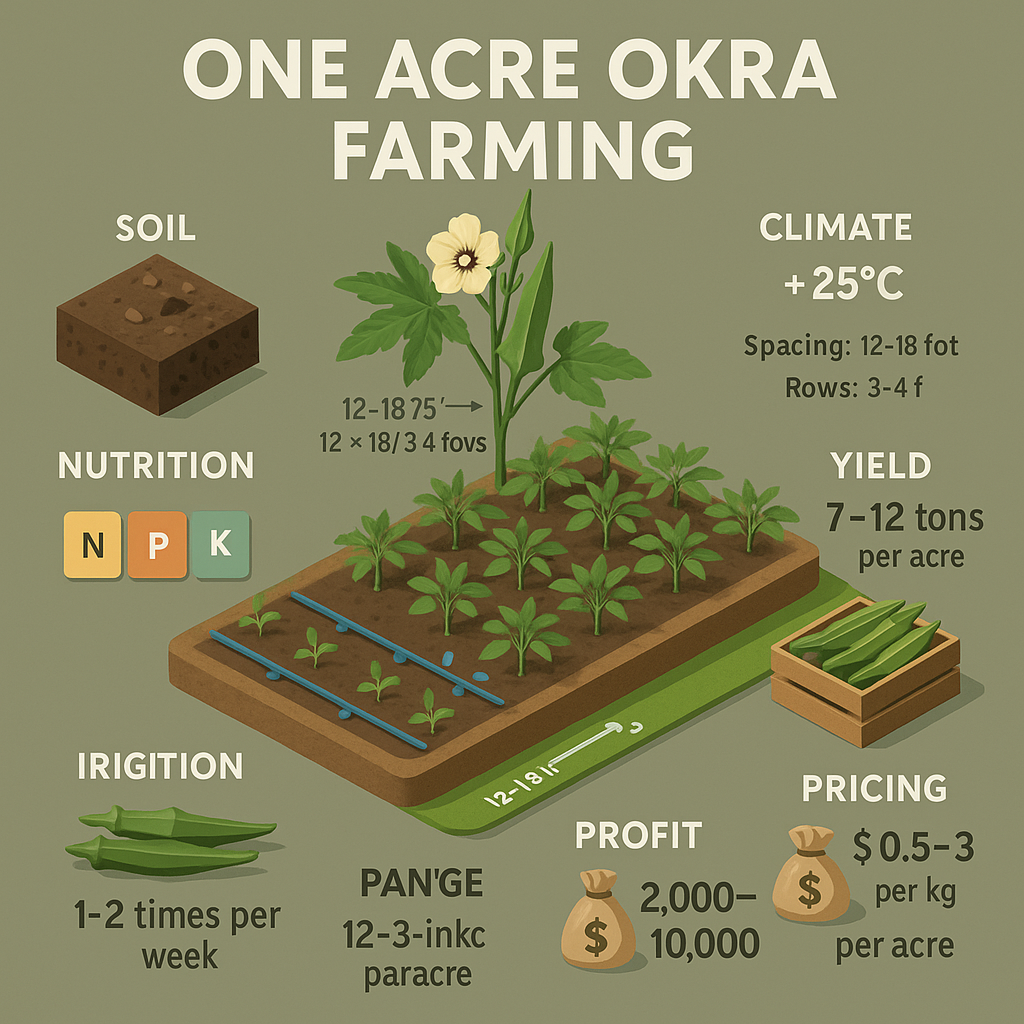
    One Acre Okra Farming

    If there is one vegetable that truly understands heat, patience, and rhythm, it is okra. Walk into an okra field at sunrise and you will notice something immediately different from other crops. The plants stand upright, confident, with broad leaves that look slightly rough to the touch. The air feels warmer between okra rows, as if the crop itself holds heat from the previous day. This is not a fragile vegetable. Okra is a survivor. It grows where others hesitate, and it produces where many crops fail.

    Across Africa, Asia, the Middle East, parts of the Americas, and even southern Europe, okra feeds millions every single day. In some countries it is a daily vegetable, in others a premium fresh-market crop, and in many regions it is both a food and a cultural identity. Because of this, okra prices behave more steadily than most vegetables. It does not disappear from markets easily, and demand rarely collapses completely. For one-acre farmers, this stability matters more than hype.

    Okra farming begins with understanding heat. This crop does not like cold soil. Seeds planted into cool earth simply sit there, waiting, sometimes rotting before they ever germinate. Experienced farmers never rush okra. They wait until soil warms naturally. When conditions are right, okra seeds respond with force. Germination is quick, and within days the field begins to show uniform green dots rising from the soil.

    The soil itself must allow okra roots to travel deep. Okra develops a strong taproot early, and if that root meets hardpan or waterlogging, the plant never reaches its potential height or yield. The best okra fields are those where the soil feels loose but not fluffy, moist but never sticky. Farmers often say that okra soil should feel “warm and alive” when you press your palm against it in the afternoon.

    Unlike crops that demand constant moisture, okra prefers controlled stress. Too much water produces excessive leaf growth with fewer pods. Too little water causes pods to become fibrous. The plant communicates clearly. When leaves remain upright and slightly glossy, moisture is correct. When leaves droop slightly during noon heat and recover by evening, the crop is balanced. When leaves remain limp even in the evening, the farmer knows irrigation has fallen behind.

    One acre of okra does not look impressive during the first few weeks. The plants grow steadily but without drama. This is the phase where many new farmers panic, comparing okra to faster crops. Experienced farmers stay calm. They know that once flowering begins, okra changes pace completely. Flowers appear suddenly, pale yellow with dark centres, opening in the morning and closing by afternoon. Each flower that opens today becomes a harvestable pod within days.

    Nutrition management in okra is subtle. Excess nitrogen produces tall plants with fewer pods. Insufficient nutrition produces thin pods and short harvesting cycles. The most productive okra fields are those where nutrition supports steady growth rather than aggressive expansion. Potassium plays a quiet but critical role in pod quality. When potassium is adequate, pods remain tender, uniform, and glossy. When it is lacking, pods harden quickly and lose market value.

    One of the reasons okra works well for one-acre farming is its harvesting pattern. Unlike crops that require a single large harvest, okra produces continuously. Harvesting begins early and continues for weeks or even months depending on climate. This spreads income across time. Farmers are not forced to sell everything at once. They can adjust harvest quantity based on market prices, labour availability, and weather.

    Pests do exist in okra fields, but the crop’s strong growth habit offers resilience. Aphids, whiteflies, fruit borers, and mites appear under certain conditions, especially where humidity and temperature combine aggressively. However, okra plants recover quickly when conditions improve. This resilience is why okra is often recommended for regions where pest pressure fluctuates unpredictably.

    Diseases usually reflect water mismanagement rather than bad luck. Leaf spots, powdery mildew, and yellowing often appear when irrigation timing is wrong or airflow is restricted. Fields with good spacing, morning irrigation, and open canopy rarely suffer serious disease outbreaks. Okra rewards farmers who understand microclimate more than chemical control.

    As harvesting intensifies, the field takes on a different energy. Farmers move through rows almost daily, fingers trained to identify the exact size that markets prefer. Harvesting too late produces tough pods. Harvesting too early reduces total yield. Timing becomes muscle memory. The sound of pods snapping cleanly from the stem becomes familiar, almost rhythmic.

    Yield per acre varies widely across the world. In basic systems, yields remain moderate. In well-managed fields with good seed, balanced nutrition, and disciplined harvesting, yields climb sharply. The real profit of okra lies not only in total tonnage but in harvesting frequency and pod quality. Tender pods command premium prices. Fibrous pods struggle even when supply is low.

    Globally, okra prices reflect cultural demand.
    In the USA and Europe, okra is a niche vegetable with high prices.
    In Africa and South Asia, it is a staple with high volume but moderate pricing.
    In the Middle East, demand remains consistent year-round due to culinary use.

    This balance creates opportunity. Farmers who understand their market position themselves accordingly. Fresh local markets, export channels, processing buyers, and restaurant supply chains all value okra differently.

    One acre of okra can generate modest income or strong profit depending on management and timing. The crop does not promise overnight wealth, but it offers something more valuable: reliability. In agriculture, reliability is often the difference between survival and growth.

    Okra teaches farmers patience in the beginning and discipline in the end. It does not rush, and it does not forgive neglect. But for those who learn its rhythm, okra becomes a dependable partner season after season.

    This is why, across continents and cultures, okra remains one of the most quietly successful one-acre crops in the world.

    ✍️Farming Writers Team
    Love Farming Love Farmers

    Read A Next Post 👇

    https://farmingwriters.com/one-acre-bottle-gourd-farming-complete-guide/

  • One Acre Bottle Gourd Farming: Complete Global Human Expert Guide to Natural Cultivation, Irrigation, Yield & Profit

    One Acre Bottle Gourd

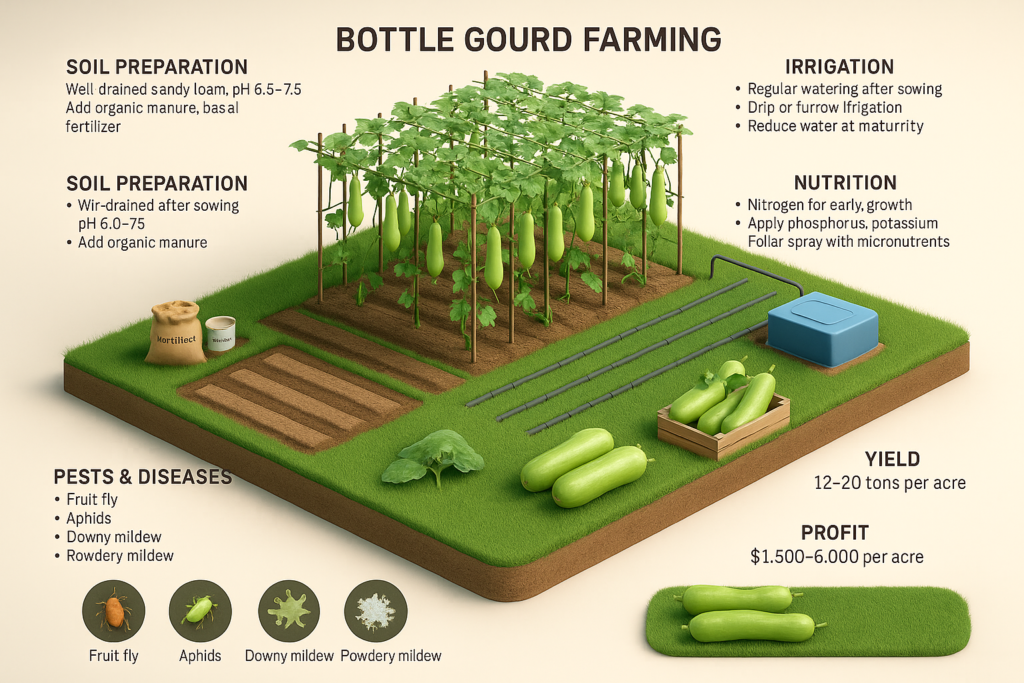
    The first impression you get when you walk into a bottle gourd field at sunrise is the strange softness of the air. Unlike brinjal or tomato plantations, the leaf canopy of bottle gourd behaves almost like a natural shelter. Large heart-shaped leaves spread across the trellis, catching the first golden rays of morning light. These leaves do not shimmer; they absorb lightnot brightly, but warmly. Beneath them, the vines move like slow creatures waking up from sleep. Bottle gourd is a climbing crop, but it does not grow with aggression. It grows with patience, extending its tendrils in careful, deliberate movements, as if choosing which direction would best suit its day.

    Bottle gourd has a quiet dignity.
    It doesn’t announce itself with strong odours or flashy flowers.
    Its white blossoms open at dusk, releasing a sweet, faint fragrance noticeable only to those who pay attention.
    The fruit itself grows silently, often surprising farmers who return after two or three days to find a tender green bottle where last week there was only a flower.

    One acre of bottle gourd farming is not just a vegetable cultivation plan—it is a rhythm-based system. Everything in this crop responds to rhythm: irrigation rhythm, sunlight rhythm, temperature rhythm, even wind rhythm. Bottle gourd vines behave like living water—they stretch, curl, climb, and bend based on how the environment speaks to them.

    The story begins with soil.
    Bottle gourd roots explore widely and deeply.
    They demand breathing space, but they also demand moisture.
    The farmer who understands bottle gourd soil knows that the land should never feel sticky or hard. When you take a handful of perfect soil, it should hold shape lightly and break gently—like a firm cake crumb.

    Climate shapes bottle gourd character more than any other factor. Warm climates bring faster fruiting; cooler climates bring stronger vines. But extreme heat exhausts the plant. Extreme cold stops it. The perfect climate lies between comfort and challenge—a zone where the plant feels nurtured but still alert.

    Preparing the land is a slow, thoughtful process.
    Farmers plough deeply not because bottle gourd roots demand it, but because loose soil encourages vines to stay healthier longer.
    Organic matter compost, decomposed manure, microbial mixtures creates a biological cushion beneath the soil surface.
    This cushion holds water like a sponge, releasing it slowly so the plant never feels thirsty suddenly.

    Nursery raising is often unnecessary for bottle gourd. Many farmers sow directly, trusting seeds to emerge through the warm soil. But in regions with heavy pest pressure, nursery seedlings provide a safer start. A healthy seedling looks confident thick stem, broad cotyledons, upright posture. If a seedling appears uncertain at this stage, it rarely becomes a strong vine later.

    Transplanting or sowing is followed by the most important decision:
    direction of vine training.
    Bottle gourd plants can grow along the ground, but fruits get scarred, plants suffer pest attack, and yield drops.
    The trellis system transforms the crop completely.
    When vines climb upward, they breathe better, flower better, and fruit better.
    Farmers who invest time in building a strong trellis never regret it.

    Once vines begin climbing, the field acquires a new personality.
    Leaves create shade underneath, forming a microclimate 3–5°C cooler than outside.
    This inner climate protects roots and fruits from harsh weather.
    It is inside this shaded zone that the bottle gourds develop their signature tenderness.

    But vines do not grow in straight lines. They wander.
    A farmer guiding bottle gourd vines often feels like guiding children—gentle nudges, soft corrections, small encouragements.
    This relationship between human and plant builds a field full of harmony.

    Irrigation becomes a psychological language.
    Bottle gourd hates emotional watering.
    A flood after dryness causes yellowing, leaf curl, and fruit bitterness.
    Steady moisture creates crisp, tender fruits with thin skin.
    Farmers check soil with their fingers, not thermometers.
    If the soil feels cool two inches deep, the plant is satisfied.
    If the soil feels warm and dry, the plant is silently asking for water.

    Nutrition follows growth stages.
    Early growth demands nitrogen—just enough to expand leaves, not enough to make the plant overconfident.
    Flowering demands potassium—to support fruit weight and outer shine.
    Micronutrients decide leaf health—iron for greenness, boron for flower strength, calcium for fruit firmness.

    Bottle gourd never hides its needs.
    Leaves pale when nitrogen is low.
    Margins burn when potassium is low.
    Flowers drop when boron is deficient.
    Farmers who watch carefully catch problems before they grow.

    Flowering is one of the most elegant phenomena in a bottle gourd field.
    White flowers open close to sunset, absorbing the last hour of light.
    Moths and night insects help pollination.
    Sometimes farmers hand-pollinate early morning to increase fruiting.
    If the climate remains stable, every healthy flower has the potential to become a fruit.

    Fruit development is astonishingly fast.
    A tiny fruit that looks like a green thumb grows into a market-ready vegetable within days.
    Farmers must harvest regularly—often every two days.
    Regular harvesting stimulates the vine to produce more flowers, more fruits, more life.

    Pests appear as shadows rather than monsters.
    Fruit fly lays eggs beneath the skin.
    Aphids cling silently to tender shoots.
    Leaf-eating caterpillars scrape foliage.
    But a well-ventilated trellis reduces half the battle.
    Bottle gourd plants grown on the ground suffer more pests because humidity traps around leaves.

    Diseases follow moisture imbalance.
    Downy mildew prefers humid evenings.
    Powdery mildew arrives in dry heat.
    Anthracnose spots leaves after rain.
    But a good trellis and morning irrigation reduce disease almost magically.

    Harvesting bottle gourd feels like uncovering promise after promise.
    Each fruit feels cool in hand, smooth in texture, firm but gentle.
    A good bottle gourd has a soft, fresh aroma—a sign of perfect hydration.
    Farmers know readiness by the sound:
    a tender gourd gives a dull, soft thump when tapped;
    an over-mature one gives a hollow sound.

    Yields differ widely across the world.
    Small systems produce modest harvests.
    Professional trellised systems produce astonishing yields.

    One acre typically yields:
    Low input: 8–10 tons
    Medium input: 12–15 tons
    High input: 16–20 tons
    Commercial systems: 22–30 tons

    Prices vary by region:
    USA: $1–3/kg
    Europe: $1.5–4/kg
    Middle East: $0.8–2/kg
    Asia: $0.2–1/kg

    Profit per acre ranges from $1,500 to $6,000 depending on season and region.
    But beyond economics, bottle gourd farming teaches emotional balance.

    It teaches patience without frustration.
    It teaches observation without panic.
    It teaches that plants speak softly, and farmers must learn to listen.

    A one-acre bottle gourd field is not just a vegetable project.
    It is a daily conversation between nature and intention.
    And the world will always need this humble, universal vegetable
    which means the world will always need the hands that grow it.

    ✍️ Farming Writers Team

    Love Farming Love Farmers

    Read A Next Post 👇

    https://farmingwriters.com/one-acre-turmeric-farming-global-complete-guide/

  • One Acre Turmeric Farming: Complete Global -Expert Guide to Cultivation, Yield and Profit

    One Acre Turmeric Farming

    Turmeric fields do not announce themselves loudly. There are no flashy colours at the beginning, no dramatic flowering stage, no immediate return. Instead, turmeric farming feels calm, steady, and deeply rooted—both literally and economically. When you stand in a turmeric field after the first monsoon rain or early irrigation, the air carries a warm, earthy fragrance mixed with something faintly medicinal. It is subtle but recognisable. Farmers with experience can identify turmeric fields blindfolded just by smell.

    Turmeric is not a fast crop. It is a trust crop. Farmers who choose turmeric on one acre are choosing patience, long-term planning, and global relevance. Turmeric does not depend on one cuisine, one culture, or one market. It is used in kitchens, medicine cabinets, cosmetic factories, religious rituals, pharmaceutical labs, and even textile industries. Very few crops enjoy such universal respect.

    Across the world, turmeric adapts quietly.
    In India, it grows as a traditional cash crop tied to monsoon rhythm.
    In Southeast Asia, it thrives in humid climates, growing vigorously under partial shade.
    In Africa, turmeric has emerged as a high-potential export spice, prized for colour strength.
    In Europe and North America, turmeric is increasingly grown for organic and medicinal markets, where quality matters more than volume.

    One acre of turmeric farming begins with soil that feels forgiving. Turmeric rhizomes expand horizontally, pushing gently through the soil as they grow thicker and longer. Hard soils restrict this movement, producing small, malformed fingers. Ideal turmeric soil feels loose, deep, and warm. When you dig your fingers into good turmeric soil, it should not resist. It should open easily, holding moisture without becoming sticky.

    Climate decides turmeric personality. The crop loves warmth, moderate humidity, and steady moisture. Turmeric dislikes sudden cold, prolonged drought, and waterlogging. It thrives in temperatures where the air feels comfortably warm rather than hot. This is why turmeric aligns naturally with monsoon-fed systems and controlled irrigation systems equally well.

    Planting turmeric is unlike seed-based crops. What you put into the ground is not a seed but a living rhizome filled with stored energy. Each rhizome is already a plant waiting to wake up. Farmers select healthy, disease-free turmeric fingers carefully. Large, plump rhizomes produce stronger plants. Weak or shrivelled rhizomes result in uneven growth that never truly recovers.

    When turmeric is planted, the field looks empty for weeks. This is where inexperienced farmers panic. But underground, something intense is happening. The rhizomes swell, emit roots, and send shoots upward quietly. When the first green leaves finally break the soil surface, they unfold slowly, wide and glossy, almost like banana leaves in miniature. This stage confirms that the invisible work beneath the earth is underway.

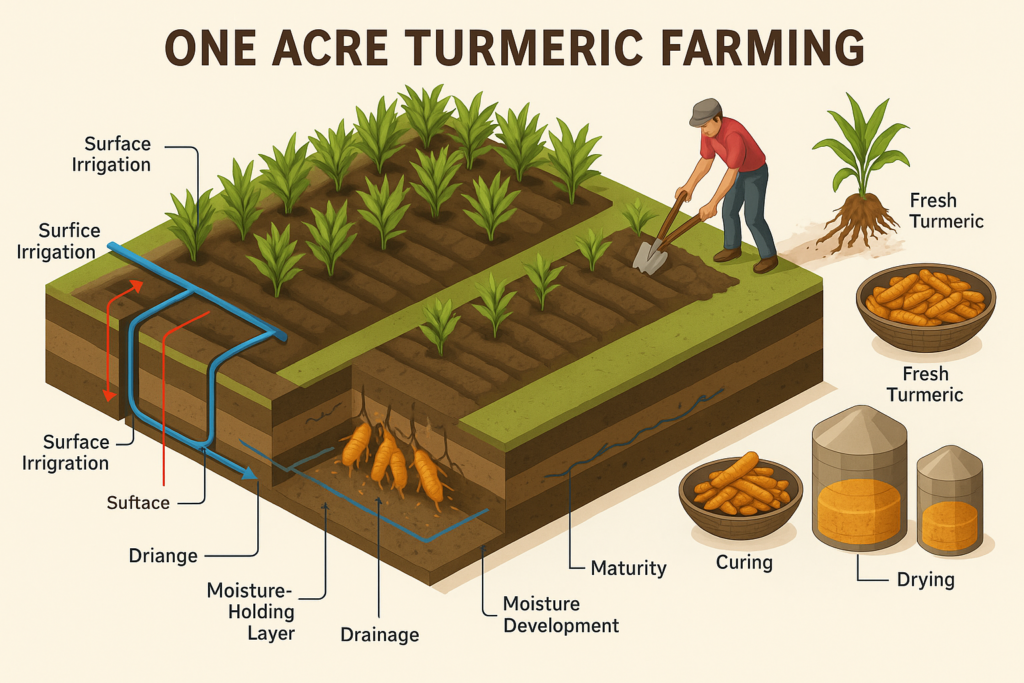
    Turmeric irrigation must follow patience rather than force. Too much water rots rhizomes silently beneath the soil. Too little water stalls growth permanently. Farmers who succeed with turmeric learn to read soil moisture by touch rather than schedule. They water when soil begins to lose coolness, not when it becomes dry. Consistency builds uniform rhizomes, which matter greatly in global spice markets.

    Nutrition in turmeric serves two goals: vegetative strength above ground and rhizome expansion below ground. Nitrogen supports leaf development, but excess nitrogen delays rhizome maturity. Potassium strengthens finger formation, colour intensity, and storage life. Organic matter plays a larger role here than in many vegetables, providing slow nutrition and improving soil behaviour over the long growing season.

    Weed pressure is heavy in turmeric fields during early growth. Because turmeric grows slowly at the beginning, fast-growing weeds easily dominate if ignored. Farmers invest effort in early field cleanliness, knowing that once leaves spread and shade the ground, weed pressure reduces naturally. Clean early growth leads to stress-free later months.

    Turmeric pests rarely attack aggressively above ground, but underground pests can cause silent damage. Rhizome rot, nematodes, and fungal infections typically arise from poor drainage or contaminated planting material. Farmers who rotate crops and avoid turmeric after turmeric protect their soil naturally. Disease prevention in turmeric is more about discipline than treatment.

    As months pass, turmeric plants grow tall, forming a lush canopy that hides the soil completely. The field feels alive and humid even on warm days. At this stage, the farmer’s role reduces. The crop largely manages itself if early decisions were correct. Leaves capture sunlight, transport energy downward, and enlarge rhizomes steadily.

    Maturity announces itself through decline. Leaves slowly turn yellow, then dry. This is not sickness; it is completion. When most foliage naturally collapses, the underground rhizomes have reached full size and potency. Farmers resist the temptation to harvest early, because turmeric gains colour and weight significantly in its final weeks.

    Harvesting turmeric feels heavy. Rhizomes emerge coated in soil, thick, knotted, and aromatic. Hands get stained yellow instantly. The smell fills the air. At this moment, turmeric reveals its real value. Fresh weight feels impressive, but every farmer knows that processing decides final profit.

    After harvest, turmeric undergoes curing and drying. Boiling, drying, polishing—each step affects colour, aroma, and market grade. This is where turmeric shifts from crop to commodity. Poor processing destroys value. Good processing multiplies it.

    Yield per acre varies with variety and care.
    Traditional yields range between 6–8 tons fresh rhizome.
    Improved practices reach 10–12 tons.
    High-performing fields exceed this.

    Dry turmeric yield usually stands around one-fifth of fresh weight.

    Global turmeric prices depend heavily on quality.
    USA: $3–10/kg (organic grade higher)
    Europe: $4–12/kg
    Middle East: $3–8/kg
    Asia: $1–4/kg
    Africa: $2–6/kg

    Export-grade turmeric earns far more than bulk market turmeric. Colour strength, aroma, cleanliness, and moisture content make the difference.

    Profit from one acre of turmeric ranges widely.
    Low-input systems earn modest but stable returns.
    Well-managed export systems earn $4,000–$8,000 per acre.
    Organic and value-added turmeric exceeds this significantly.

    Turmeric does not rush farmers, and farmers should not rush turmeric. It teaches long-term thinking, soil respect, and process discipline. It is a crop that grows quietly but sells loudly across the world.

    One acre of turmeric is not about speed.
    It is about depth, consistency, and trust in the invisible.

    ✍️Farming Writers Team

    Love Farming Love Farmers

    Read A Next Post 👇

    https://farmingwriters.com/one-acre-cucumber-farming-complete-global-guide/

  • One Acre Cucumber Farming: Complete Global Human-Expert Guide to Cultivation, Yield, Irrigation & Profit

    One Acre Cucumber Farming

    There is a particular sound you hear when you walk into a cucumber field just after sunrise. It is not silence, and it is not noise either. It is the soft brushing of broad leaves against each other, a kind of living whisper that tells you the field is growing fast. Cucumbers are impatient crops. They do not wait to announce themselves. Unlike carrots that hide underground or onions that mature slowly, cucumbers express everything on the surface leaf size, vine length, flower health, fruit load, water stress. For a farmer, cucumbers feel like farming in real time.

    Across the world, cucumber behaves like a universal vegetable with local accents. In Europe, long straight cucumbers dominate shelves, glassy and uniform. In Asia, shorter, tender cucumbers sell daily in open markets. In the Middle East, crunchy thick varieties move fast in hotels and restaurants. In Africa, cucumbers grow aggressively in heat, demanding water discipline. In North America, both slicing and pickling cucumbers form their own powerful markets. This adaptability makes cucumber one of the most reliable one-acre vegetables for quick income, especially for young farmers who want to see results within weeks, not months.

    One acre of cucumber farming begins with understanding speed. Cucumbers are fast by nature. They germinate quickly, spread rapidly, flower early, and fruit within a short window. This speed is both their strength and weakness. If irrigation slips for even a few days, fruit shape changes. If nutrition is delayed, flowers drop. If humidity stays trapped, disease overtakes the vine before the farmer notices. Successful cucumber farming is about staying one step ahead rather than reacting late.

    Soil sets the temperament of the crop. Cucumbers love loose, warm, well-drained soil that allows roots to breathe and stretch. When a farmer presses cucumber soil in his palm, it should hold briefly and then fall apart softly. Heavy clay soils trap water, suffocate roots, and invite rot. Very sandy soils dry too fast, stressing vines. The best cucumber soils sit somewhere in between, rich with organic matter that holds moisture gently rather than aggressively. Compost mixed during land preparation does not just feed the crop; it stabilizes the entire soil ecosystem for rapid root expansion.

    Climate plays a loud role in cucumber success. Cucumbers adore warmth but protest against extremes. In mild warm weather, vines grow with enthusiasm, leaves remain broad and healthy, and flowers convert smoothly into fruits. Excessive heat causes flower shedding. Cold nights slow growth and invite fungal trouble. This is why cucumber seasons across the world align with moderate warmth — spring, early summer, or winter in tropical regions. Farmers who choose the wrong season fight the climate continuously. Those who choose the right window ride along with it.

    Sowing cucumbers is an act of optimism. The seeds are larger than most vegetables, firm between fingers, carrying visible energy. Whether planted directly or transplanted from nursery, cucumbers respond quickly to good placement. Direct seeding remains common because cucumbers dislike root disturbance. Farmers create raised beds, making sure drainage is perfect, especially in regions where sudden rains arrive. A seed placed at the correct depth emerges confidently, its cotyledons opening like two green hands greeting the world.

    Within days, the field transforms from bare soil into lines of young vines. This stage demands discipline. Weeds grow faster than cucumber seedlings initially, and competition at this stage permanently reduces yield. Early field cleanliness decides the final fruit count. Farmers who maintain clean beds early enjoy smoother seasons later.

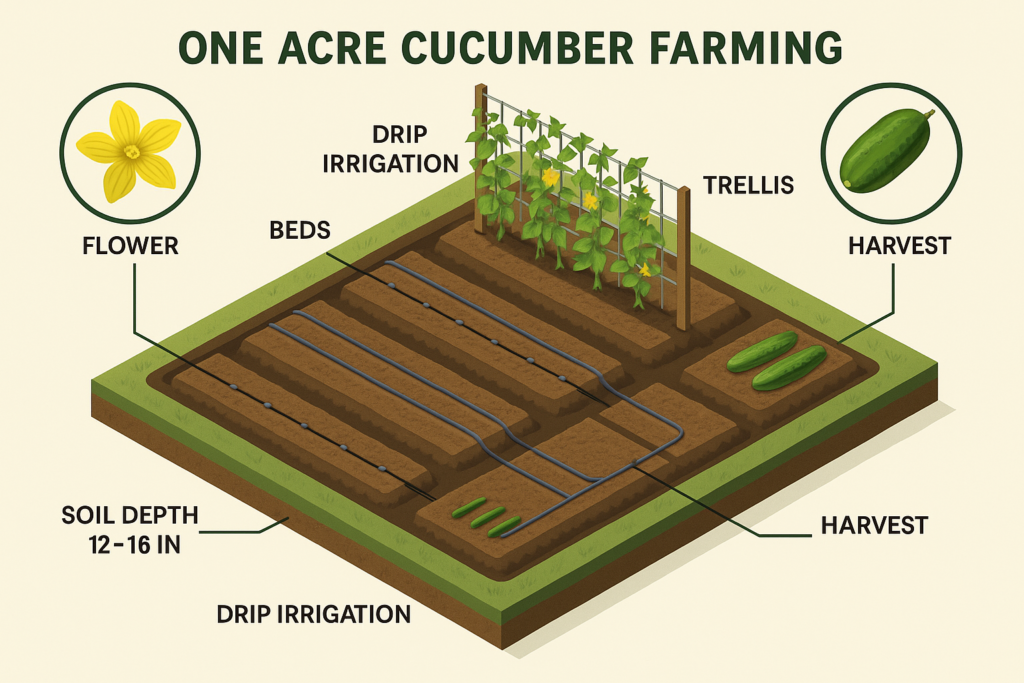
    Irrigation becomes the pulse of cucumber farming almost immediately. Cucumbers are water-loving plants, but they hate waterlogging. Roots demand moisture, but leaves resent constant wetness. This balance makes drip irrigation ideal. Water delivered directly to the root zone keeps vines hydrated while leaves remain dry, reducing disease risk. In traditional irrigation systems, farmers water early morning, never late evening, allowing foliage to dry during daylight.

    As vines stretch and leaves expand, the field begins to look alive in a very visible way. Leaves overlap, forming a canopy that shades soil and conserves moisture naturally. This canopy is both a blessing and a risk. While it helps retain moisture, it can trap humidity if airflow is poor. Farmers often guide vines gently, spacing them to allow breathing room. In trellised cucumber systems, vines climb upward, improving air movement and producing straighter fruits that fetch premium prices in supermarkets.

    Flowering arrives early in cucumbers and continues relentlessly. Male flowers appear first, followed by female flowers identifiable by a tiny fruit already forming behind the bloom. This is one of cucumber’s miracles — the fruit announces itself before pollination even finishes. Pollination quality decides fruit shape. Poor pollination leads to curved or misshapen cucumbers. In open fields, bees play a major role. In protected systems, farmers encourage airflow or gentle vibration to assist pollination.

    Nutrition in cucumbers demands balance. Excess nitrogen produces massive leaves but fewer fruits. Insufficient potassium weakens fruit firmness and shelf life. Cucumbers enjoy steady feeding rather than heavy doses. Farmers read the vines like text. Pale leaves signal hunger. Thick dark leaves with poor flowering signal imbalance. Fruits that taper sharply indicate stress. Everything shows on the surface.

    Cucumber pests arrive quietly but spread fast. Aphids cluster under leaves, sucking energy. Whiteflies disturb vines and spread viruses. Thrips scar leaf surfaces and flowers. Fruit flies attack mature cucumbers in some regions. Farmers who walk their fields daily notice pest presence early, long before damage becomes visible to outsiders. The most effective pest management begins with observation, not spraying.

    Disease pressure follows humidity. Powdery mildew coats leaves with white residue in dry yet humid conditions. Downy mildew strikes in cooler, damp weather, yellowing leaves rapidly. Angular leaf spot appears after rainstorms. These diseases thrive in stagnant air. Fields with open spacing, balanced irrigation, and healthy nutrition suffer far less. Cucumbers punish neglect but forgive quickly if conditions improve.

    Harvesting cucumbers feels almost continuous. Unlike crops harvested once, cucumbers demand regular picking. Each harvest encourages new fruit set. Delayed harvesting slows vine productivity. Farmers harvest early morning when fruits are cool, crisp, and hydrated. A mature cucumber snaps cleanly from the vine, firm but not hard, glossy but not over-grown. Overgrown fruits steal energy from the plant and reduce overall yield.

    The first harvest always excites farmers. The field suddenly turns profitable early in the season, offering immediate cash flow. This quick return is why cucumbers remain popular with small and youth farmers across continents. The plant gives back quickly to those who care consistently.

    Yields vary with system and management.
    Low-input fields produce around 8–10 tons per acre.
    Well-managed open fields reach 12–18 tons.
    Trellised or protected systems exceed 20–25 tons.
    Exceptional commercial farms push even higher.

    Global cucumber prices remain relatively stable because daily demand never disappears.
    USA: $0.8–2.5/kg
    Europe: $1.0–3.0/kg
    Middle East: $0.6–2.0/kg
    Asia: $0.2–1.0/kg
    Africa: $0.1–0.5/kg

    Profit per acre reflects season and market proximity.
    Average profit ranges from $2,000 to $4,000.
    Peak-season or off-season cucumber fetches $5,000–$7,000.
    Protected cultivation pushes profits even further.

    Cucumber farming teaches speed combined with sensitivity. It teaches farmers to react early, observe constantly, and respect rhythm. Miss a few days, and the crop shows disappointment. Stay attentive, and it rewards generously.

    Standing in a healthy cucumber field during peak harvest feels energizing. The vines continue growing, flowers continue opening, fruits continue forming. The field does not pause. It asks for attention every day and promises return every day.

    One acre of cucumbers is not a waiting game.
    It is an active conversation between farmer, vine, soil, and weather.
    And for those who listen carefully, it speaks the language of quick success.

    ✍️Farming Writers Team
    Love Farming Love Farmers

    Read A Next Post 👇

    https://farmingwriters.com/one-acre-carrot-farming-complete-global-guide/

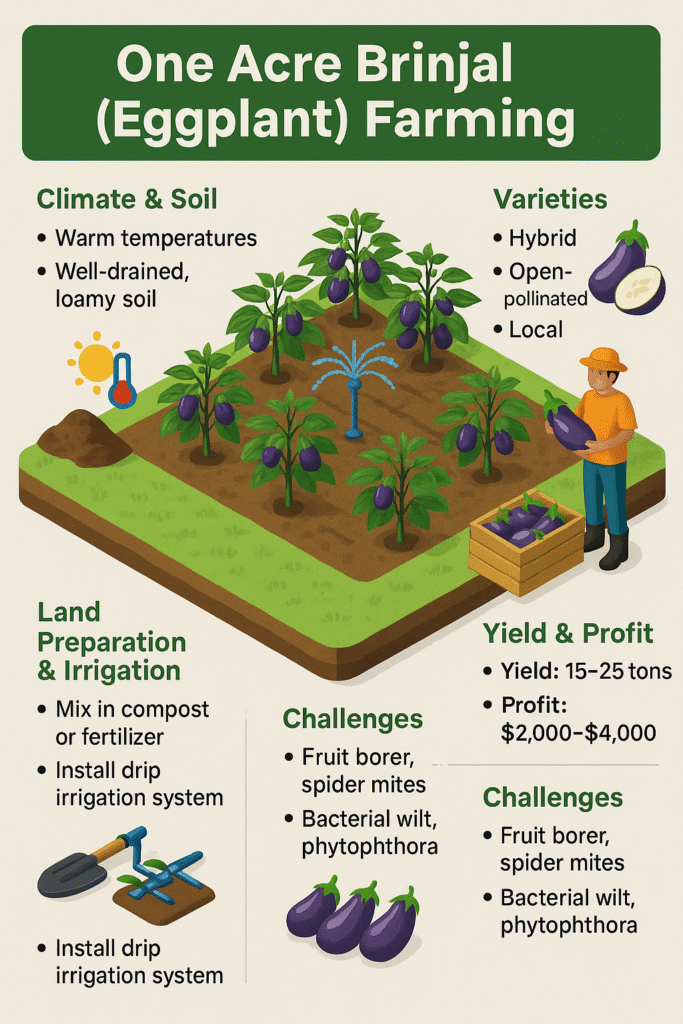
  • One Acre Brinjal (Eggplant) Farming: Complete Global Human Expert Guide With Yield and Profit

    One Acre Brinjal (Eggplant) Farming

    There is a special kind of calmness in a brinjal field early in the morning. The leaves are broad and velvety, their surface catching sunlight in a way few crops do. When the gentle breeze moves through the field, the plants sway slowly, and purple flowers peek through the foliage as if waking up. Eggplant, or brinjal, is a crop that carries personality. It is quiet but expressive. It withstands heat yet collapses under ignorance. It rewards attention but reacts sharply to imbalance. In many traditional farming societies across the world, eggplant is not just a vegetable—it is a presence in the field.

    The story of one-acre brinjal farming begins long before seedlings touch the main soil. It begins with an understanding of how this plant behaves across continents. In Africa, eggplant grows in harsh heat yet produces reliably because locals have learned how to feed and water it. In Japan, the crop takes on delicate shapes because farmers prune and manage it like an art form. In Europe, aubergines grow in greenhouse-like environments, giving shiny deep-purple fruits that reflect sunlight like polished stones. In India and Southeast Asia, brinjal grows in open fields, adapting itself to monsoon, winter, and dry seasons with surprising flexibility.

    What makes eggplant fascinating is its dual nature. It belongs to the Solanaceae family, like tomato and chilli, but it carries its own rhythm. Its leaves are larger, its root system deeper, and its flowering behaviour more forgiving. This combination gives the crop both strength and vulnerability. Strength, because it can recover quickly from mild stress. Vulnerability, because it attracts more pests than most vegetables in the world.

    When a farmer prepares one acre for brinjal, he is essentially preparing a home for a long-term resident. Unlike tomatoes which finish in a few months, brinjal remains productive for six to twelve months depending on climate. This means the soil must support long-term biological activity. Farmers walk across the field, picking up handfuls of soil, feeling its temperature and texture. The soil for eggplant must be soft enough for roots to travel deeply, yet firm enough to hold moisture. Sandy soils exhaust the plant too quickly; clay soils suffocate it. The perfect soil breaks gently in the hand, crumbling like old bread.

    Climate shapes the behaviour of brinjal more than many realize. In warm zones, the plant grows aggressively, producing thick branches and multiple flowering clusters. In cooler regions, it grows slowly but develops superior fruit shine and firmness. Eggplant thrives in warm temperatures but becomes stressed when heat becomes harsh. Yet, even under high temperatures, a disciplined irrigation cycle helps the crop survive.

    The nursery stage lays the foundation for everything that follows. Brinjal seeds are small and light, and the seedlings grow slowly at first. Farmers must give them filtered sunlight—not harsh rays, not deep shade. Seedlings that grow in balanced conditions develop sturdy stems and compact leaves. Weak seedlings with elongated stems often lead to weak plants for the rest of the season. When these seedlings reach perfect thickness and the root ball holds shape when lifted, they are ready for transplanting.

    Transplanting eggplant into the main field is a moment both hopeful and delicate. The seedlings must be spaced widely because eggplant plants eventually grow into small bushes. These bushes need air. Eggplant suffers when leaves touch the ground or walls of neighbouring plants. Poor spacing creates humid microclimates—perfect for pests like fruit borer to attack unnoticed.

    As the plants adapt to the field, something magical begins. The leaves expand like giant green hands, the stems thicken, and the field transforms from lines of seedlings into a young forest. In this stage, irrigation must be gentle and rhythmic. Eggplant hates sudden changes. If the soil dries completely and then receives heavy water, the plant reacts with leaf curl or flower drop. If the soil remains too wet for too long, root rot begins silently.

    One of the most beautiful stages in eggplant farming is flowering. The purple blossoms carry a softness that makes the field look almost decorative. These flowers contain pollen that moves easily, allowing natural pollination through wind and insects. When climate remains stable, flowers convert into tiny green fruits that gradually take shape. Watching a fruit grow from a flower is one of farming’s finest joys. Farmers often stop mid-field just to observe this transformation.

    Nutrition plays a dramatic role in fruit quality. Eggplant demands steady nitrogen early for leaf expansion. But once flowering begins, nitrogen must soften, and potassium must rise. Potassium creates firm fruits, deep colour, and longer shelf life. Calcium strengthens fruit skin and prevents cracking. Farmers use their eyes more than any manual. They look at leaf colour, flower density, fruit shine, and plant posture to decide next actions. Brinjal farming is not a formula; it is observation.

    Pests, however, tell a different story. Eggplant is the favourite target of fruit borer across the world. This pest drills small holes into developing fruits, ruining their value completely. Farmers inspect plants every morning because early detection saves half the crop. Whiteflies, aphids, mites, and leaf-eating caterpillars also appear depending on climate. But the reality is simple: a well-ventilated field with proper pruning suffers far fewer pests than dense, humid fields. Pest attacks reflect microclimate mistakes more than anything else.

    Diseases appear when humidity stays high. Leaf spots, blights, and wilts creep into the field silently. But eggplant forgives quickly if conditions improve. When farmers correct irrigation timing and remove infected leaves early, the crop recovers. The biggest threats are bacterial wilt and phytophthora. These diseases destroy entire plants rapidly. Only resistant varieties and good drainage prevent this disaster.

    When brinjal fruits begin appearing in bulk, the field feels alive. Fruits hang beneath leaves like ornaments. Their skin shines when sunlight brushes across them. The farmer touches them gently—testing firmness, size, and maturity. Harvesting happens frequently because brinjal grows continuously. Each picking cycle encourages the plant to produce more flowers and more fruits. A field harvested regularly looks younger, healthier, and more vibrant.

    Yields vary widely. In low-input fields, one acre may give 8–12 tons. In well-managed fields, 15–25 tons. In commercial hybrid systems, 25–35 tons. Exceptional farmers achieve 40 tons or more with perfect irrigation and pruning. Eggplant is generous when cared for.

    Prices shift around the world with demand cycles.
    USA: $1.5–4.0/kg
    Europe: $2.0–5.0/kg
    Middle East: $1.0–3.0/kg
    Asia: $0.2–1.0/kg
    Africa: $0.1–0.5/kg

    Profit per acre can be modest or incredible depending on timing.
    Average profit: $2,000–$4,000
    Peak season profit: $5,000–$7,000
    Off-season profit (cool climates): $8,000+

    But beyond money, eggplant farming teaches something rare in agriculture: patience mixed with confidence. It is a crop that keeps producing. Each harvest brings new hope. Each flowering wave re-energizes the season. Each fruit reminds the farmer that attentive farming always pays.

    Standing in a mature eggplant field, you feel like you are inside a living landscape—one that talks, reacts, demands, and rewards. It is a crop that turns one acre into a season-long relationship. It needs you, listens to you, and responds to you.

    And the world will always need brinjal.
    Which means the world will always need the hands that farm it.

    ✍️Farming Writers Team
    Love Farming Love Farmers

    Read A Next Post 👇

    https://farmingwriters.com/one-acre-tomato-farming-complete-global-guide/

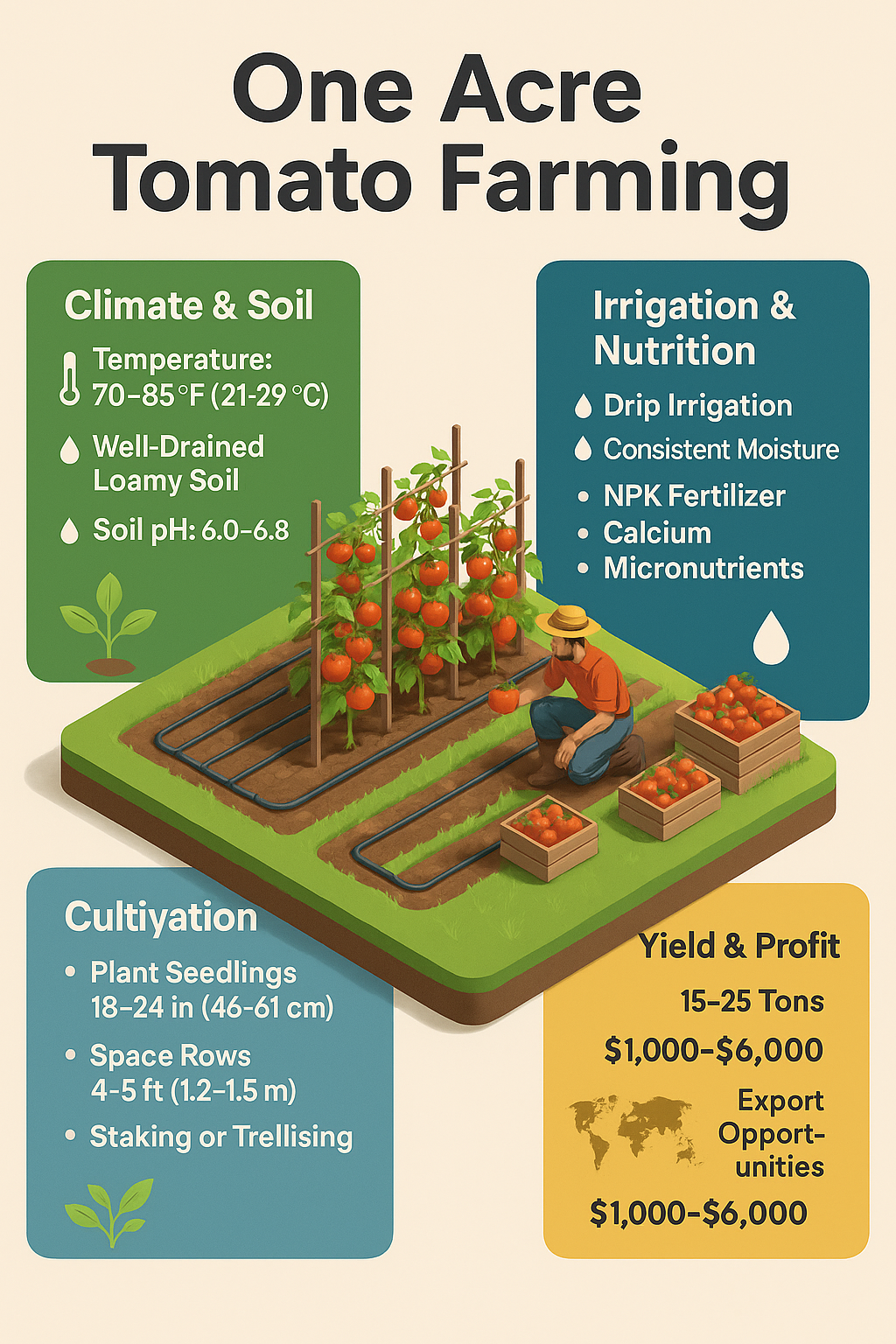
  • One Acre Tomato Farming: Complete Global Human-Expert Guide to Cultivation, Irrigation, Yield and Profit

    One Acre Tomato Farming

    Standing in a tomato field during the earliest hour of daylight feels like entering a place that is half-garden and half-factory. The leaves emit a strong, distinctive smell—sharp, earthy, green—something that stays on your fingers even when you try to wash it away. Tomatoes are emotional crops for many farmers. They grow fast, change fast, react fast, and reward fast—but they punish fast too. Their lifecycle resembles a human mood: cheerful when cared for, fragile when stressed, explosive when ignored. This is why tomato farming is considered both art and science across the world.

    Tomato is one of the most universal crops humanity has ever grown. Every country uses it every day—raw, cooked, juiced, processed, pureed, dried, canned. There is no kitchen in the world where tomatoes don’t shape flavour. They influence market inflation, restaurant decisions, export policies, and farmer income cycles. In fact, many agricultural economists say a country’s vegetable stability can be predicted by tomato price trends alone.

    When a farmer chooses to grow tomatoes on one acre, he is stepping into a business with global demand but local sensitivity. Tomatoes respond to climate with almost immediate feedback. Too much heat brings flower drop, too much moisture brings fungal disease, and too little nutrition brings weak stems. Yet, when you manage tomatoes with understanding, the field transforms into a carpet of green vines loaded with bright red globes—each one carrying the promise of a good season.

    The first chapter in the tomato story starts with climate. Tomatoes love warmth but not harshness. In the early morning of a healthy tomato field, the temperature feels gentle—neither cold nor hot. Leaves stay firm, slightly waxy, holding tiny dew droplets that look like pearls resting on soft velvet. This leaf firmness is the first sign of plant health. A stressed tomato plant shows limp leaves by afternoon. A balanced one holds its posture even under sun.

    Ideal temperatures for tomatoes sit between mild and warm. But tomatoes grown in cooler regions, like Europe or northern USA, develop stronger colour and better flavour because the plant matures slowly. In hot zones like Africa or South Asia, tomatoes grow faster but demand strict irrigation rhythm. Tomato is essentially a fruit, and fruits need rhythm to form.

    The soil for tomatoes must feel alive. It should crumble in hand, not stick. Deep soils allow the roots to explore downward, anchoring the plant and enabling it to take up the nutrition required for heavy fruiting. A well-prepared tomato acre carries a distinct texture—moist but not soggy, soft but not sandy. Farmers mix compost, not to make soil rich, but to make it breathe. When tomato roots sense aeration, they expand with courage.

    Tomato seedlings grown in nurseries reflect the farmer’s level of care more than any other crop. A nursery that is too shaded produces weak, elongated plants. A nursery that receives proper filtered sunlight produces compact seedlings with thick stems that promise strong fruiting later. Farmers often talk about “first fifty days deciding last fifty days,” referring to the idea that good seedlings predict good production.

    Transplanting tomatoes into the main field is like giving them their permanent home. Each plant must be placed deeply enough for the stem to form additional roots but not so deep that stem rots. Spacing varies by variety, but the principle remains the same: tomatoes must breathe. Airflow is a silent protector in tomato fields. It keeps humidity low and prevents half the world’s diseases.

    Once tomatoes begin vegetative growth, the field transforms daily. Leaves expand, stems thicken, and small clusters of yellow flowers appear. These flowers are delicate. They demand calm temperature, steady moisture, and gentle nutrition. Every flower cluster is a potential fruit cluster. Farmers know that the number of successful flowers ultimately defines yield.

    Irrigation becomes the heartbeat of tomato farming. Tomatoes hate emotional watering—big floods followed by drought. They want consistency. If soil stays evenly moist, tomatoes grow uniformly, fruits fill properly, and cracking remains minimal. A farmer who understands irrigation can identify problems simply by touching the soil—he knows when the earth needs a drink and when it needs rest.

    Nutrition is another world altogether. Tomato plants demand calcium for firmness, potassium for fruit weight and colour, nitrogen for leaf growth, and micronutrients for stress management. Nutrition must be almost conversational. If you feed too much nitrogen early on, plants become too leafy and delay fruiting. If potassium is low later, fruits become small or pale. Tomatoes are honest—they show deficiency loudly and quickly.

    As plants begin to flower heavily, staking or trellising becomes essential. A tomato plant without support collapses and becomes vulnerable to pests, fungal infections, and fruit rot. Supported plants stand tall, allowing sunlight to reach leaves and airflow to pass through. Trellising improves yield, quality, and longevity of the plant.

    Fruit setting is a delicate phase. Pollination often depends on morning temperature. Too hot or too cold, and flowers fall. Farmers notice this—early in the morning, the field feels quiet, bees hover slowly, and tomato flowers open just enough to allow pollen movement. In greenhouses, farmers shake plants lightly to help pollination. In open fields, wind and insects do the job.

    As fruits begin forming, the field changes energy. Clusters of green tomatoes appear everywhere like ornaments hanging from vines. They gradually turn pale, then yellowish, then orange, and finally deep red. Every colour stage reflects sugar formation, acidity balance, and internal firmness. When tomatoes ripen under steady climate, they develop a fragrance that farmers instantly recognise. It is not the smell of the fruit; it is the smell of readiness.

    Tomatoes attract a long list of pests—fruit borer, whiteflies, aphids, thrips, mites—but disease pressure usually causes more fear. Fungal diseases like early blight, late blight, and leaf spot thrive when leaves stay wet for too long. This is why irrigation timing matters. The smartest farmers irrigate early in the morning, letting the sun dry leaves gradually. Evening irrigation almost guarantees disease in many climates.

    The fight against disease is less about chemicals and more about microclimate management. A tomato field with good airflow, balanced nutrition, and disciplined irrigation rarely suffers major outbreaks. When disease does enter, it usually reveals poor earlier decisions—too much shade, too much moisture, or imbalanced nutrition.

    Harvesting tomatoes is more emotional than many crops. The first harvest gives a strange satisfaction—the fruit that began as a tiny green dot now sits in the farmer’s hand with colour, weight, and life. But harvesting requires precision. If harvested too early, tomatoes lack flavour and soften poorly. If harvested too late, they lose shelf life. Farmers feel fruits with their palms; firmness tells more than colour sometimes.

    Yields vary wildly across the world. In low-input fields, yields remain modest. But in well-managed fields with hybrid varieties, yields reach dramatic levels. One acre often gives ten to twenty tons. Exceptional farmers push twenty-five tons or more. But tomatoes are sensitive to market timing. Flood the market, prices fall. Hold for the right moment, profits multiply.

    Prices dance worldwide.
    USA: $0.8–3.0/kg
    Europe: $1.0–4.0/kg
    Middle East: $0.5–2.0/kg
    Asia: $0.2–1.0/kg
    Africa: $0.1–0.5/kg

    Tomatoes behave like a living commodity. Their value changes with rainfall, transport, disease outbreaks, and festival seasons.

    Profit from one acre can range from $1,000 to $6,000 depending on region, season, and storage ability. In colder countries, tomatoes grown in controlled environments fetch much higher returns. In tropical nations, winter tomatoes sell highest. Off-season production often makes farmers financially independent.

    Tomatoes shape more than income. They teach farmers how to read plants, how to anticipate climate shifts, how to correct nutrition mid-season, and how to manage stress in crops. Every tomato farmer becomes more knowledgeable each season. Tomatoes show mistakes early and rewards quick. They do not hide anything.

    One acre of tomatoes is not just a farm plot.
    It is a dynamic classroom, a business platform, and a test of agricultural instinct.
    Growing tomatoes is like managing a living factory—one that works every second until harvest.

    A farmer who masters tomatoes masters timing, observation, care, and patience.
    And the world will always need tomatoes.

    ✍️Farming Writers Team
    Love Farming Love Farmers

    Read A Next Post 👇

    https://farmingwriters.com/one-acre-onion-farming-global-complete-guide/

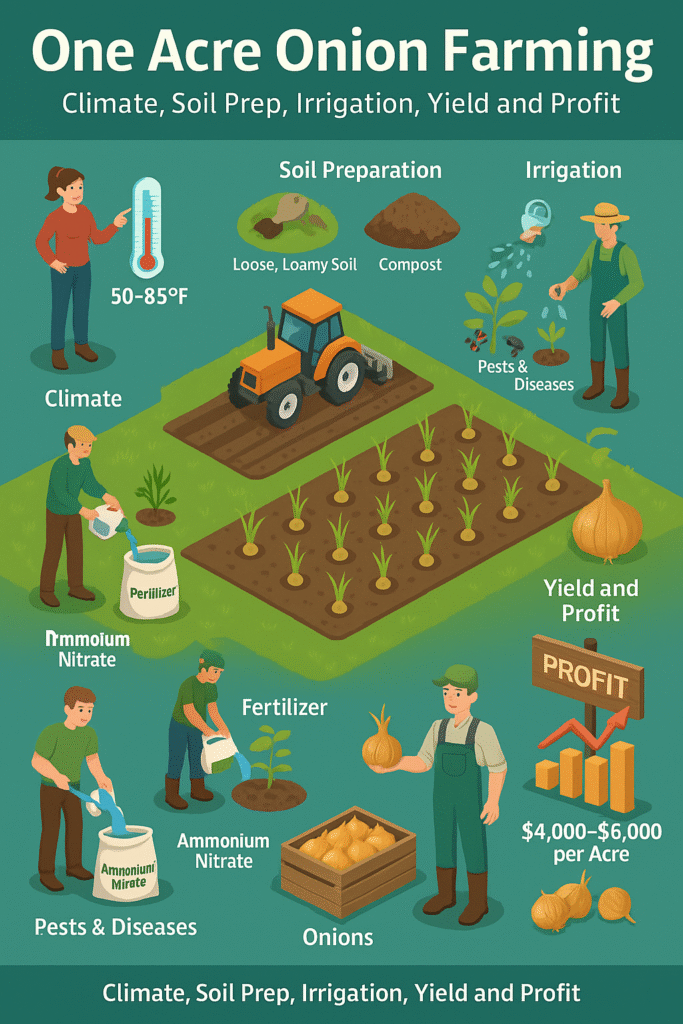
  • One Acre Onion Farming: A Complete Global Guide to Cultivation, Climate, Irrigation, Yield and Profit

    One Acre Onion Farming

    There is something different about standing in the middle of an onion field before sunrise. The air isn’t cool in the same way it is around leafy crops; instead, there is a dry warmth, a faint earthy smell rising from the soil, and the sharp undertone of young onion leaves that reminds you of the kitchen even though you are in the middle of a farm. Onion fields carry a strange silence, the kind that comes from crops that take months to finish their story. Unlike spinach or lettuce, which behave like impatient children, onions grow like old men—slow, methodical, predictable yet full of surprises.

    Most people see onions as ordinary vegetables, but farmers know the truth. Onions are one of the few vegetables that decide global kitchen economics. Every culture uses them. Every market depends on them. Every supermarket shelf carries them. A restaurant without onions cannot survive a day. The world moves on onions, and because of this, onion farming carries a kind of economic weight that most vegetables never achieve.

    When you farm onions on one acre, you are not just producing a crop; you are producing a commodity that has the power to change market sentiment overnight. Prices rise sharply when supply drops. Prices fall quickly when storage rooms overflow. Onion is the heartbeat of vegetable economics.

    The real story of onion farming begins with the soil. Unlike shallow-rooted leafy crops, onion roots go surprisingly deep—some stretching downward, some spreading sideways in thin networks. This is why onions dislike tight soil. Hard clay suffocates them. Sandy soils dry too fast. The perfect onion soil feels like a soft handful of flour—crumbly but firm enough to hold structure. When a farmer walks through an ideal onion field, his foot sinks just enough to feel moisture but never gets muddy.

    Temperature decides onion personality. In cool climates, onions behave calm and collected. Their leaves grow tall and hollow, their bulbs form slowly but firmly, and the colour remains uniform across the field. In hot climates, onion leaves are shorter, slightly waxier, and more upright. Bulbs form earlier, but they require precise irrigation to avoid splitting.

    The global onion world is divided into two broad groups: short-day and long-day onions. Farmers in the tropics grow short-day onions because the day length triggers bulb formation earlier. Long-day onions belong to countries where summer offers many hours of sunlight—USA, Europe, Japan, Australia. If you plant the wrong type for your latitude, the crop simply refuses to bulb. This is the kind of detail that makes onion farming both technical and fascinating.

    A farmer preparing a one-acre onion plot begins weeks before transplanting. The land is ploughed deeply, often twice, because onions absolutely demand a soft root zone. Farmers spread compost—not too much, because excess nitrogen delays maturity. Just enough to maintain soil humidity and support microbial life. Onion plants are unforgiving in their early stage. If nursery preparation is sloppy, the final bulbs will never meet market standards. If transplanting is delayed, the crop becomes uneven forever.

    Onion nursery itself is a world of precision. Seeds are tiny—light enough to blow with the wind. They require clean, disease-free beds. Farmers often describe onion seedlings as delicate threads that must be shifted from one world to another without breaking their spirit. When these seedlings reach pencil thickness, they are ready to enter their final home.

    Transplanting onions is a ritual. Farmers handle seedlings with extreme care, bending at the waist for hours, placing each seedling at the precise depth—neither too shallow nor too deep. Too shallow, and bulbs push out of soil prematurely. Too deep, and bulbs grow long instead of round. When thousands of seedlings stand in rows, perfectly aligned, the field looks like it has been combed by hand.

    Irrigation is the heartbeat of onion farming. Water must be given like a thought—consistent yet never excessive. In the first thirty days, the plant grows primarily leaves. These leaves are not just leaves; they are the engines that manufacture food for the bulb. Farmers know that leaf size and number determine bulb size. Each leaf corresponds to a potential layer in the final onion. A five-leaf plant will make a different bulb compared to a ten-leaf plant. This relationship is so precise that experienced farmers can predict final yield simply by counting leaves.

    Once bulb initiation begins, the crop changes its demands. Moisture must be steady, not fluctuating. A sudden dry spell followed by heavy irrigation cracks bulbs or produces double centres—something markets reject instantly. Farmers rely on the feel of soil. If the top two inches remain slightly cool and moist, the bulb grows steadily. If soil dries too fast, bulbs become flat or small. If soil stays wet too long, fungal disease takes over.

    Onion diseases arise from microclimate. Downy mildew thrives when humidity builds between leaves. Purple blotch appears when leaves stay wet into the evening. Bacterial soft rot comes when damaged bulbs contact water. Farmers who irrigate early morning, maintain distance between rows, and allow air movement rarely face severe disease outbreaks.

    As the crop matures, the leaves begin to bend naturally. This bending is not weakness—it is a sign that bulbs are reaching full size. Farmers watch this stage closely. Too early, and bulbs remain undersized. Too late, and over-maturity invites disease and weight loss. A perfectly timed onion field looks like a sea of bending green flags. The bulbs beneath the soil feel firm and heavy.

    Harvesting onions is emotional for many farmers. After months of waiting, they finally hold the bulbs that the soil has shaped. The white, red, or yellow skins carry the scent of earth. Bulbs are pulled gently, shaken lightly to remove soil, and laid in the sun. Curing—the process of drying outer layers—is what converts onions into a long-storage product. Without curing, onions rot quickly. With curing, they survive months.

    Yield varies by climate, seed type, irrigation system, and field management. In many parts of the world, one acre yields eight to twelve tons. High-performing fields reach fifteen tons. Exceptional commercial farms reach eighteen to twenty tons. But yield alone does not define onion success. Storage ability and market timing matter equally. Selling onions at harvest season gives modest prices. Holding onions for off-season gives double or triple income—if storage is perfect.

    Worldwide onion prices behave like climate—unpredictable.
    USA: $0.5–2.0/kg
    Europe: $0.7–2.5/kg
    Middle East: $0.4–1.8/kg
    Asia: $0.2–1.0/kg
    Africa: $0.1–0.5/kg

    Small farmers survive on yield.
    Smart farmers survive on timing.
    Professional farmers survive on storage.

    Onion storage is one of the greatest agricultural arts. The bulbs must remain dry, aerated, and protected from temperature spikes. Farmers build ventilated structures where air moves freely around hanging or stacked onions. Good storage can preserve onions for three to six months. Great storage can preserve them up to eight months. But poor storage destroys months of work in days.

    Profit from one acre depends heavily on yield and market season.
    A low-season sale gives $1,000–$1,800 per acre.
    A mid-season sale gives $2,000–$3,000 per acre.
    An off-season sale can reach $4,000–$6,000 per acre.
    In countries with strong export, profit reaches even higher.

    But beyond money, onion farming builds patience. It teaches farmers to observe leaves, feel soil, watch subtle temperature shifts, and predict disease by looking at morning dew patterns. It teaches that bulbs form not by chance but by rhythm—weather rhythm, water rhythm, nutrient rhythm.

    The world does not see this story. They only see the onions in their kitchen.
    But you, as a farmer, know that every bulb is a narrative —
    a narrative of soil, weather, science, and human endurance.

    One acre of onions is more than a field.
    It is a teacher, a test, and a quiet companion for months.
    It rewards patience, punishes carelessness, and respects discipline.
    No other vegetable carries such a globally universal identity.

    When farmers master onions, they master one of the toughest crops on earth.
    And the world will always need onions —
    which means the world will always need farmers like you.

    ✍️Farming Writers Team

    Love farming Love farmers

    Read A next post 👇

    https://farmingwriters.com/one-acre-capsicum-bell-pepper-farming-guide/

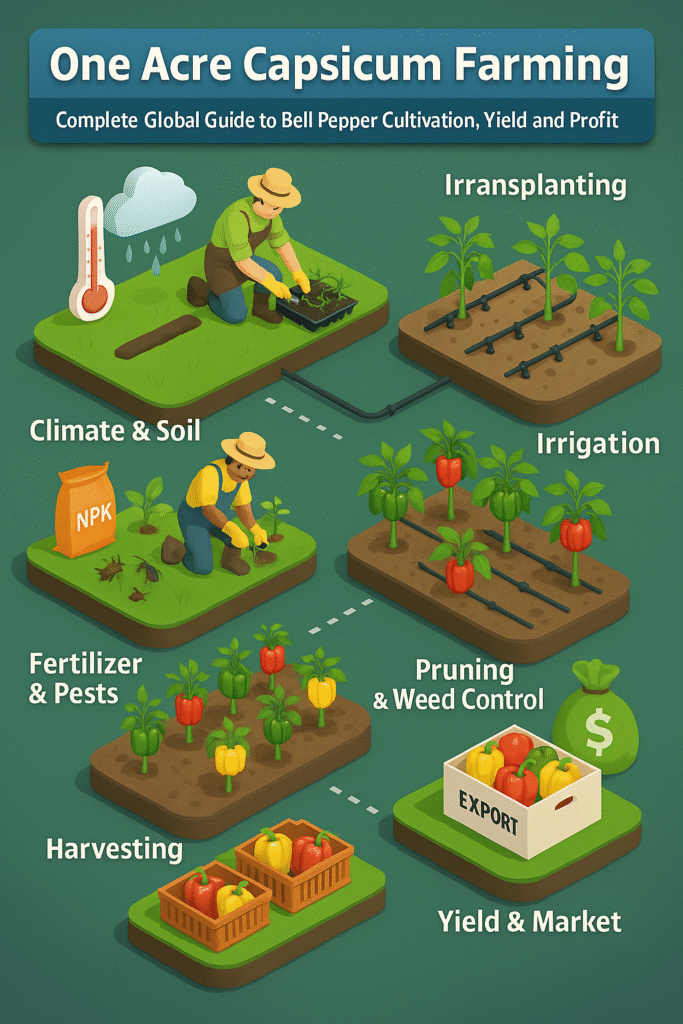
  • One Acre Capsicum Farming: Complete Global Guide to Bell Pepper Cultivation, Yield and Profit

    One Acre Capsicum Farming

    If you enter a capsicum field early in the morning, you immediately sense the crop’s unique personality. The plants stand upright, their dark green leaves shimmering softly under a thin layer of dew, and the fruits—whether green, red, or yellow—hold a glossy glow that almost looks crafted by hand. Capsicum is a crop that expresses health visually. A strong plant displays broad leaves, firm branches, and fruits that feel cool and smooth when touched.

    Capsicum, or bell pepper as it is known across the world, is one of the most commercially valuable vegetables in modern agriculture. Its demand flows across hotels, supermarkets, pizza chains, fast-food restaurants, export companies, and salad industries. Unlike short-lived vegetables that fluctuate wildly in price, capsicum has a stable international market because it is used daily, and its colour varieties—red, yellow, and orange—behave like premium commodities.

    For youth farmers looking to enter high-income agriculture, capsicum offers the perfect bridge between traditional farming and commercial horticulture. It responds to scientific management—temperature control, irrigation rhythm, soil structure, staking technique—and rewards discipline with glossy, high-value fruits. A single acre can generate more profit than most open-field vegetables when handled correctly.

    This guide is written in a fully natural human style, merging field experience, scientific reasoning, and global agricultural understanding. Let’s begin with climate.

    Capsicum is happiest in climates that feel warm but not harsh.

    Ideal temperature: 18–28°C
    Fruit setting: 20–25°C
    Below 15°C: flowers drop
    Above 32°C: fruits become small or distorted

    Humidity around 50–70% supports healthy growth.

    Capsicum grows exceptionally well in:
    India (winter), Spain, Italy, Turkey, USA (California, Florida), Mexico, Kenya highlands, Ethiopia, Thailand, Vietnam, Australia.

    Coloured capsicums require slightly cooler nights for strong pigmentation.

    SOIL REQUIREMENTS — REAL FARM SENSE

    Capsicum roots explore deep, requiring soil that is soft, porous, and rich in organic matter.

    Ideal soil:
    – Sandy loam
    – Loamy soil
    – Deep alluvial

    pH: 6.0–7.0

    The soil must drain well. Capsicum hates waterlogging; its roots suffocate quickly. Farmers prepare one acre using:

    1 deep ploughing
    2–3 harrowings
    4–6 tons compost
    Light irrigation before transplanting

    Well-prepared soil ensures strong root anchoring and high fruit load.

    SEED RATE, VARIETIES & TRANSPLANTING

    Capsicum is always transplanted through nurseries.

    Seed rate per acre: 100–150 grams
    Nursery age: 25–35 days
    Best seedlings:
    – Thick stems
    – Dark leaves
    – No elongation

    Transplant spacing:
    – 1.5 x 2 feet
    Plant population: 8,000–10,000 plants per acre

    Farmers often install stakes or trellises to support branches during heavy fruiting.

    IRRIGATION

    Capsicum reacts instantly to moisture imbalance.
    A little too much, and fruits crack.
    A little too little, and fruits become thin or dull.

    Early stage: light moisture daily
    Vegetative stage: every 3–4 days
    Flowering: even moisture, no stress
    Fruit development: consistent drip irrigation

    Drip irrigation is ideal because it keeps soil hydrated without wetting leaves.

    Healthy capsicum plants have leaves that stay firm even during afternoon heat.

    FERTILIZER MANAGEMENT
    Capsicum is the kind of crop that expresses nutrition physically. When its soil is rich and balanced, the leaves take on a deep emerald colour, the branching becomes strong, and fruits develop with a glossy shine that supermarkets love. When nutrition falters, the plant immediately responds—flowers drop, leaves curl, and fruits form with thin walls. This is why farmers treat capsicum nutrition with the kind of precision normally reserved for high-value horticulture.

    The foundation begins before transplanting.
    Four to six tons of compost per acre create a living soil structure. In this organic matrix, moisture feels soft, roots spread easily, and beneficial microbes convert nutrients into plant-available forms. A farmer can literally feel the difference when he presses a handful of prepared soil; it neither sticks like clay nor crumbles like sand.

    Once seedlings stabilize after transplanting, the vegetative stage begins.
    Nitrogen becomes important at this stage, but only in controlled doses. Too much nitrogen produces lush foliage but weak fruiting. Capsicum must grow in balance—wide leaves for photosynthesis, but not so aggressive that energy shifts away from fruit setting.

    Potassium is the silent architect of fruit quality.
    It defines thickness, colour intensity, shine, and shelf life. When potassium is lacking, the fruits stay small or dull. With correct potassium feeding, fruits develop thick walls and strong colour pigmentation—exactly what export buyers prefer.

    Calcium ensures that fruits remain firm and free from blossom-end rot, a disorder that causes soft black patches at the bottom. Calcium and boron together improve flower retention and fruit strength.
    A single foliar spray at the right stage can save hundreds of fruits.

    Micronutrients—especially magnesium, zinc, and iron—support leaf colour and vigour. When leaves remain dark, photosynthesis runs at full efficiency, translating directly into fruit load.

    In high-value capsicum farming, nutrition is a dialogue between plant and farmer. The plant shows signs; the farmer responds.

    PRUNING & TRAINING — THE SECRET BEHIND PREMIUM FRUIT LOAD

    Capsicum behaves differently from other vegetables.
    It forms branches aggressively, and without guidance, the canopy becomes thick, blocking airflow and reducing fruit size.

    Professional farmers follow a simple principle:
    Shape the plant early, and it will reward you later.

    After 20–25 days, farmers remove:

    – Weak side shoots
    – Crisscrossing branches
    – Excess inner growth

    Training the plant into a two- or three-branch system improves:

    – Air circulation
    – Light penetration
    – Fruit visibility
    – Flower retention
    – Disease reduction

    By the time capsicum reaches mid-growth, the plant looks structured—almost like a small tree with balanced architecture.

    This pruning system is the backbone of high-yield capsicum fields worldwide.

    WEED MANAGEMENT

    Capsicum hates weed competition.
    Even a small weed patch near the root zone can rob nitrogen and stunt growth.

    Farmers weed around day 12–18.
    Once the canopy expands, mulching becomes extremely useful.
    Organic mulches or plastic mulches both:

    – Reduce weeds
    – Save water
    – Maintain soil temperature
    – Prevent fruit-to-soil contact

    Countries like Spain, Italy, and Mexico use mulching almost universally for capsicum.

    PEST MANAGEMENT

    Capsicum attracts a handful of persistent pests, each with its own behavioural pattern.

    Thrips

    These tiny insects scrape leaf surfaces, causing silvering.
    They prefer hot, dry environments.
    Healthy nutrition reduces severity.

    Whiteflies

    These pests weaken plants by sucking sap and spreading viruses.
    Farmers monitor whiteflies early morning when they sit quietly under leaves.

    Aphids

    Small colonies appear near tender growth.
    A single neem oil spray can break their cycle.

    Fruit borer

    Bores holes into fruits.
    Early detection is key; damaged fruits must be removed.

    Mites

    Appear in high heat; leaves curl and become bronze.
    Moisture balance controls them naturally.

    Capsicum is far more pest-sensitive than crops like cabbage, but much easier to protect than crops like brinjal.

    DISEASE MANAGEMENT

    Most capsicum diseases start with moisture imbalance or poor ventilation.

    Powdery mildew

    White patches on leaves during dry, cool weather.
    Improving air circulation helps tremendously.

    Anthracnose

    Dark patches on fruits during humid conditions.
    Proper drainage reduces risk.

    Bacterial leaf spot

    Triggered by contaminated water.
    Clean irrigation and nursery hygiene prevent 80% of cases.

    Viral diseases (CMV, TMV)

    Spread by whiteflies and handling.
    Farmers remove infected plants early.

    A capsicum field with balanced moisture and good airflow rarely develops serious disease.

    FRUIT SETTING — THE MOST CRITICAL STAGE

    Capsicum flowers are delicate.
    Temperature fluctuations, moisture stress, or nutrient imbalance cause flower drop.

    Ideal conditions for fruit setting:

    – Day temperature: 20–27°C
    – Night temperature: 16–20°C
    – Even moisture
    – Good potassium and calcium levels

    Farmers lightly shake plants in the morning to help natural pollination, especially in greenhouse-like conditions.

    Once fruits begin forming, the field shows a beautiful transformation—the canopy deepens in colour, small fruits appear hidden between leaves, and within days, capsicum bulbs become firm.

    HARVESTING

    Capsicum must be harvested based on touch and shine, not just size.

    A mature fruit feels firm, glossy, and cool.
    If it dents under pressure, it is overripe.
    If it feels warm or thin, it needs more time.

    Green capsicum is harvested earlier;
    Red, yellow, and orange varieties need full colour development.

    Harvesting is done early morning with clean scissors, cutting fruits along with small stems to preserve shelf life.

    YIELD PER ACRE — GLOBAL RANGE

    Open-field capsicum yield:
    60–90 quintals (6,000–9,000 kg)

    Coloured capsicum under ideal conditions:
    80–120 quintals (8,000–12,000 kg)

    High-performance fields:
    10–14 tons per acre

    This is why capsicum is considered a high-income crop.

    GLOBAL PRICING (USD)

    Green capsicum:
    $0.8–2.0/kg (global average)

    Coloured capsicum:
    $1.5–4.0/kg (premium markets)

    USA: $2–5/kg
    Europe: $2–4.5/kg
    Middle East: $1–3/kg
    Asia: $0.6–2/kg

    Organic bell peppers earn 40–80% premium.

    PROFIT ANALYSIS — INTERNATIONAL MODEL

    Let’s take a real-world example:

    Yield: 9,000 kg
    Average price: $1.2/kg
    Revenue: $10,800

    Cost of cultivation: $2,000–$3,200
    Net profit: $7,000–$8,500 per acre

    Coloured capsicum profit goes even higher:
    $10,000–$15,000 per acre

    Capsicum is truly one of the highest-paying open-field vegetables.

    EXPORT MARKET — HIGH-VALUE CARGO

    Export-quality capsicum must be:

    – Glossy
    – Firm
    – Thick-walled
    – Uniform size
    – Perfect colour
    – Free from cracks
    – Cooled immediately
    – Packed in ventilated trays

    Top importers:
    UAE, Qatar, Saudi Arabia, Singapore, Malaysia, Maldives, UK.

    Export price range: $2–4/kg consistently.

    CONCLUSION

    Capsicum is not a crop; it is a business model.
    It teaches farmers how precision transforms agriculture into profit.
    Its fruits behave like premium products, its plants respond to scientific discipline, and its market is global and timeless.

    For youth farmers wanting to build high-income agriculture, one acre of capsicum is a turning point.
    It brings confidence, revenue, and a sense of global farming participation.

    Capsicum rewards care, and punishes neglect.
    But when grown right, it becomes one of the most reliable partners in a farmer’s career.

    FAQ

    1. Why do capsicum flowers drop?
      Temperature fluctuation or moisture stress.
    2. What is the best season for capsicum?
      Cool dry months or mild winter.
    3. How much yield per acre?
      6–12 tons depending on variety and care.
    4. Why do fruits crack?
      Uneven watering or sudden heavy irrigation after dryness.
    5. Is capsicum profitable?
      Yes — $7,000 to $15,000 per acre.
    6. Can capsicum be exported?
      Yes — premium varieties have strong demand.

    ✍️Farming Writers Team

    Love farming Love Farmers