ONE ACRE FENUGREEK FARMING INTRODUCTION
There is a particular smell that rises from a fenugreek field in the early morning hours, something between the sweetness of fresh leaves and the mild bitterness of a medicinal plant. It is unmistakable. When sunlight touches the dew resting on the leaves, the fragrance sharpens for a moment, giving the entire field a personality of its own. Fenugreek, or methi as millions know it, is a crop that carries history inside its leaves. Every culture that grows it attaches some memory to it—winter dishes, herbal medicines, nutritious meals, and daily cooking rituals.
Fenugreek is not just a leafy vegetable. It is a seed crop, a medicinal plant, a herbal remedy, and a flavouring agent used around the world. And this is what makes it one of the most stable and profitable crops for one-acre farming. Whether the market prefers fresh bunches or dry seeds, fenugreek finds buyers everywhere. Even in global spice markets, fenugreek seed is a steady commodity, traded from India to the Middle East, Africa, Europe, and North America.
But the heart of one-acre fenugreek farming lies in the field itself. The plant behaves with remarkable simplicity. It grows steadily, responds predictably to irrigation, and expresses nutrient imbalance almost immediately through leaf colour and texture. Farmers appreciate this honesty. There is no hidden struggle, no complex disease cycles, no long maturity period. Fenugreek rewards discipline with speed: leafy varieties mature in 25–35 days, seed varieties in 90–110 days.
For youth farmers, this crop is one of the best entry points into commercial farming. It requires modest investment, adapts to most climates, and offers quick payback cycles. This combination of low risk and high practical value is rare in agriculture.
Now, let’s walk through the science and narrative of fenugreek farming—from climate to soil, seed to harvest—exactly the way an expert agronomist explains inside a real field.
CLIMATE REQUIREMENTS
Fenugreek enjoys climates that feel like a quiet winter morning. Temperatures between ten and twenty-five degrees Celsius allow the plant to grow steadily with thick, aromatic leaves. When temperatures rise above thirty degrees, the leaves lose moisture quickly and the plant begins to stretch, becoming thin and leggy.
Humidity between forty and sixty percent brings out the best growth. Too much humidity encourages fungal spots; too little makes the leaf edges dry and brittle.
Fenugreek grows successfully in India, Pakistan, Bangladesh, Egypt, Turkey, UAE (winter), Kenya, Ethiopia, USA (California), and southern Europe. It thrives in regions where nights are cool and days gentle.
Frost is harmful. Just a single night of strong frost can damage tender leaves. Farmers in colder countries use light plastic coverings or low tunnels to protect the crop during its early stage.
SOIL REQUIREMENTS
Fenugreek does not like heavy soils. It prefers a loose, airy field where roots can breathe and expand without resistance. Sandy loam and loam soils with good drainage are ideal.
The soil should crumble easily between fingers.
It should never form sticky lumps.
A pH between six and seven and a half is perfect.
One-acre land preparation starts with a deep ploughing to break old compact layers, followed by harrowing to achieve a soft texture. Fenugreek roots explore the upper twenty to twenty-five centimetres of soil, so this zone must be gently loosened.
Organic matter is essential. Two to three tons of compost enriches the soil, stabilizing moisture and providing natural micronutrients that improve leaf aroma.
Before sowing, the soil should be levelled lightly. An uneven field causes water to accumulate in small pockets, which burns the lower leaves and increases disease risk.
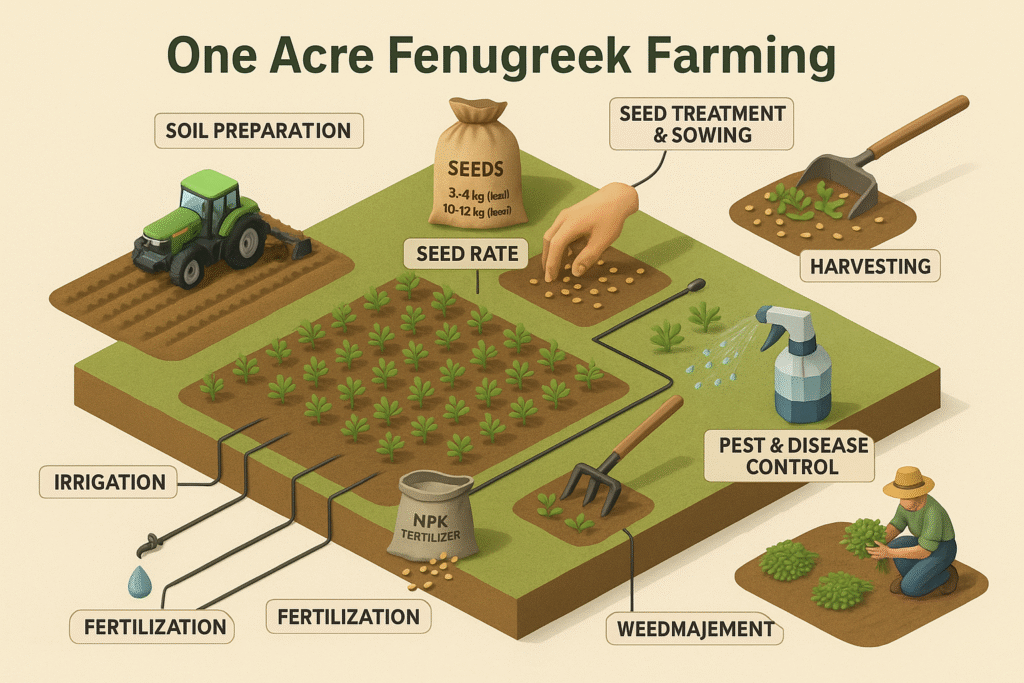
SEED RATE, SEED TREATMENT & SOWING
Fenugreek seeds carry a warm, nutty smell. When soaked in water for six to eight hours, they swell slightly and germinate faster. For one acre:
Fresh-leaf crop: 3–4 kg seed
Seed-production crop: 10–12 kg seed
Seeds are sown in shallow lines spaced twenty to twenty-five centimetres apart. The depth is small—not more than one and a half centimetres—because fenugreek seeds struggle when buried too deep.
Within four to seven days, germination begins. Small twin leaves appear, soft in texture and pale green at first. Uniform moisture is crucial during this phase.
IRRIGATION RHYTHM
Fenugreek dislikes excess water.
It prefers gentle, timely irrigation rather than heavy watering.
In the first seven days, light daily irrigation keeps the seedbed moist.
Once seedlings establish, irrigation shifts to every three or four days depending on climate.
During the vegetative stage—day fifteen to thirty—the plant demands the most water. This is when leaves expand rapidly and develop full flavour.
Overwatering reduces aroma and makes the leaves watery.
Under-watering makes the crop fibrous and dull in colour.
Drip irrigation is ideal because it maintains moisture without wetting leaves. Overhead irrigation is used, but only early morning to prevent disease.
FERTILIZER MANAGEMENT
If you stand at the edge of a healthy fenugreek field during its second or third week, you can almost read the plant’s nutrient needs from the colour of its leaves. Fenugreek responds immediately to nutritional changes. When the soil carries sufficient nitrogen, its leaves widen smoothly, forming a soft three-lobed shape with a deep green tint. The moment nitrogen falls short, the veins stand out slightly lighter, and the growth rhythm slows. Unlike some crops that hide deficiencies until the final stages, fenugreek speaks early and clearly.
The foundation of good nutrition begins before the seed even touches the soil. Farmers who understand soil biology always add organic matter first—two to three tons of compost or well-decomposed manure. This not only feeds the crop slowly but creates a living environment where microorganisms help convert nutrients into forms the plant can easily absorb. Fenugreek leaves actually carry more aroma when grown in organically rich soil.
Once the seedlings reach ten to twelve days old, the crop enters its early vegetative expansion stage. Here, the plant needs a gentle push—small amounts of nitrogen, not too strong to make it watery, not too weak to leave it stunted. Farmers typically give a mild urea dose in two or three splits, always after irrigation so that the granules dissolve into the soil without burning the delicate roots.
By the time the crop reaches its third week, potassium becomes essential. Potassium strengthens cell walls, deepens aroma, and increases leaf thickness. Farmers who grow fenugreek for the fresh market aim for strong, crisp leaves because they fetch better prices. A light dose of potash or a balanced NPK helps achieve that texture.
Micronutrients such as iron, zinc, and magnesium are the secret behind that beautiful bluish-green leaf tone. Their deficiency shows up quickly as pale patches, narrow leaves, or slow canopy development. A single foliar spray often brings the crop back to perfect health. Fenugreek is surprisingly responsive to foliar nutrition; its leaves absorb nutrients efficiently, and colour improvement becomes visible in less than four days.
Well-balanced nutrition is the biggest difference between average fenugreek and premium fenugreek.
WEED MANAGEMENT — REAL FIELD EXPERIENCE
Fenugreek seedlings have a habit of emerging softly, without aggressive speed. This makes them vulnerable to weeds during the first fifteen days. If weeds appear early, they compete for nitrogen and sunlight, weakening the young fenugreek plants. A clean field during the first three weeks is essential to shape final yield.
Experienced farmers often do the first weeding manually because the roots of fenugreek are shallow, and tools can disturb the soil structure. A gentle hand weeding at around ten to fifteen days clears the competition and allows the canopy to spread evenly. Once the leaves expand and the canopy shades the soil, weeds naturally slow down.
Mulching is another technique that farmers in hot countries use. A thin layer of straw or dried leaves keeps soil temperature cool, improves moisture retention, and suppresses weed growth. In winter climates, weeds grow slower, but weed removal is still necessary to support uniform leaf size.
PEST MANAGEMENT
Fenugreek plants attract a specific set of pests, but their behaviour varies with climate. The most common visitor is the aphid—a tiny insect that gathers in colonies under leaves and sucks sap quietly. The first sign of aphid presence is a slight curl on the leaf edges or a subtle sticky shine on the surface. Farmers who inspect their fields during sunrise catch the problem early and treat it with neem-based sprays or light insecticides.
Leaf miners also trouble the crop occasionally. They create thin winding tunnels inside the leaves, reducing the visual appeal. Removing infected leaves and improving ventilation significantly slows the attack.
In humid climates, a small caterpillar called the gram pod borer sometimes chews the leaf edges. Farmers control it through biological sprays or timely monitoring.
Fenugreek has natural resistance to many pests. Most problems arise from moisture imbalance rather than external attack. A well-ventilated field with balanced irrigation rarely faces severe pest issues.
DISEASE MANAGEMENT — SCIENCE WITH NARRATIVE
Diseases in fenugreek appear subtly, almost politely. A faint yellow spot on the leaf, a soft patch of fungus developing near the soil line—these signs appear when the environment becomes too moist or too still. Downy mildew is the most common disease, forming a light grey underside patch. It spreads when nights are cool, days are humid, and leaves stay wet for too long.
Farmers prevent this by watering early in the morning, allowing leaves to dry naturally through the day. A simple cultural practice prevents more disease than chemicals ever can. When necessary, light copper-based sprays stop fungal growth without damaging leaf quality.
Root rot appears only in waterlogged soils. Good drainage is the solution, not heavy pesticide use. Fenugreek rewards farmers who focus on environment rather than medicines.
HARVESTING — THE MOST DELICATE STAGE
Harvesting fenugreek is almost an art. The timing affects aroma, leaf tenderness, and shelf life. In most regions, leafy fenugreek is harvested between twenty-five and thirty-five days. The ideal moment is when the canopy becomes dense, leaves are fully shaped, and stems feel firm at the base.
Farmers harvest at dawn, when leaves are still cool and moist with natural dew. This preserves fragrance and prevents wilting. The sound of pulling a mature fenugreek bunch from the soil is soft yet satisfying—a gentle release rather than a tear.
Some farmers harvest by cutting the stems two to three centimetres above soil, allowing regrowth. Others uproot plants entirely for maximum yield.
Fresh fenugreek must be washed lightly and packed in loosely tied bundles. Air circulation is more important than tight packaging.
YIELD — REALISTIC GLOBAL RANGE
Yield varies by climate, seed type, and management:
Leafy crop yield per acre:
3500 to 6000 kg (average)
7000 kg (excellent management)
Seed crop yield per acre:
350 to 650 kg
Fenugreek seed remains a major export spice, while leafy fenugreek dominates daily markets.
GLOBAL MARKET PRICING (USD)
Fresh leafy fenugreek pricing:
India: $0.30–1.00/kg
Middle East: $1.2–3.0/kg
Europe (ethnic market): $2.0–4.5/kg
USA: $2.5–5.0/kg
Fenugreek seed pricing:
Global spice markets: $1.0–2.5/kg
Premium cleaned export seed: $2.0–3.8/kg
Leafy fenugreek has faster turnover; seed fenugreek has longer shelf life and stable pricing.
PROFIT ANALYSIS — GLOBAL USD MODEL
Leafy fenugreek profit calculation:
Yield example: 5000 kg
Average price: $0.80 per kg
Revenue: $4000
Cost of production (1 acre): $700–$1100
Net profit per cycle: $2900–$3300
Cycles per year: 4 to 5
Annual income per acre: $11,000 to $16,000
Seed fenugreek profit is lower per cycle but much more stable for long-term spice trade.
EXPORT MARKET — REAL WORLD DETAILS
Export fenugreek leaves must be:
Deep green
Fresh
Free from soil and moisture
No rotting or fungal marks
Packed loosely in ventilated crates
Cooled immediately
Seed fenugreek is more widely exported:
Major importers:
Egypt, UAE, China, Turkey, Saudi Arabia, Netherlands, Ethiopia, Sri Lanka.
Cleaned, polished seed fetches premium pricing.
CONCLUSION
Fenugreek is one of those crops that quietly rewards farmers who understand rhythm more than techniques. It grows with humility but offers income with generosity. In one acre, it creates a complete ecosystem—aroma, nutrition, medicine, and market. Its simple cultivation requirements make it perfect for youth farmers building a new agricultural career. Its global demand ensures long-term stability. Its speed ensures quick income. And its personality ensures satisfaction.
A farmer who grows fenugreek grows confidence.
FAQ
1. How long does fenugreek take to grow?
Leafy type: 25–35 days. Seed type: 90–110 days.
2. Why do fenugreek leaves become pale?
Moisture imbalance or micronutrient deficiency.
3. Can fenugreek be grown year-round?
Yes in mild climates; winter is ideal.
4. Which irrigation method is best?
Drip irrigation with gentle, regular moisture.
5. How many cycles per year?
Four to five cycles for leafy fenugreek.
6. Is fenugreek profitable for exports?
Yes—especially seed fenugreek due to global spice demand.
fenugreek seed rate, methi irrigation schedule, leafy fenugreek crop, global methi cultivation
Trigonella foenum-graecum cultivation, medicinal herb farming, leafy methi production, global spice-leaf crop
✍️Farming Writers Team
Love Farming Love Farmers
Read A Next Post 👇
https://farmingwriters.com/one-acre-coriander-farming-complete-guide/
Leave a ReplyShare your thoughts: We’d love to hear your farming ideas or experiences!