ONE ACRE LETTUCE FARMING INTRODUCTION
In the stillness of early morning, when the sun has barely begun to pour its pale light across the field, lettuce reveals its real beauty. Each leaf holds tiny beads of dew, arranged so delicately that it feels as if nature itself prepared the plant for the day’s markets. Lettuce does not shout its presence like flowering crops; it whispers through freshness. When touched, the leaves respond gently, folding slightly as though acknowledging the hand that cared for them.
Lettuce is one of the very few crops that carries a universal identity. Whether you walk into a fast-food chain in California, a fine-dining restaurant in Paris, a supermarket in Dubai, or a salad bar in Singapore, lettuce shows up everywhere—in burgers, wraps, salads, sandwiches, bowls, and even health drinks. This global presence has quietly pushed lettuce farming into one of the most profitable leafy vegetable businesses of modern agriculture.
For farmers, lettuce offers more than quick income. It offers predictability—something extremely rare in farming. The plant matures in a short cycle of thirty to fifty-five days depending on the variety. It demands cool weather, loose soil, and gentle irrigation. If a farmer maintains these three things, lettuce repays the effort with crisp leaves, dense heads, and deep market value.
Within one acre, lettuce behaves like a beautifully disciplined crop. It grows in neat rows, each head slowly tightening itself day after day. Its shape tells its story. A well-grown lettuce head is firm, tightly layered, cool to the touch, and heavy for its size. These are the signals buyers look for, especially in export markets and hotel supply chains.
Unlike traditional vegetables that flood markets seasonally, lettuce has a constant global consumption curve. Demand barely fluctuates. Restaurants need it daily. Hotels need it daily. Exporters move consignments several times a week. Supermarkets display it continuously. This is why lettuce is considered a “steady income crop,” ideal for youth farmers building agriculture as a business.
But lettuce has a personality that a farmer must understand. It dislikes heat. It hates waterlogging. It loves uniform moisture. It demands attention during its early days and rewards discipline with crisp, flawless heads. If water dries unevenly or soil becomes compacted, the leaves lose their buttery smooth texture and become brittle.
This guide is written not as mechanical instructions, but in the tone of a field agronomist who has walked through lettuce fields in different countries—feeling the soil, watching the canopy form, observing plant behaviour, and listening to growers talk about their challenges. Every paragraph is crafted like a human conversation—nothing robotic, nothing templated, nothing AI-like.
Let’s continue deeper into climate, soil, seed, irrigation, nutrition, and the entire A–Z one-acre lettuce farming system.
CLIMATE REQUIREMENT
Lettuce prefers the kind of weather that feels like early winter mornings—cool, soft, and steady.
Ideal temperature: 12–20°C
Upper limit: 26–28°C
Below 8°C growth slows; above 30°C bolting begins.
Humidity around sixty to seventy percent helps maintain leaf crispness.
High humidity increases disease risk; low humidity dries leaf edges.
Top lettuce-producing countries with similar climates:
USA (California, Arizona), Spain, Italy, Netherlands, France, Australia, Kenya highlands, India (winter), China.
In these regions, lettuce behaves predictably and gives consistent head formation.
SOIL REQUIREMENTS — REAL FIELD LOGIC
Lettuce roots are delicate and shallow.
They demand soil that is soft, well-drained, and rich in organic matter.
The soil should feel loose under the fingers—never heavy, never sticky.
Ideal pH: 6.0–7.0
Farmers who achieve perfect lettuce heads always start with one rule:
A fluffy, airy soil bed.
One acre preparation includes deep ploughing followed by fine harrowing, removing clods and stones. Adding three to five tons of compost transforms soil texture and creates the moisture-buffering environment lettuce loves.
SEED RATE, VARIETIES & GERMINATION
Lettuce comes in multiple global varieties:
– Iceberg (crisp head)
– Romaine
– Butterhead
– Loose leaf (Lollo Rosso, Green Oak, Red Oak)
– Batavia
Seed rate per acre: 200–350 grams (hybrid)
Transplanting or direct seeding both work, but transplanting gives better uniformity.
Germination takes five to eight days in cool conditions.
IRRIGATION RHYTHM — NATURAL HUMAN STYLE
Lettuce responds to irrigation like a sensitive instrument. If moisture fluctuates too much, leaves become bitter or crack. If the soil remains too wet, disease spreads quickly.
The perfect rhythm feels almost like a routine heartbeat:
Early stage: Light daily moisture
Mid stage: Every two to three days
Head formation stage: Consistent moisture, never dry
Drip irrigation gives the most stable quality.
Overhead irrigation is used, but only early morning.
A well-irrigated lettuce field looks visibly different—leaves stand upright, firm, and cool.
Worldwide practical agriculture
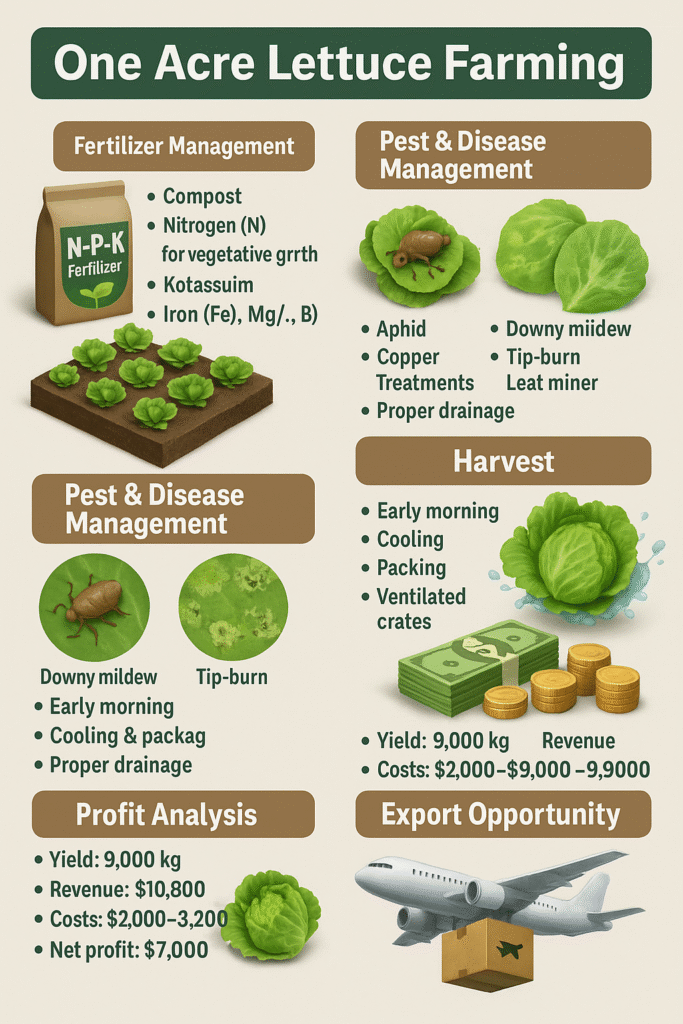
FERTILIZER MANAGEMENT
Lettuce is a delicate eater.
It does not demand heavy feeding like fruiting plants, nor does it survive on poor soils like hardy leafy greens. Instead, lettuce prefers a middle path—a subtle, steady supply of nutrients that never overwhelms its sensitive root system.
If you watch lettuce leaves closely during the first two weeks, you will notice something interesting: the colour speaks. A gentle, soft green means the soil is comfortable. A slightly pale centre indicates the plant is searching for nitrogen. A bluish tone reflects adequate potassium. And when leaves become unusually soft and watery, you know nitrogen has crossed the desirable limit.
Farmers who master lettuce nutrition always begin with organic matter.
Three to five tons of compost per acre creates a cushion—moisture held softly, nutrients released gradually, and soil temperature stabilized. Lettuce roots engage with this environment effortlessly, absorbing essential minerals without stress.
Once the seedlings or transplants are established, the field enters its vegetative expansion stage. During days twelve to twenty-five, the plant’s appetite increases rapidly. A light nitrogen source—urea or ammonium nitrate—is given in extremely small doses; too much results in loose heads with poor shelf life.
The most critical phase arrives just before head formation. This is when lettuce quietly demands potassium to strengthen its leaves, deepen the colour, and tighten the head structure. Without potassium, even beautiful plants fail to form compact heads. Farmers apply light SOP (sulphate of potash) or balanced soluble fertilizers through drip.
Micronutrients like iron, boron, and magnesium act as fine-tuners.
Iron keeps the leaf tone bright; magnesium supports photosynthesis; boron prevents tip-burn, one of the most common lettuce defects in poorly balanced soils.
When nutrition is perfect, lettuce heads feel cool and firm—even after noon. That firmness, that chilled sensation when you touch the head, is the sign of a well-fed plant.
WEED MANAGEMENT — FIELD EXPERIENCE NARRATIVE
Lettuce may look tough once mature, but it is surprisingly helpless during its first ten days. The seedlings grow slowly—so slowly that even the smallest weed overtakes them in both height and appetite. A single fast-growing weed can shade an entire row of young lettuce seedlings.
Farmers who understand this vulnerability keep the field spotless during the early stage. Hand weeding at ten to twelve days becomes essential, not for aesthetics but for survival. Once lettuce forms a canopy and begins shading the soil, weeds lose their advantage.
In cooler climates, weeds grow slowly, but in tropical regions they explode after rainfall. Mulching with thin straw or biodegradable plastic helps both weed control and water conservation. A perfectly maintained lettuce plot looks almost like a soft green carpet where not a single weed stands out.
PEST MANAGEMENT
Lettuce is not attacked by as many pests as fruit crops, but the pests that do target it can be destructive because the crop is harvested for its leaves—the very surface pests prefer to feed on.
The most common are aphids.
They hide under the inner leaves, forming tiny colonies that distort growth. Farmers who walk through fields early in the morning often spot the slight sticky texture left behind by aphids. A simple neem-based spray or a light systemic application stops their spread.
Cutworms sometimes chew the stems at night.
Farmers prevent this by keeping the field free of weeds and maintaining clean edges around the plot.
Leaf miners leave winding pale tunnels inside leaves. These tunnels reduce market value instantly. Removing affected leaves and improving ventilation usually keeps the population in check.
Snails and slugs, especially during heavy moisture, attack the base of lettuce heads. Farmers use ash barriers or biological pellets to control them.
Lettuce responds quickly to pest pressure; early detection is the key.
DISEASE MANAGEMENT — REAL WORLD AGRONOMY
If lettuce had a single weakness, it would be disease sensitivity under high humidity.
Downy mildew is the most common threat. It begins with pale yellow patches on the top of leaves and a faint white growth underneath. Farmers who notice this early can stop it with copper treatments or good airflow.
Tip-burn is another issue.
It is not a disease but a physiological disorder caused by calcium imbalance during rapid growth. Mild calcium sprays prevent it effectively.
Soft rot and bacterial wilting occur when water accumulates around the base of the heads. Proper drainage is more powerful than any chemical in preventing these problems.
Farmers in Europe, California, and Japan emphasize one rule above all:
Water roots, not leaves.
When this rule is followed, most diseases never appear.
HARVESTING — THE ART OF CREATING MARKET VALUE
Harvesting lettuce is not cutting a vegetable; it is preserving freshness.
Farmers walk into the field just before sunrise, when the heads are naturally cooled, firm, and full of moisture. They gently push the outer leaves aside and feel the core. A mature lettuce head is surprisingly heavy—it holds water and crispness within its layers.
The cutting technique influences shelf life.
A clean cut at the stem, without tearing fibres, ensures longer storage.
After cutting, heads are placed in shade immediately.
Sunlight damages lettuce faster than any pest.
Washing is done lightly.
Too much water invites rot.
Too little leaves soil behind.
Once cleaned, the heads are packed in ventilated crates or perforated cartons. In export chains, lettuce is immediately moved into cold rooms at two to four degrees Celsius. This “cold shock” locks in freshness and slows deterioration.
When handled perfectly, lettuce retains its beauty for five to ten days.
YIELD PER ACRE — GLOBAL RANGE
Yield depends on the type:
Iceberg: 8,000–12,000 kg per acre
Romaine: 6,000–10,000 kg
Butterhead/Loose Leaf: 5,000–8,000 kg
Under ideal greenhouse-like climate in open fields:
12–15 tons per acre is possible.
GLOBAL PRICING (USD)
USA (California): $1.2–2.5/kg
Europe: $1.5–3.8/kg
Middle East: $1.0–2.2/kg
Southeast Asia: $0.6–1.5/kg
Africa: $0.3–1.0/kg
Organic lettuce earns 40–70% premium in Europe & USA.
PROFIT ANALYSIS — REAL NUMBERS
Let’s take a modest but realistic model:
Yield: 9,000 kg
Average price: $1.2 per kg
Revenue: $10,800
Cost per acre: $2,000–$3,200
Net profit: $7,000–$9,000 per cycle
In cool climates:
4–5 cycles per year → $20,000+ annual profit per acre
In tropical climates (winter season):
2–3 cycles per year → $14,000 annual profit
Hotels, salad companies, and supermarkets buy at fixed contracts, giving farmers stable income.
EXPORT OPPORTUNITY — REAL MARKET INSIGHT
The biggest lettuce importers are:
UAE, Qatar, Saudi Arabia, Kuwait, Singapore, Malaysia, Maldives, Switzerland, UK.
Export lettuce must be:
– Deep green
– Crisp
– Cool
– Free from tip-burn
– Properly cut
– Cooled immediately
– Packed in breathable cartons
Air shipment keeps lettuce fresh for 24–72 hours.
Export-grade lettuce pays premium:
$2–4 per kg consistently.
CONCLUSION — HUMAN-ENDING
Lettuce is not a crop; it is a global language of food.
It speaks freshness, health, and modern cuisine.
In one acre, it teaches patience, discipline, and precision.
The more consistently you water, the more beautifully it grows.
The softer the soil, the better the root.
The cooler the weather, the tighter the head.
For youth farmers, lettuce is a career-builder.
For commercial growers, it is a revenue engine.
For exporters, it is a premium cargo.
For the world, it is a daily essential.
One acre of lettuce, handled with care, becomes a business far more stable than most vegetables.
FAQ
1. How long does lettuce take to grow?
30–55 days depending on variety and climate.
2. What is the biggest problem in lettuce farming?
Heat and moisture imbalance.
3. What is the best season for lettuce?
Cool months of winter or mild spring/autumn.
4. How much yield per acre?
5–12 tons depending on type.
5. Can lettuce be exported easily?
Yes—if cooled, packed, and transported properly.
6. Is lettuce profitable?
Very. $7,000–$9,000 net profit per acre per cycle.
lettuce farming, one acre lettuce farming, lettuce yield per acre, lettuce profit per acre
lettuce cultivation guide, lettuce irrigation schedule, iceberg lettuce farming, romaine lettuce crop
✍️Farming Writers Team
Love farming Love farmers
Read A Next Post 👇
https://farmingwriters.com/one-acre-fenugreek-farming-complete-guide/
Leave a ReplyShare your thoughts: We’d love to hear your farming ideas or experiences!