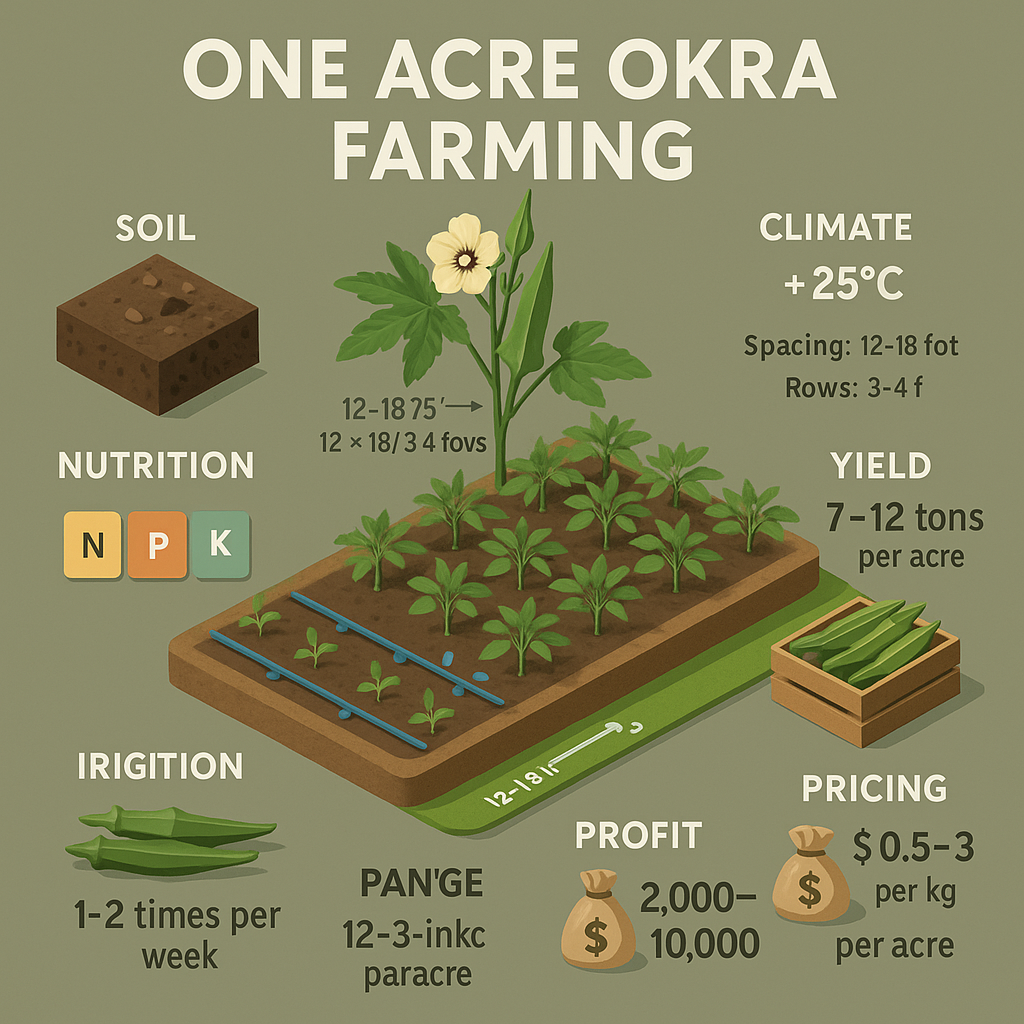
If there is one vegetable that truly understands heat, patience, and rhythm, it is okra. Walk into an okra field at sunrise and you will notice something immediately different from other crops. The plants stand upright, confident, with broad leaves that look slightly rough to the touch. The air feels warmer between okra rows, as if the crop itself holds heat from the previous day. This is not a fragile vegetable. Okra is a survivor. It grows where others hesitate, and it produces where many crops fail.
Across Africa, Asia, the Middle East, parts of the Americas, and even southern Europe, okra feeds millions every single day. In some countries it is a daily vegetable, in others a premium fresh-market crop, and in many regions it is both a food and a cultural identity. Because of this, okra prices behave more steadily than most vegetables. It does not disappear from markets easily, and demand rarely collapses completely. For one-acre farmers, this stability matters more than hype.
Okra farming begins with understanding heat. This crop does not like cold soil. Seeds planted into cool earth simply sit there, waiting, sometimes rotting before they ever germinate. Experienced farmers never rush okra. They wait until soil warms naturally. When conditions are right, okra seeds respond with force. Germination is quick, and within days the field begins to show uniform green dots rising from the soil.
The soil itself must allow okra roots to travel deep. Okra develops a strong taproot early, and if that root meets hardpan or waterlogging, the plant never reaches its potential height or yield. The best okra fields are those where the soil feels loose but not fluffy, moist but never sticky. Farmers often say that okra soil should feel “warm and alive” when you press your palm against it in the afternoon.
Unlike crops that demand constant moisture, okra prefers controlled stress. Too much water produces excessive leaf growth with fewer pods. Too little water causes pods to become fibrous. The plant communicates clearly. When leaves remain upright and slightly glossy, moisture is correct. When leaves droop slightly during noon heat and recover by evening, the crop is balanced. When leaves remain limp even in the evening, the farmer knows irrigation has fallen behind.
One acre of okra does not look impressive during the first few weeks. The plants grow steadily but without drama. This is the phase where many new farmers panic, comparing okra to faster crops. Experienced farmers stay calm. They know that once flowering begins, okra changes pace completely. Flowers appear suddenly, pale yellow with dark centres, opening in the morning and closing by afternoon. Each flower that opens today becomes a harvestable pod within days.
Nutrition management in okra is subtle. Excess nitrogen produces tall plants with fewer pods. Insufficient nutrition produces thin pods and short harvesting cycles. The most productive okra fields are those where nutrition supports steady growth rather than aggressive expansion. Potassium plays a quiet but critical role in pod quality. When potassium is adequate, pods remain tender, uniform, and glossy. When it is lacking, pods harden quickly and lose market value.
One of the reasons okra works well for one-acre farming is its harvesting pattern. Unlike crops that require a single large harvest, okra produces continuously. Harvesting begins early and continues for weeks or even months depending on climate. This spreads income across time. Farmers are not forced to sell everything at once. They can adjust harvest quantity based on market prices, labour availability, and weather.
Pests do exist in okra fields, but the crop’s strong growth habit offers resilience. Aphids, whiteflies, fruit borers, and mites appear under certain conditions, especially where humidity and temperature combine aggressively. However, okra plants recover quickly when conditions improve. This resilience is why okra is often recommended for regions where pest pressure fluctuates unpredictably.
Diseases usually reflect water mismanagement rather than bad luck. Leaf spots, powdery mildew, and yellowing often appear when irrigation timing is wrong or airflow is restricted. Fields with good spacing, morning irrigation, and open canopy rarely suffer serious disease outbreaks. Okra rewards farmers who understand microclimate more than chemical control.
As harvesting intensifies, the field takes on a different energy. Farmers move through rows almost daily, fingers trained to identify the exact size that markets prefer. Harvesting too late produces tough pods. Harvesting too early reduces total yield. Timing becomes muscle memory. The sound of pods snapping cleanly from the stem becomes familiar, almost rhythmic.
Yield per acre varies widely across the world. In basic systems, yields remain moderate. In well-managed fields with good seed, balanced nutrition, and disciplined harvesting, yields climb sharply. The real profit of okra lies not only in total tonnage but in harvesting frequency and pod quality. Tender pods command premium prices. Fibrous pods struggle even when supply is low.
Globally, okra prices reflect cultural demand.
In the USA and Europe, okra is a niche vegetable with high prices.
In Africa and South Asia, it is a staple with high volume but moderate pricing.
In the Middle East, demand remains consistent year-round due to culinary use.
This balance creates opportunity. Farmers who understand their market position themselves accordingly. Fresh local markets, export channels, processing buyers, and restaurant supply chains all value okra differently.
One acre of okra can generate modest income or strong profit depending on management and timing. The crop does not promise overnight wealth, but it offers something more valuable: reliability. In agriculture, reliability is often the difference between survival and growth.
Okra teaches farmers patience in the beginning and discipline in the end. It does not rush, and it does not forgive neglect. But for those who learn its rhythm, okra becomes a dependable partner season after season.
This is why, across continents and cultures, okra remains one of the most quietly successful one-acre crops in the world.
✍️Farming Writers Team
Love Farming Love Farmers
Read A Next Post 👇
https://farmingwriters.com/one-acre-bottle-gourd-farming-complete-guide/
Leave a ReplyShare your thoughts: We’d love to hear your farming ideas or experiences!