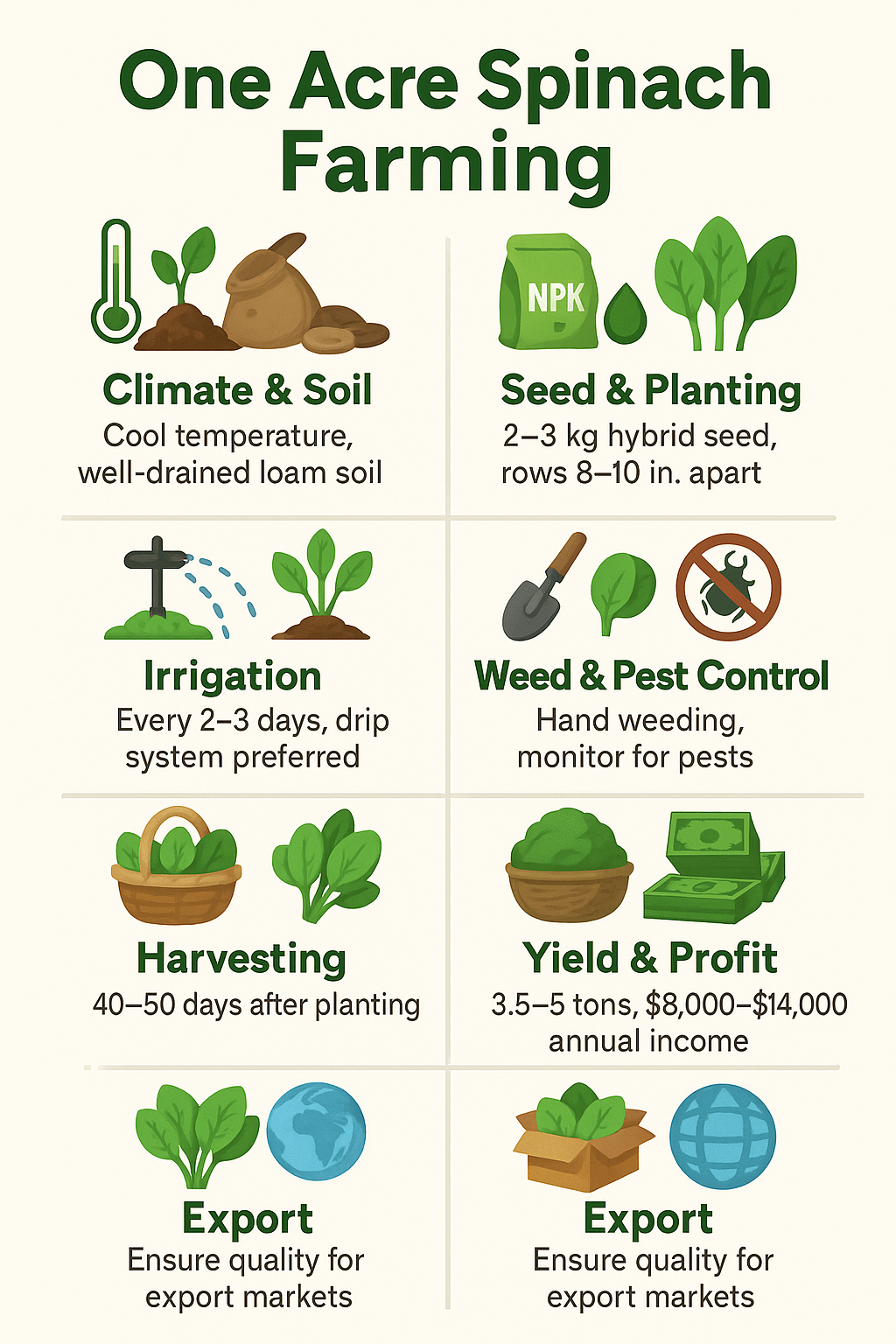
Spinach behaves like a plant that prefers quiet weather. It does not appreciate extremes; it dislikes scorching heat as much as it dislikes severe frost. The ideal temperature range where spinach expresses its full natural character lies somewhere between fifteen and twenty-two degrees Celsius. In this climate band the leaves thicken gently, the colour deepens without stress marks, and the plant maintains a steady growth pace that seems almost rhythmic.
Spinach is grown across the world in climates as different as California’s coastal belt, Europe’s mild summers, South Asia’s winter months, and Kenya’s highland zones. But one thing remains consistent everywhere: the plant loves a steady coolness in the soil. When temperatures begin to cross thirty degrees, you can almost see the crop losing its breath. Leaves grow thinner, tips turn brittle, and the plant urges the farmer to give shade or more moisture. Conversely, when temperatures fall too low, the growth slows, but the plant rarely dies unless the frost is sharp.
Sunlight plays a quiet but significant role. Six hours of soft sun, followed by a mild afternoon, is the perfect environment. In harsh countries where sunlight burns the topsoil, farmers often use thin shade nets not to block light, but to soften its intensity. Spinach responds immediately by producing wider leaves, a sign that the plant feels safe.
Humidity between sixty and eighty percent keeps the leaves succulent. Very low humidity makes the plant lose moisture rapidly, and very high humidity allows diseases to appear. The sweet spot lies somewhere in the middle, where the leaves hold moisture without welcoming fungal infections.
The world’s top spinach production regions—China, USA, Japan, Turkey, India, Italy, Belgium—follow the same climate principle: keep the plant cool, moist, and well-ventilated.
SOIL REQUIREMENTS
If you observe an experienced farmer handling spinach soil, you will notice something subtle. He crushes the soil gently between his fingers, not to test moisture but to understand softness. Spinach roots are delicate. They do not fight resistance; they prefer soil that yields easily.
The soil should crumble lightly.
It should not form lumps.
It should not crust on drying.
Sandy loam and loam soils are ideal. Clay soil, if not improved, turns spinach farming into a difficult exercise. Heavy clay suffocates roots, making leaves shorter and growth uneven.
The pH must rest between six and seven. If soil turns acidic, growth slows noticeably; if too alkaline, nutrient uptake becomes weak. Farmers in alkaline regions often add organic matter—compost, cow dung, decayed leaves—to restore balance.
One acre soil preparation begins with a deep plough to break old compaction layers. This helps the roots explore deeper, allowing faster leaf growth. Soil should be harrowed until its texture becomes soft, airy, and velvet-like. Organic matter is essential here—three to five tons of compost enriches soil biology and enhances leaf colour.
Before sowing, farmers often smoothen the surface with a light rake, ensuring no stones, no clods, no uneven patches. Spinach rewards this attention with a uniform plant population.
SEED RATE, SOWING & GERMINATION
The seed itself carries a certain fragrance—slightly earthy, slightly metallic. When soaked in water for a few hours, it absorbs moisture and prepares for germination. This soaking step shortens germination days and ensures uniform emergence.
For one acre, farmers require two to three kilograms of high-quality hybrid spinach seed. Open-pollinated seeds need slightly more, but hybrids provide greater uniformity and colour quality.
Seeds should always be sown shallow—a depth of just one to one and a half centimetres. If buried deeper, the emerging shoots struggle, slowing the crop.
Line sowing remains the most reliable technique. Rows spaced twenty to twenty-five centimetres apart allow enough room for air movement while maximizing leaf production. Seeds are sprinkled gently along the line, then covered with a whisper-thin layer of soil.
Within five to eight days, tiny green hooks appear. These seedlings carry the entire promise of the crop. If the soil surface dries too quickly during this phase, germination becomes patchy. Therefore, light irrigation is crucial during early days.
IRRIGATION RHYTHM
Spinach likes regularity.
Not too much water.
Not too little.
Just enough to keep the soil’s top layer comfortably moist.
During the first ten days, farmers give light irrigation daily or every alternate day. These gentle irrigations help seedlings emerge without crusting the soil.
As growth progresses, irrigation shifts to every three days. The roots appreciate this routine because it prevents wilting in hot climates and waterlogging in cooler regions.
The most critical period begins around day twenty, when leaves expand rapidly. This is the vegetative surge phase. If soil becomes dry at this moment, the leaves become narrow and develop pale streaks. To avoid this, farmers keep a stable moisture rhythm—watering every two to three days depending on temperature.
Drip irrigation has become the global standard because it maintains moisture without splashing water on leaves. Overhead irrigation, though used widely, sometimes invites fungal spots, especially in humid areas.
A well-irrigated spinach field looks different. The leaves stand upright, the colour appears rich, and the surface glistens slightly in morning light. This is the sign of a perfectly hydrated crop.
FERTILIZER PLAN (HUMAN-EXPERT EXPLANATION)
Spinach is a leaf crop; therefore, it consumes nutrients differently from root or fruiting crops. Its appetite for nitrogen is high but must be moderated wisely. Too much nitrogen produces lush but fragile leaves prone to decay; too little nitrogen results in thin, pale foliage.
Before sowing, one acre soil receives organic manure—three to five tons of compost or farmyard manure. This prepares the soil bed with slow-release nutrients.
Twenty-five kilograms of neem cake protects early roots. Farmers who understand soil biology know neem cake does more than pest control; it balances soil microbes and reduces alkaline tendencies.
During early growth, light urea applications (six to eight kilograms per acre) promote leaf expansion. But urea must never be applied on wet leaves; doing so burns the leaf surface. The best practice is to apply after irrigation or mix through drip.
By day twenty to thirty, spinach demands nitrogen-potassium balance. This is the leaf-strengthening stage. Potassium deepens leaf colour and thickens the tissue, making the crop more marketable.
In high-quality commercial farms, farmers use soluble fertilizers through drip—small doses of NPK 19:19:19 or 13:00:45 depending on leaf colour and growth.
Micronutrients like iron, magnesium, and zinc play a subtle role. Their deficiency appears as faint yellowing between leaf veins. Foliar sprays correct this quickly, restoring natural colour.
A well-nourished spinach field emits a distinct freshness. When you touch the leaves, they feel firm—not watery, not leathery. This firmness is what buyers notice.
WEED CONTROL (HUMAN-STYLE EXPLANATION)
Spinach is sensitive to early weed competition. Weeds steal nitrogen and sunlight, causing spinach leaves to shrink. A clean field during the first twenty-five days is crucial.
Farmers often do hand weeding — not because machines cannot do the job, but because spinach roots are shallow and machines disturb the soil too aggressively. A single round of hand weeding at fifteen to twenty days creates dramatic improvement in growth uniformity.
Mulching with organic material helps in hot countries by cooling soil and suppressing weed seeds.
DISEASES & PESTS (REAL-WORLD NARRATIVE)
Spinach leaves, being tender and moisture-rich, often attract fungal diseases when humidity rises. The most common are leaf spot and downy mildew. These appear as faint circular patches on the upper surface. Experienced farmers act before patches spread—using light copper-based sprays to halt disease progression.
Aphids arrive quietly. One morning you find clusters of tiny soft-bodied insects under the leaves. They drain sap and distort leaf shape. Early detection matters. A gentle spray of neem oil or imidacloprid stops them effectively.
Leaf miners create winding tunnels inside leaves, reducing market value. Removing affected leaves immediately slows the spread.
Good airflow prevents most diseases. The more open the field, the healthier the crop.
HARVESTING & POST-HARVEST HANDLING
Spinach matures quickly—forty to fifty days after sowing. Farmers usually inspect the field early morning, touching the leaves to judge firmness. When leaves reach a natural spread and thickness, they cut or uproot plants depending on market preference.
Harvesting always occurs at dawn. The cool air preserves freshness. Leaves are washed immediately to remove soil traces, then drained to prevent excess moisture.
Bundles are tied loosely—not tight—allowing air circulation. In commercial chains, spinach is packed in perforated crates or breathable cartons, ensuring shelf life of two to five days depending on climate.
YIELD & GLOBAL PRICING (USD)
One acre spinach yield depends heavily on climate, irrigation rhythm, and seed quality.
Average yield: 3.5–5 tons
High yield: 6–7 tons
Global pricing varies:
USA: $1.2 – $3.5 per kg
Europe: $1.5 – $4.2 per kg
Middle East: $0.8 – $2.5 per kg
Asia: $0.3 – $1.2 per kg
Africa: $0.2 – $0.8 per kg
Because spinach is sold fresh, early-morning supply often fetches premium prices.
PROFIT PER ACRE (WORLD AVERAGE)
Revenue (example):
5,000 kg × $0.80 = $4,000
Cost per acre:
$700 – $1,200
Net Profit:
$2,800 – $3,500 per cycle
Multiple cycles per year →
$8,000 to $14,000 annual income
(one acre se)
EXPORT OPPORTUNITIES
Export-grade spinach must be:
Dark green
Free of yellow tips
No disease spots
Washed & cooled
Packed in ventilated crates
Top importers:
UAE, Qatar, Oman, Singapore, Maldives, Sri Lanka, Malaysia.
Cold-chain increases profit dramatically.
CONCLUSION
Spinach is one of the world’s fastest, safest, and most profitable leafy vegetables for one-acre farming. It respects farmers who maintain irrigation rhythm, soil softness, and nutrient balance. The crop returns income within weeks, making it ideal for youth agripreneurs. Its universal demand—from homes to hotels—provides unmatched market stability. With proper management, a single acre can become a year-round source of reliable profit.
FAQ
1. How long does spinach take to grow
Forty to fifty days under ideal conditions.
2. How many cycles per year are possible?
Four to six depending on climate.
3. What is the most important factor for leaf quality?
Moisture consistency and nitrogen-potassium balance.
4. How much yield per acre?
3.5 to 7 tons.
5. What causes yellowing of leaves?
Moisture imbalance or micronutrient deficiency.
6. Best irrigation method?
Drip irrigation for uniform moisture.
✍️Farming Writers Team
Love Farming Love Farmers
Read A Next Post 👇
https://farmingwriters.com/one-acre-beetroot-farming-complete-guide/
Leave a ReplyShare your thoughts: We’d love to hear your farming ideas or experiences!