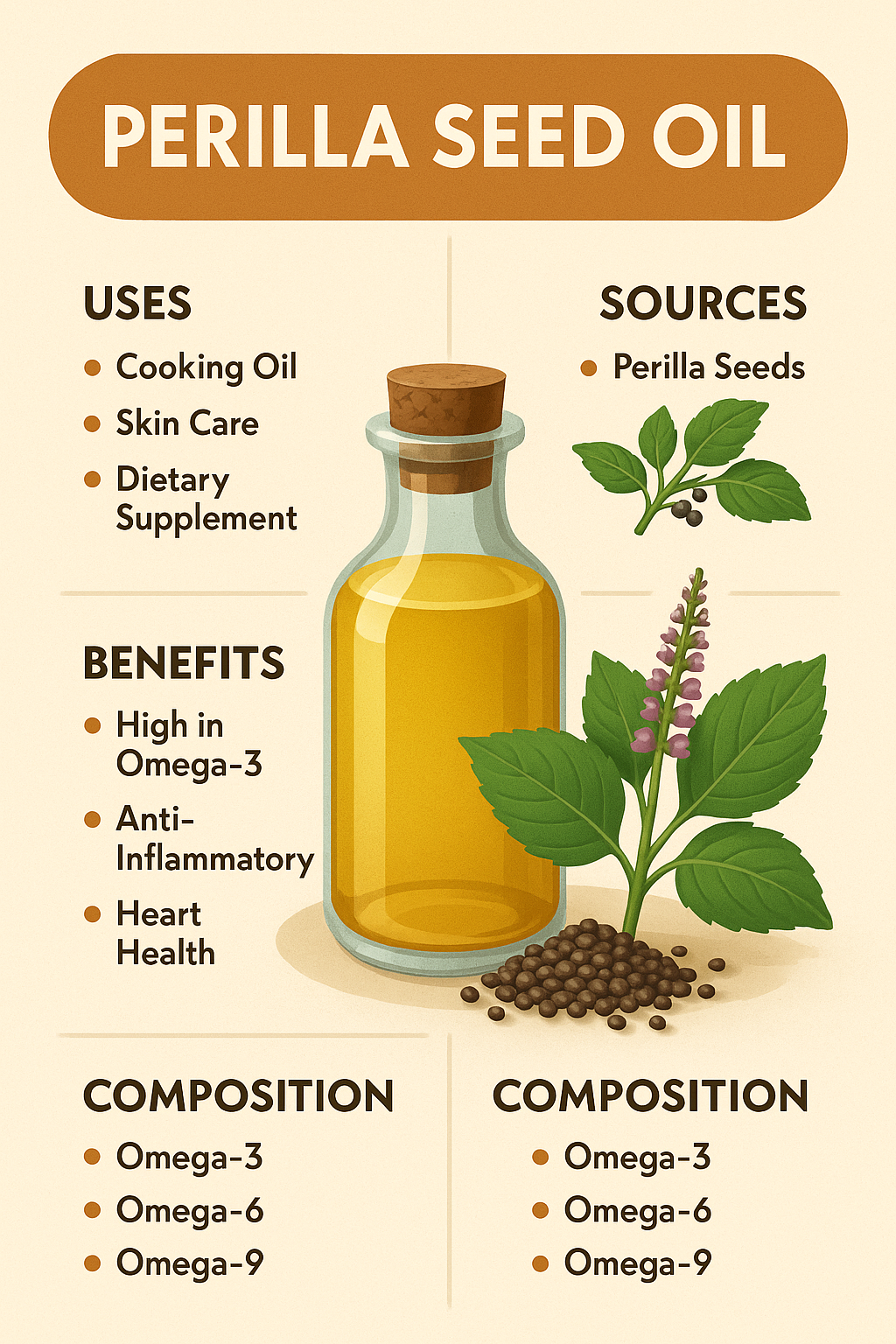
Perilla is one of those plants that almost never appears in mainstream agricultural discussions, yet if you follow its trail through East Asian landscapes, mountain slopes, smallholder gardens, and ancient culinary traditions, you discover a world where this plant is far more than another oil crop. Perilla belongs to a very old cultural memory in several Asian regions, especially Korea, parts of Japan, inland China, and certain Himalayan communities. Its presence in fields is so understated that agricultural outsiders often overlook it. But when you begin to examine the seeds, the aroma, the oil purity, the botanical behavior of the plant, and the cultural rituals attached to it, you realize Perilla is one of the most layered oil crops in Asia — layered not only in chemistry but also in meaning.
Walking through Korean countryside during late summer, you may see Perilla plants standing quietly between more dominant crops like sesame and soybeans. They grow with a deceptive calmness, with soft, heart-shaped leaves and a fragrance that drifts across fields, hinting at its significance in traditional kitchens. Yet the story truly begins in the seeds. Perilla seeds hold one of the highest concentrations of plant Omega-3 fatty acids known in nature. This alone has caught the attention of modern nutritionists, but what many people fail to grasp is that the oil from these tiny seeds is not merely a nutritional product—it is a record of centuries of ecological adaptation.
To understand Perilla oil properly, one must step into the ecological world in which the plant evolved. Perilla prefers regions where summers are warm and humid, where monsoon cycles bring a sequence of moisture and sunlight, and where soils range from loamy to slightly acidic. The plant grows at altitudes that surprise agricultural scientists. In parts of the Himalayas, you find Perilla thriving on steep terraces carved by hand, receiving only partial sunlight as fog hangs above the valley. In these highlands, farmers rarely speak about Perilla as a commodity. For them, it is a household plant, one that provides both medicinal oils and culinary agents, something that stood beside them long before modern edible oils entered their diets.
What makes Perilla’s agricultural personality intriguing is its dual life. In the lowlands of China, it behaves like a fairly standard annual herb. In the Korean peninsula, it becomes a cultural symbol of autumn harvests. In mountainous terrain, it acts more like a survival plant capable of enduring cold nights and misty mornings. Such geographic diversity gives rise to a wide range of chemotypes. Some Perilla lines accumulate more aromatic compounds in their leaves; others send their biochemical energy into oil-rich seeds. There are communities in Japan that use versions of Perilla mainly for leaf flavoring, and others that cultivate special lines purely for oil extraction.
The oil itself carries stories that stretch far beyond laboratories. For centuries, Perilla oil was used as a cooking medium in households where animal fats were limited or expensive. Ancient documentation from East Asian medical texts describes Perilla oil as a protective agent for the lungs, a remedy for chronic chest discomfort, and a soothing substance for skin irritations. It makes sense scientifically when you observe the oil’s composition: high Omega-3 levels, balanced antioxidants, and a delicate viscosity that absorbs into the skin without leaving a heavy trace. But traditional communities arrived at these conclusions not through biochemical analysis but through generational observation — trial, error, and subtle wisdom shaped by lived experience.
When one visits a seed oil press in a rural Korean village, especially in the older regions of Gyeongsang or Jeolla provinces, you notice the extraction process is not merely mechanical. It is almost ceremonial. The seeds are harvested at precise moisture levels, dried under diffused sunlight, cleaned manually with sieves and hand fans, and then pressed slowly at low temperatures to preserve what Koreans call “ddeokddeokhan hyanggi,” a thick and dense aroma associated with high-quality Perilla oil. This aroma is not easy to describe. It is neither pungent like mustard oil nor neutral like refined olive oil. It carries an earthy, slightly sweet fragrance with a warm undertone that hints at its high fatty acid concentration.
Modern extraction facilities, especially in South Korea and certain Chinese provinces, use advanced cold-press systems that maintain the oil’s chemical integrity. Researchers studying Perilla have noted that the oil oxidizes more slowly than many other plant oils despite its high unsaturated fat content. This stability, they argue, is partly due to its inherent antioxidant profile. Even so, Perilla oil must be stored carefully because Omega-3-rich oils naturally degrade faster under light and heat. Traditional storage methods — dark clay jars, cool storage rooms, wooden shelves away from sunlight — were inadvertently ideal for protecting its quality.
Perilla cultivation varies depending on purpose. For leaf-type Perilla, farmers promote lush foliage through moderate nitrogen use. For seed-type Perilla, they manage spacing, sunlight distribution, and drainage differently to encourage seed head development. The plant responds uniquely to soil fertility. Too much fertility causes it to grow tall but reduces seed density. Too little fertility limits biomass but increases oil concentration in surviving seeds. This delicate balance is well understood by experienced growers but still puzzles new farmers.
Rainfall plays an interesting role in seed formation. Excessive rain during seed maturation dilutes lipid accumulation in the seed head. Too little rainfall before flowering stunts plant height. Hence, Perilla thrives best in regions with rhythmic rainfall — early moisture, stable midsummer, and dry autumns. These climatic rhythms coincide beautifully with Korea’s agricultural calendar, which may explain why Perilla oil has been culturally significant there for centuries.
When examining Perilla seed morphology, you notice seeds are tiny, round, and often carry faint patterns on the surface. These patterns are indicators of genetic lineage. Some seeds appear smooth and glossy, others carry a faint mosaic-like texture. Researchers associate these surface differences with variations in oil yield and fatty acid distribution. Seeds from cooler mountainous regions often show slightly darker pigmentation, which in turn correlates with higher antioxidant concentration in the oil.
Economically, Perilla oil occupies a hybrid position. It is not as industrially widespread as soybean or canola oil, but its value in the health food sector and premium culinary markets is rising rapidly. South Korea alone consumes thousands of tons of Perilla oil annually for cooking, seasoning, cosmetics, traditional medicine, and even religious rituals. Farmers in Nepal and Bhutan have begun exporting Perilla seeds to Korean companies, and Chinese agricultural businesses have expanded Perilla cultivation in Yunnan and Sichuan to meet growing export demand.
The global health industry’s fascination with Omega-3 fatty acids has opened a new path for Perilla oil. While flaxseed oil has historically dominated the plant-based Omega-3 market, Perilla oil is now considered a strong competitor because it has a more balanced aroma and tends to be more culturally integrated in Asian diets. The oil’s high alpha-linolenic acid (ALA) content makes it beneficial for heart health, inflammation reduction, and metabolic balance. Nutritionists studying cardiovascular patterns in traditional Korean diets often attribute their historical heart-health advantages partly to the consumption of Perilla oil.
From a cultural perspective, Perilla oil carries meanings that transcend nutrition. It represents seasonal transition in Korea, where families press oil after autumn seed harvest to prepare for winter dishes. Perilla oil is used in temple cuisine prepared by Buddhist monks, who avoid animal-based fats, making plant oils spiritually significant. In these monasteries, Perilla oil is valued for its purity and its subtle effect on the energy of food — not heavy, not overpowering, but nourishing in a calm, almost meditative way.
Perilla’s journey beyond Asia is relatively new. When American and European chefs discovered its culinary potential, they began experimenting with its nutty aroma in salads, marinades, artisan breads, and fusion dishes. Cosmetic companies, particularly those focusing on natural plant-based oils, have begun incorporating Perilla oil in formulations for sensitive skin, eczema management, and anti-inflammatory serums. This interest has transformed Perilla into a commodity with international potential.
But global expansion brings challenges. One challenge is maintaining seed purity. Perilla cross-pollinates easily, and when leaf varieties cross with seed varieties, the oil yield and aroma change. Another issue is the plant’s sensitivity to photoperiod. Perilla in northern latitudes may not flower at the correct time unless daylight hours align with its genetic rhythm. This restricts its cultivation outside certain warm-temperate regions unless breeders develop photoperiod-flexible varieties.
From an ecological standpoint, Perilla interacts smoothly with biodiversity. It attracts pollinators, particularly small bees, and its flowers support micro-habitats for beneficial insects. Unlike many commercial oil crops, Perilla rarely relies on heavy pesticide use. The plant has natural aromatic defenses and grows vigorously enough to outcompete many weeds. This makes it environmentally friendly and suitable for organic systems.
The economics of Perilla oil farming are not straightforward, however. Because seed yield varies widely by region, altitude, and genetic type, farmers must learn local cultivation knowledge rather than relying solely on general guidelines. In Korea, farmers often rotate Perilla with barley, sesame, and legumes. This cyclic pattern rejuvenates soil conditions and reduces pest buildup. In Himalayan regions, Perilla fits into mixed cropping systems with millet and buckwheat, where it thrives on residual moisture. The crop’s inherent adaptability to marginal soils makes it valuable for remote communities with limited agricultural inputs.
The question many economists ask is whether Perilla can scale. The answer depends on how we define scale. If the goal is to replace mass oils like soybean or palm, Perilla cannot compete. But if the goal is to create a premium oil market—nutrition-forward, culturally rich, environmentally low-impact—Perilla fits perfectly. Modern consumers increasingly value oils with heritage, traceability, and health benefits. Perilla matches all three criteria.
The extraction industry surrounding Perilla remains small compared to global edible oil giants, but that may be an advantage. Small-scale presses maintain quality. Local cooperatives keep profits within rural communities. When Perilla becomes too industrialized, its uniqueness risks dilution. Maintaining artisanal quality while expanding international availability is a delicate balance the industry must navigate.
As for the oil’s sensory profile, chefs often describe Perilla oil as warm, earthy, slightly citrusy at times, with a softness that lingers. Its aroma blooms when lightly heated, though overheating destroys its delicate compounds. This sensitivity explains why Perilla oil is traditionally drizzled over dishes rather than used for deep frying. It elevates flavors rather than competing with them.
In the realm of human health, Perilla oil is studied for its anti-inflammatory effects, its ability to support neurological function, and its potential role in metabolic health. Researchers are investigating how Perilla oil may influence lipid profiles and reduce chronic inflammation. These studies are still ongoing, but early findings are promising.
Side effects associated with Perilla oil are minimal, though individuals with seed allergies should exercise caution. Like all high-Omega-3 oils, it must be stored properly. When exposed to light, air, or heat, it loses potency. Traditional clay jars, dark glass bottles, and cool storage environments still offer the best preservation.
The future of Perilla oil seems to be moving toward greater global recognition. Climate change may ironically increase Perilla’s importance. As rainfall becomes unpredictable and temperatures rise, crops that tolerate stress while maintaining high nutritional output will become essential. Perilla fits that description. Its deep root system allows it to endure dry spells. Its flowering pattern adapts to varying altitudes. Its seeds concentrate valuable lipids even under environmental stress. This resilience positions it as a future-forward crop.
For farmers exploring diversification, Perilla presents an interesting opportunity. It does not demand heavy investment. It is compatible with organic farming. It fits into mixed cropping systems. It has strong cultural markets and emerging international demand. These layers make it more than a botanical product; they make it a socio-economic bridge between tradition and global modernity.
Perilla’s history is shaped not by mass agriculture but by everyday human experience. The plant’s fragrance in summer fields, the slow pressing of seeds in rural oil houses, the seasonal dishes flavored with its oil, the elders who describe how it kept families nourished in lean years — all of these form a narrative that is difficult to quantify but easy to feel once you step into its world.
Thus, Perilla oil is not simply extracted from seeds. It is extracted from landscapes, from memory, from centuries of adaptation, and from the intimate relationship between humans and a plant that never needed fame to prove its worth.
This is why Perilla seed oil deserves careful attention today — from farmers, scientists, nutritionists, policymakers, and anyone interested in how traditional plants can shape future food and health systems.
✍️ Farming Writers Team
Love farming Love Farmers
Leave a ReplyShare your thoughts: We’d love to hear your farming ideas or experiences!