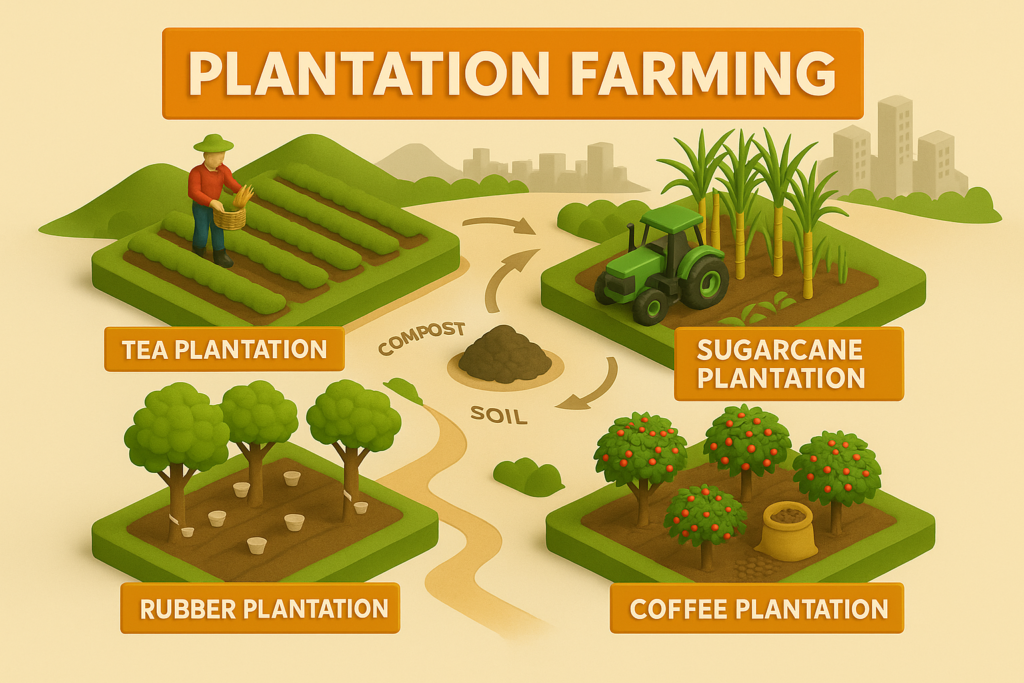
Plantation farming represents one of the most influential agricultural systems in the world. It is a large-scale, commercialized farming method built around a single major cropknown as a monoculture crop cultivated primarily for export and industrial use. Unlike subsistence agriculture, which focuses on feeding the farmer’s family, plantation farming is designed to produce huge volumes of high-value crops for global markets, often operated with advanced management systems, hired labor, and significant capital investment.
This farming system originated during the colonial era, when European empires established massive plantations in Asia, Africa, Latin America, and the Caribbean to grow crops like sugarcane, coffee, cocoa, tea, tobacco, cotton, and rubber. Even today, plantation agriculture remains a pillar of the global commodity supply chain, supplying essential raw materials to industries such as food processing, textiles, beverages, pharmaceuticals, cosmetics, and manufacturing.
Plantation farming requires specific natural, economic, and labor conditions. These operations thrive in tropical and subtropical climates with abundant rainfall, fertile soils, and long growing seasons. They demand sophisticated management practices, large tracts of land, mechanization, and a trained workforce.
As global demand for plantation-based crops increases, modern plantations are evolving from traditional labor-intensive systems to highly mechanized, technology-driven, climate-smart operations. This transformation is driven by new challenges: climate change, soil depletion, biodiversity loss, and fluctuating commodity markets.
- Key Characteristics of Plantation Farming
Plantation farming has distinct features that separate it from other farming systems:
2.1 Large-Scale Commercial Production
Plantations are typically spread over hundreds or thousands of hectares, producing high-value cash crops for industrial processing or export.
2.2 Monoculture System
One major crop dominates the landscape—coffee, tea, sugarcane, cocoa, cotton, rubber, oil palm, or banana.
2.3 Specialized Crop Management
Plantations rely on expert-level crop management techniques including:
Pruning
Irrigation scheduling
Fertilizer management
Disease monitoring
Plantation renewal cycles
2.4 Capital and Labor Intensive
Plantation agriculture requires:
Heavy investment in machinery
Processing units
Transportation infrastructure
Skilled and unskilled labor
2.5 Close Link to Agro-Based Industries
Crops are grown primarily for transformation into finished products such as:
Tea bags
Coffee powders
Sugar
Cocoa butter
Rubber sheets
Textile fibers
Vegetable oils
2.6 Export-Oriented Production
Many plantation crops form the backbone of international trade.
- Global History and Development
Plantation farming originated in the 15th to 19th centuries when European colonizers established large agricultural estates in tropical regions. Crops like sugarcane in the Caribbean, cotton in America, tea in India, rubber in Malaysia, and coffee in Brazil shaped global trade routes.
The huge demand from European markets led to:
Introduction of new crops in colonies
Establishment of large-scale estates
Development of global shipping and trading networks
Modern plantations continue this legacy but with advanced technologies, international corporations, and strict regulations on labor and environmental standards.
- Geographic Distribution of Plantation Farming
Plantation farming thrives in humid tropical and subtropical zones.
Major Countries and Regions
Brazil: Coffee, sugarcane, cocoa, orange
India: Tea, coffee, sugarcane, rubber, cotton
Sri Lanka: Tea, rubber
Indonesia: Palm oil, rubber
Malaysia: Palm oil, cocoa, rubber
Vietnam: Coffee, pepper
Kenya: Tea, coffee
Ghana: Cocoa
Colombia: Coffee
Ethiopia: Coffee
- Major Plantation Crops and Their Requirements
5.1 Tea
Grown in hilly regions with acidic soils and abundant rainfall. Requires careful plucking cycles and skilled labor.
5.2 Coffee
Prefers high-altitude tropical climates with shade trees. Sensitive to temperature and rain variability.
5.3 Sugarcane
A major industrial crop requiring fertile soil, irrigation, and strong sunlight. Used for sugar, ethanol, and biofuels.
5.4 Rubber (Hevea brasiliensis)
Grown in hot, wet climates. Requires latex tapping cycles and disease management.
5.5 Oil Palm
One of the world’s highest-yielding oil crops. Used in food, cosmetics, and biofuel industries.
5.6 Cocoa
Grown in humid forest zones. Sensitive to pests and fungal diseases.
5.7 Cotton
A major textile crop requiring warm climates and mechanized harvesting.
5.8 Banana and Pineapple
Large-scale fruit plantations supplying global markets.
- Plantation Management Practices
6.1 Land Preparation and Layout
Plantations are carefully planned with:
Graded slopes
Drainage channels
Irrigation systems
Access roads
Worker housing
6.2 Irrigation Systems
Sugarcane and fruit plantations rely heavily on:
Drip irrigation
Sprinklers
Micro-jets
Canal irrigation
6.3 Nutrient Management
Plantations use soil testing, leaf analysis, and precision fertilization to ensure consistent nutrient supply.
6.4 Weed and Pest Management
Integrated practices include:
Manual weeding
Herbicides
Biological control agents
Disease-resistant varieties
6.5 Harvesting Cycles
Different crops have unique harvest calendars:
Tea: Weekly plucking
Sugarcane: 10–18 month harvest cycle
Coffee: Annual selective picking
Rubber: Daily/alternate-day tapping
6.6 Processing and Value Addition
Plantations often operate on-site processing units:
Sugar mills
Tea factories
Rubber smokehouses
Coffee pulping units
- Economic Structure of Plantation Farming
7.1 Capital Requirements
Plantations require high investment in:
Land
Machinery
Irrigation
Processing plants
Storage facilities
7.2 Labor Economics
Historically labor-intensive, plantations today use:
Mechanized harvesters
Automated irrigation
Digital monitoring
7.3 Market Dependence
Plantation crops are vulnerable to:
Price fluctuations
Global demand shifts
Trade regulations
7.4 Export Revenue
Countries like India, Brazil, Ghana, Kenya, and Vietnam earn billions from plantation commodities.
- Environmental Impact
8.1 Deforestation
Large plantations often replace natural forests, reducing biodiversity.
8.2 Soil Degradation
Monoculture systems exhaust soils without proper management.
8.3 Water Stress
Sugarcane and oil palm plantations consume significant water.
8.4 Carbon Emissions
Land clearing, machinery, and processing increase emissions.
- Sustainable Plantation Farming
Modern plantations are shifting to:
Agroforestry
Integrated pest management
Precision nutrient application
Eco-certification (Rainforest Alliance, Fair Trade)
Reforestation and shade-tree planting
- Global Case Studies
India – Tea and Rubber
India’s plantations combine traditional labor with modern irrigation and soil testing.
Brazil – Sugarcane & Coffee
High mechanization, biofuel production, and advanced breeding programs.
Malaysia – Palm Oil
Industry transitioning to sustainable certification schemes.
Ghana – Cocoa
Government programs promote agroforestry and disease-resistant varieties.
- FAQs
- What is plantation farming?
A large-scale commercial farming system focused on growing one major crop.
- Why is plantation farming important?
It supports global supply chains of sugar, coffee, tea, rubber, cotton, and oil crops.
- Which climate suits plantation crops?
Tropical and subtropical regions with high rainfall.
- Is plantation farming sustainable?
Traditional systems were not; modern systems are becoming sustainable with regulations.
- What industries depend on plantation farming?
Food, beverages, textiles, cosmetics, pharmaceuticals, and biofuels.
- Conclusion
Plantation farming has shaped global trade and agricultural economics for centuries. Its large-scale, commercial nature makes it a powerful contributor to national GDPs and rural employment. However, monoculture systems come with environmental and social challenges that demand modernization and sustainable transformation. Today’s plantations are adopting advanced technologies, precision farming tools, sustainability certifications, and climate-resilient strategies to meet growing global demands without compromising ecological integrity.
✍️Farming Writers Team
Love farming Love Farmers.
Read A Next Post 👇
https://farmingwriters.com/urban-farming-complete-global-guide/
Leave a ReplyShare your thoughts: We’d love to hear your farming ideas or experiences!