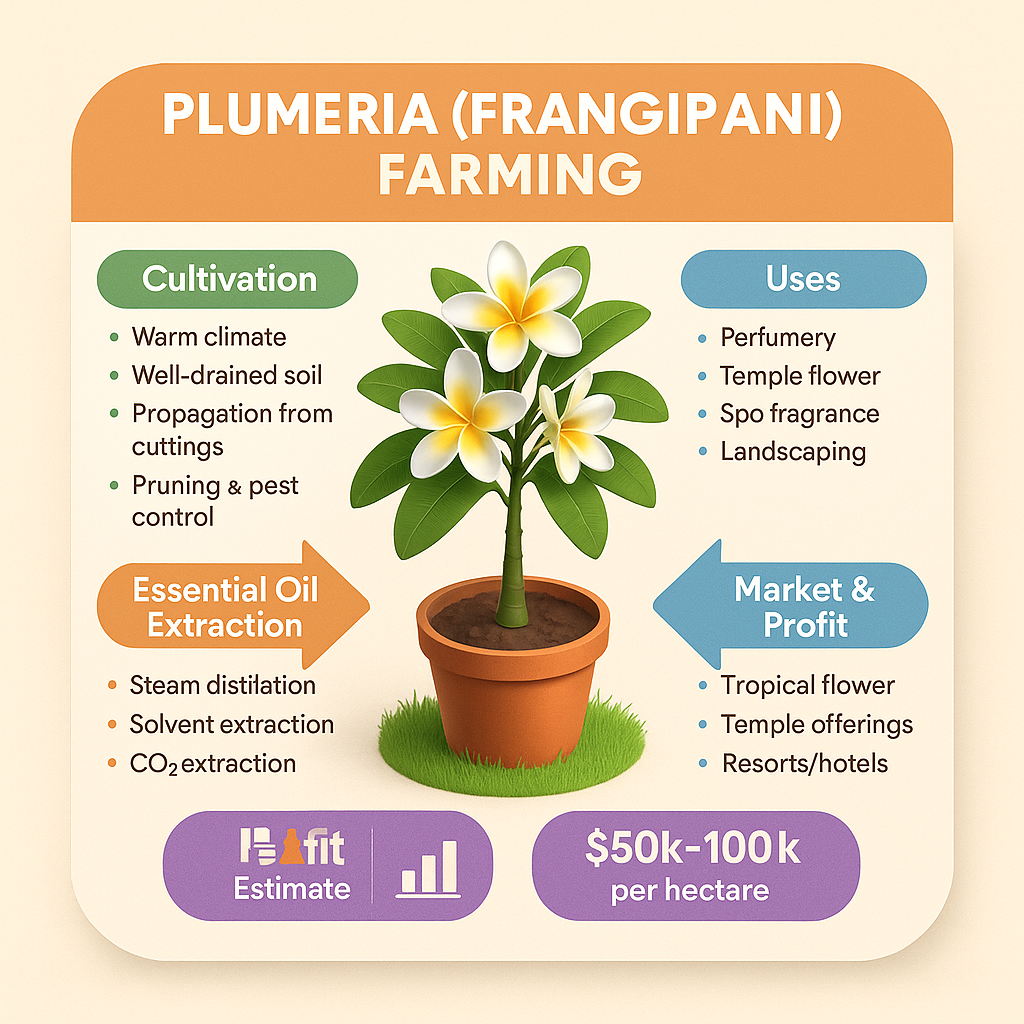
INTRODUCTION
Plumeria, commonly known as Frangipani, is one of the most recognized aromatic flowers in the world. Known for its strong, long-lasting fragrance, Plumeria is highly valued in perfume industries, spa fragrances, essential oil production, temple flower offerings, weddings, resorts, landscape design, tropical gardens, and luxury hotels. It is one of the few flowers that survive in harsh tropical climates while still producing premium-quality blooms throughout the year.
Native to Central America, Mexico, and Caribbean islands, Plumeria has become a dominant commercial flower in tropical and subtropical regions around the world. The plant is a hardy, low-maintenance, drought-resistant, and long-lived tree, making it exceptionally profitable for flower farming, essential oil extraction, landscaping supply chains, and nursery businesses.
Plumeria is culturally important in Thailand, Hawaii, Sri Lanka, India, Indonesia, Philippines, Fiji, Maldives, and many Pacific islands. Hawaiians use Plumeria in garlands (lei-making), while Thailand exports Plumeria plants and cuttings to international garden centers. India uses Plumeria extensively in temples, aroma therapies, spa centers, and decorative floral installations.
The global Plumeria market is expanding due to:
1. Rising demand for natural essential oils
2. Growing spa and wellness centers
3. Resort and hotel landscaping projects
4. Increasing use of temple flowers
5. Premium nursery sales
6. Flower exports to Gulf and Asian markets
Although Plumeria is easy to grow, commercial-scale farming requires knowledge of soil type, propagation, flowering cycles, pruning management, essential oil extraction, disease control, and high-grade flower harvesting techniques.
SCIENTIFIC CLASSIFICATION & ORIGIN
Common Name: Plumeria / Frangipani
Scientific Name: Plumeria rubra, Plumeria alba, Plumeria obtusa
Family: Apocynaceae
Origin: Mexico, Central America, Caribbean
Plant Type: Perennial, drought-resistant, deciduous or evergreen shrub/tree
Flowering: Seasonal and continuous depending on species
Commercial Height: 2–8 meters
Top Global Producers: Thailand, Indonesia, India, Sri Lanka, Hawaii (USA), Mexico, Brazil, Australia
Plumeria species vary in fragrance, flower size, colors, and petal width. The two most commercially grown species are:
1. Plumeria rubra
Known for deep red, pink, and orange flowers with extremely strong fragrance. Preferred for essential oil extraction.
2. Plumeria alba
White flowers with yellow centers. Common in temples, landscapes, and resorts.
Plumeria is an ancient tropical flower. In Ayurveda, it is used for skin treatments, anti-inflammatory applications, and aromatic therapies. Hawaiians consider Plumeria a symbol of hospitality, while in India it is associated with spirituality.
COMPLETE CULTIVATION GUIDE
CLIMATE REQUIREMENTS
Plumeria thrives in tropical and subtropical regions globally.
Optimal Conditions:
Temperature: 22–35°C
Humidity: 40–80%
Sunlight: Full sun for 6–8 hours
Rainfall: 600–1500 mm annually
Frost: Not tolerated
Wind: Moderate wind required for airflow
Plumeria is extremely drought tolerant but cannot tolerate waterlogging or heavy frost. It performs best in warm, dry climates.
SOIL REQUIREMENTS
Plumeria prefers well-drained, sandy or loamy soil with high aeration.
Ideal Soil Characteristics:
pH: 6.2–7.5
Drainage: Excellent
Organic matter: Moderate
Soil structure: Light and porous
Recommended Soil Mix for Superior Growth:
40% sandy loam
30% compost or leaf mold
20% coarse sand
10% coco peat
Heavy clay soil must be amended with sand and organic matter.
PROPAGATION METHODS
1. Stem Cuttings (Most Popular)
Use 20–30 cm cuttings
Let them dry for 7–10 days
Plant in well-drained mixture
This is the fastest commercial propagation system.
2. Air Layering
Used to produce larger plants for nurseries.
3. Seeds
Used for hybrid development; not preferred for commercial farming.
4. Grafting
Used for multi-color Plumeria trees.
PLANTING AND SPACING
Spacing: 3 x 3 meters for small farms; 4 x 4 meters for large trees
Plant Density: 625–1,111 plants per hectare
Planting Season: Spring or early monsoon
Large nurseries prefer polybags or large pots for selling saplings.
IRRIGATION MANAGEMENT
Plumeria requires controlled irrigation.
Early stage: Light irrigation for 4–6 weeks
Mature stage: Once every 7–10 days
Avoid constant wet soil
Drip irrigation recommended
Waterlogging causes root rot.
FERTILIZATION PROGRAM
Plumeria responds well to phosphorus-rich fertilizers which enhance blooming.
Base Fertilizers:
Compost: 5–8 kg per plant
Bone meal: 250 g per plant
Seasonal Fertigation:
NPK 10:20:20 monthly
Potassium sulfate before flowering
Micronutrients (Zn, Fe, Mg) every 45 days
Balanced feeding improves flower size, color, and fragrance.
PRUNING & TRAINING
Plumeria requires structured pruning to increase branching and flower density.
Prune after flowering season
Remove inward and crossing branches
Maintain 3–5 primary branches
Encourage outward growth
Pruned branches can be used as propagation cuttings.
PEST & DISEASE MANAGEMENT
Pests:
Aphids
Whiteflies
Mealybugs
Spider mites
Control measures include neem oil, soap sprays, and systemic insecticides (as per export regulations).
Diseases:
Rust
Root rot
Stem rot
Preventive steps:
Good drainage
Copper fungicide
Avoid overhead watering
FLOWERING AND HARVESTING
Flowering Season
Peak: Summer
Multiple flushes yearly in tropical areas
Harvesting System
Harvest early morning
Use clean knives
Handle gently to avoid bruising
Flowers are used for:
Perfume
Essential oil
Hotel decoration
Spa centers
Religious offerings
ESSENTIAL OIL EXTRACTION (HIGH VALUE)
Plumeria essential oil is among the most expensive in the world due to low yield and high demand.
Extraction Methods:
Steam distillation
Solvent extraction
CO₂ extraction
Oil Yield:
Very low — making it premium grade.
Price:
Raw Plumeria essential oil: 450–1200 USD per kg
Diluted oil blends: 50–200 USD per liter
Major buyers include perfume industries, luxury spas, aromatherapy companies, and skincare brands.
GLOBAL MARKET ANALYSIS (USD)
Global Plumeria Market Value (2024): 2.5–3.2 billion USD
Growth Rate: 6.0% CAGR
Top Exporters:
Thailand
Indonesia
India
Hawaii (USA)
Vietnam
Top Importers:
USA
UAE
Saudi Arabia
Japan
Singapore
France
Price Structure:
Fresh flowers: 1–4 USD per kg
Potted plant: 10–30 USD
Mature tree: 50–150 USD
Essential oil: 450–1200 USD/kg
Hotels, spas, resorts, temples, and aromatherapy businesses are major consumers.
BUSINESS OPPORTUNITIES
Plumeria provides multiple income streams:
1. Fresh flowers for temples
2. Export-quality cuttings
3. Essential oil
4. Perfume-making
5. Landscaping plants
6. Bonsai-grade Plumeria
7. Nursery saplings
8. Hybrid seed sales
9. Resort decoration contracts
HEALTH BENEFITS
Plumeria flowers and oil are used for:
Stress relief
Anti-inflammatory properties
Mild pain relief
Aromatherapy
Skin-soothing
Relaxation in spas
PRECAUTIONS
Latex sap may irritate skin
Not edible
Keep away from small children
COST & PROFIT ANALYSIS (USD)
Investment per Hectare:
Land + planting: 5,000–8,000 USD
Saplings: 6,000–12,000 USD
Irrigation + fertilizer: 2,000 USD
Total: 13,000–22,000 USD
Returns:
Flowers: 20,000–35,000 USD
Nursery plants: 40,000–90,000 USD
Essential oils: 15,000–50,000 USD
Total Annual Revenue: 75,000–150,000 USD
Net Profit: 50,000–100,000 USD per hectare
20 FAQS
1. Which climate is best for Plumeria?
Warm tropical climates with 6–8 hours sunlight.
2. Can Plumeria grow indoors?
Yes, near well-lit windows.
3. What soil is best?
Fast-draining sandy loam with organic matter.
4. How profitable is Plumeria?
Very profitable: 50,000–100,000 USD annual profit per hectare.
5. How many plants per hectare?
600–1100 depending on spacing.
6. Do Plumerias need a lot of water?
Low water requirement; avoid waterlogging.
7. When do Plumerias flower?
Mainly summer; multiple flushes in tropics.
8. Can Plumeria survive drought?
Yes, extremely drought-resistant.
9. What is Plumeria essential oil used for?
Perfume, aromatherapy, luxury skincare.
10. Is Plumeria toxic?
Sap may irritate skin; not edible.
11. How long does Plumeria live?
50–70 years easily.
12. Can Plumeria be exported?
Yes—cuttings, saplings, and oil are major exports.
13. What is the price of Plumeria plants?
10–150 USD depending on size.
14. Which species is best for oil?
Plumeria rubra.
15. How long does it take to flower?
Cuttings flower in 8–12 months.
16. Why is my Plumeria not blooming?
Low sunlight or excess nitrogen.
17. What pests attack Plumeria?
Mealybugs, aphids, whiteflies.
18. Can Plumeria grow in pots?
Yes, grows very well in large pots.
19. What fertilizer is best?
High phosphorus NPK 10:20:20.
20. Is Plumeria good for landscaping?
One of the best tropical landscaping plants.
CONCLUSION
Plumeria is one of the best and most profitable tropical flowers in the global floriculture and essential oil industry. Its ease of cultivation, worldwide demand, multiple business streams, long life, high oil value, and strong landscaping market make it a top-tier commercial crop. With proper sun exposure, drainage, pruning, and nutrient management, Plumeria farming can deliver excellent returns for decades.
✍️Farming Writers
Leave a ReplyShare your thoughts: We’d love to hear your farming ideas or experiences!