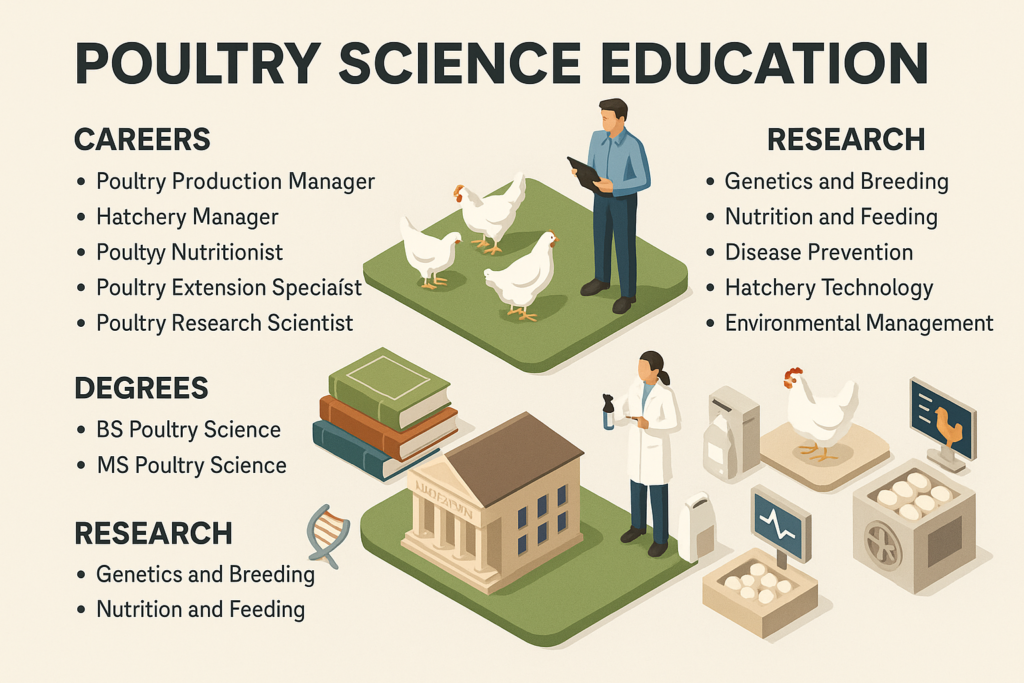
Poultry Science Education in the United States: A Complete Deep Study
Poultry Science is one of the most specialized, industrialized and technology-driven branches of agricultural education in the United States. The USA is among the world’s largest producers of poultry meat and eggs, and this achievement is strongly supported by scientific education, genetics research, nutrition technology, disease control systems and precision management practices.
Poultry science education in the USA goes far beyond traditional chicken farming. It integrates animal biology, feed science, genetics, disease diagnostics, food safety, processing technology and large-scale production management. Students are trained to work in highly organized commercial systems that operate at national and global scales.
This article presents a complete and original overview of poultry science education in the United States, including degree structures, universities, research areas, practical training, career paths, salaries and opportunities for international students.
- Importance of Poultry Science in the USA
The poultry industry is one of the fastest-growing agricultural sectors in the United States. Poultry science education supports:
High-efficiency broiler production
Large-scale egg production
Feed conversion optimization
Disease prevention and biosecurity
Genetic improvement of poultry lines
Hatchery technology
Poultry meat quality and safety
Export-grade processing standards
Sustainable poultry systems
Because poultry production operates on a highly technical and commercial scale, trained poultry science professionals are essential to the industry.
- Structure of Poultry Science Education
Poultry science is taught as a specialized discipline within animal science or as an independent department at selected universities.
Undergraduate Programs (BS Poultry Science / BS Animal Science – Poultry Track)
Core subjects generally include:
Introduction to poultry science
Poultry anatomy and physiology
Broiler production systems
Layer production and egg technology
Poultry nutrition and feed formulation
Poultry genetics and breeding
Hatchery management
Poultry housing and ventilation
Environmental control systems
Biosecurity and disease prevention
Poultry behavior and welfare
Meat and egg quality evaluation
Poultry farm management
Poultry industry economics
Undergraduate students receive extensive hands-on training in:
Broiler farms
Layer housing systems
Hatcheries
Feed mills
Poultry laboratories
Processing units
Graduate Programs (MS Poultry Science / MS Animal Science – Poultry Specialization)
Graduate education focuses on advanced specialization and research. Common focus areas include:
Poultry nutrition and feed efficiency
Breeder management and reproduction
Poultry genetics and selection
Disease resistance and immunology
Hatchability improvement
Environmental stress management
Poultry product quality
Sustainable poultry systems
Graduate students conduct laboratory and field research linked to industry challenges.
Doctoral Programs (PhD Poultry Science / PhD Animal Science)
PhD-level research includes:
Genetic improvement of broilers and layers
Gut health and microbiome studies
Vaccine development and disease control
Feed additives and alternative proteins
Climate impact on poultry production
Precision poultry monitoring systems
Automation and sensor-based housing
Antibiotic-free production systems
PhD graduates often move into research leadership, academia or advanced industry roles.
- Top Universities for Poultry Science in the USA
The USA has a small but extremely strong group of poultry science institutions:
University of Georgia
Auburn University
North Carolina State University
Texas A&M University
Mississippi State University
University of Arkansas
Purdue University
University of Maryland
Virginia Tech
Iowa State University
These universities maintain:
Experimental broiler and layer farms
Hatchery research facilities
Nutrition and feed labs
Poultry disease diagnostic labs
Processing and food safety labs
Extension training units
- Major Research Areas in Poultry Science
Poultry science research in the USA focuses on productivity, health and food safety.
Poultry Nutrition
Optimizing nutrient utilization, feed additives and alternative feed ingredients.
Genetics and Breeding
Improving growth rate, egg production, feed efficiency and disease resistance.
Poultry Health and Disease
Biosecurity systems, vaccination programs, pathogen control and diagnostics.
Hatchery Technology
Incubation systems, chick quality, hatchability improvement.
Environmental Management
Ventilation, temperature control, ammonia management and housing design.
Meat and Egg Quality
Processing standards, shelf life, grading systems and food safety compliance.
Precision Poultry Farming
Sensors, cameras, data analytics and automated monitoring systems.
- Practical Training and Industry Exposure
Poultry science education is highly practical. Students participate in:
Broiler and layer management
Hatchery operations
Feed manufacturing
Disease monitoring
Processing plant exposure
Quality control testing
Data recording and performance analysis
Industry internships
This practical emphasis ensures graduates are industry-ready.
- Careers After Studying Poultry Science
Graduates work in diverse parts of the poultry value chain.
Major Career Roles
Poultry production manager
Broiler farm supervisor
Layer farm manager
Hatchery manager
Poultry nutritionist
Feed formulation specialist
Poultry health technician
Quality assurance manager
Processing plant supervisor
Poultry extension educator
Poultry research scientist
- Salary Scope in the USA (USD)
Salaries depend on role, specialization and experience:
Poultry production manager: stable to high income
Poultry nutritionist: strong earning potential
Hatchery manager: moderate to high
Quality assurance manager: competitive salary
Poultry consultant: long-term income growth
The poultry industry provides consistent employment due to continuous demand.
- Opportunities for International Students
International students choose poultry science in the USA due to:
Strong global poultry industry exposure
Advanced research labs
Industry-linked internships
Research assistantships
Modern housing and management systems
High employability worldwide
Graduates often return to their countries to modernize poultry industries.
- Admission Requirements
Science background at high-school level (for BS)
Bachelor’s degree in agriculture/animal science (for MS)
TOEFL/IELTS for English proficiency
Academic transcripts
Statement of Purpose
Letters of recommendation
Research interest (for PhD)
Frequently Asked Questions
- Is poultry science a good career in the USA?
Yes. Poultry is one of the fastest-growing livestock industries. - Which university is best for poultry science?
University of Georgia and Auburn University are global leaders. - Does poultry science include hatchery training?
Yes. Hatchery technology is a core subject. - Can international students study poultry science?
Yes. Many programs accept international students. - Is feed formulation part of poultry science?
Yes. Nutrition is a major component. - Are internships compulsory?
In most programs, yes. - Can poultry graduates work in processing plants?
Yes. Processing and quality control are major career areas. - Is poultry science different from animal science?
Yes. Poultry science focuses exclusively on birds and industrial systems. - Are modern technologies taught?
Yes. Precision monitoring and automation are included. - What is the future of poultry science?
Disease-free, antibiotic-free and technology-driven production systems.
Conclusion
Poultry science education in the United States represents one of the world’s most advanced livestock education models. By combining genetics, nutrition, disease control, automation and industry management, US poultry programs prepare students for leadership roles in global poultry industries. With high demand, practical training and international relevance, poultry science remains a strong and future-oriented agricultural career.
✍️Farming Writers Team
Love Farming Love Farmers
Read A Next Post 👇
Leave a ReplyShare your thoughts: We’d love to hear your farming ideas or experiences!