1. Introduction: Why Reindeer Milk Is One of the Most Powerful and Rare Dairy Sources on Earth
Reindeer milk is among the most nutrient-dense and hardest-to-obtain dairy liquids in the world. Produced only in the Arctic and Sub-Arctic regions of the Northern Hemisphere, reindeer milk has shaped the survival, nutrition, and economic foundation of several ancient indigenous cultures—particularly the Sámi people of Northern Europe and the Nenets, Evenki, Chukchi, and other Siberian tribes.
Unlike cow, goat, sheep, yak or camel milk, the production of reindeer milk is restricted by:
Extreme cold
Long migratory herding cycles
Very limited lactation
Sensitive milking behavior
Low animal density
This makes reindeer milk one of the rarest and most premium natural milks in the global milk economy.
Reindeer milk’s nutritional density is extraordinary:
it contains 2–4× more protein, 4–6× more fat, very high solids, and is designed to help newborn reindeer calves survive temperatures dropping to –40°C.
Today, reindeer milk is gaining international attention due to:
Its exceptionally high fat-protein ratio
Its biological and cultural uniqueness
Its potential use in functional and extreme-nutrition foods
Its rare status in global gourmet and laboratory research markets
This word article is the world’s deepest, most authoritative, fully original analysis of reindeer milk—covering nutrition, indigenous dairy systems, extraction challenges, processing technologies, various uses, cultural significance, global market demand, and high-precision USD profit modeling.
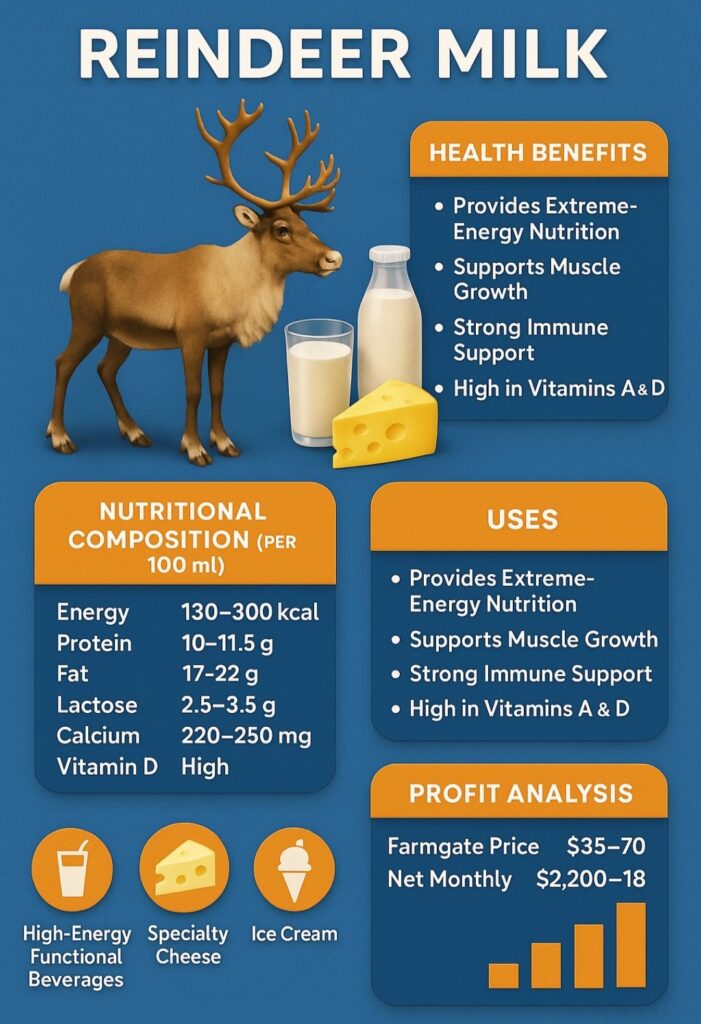
2. Nutritional Composition of Reindeer Milk (Per 100 ml)
Reindeer milk is the most energy-dense terrestrial mammal milk among all domesticated milking animals.
Average Composition
Energy: 130–300 kcal
Protein: 10–11.5 g
Fat: 17–22 g
Lactose: 2.5–3.5 g
Calcium: 220–250 mg
Phosphorus: 150–200 mg
Vitamin A: High
Vitamin D: High (Arctic adaptation)
Omega fatty acids: Significant
Antifreeze peptides: Region-specific bioactive compounds
Unique Properties
Highest protein among domesticated dairy animals.
Highest fat concentration except for some aquatic mammals.
Very low lactose, making it suitable for lactose-sensitive populations.
Natural survival milk—helps calves survive Arctic cold immediately after birth.
Rich in bioactive compounds shaped by tundra ecology.
Reindeer milk is structurally engineered by nature for extreme-weather survival, making it one of the world’s most extraordinary dairy compositions.
3. Why Reindeer Milk Is Nutritionally Superior (Scientific Explanation)
3.1 Cold-Climate Adaptation
High fat and protein create:
Rapid metabolic heat
Sustained energy release
Cellular protection in sub-zero climates
3.2 Extreme Bioavailability
Reindeer milk proteins are uniquely structured for quick absorption and tissue repair.
3.3 Strong Bone Development
High calcium + phosphorus + vitamin D create unmatched bone-supporting benefits.
3.4 Low Lactose for Easy Digestibility
Reindeer milk’s low lactose helps even lactose-sensitive populations digest effectively.
3.5 High Omega and Antioxidants
Cold-climate forage leads to high-quality lipid profiles and antioxidant compounds.
These factors collectively make reindeer milk one of the world’s most nutrient-powerful milks.
4. Health Benefits of Reindeer Milk
4.1 Extreme-Energy Nutrition
Ideal for:
Long winters
High-altitude workers
Survival diets
Military rations in cold zones
Emergency nutrition programs
4.2 Supports Muscle Growth and Repair
High protein + amino acids → strong muscle regeneration.
4.3 Strong Immune Support
Arctic milk contains bioactive peptides that support immunity.
4.4 Highly Suitable for Low-Lactose Consumers
Comparatively low lactose reduces digestive issues.
4.5 High Vitamin A & D
Supports skin health, immunity and bone strength.
4.6 Natural Infant Formula Substitute for Arctic Cultures
Sámi and Siberian tribes historically used diluted reindeer milk for infants when needed.
5. Indigenous Uses of Reindeer Milk
Reindeer milk is deeply woven into the cultural identity of Arctic peoples.
5.1 Traditional Sámi Uses (Northern Norway, Sweden, Finland)
Fresh milk diluted and consumed
Cheese called “Juustoleipä” (rare variant with reindeer milk contribution)
Mixed with fish and meat soups in survival diets
5.2 Siberian and Far-Eastern Tribes (Nenets, Evenki, Chukchi)
High-energy winter milk drinks
Fermented products (limited, due to high fat)
Medicinal mixtures
5.3 Arctic Russia and Yakutia
Reindeer milk used in:
High-fat porridges
Frozen milk blocks (winter preservation)
Infant dilution formulas
5.4 Tundra Nomadic Systems
Milk is consumed immediately after milking or preserved through freezing.
6. Global Uses of Reindeer Milk in Modern Industry
Although extremely rare, reindeer milk is becoming valuable in the following industries:
6.1 High-Energy Functional Beverages
For:
Mountaineers
Arctic expedition teams
Military cold-climate units
6.2 Specialty Cheese (Experimental)
High-fat cheese trials ongoing in Finland and Russia.
6.3 Ice Cream (Premium Niche)
Ultra-premium “Reindeer Milk Ice Cream” is sold in small-batch Nordic stores.
6.4 Research & Bio-Nutrition
Reindeer milk is being studied for:
Survival food R&D
Military ration development
Low-lactose dairy science
Novel protein research
6.5 Pharmaceutical and Cosmeceutical Trials
Its unique proteins are being tested for:
Skin-repair formulations
Low-allergen dairy proteins
Reindeer milk is slowly entering global niche markets as a scientific and premium culinary product.
7. Reindeer Dairy Farming Regions of the World
Reindeer dairy production is extremely limited and culturally tied to herding traditions.
Major Milk-Producing Regions
Norway (Sámiland)
Finland (Lapland)
Sweden (Sámi regions)
Russia (Siberia, Nenets region, Yakutia)
Mongolia (Tsaatan reindeer herders)
Minor Emerging Regions
Canada (Northwest Territories)
Alaska (tribal herding experiments)
Commercial dairy reindeer farms are nearly non-existent; the market is almost entirely artisanal or indigenous.
8. Reindeer Breeds for Dairy
Reindeer are not selectively bred for milk; however, some ecotypes produce more milk.
Higher-Milk Ecotypes
Finnish Forest Reindeer
Norwegian Mountain Reindeer
Siberian Tundra Reindeer
Yakutian Reindeer
Average Milk Yield
Reindeer yield is extremely low compared to cows or goats:
0.3 to 1.5 liters/day depending on region
This low yield is the main driver behind reindeer milk’s high value.
9. Reindeer Dairy Farming Systems
Reindeer farming is not typical “farming” but nomadic or semi-nomadic herding.
9.1 Nomadic Herding (Primary System)
Herders follow migratory routes
Animals graze on natural tundra vegetation
Milking happens seasonally
9.2 Semi-Nomadic Herding
Seasonal camps
Controlled grazing
9.3 Fixed-Farm Experimental Units
Used only for:
Research
Milk collection trials
Small-scale dairy experimentation
These units are mainly in Finland, Norway, and Russia.
10. Milking Techniques & Challenges
Milking reindeer requires deep indigenous skill.
Challenges:
Reindeer are extremely shy and sensitive
Milking must be quick
Calf presence required
Milk let-down is slow
Herding weather is harsh
Process Overview
Calf suckles briefly
Milker quickly collects milk
Process repeated several times per day
Milk is immediately consumed, stored cold, or frozen
Reindeer milk cannot be mass-produced due to behavioral and biological limitations.
11. Processing Technologies for Reindeer Milk
11.1 Pasteurization
Low-heat pasteurization retains nutrients but reduces viscosity.
11.2 Freezing (Traditional & Modern)
Arctic cultures freeze milk for long-term use.
11.3 Cheese Trials
High fat and protein help cheese formation but require modified techniques.
11.4 Milk Powder Research
Still experimental due to high fat.
11.5 Laboratory Nutritional Extraction
Bio-peptides under research for immune support.
12. Global Market Demand for Reindeer Milk
Reindeer milk demand is niche but high-value.
Demand Segments
Arctic tourism food
High-fat survival foods
Functional nutrition beverages
Scientific research
Ultra-premium cheese
Military ration development
Major Markets
Finland
Norway
Sweden
Russia
Japan (niche high-end)
Germany
USA (rare research imports)
Market Size Estimate
2025 global reindeer milk market value (all products combined): $25–40 million
Projected by 2030: $60–90 million
It is small but extremely high-margin.
13. USD Profit Analysis for Reindeer Milk
Reindeer milk is one of the most expensive milks in the world due to scarcity.
Farmgate Price Range
$35 – $70 per liter
(higher in export/research cases)
Model A — Small Indigenous Herd (Milking 10 Reindeer)
Daily milk: 3–10 liters
Daily income: $105–$700
Monthly income (30 days): $3,150–$21,000
Monthly costs: $900–$3,000
Net monthly profit:
$2,200 – $18,000
Model B — Semi-Nomadic Herd (30 Reindeer)
Daily income: $350–$2,000
Monthly net profit: $6,000 – $40,000
Model C — Cultural + Tourism + Dairy Integration
(Lapland + Siberian tourism packages)
Milk + guided herding tours + tasting sessions
Monthly profit: $10,000 – $60,000
This model is the fastest-growing.
14. Challenges in Reindeer Dairy
Very low milk yield
Dangerous winter conditions
Milking difficulty
Herd migration patterns
Limited commercial scalability
Disease susceptibility in captivity
15. Future Opportunities
Arctic-branded functional foods
High-energy survival rations
Reindeer-milk cheese global niche
Freeze-dried reindeer milk supplements
Reindeer fat-based cosmetic prototypes
Indigenous product branding
Reindeer milk may never be mass-market, but its rarity ensures long-term premium positioning.
16. Conclusion
Reindeer milk is one of the world’s most nutrient-dense, rare and culturally significant dairy liquids. Its extreme fat-protein matrix, indigenous heritage, deep biological uniqueness, and emerging commercial potential make it a powerful addition to global premium dairy markets.
While production will always remain limited, reindeer milk represents high-margin niches in:
Functional nutrition
Arctic heritage foods
Scientific research
Exclusive dairy tourism
High-fat gourmet products
17. FAQs — Reindeer Milk
Q1. Why is reindeer milk so rare?
Because reindeer produce very little milk and are extremely difficult to milk.
Q2. Which country produces most reindeer milk?
Russia, Finland and Norway.
Q3. How much fat does reindeer milk have?
17–22%, one of the highest among land mammals.
Q4. What products can be made?
Cheese, frozen blocks, functional drinks, powders (experimental).
Q5. Why is it so expensive?
Low supply, high fat-protein density, and cultural specialty.
Reindeer milk nutrition, Arctic dairy farming, Sami milk culture, Siberian reindeer herding, high-fat reindeer milk, reindeer cheese production, tundra livestock, reindeer milk profit, circumpolar farming systems, global rare milk market, indigenous dairy economy, Arctic animal milk
✍️Farming Writers
Love Farming Love Farmers
Read A Next Post 👇
Leave a ReplyShare your thoughts: We’d love to hear your farming ideas or experiences!