Rice Plant Distance: Why Overcrowded Paddy Looks Fine but Sells Cheap
Rice failures usually arrive after harvest, not before it.
The crop stands tall.
Panicles appear full.
The field looks successful.
Yet, when the lot reaches milling or mandi, the story changes: more broken grains, poor head rice recovery, weak test weight.
The damage traces back to a quiet early decision plant distance during transplanting.
The Assumption That Pushes Farmers Into Trouble
Many farmers believe:
Closer transplanting means more panicles, so more yield
This belief survives because:
Early vegetative growth looks strong
Tiller counts increase
The field closes canopy fast
But rice is not sold by hill count.
It is sold by grain recovery, grain strength, and uniform filling.
Close spacing shifts the problem from the field to the mill.
Why Rice Suffers From Crowding More Than It Shows
When rice hills are too close:
Tillers compete unevenly
Panicles emerge underfed
Grain filling time shortens
The plant completes its life cycle.
But grains:
Remain lighter
Break easily during milling
Reduce head rice percentage
These losses don’t show at harvest.
They show at payment.
Market & Milling Reality Farmers Often Miss
Millers and buyers focus on:
Head rice recovery
Broken percentage
Uniform grain length
Dense planting often results in:
More chalky grains
Higher breakage
Lower milling returns
Even a 2–3% drop in head rice recovery can erase profits from an entire season.
Safe Open-Field Rice Spacing (Transplanted Paddy)
This distance is not designed to “maximize tillers.”
It is designed to stabilize grain filling.
Commercial Safe Spacing
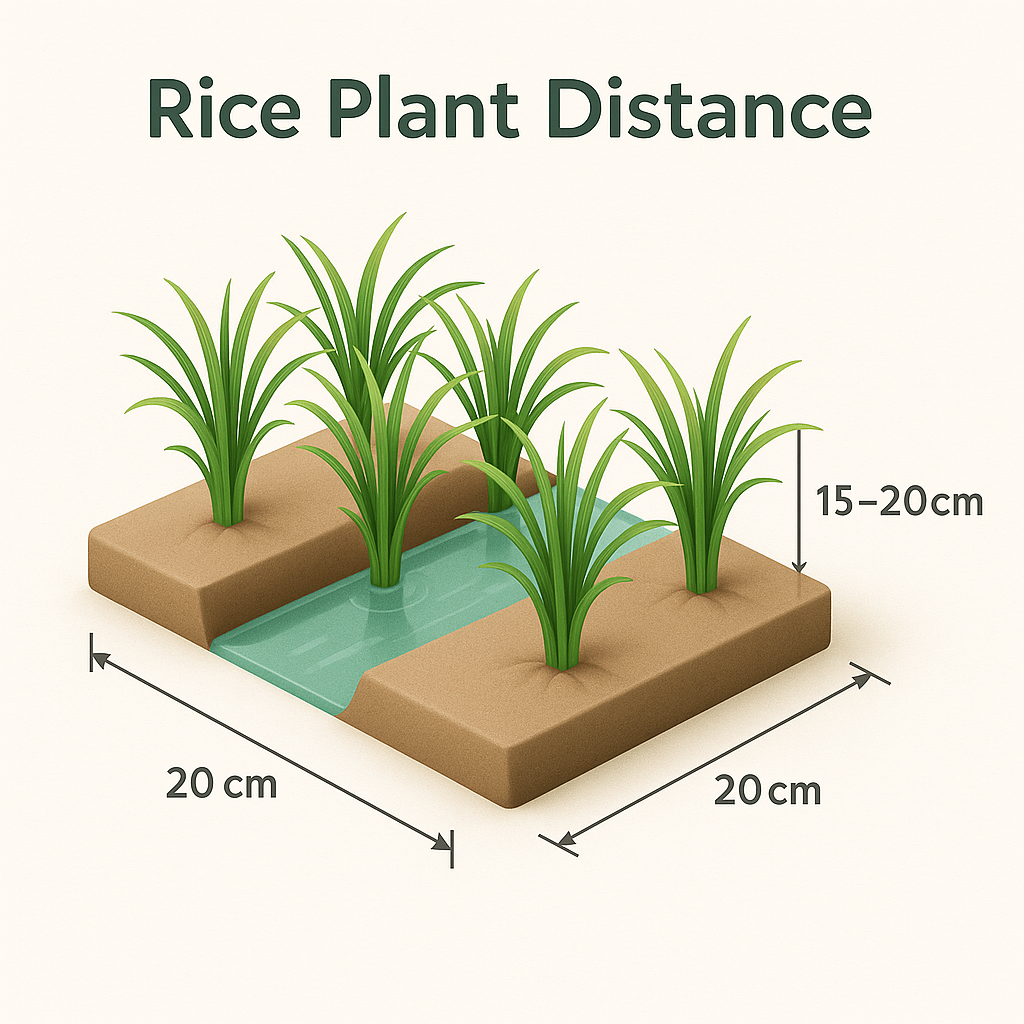
Row to row: 20 cm
Plant to plant: 15–20 cm
Seedlings per hill: 2–3 only
This range allows:
Balanced tiller development
Better light interception
Stronger grain structure
Where Close Rice Spacing Fails the Fastest
Loss risk rises sharply when:
Nitrogen use is high
Cloudy or humid weather extends
Fields remain waterlogged continuously
In these cases, dense spacing:
Encourages soft straw
Reduces assimilate flow to grains
Increases lodging and breakage
Farmers often blame fertilizer or weather.
Spacing made the damage irreversible.
SRI and Wide Spacing: Not for Everyone
Wide spacing systems promise miracles, but reality is mixed.
They fail when:
Weed pressure is unmanaged
Labour for line transplanting is unavailable
Fields cannot maintain proper water control
Distance is not magic.
It only works when management can support it.
Rice Hills per Acre: A Reality Window
With standard spacing (20 × 20 cm):
Hills per acre fall into a balanced range
Tillering compensates naturally
Grain filling remains uniform
Chasing extreme hill counts usually creates yield illusion with quality loss.
Repeating Distance Errors in Rice Farming
Using 4–5 seedlings per hill to “ensure stand”
Reducing spacing to hide poor nursery quality
Keeping fields flooded continuously in dense crops
Copying SRI spacing without management capacity
These mistakes don’t reduce yield immediately.
They reduce payment.
Decision Check Before Transplanting
If your selling channel:
Penalizes broken grains → avoid dense spacing
Depends on milling recovery → protect grain filling
Pays by quality, not weight → spacing discipline matters
Distance decides grain integrity, not just plant count.
Final Judgment
Rice spacing should protect what the buyer pays for, not what the field displays.
An overcrowded paddy can look perfect and still sell cheap.
Once grains are weak, no practice can fix them later.
Plant distance is not a layout choice.
It is a value-protection decision made on transplanting day.
✍️Farming Writers Team
Love farming Love farmers
Read A Next Post 👇
Leave a ReplyShare your thoughts: We’d love to hear your farming ideas or experiences!