INTRODUCTION: WHEN FERTILIZERS FAIL, ROOTS ARE THE REAL PROBLEM
Across the world, farmers increasingly face a confusing situation. Fertilizers are applied on time, in recommended quantities, yet crops fail to respond properly. Leaves may initially appear green, but growth slows, root anchorage weakens, and yield potential collapses.
This is not always a fertilizer problem.
It is a root system failure problem.
Modern agriculture has focused heavily on feeding soil chemically while ignoring how roots actually function inside that soil. When root systems weaken, no amount of fertilizer can compensate. Nutrients may be present, but roots are unable to absorb them efficiently.
This article explains why root systems are failing in modern soils, how soil conditions disrupt root function, and what practical steps restore nutrient uptake capacity worldwide.
WHAT IS ROOT SYSTEM FAILURE
Root system failure occurs when plant roots lose their ability to:
grow deeply and widely
absorb water and nutrients effectively
maintain healthy interaction with soil microorganisms
This failure is often invisible above ground until yield loss becomes severe.
In healthy systems, roots act as intelligent sensors, responding to moisture, nutrients, oxygen, and microbial signals. In degraded soils, this communication collapses.
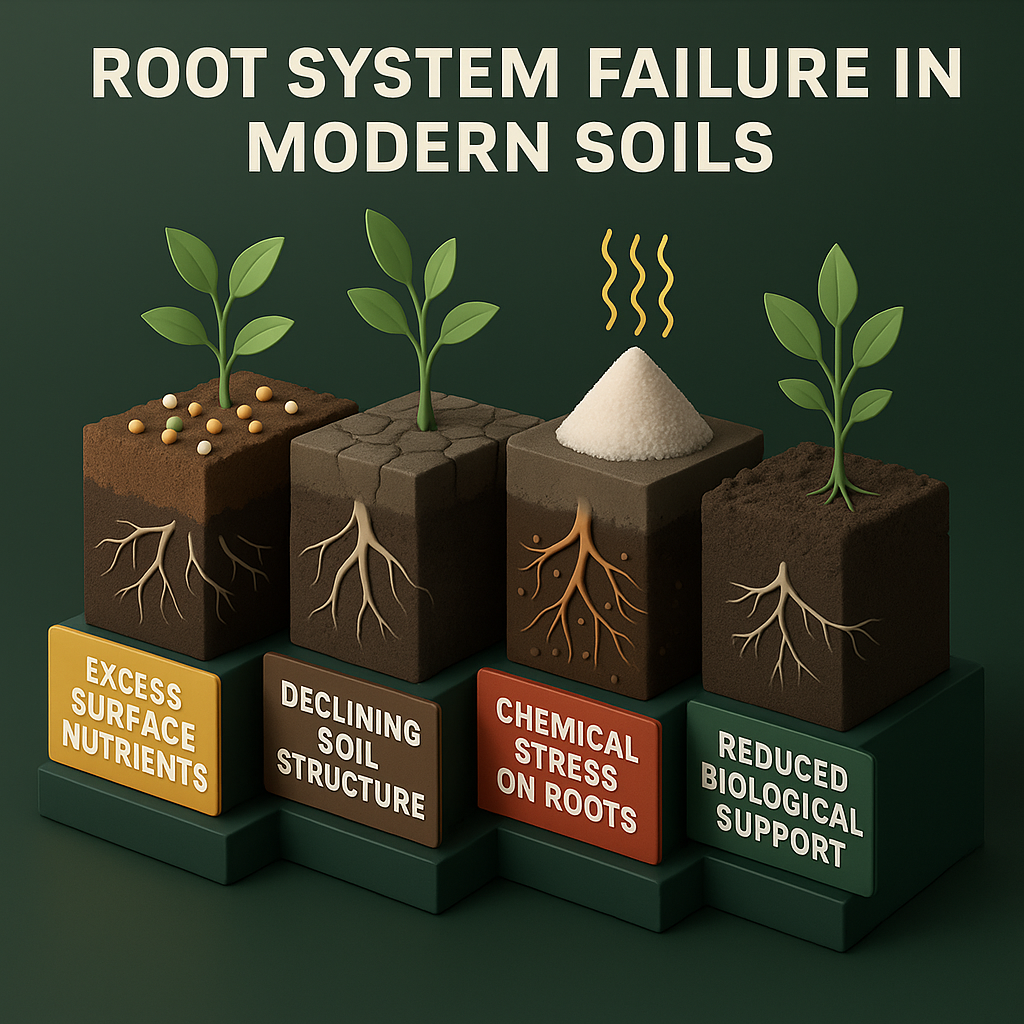
WHY ROOTS ARE WEAKER IN MODERN AGRICULTURE
Excess Surface Nutrients
High doses of surface-applied nitrogen and phosphorus reduce the need for roots to explore deeper soil layers. Plants adapt by forming shallow, fragile root systems.
Declining Soil Structure
Repeated tillage, compaction, and organic matter loss collapse soil pores. Roots struggle to penetrate dense layers.
Chemical Dependency
Rapid-release fertilizers supply nutrients faster than roots can physiologically adjust. Roots lose adaptive growth behavior.
Reduced Biological Support
Soil microbes that assist root growth are suppressed by nutrient imbalance and soil toxicity.
THE SOIL–ROOT–NUTRIENT CONNECTION
Roots do not absorb nutrients directly from fertilizer granules. They absorb nutrients dissolved in soil water, regulated by:
soil porosity
microbial activity
organic matter
root hair development
If any one of these systems fails, nutrient uptake collapses.
HOW SOIL PHYSICAL PROBLEMS DESTROY ROOT SYSTEMS
Soil Compaction
Compaction reduces oxygen diffusion. Roots suffocate, slow metabolism, and lose nutrient absorption efficiency.
Hardpan Formation
Repeated shallow tillage creates dense subsurface layers that roots cannot penetrate, limiting access to deeper moisture and nutrients.
Poor Drainage
Waterlogging kills root tips and promotes toxic microbial activity, permanently damaging root zones.
CHEMICAL STRESS ON ROOTS
Salt Accumulation
Over-fertilization increases soil salinity, causing osmotic stress and root dehydration.
pH Imbalance
Extreme pH reduces nutrient solubility and damages root membranes.
Nutrient Antagonism
Excess of one nutrient blocks uptake of others, creating deficiency symptoms despite sufficient soil supply.
BIOLOGICAL BREAKDOWN AND ROOT FAILURE
Healthy roots depend on symbiotic organisms:
mycorrhizal fungi
beneficial bacteria
decomposer organisms
Modern inputs often reduce biological diversity, leaving roots isolated in chemically active but biologically dead soil.
GLOBAL PATTERNS OF ROOT SYSTEM FAILURE
Asia
Shallow roots due to repeated urea use and puddled soils.
Europe
Compaction from heavy machinery limits root expansion.
North America
Chemical dependency weakens root-microbe interaction.
Africa
Low organic matter prevents stable root development.
Different environments, same outcome: fertilizer efficiency drops as roots fail.
WHY MORE FERTILIZER CANNOT FIX ROOT FAILURE
Fertilizer cannot:
rebuild soil structure
restore microbial networks
undo compaction
repair damaged root membranes
In fact, excess fertilizer accelerates root degeneration by increasing chemical stress.
PRACTICAL STRATEGIES TO RESTORE ROOT FUNCTION
Improve Soil Structure
Reduce compaction, include organic inputs, allow natural aggregation.
Balance Nutrition
Avoid nutrient shock. Supply nutrients steadily instead of in bursts.
Encourage Deep Rooting
Reduce surface nitrogen overload. Promote vertical root exploration.
Restore Soil Biology
Support microbial communities through residue retention and reduced disturbance.
Match Irrigation to Root Depth
Avoid constant surface wetness that discourages deep rooting.
LONG-TERM BENEFITS OF HEALTHY ROOT SYSTEMS
Higher nutrient use efficiency
Better drought tolerance
Reduced fertilizer cost
Stable yields across seasons
Improved soil resilience
Healthy roots transform fertilizers from short-term stimulants into long-term productivity tools.
FREQUENTLY ASKED QUESTIONS
FAQ 1: Can crops fail even when nutrients are present in soil?
Yes. If roots are weak, nutrients remain unavailable despite presence.
FAQ 2: Does high fertilizer use cause shallow roots?
Yes. Excess surface nutrients discourage deep root growth.
FAQ 3: Is root failure reversible?
In many cases, yes, with soil restructuring and balanced nutrition.
FAQ 4: Do microbes affect root nutrient uptake?
Strongly. Microbes extend root absorption capacity far beyond root tips.
FAQ 5: Why do crops lodge easily in modern fields?
Weak root anchorage due to shallow and fragile root systems.
FAQ 6: Does soil compaction affect nutrient uptake?
Yes. Compaction limits oxygen and root movement.
FAQ 7: Is root failure visible early?
No. It usually becomes visible only after yield loss.
FAQ 8: Do all soils support deep roots naturally?
No. Soil structure and management determine rooting depth.
FAQ 9: Can root health improve fertilizer efficiency?
Dramatically. Healthy roots absorb nutrients more predictably.
FAQ 10: What is the first step to restoring roots?
Understanding soil physical condition, not adding more fertilizer.
CONCLUSION
Root system failure is one of the most overlooked yet destructive problems in modern agriculture. Fertilizers are not failing—roots are failing. Until farming systems restore soil structure, biological balance, and root functionality, fertilizer efficiency will continue to decline.
Strong roots are the foundation of sustainable yield, soil health, and long-term farm profitability.
This post forms the scientific backbone of the Soil → Root → Nutrient Science category and connects directly to global fertilizer inefficiency and farming system decline.
✍️ Farming Writers Team
Love farming Love Farmers.
Read A Next Post 👇
https://farmingwriters.com/global-nitrogen-loss-crisis-modern-agriculture/


Leave a ReplyShare your thoughts: We’d love to hear your farming ideas or experiences!