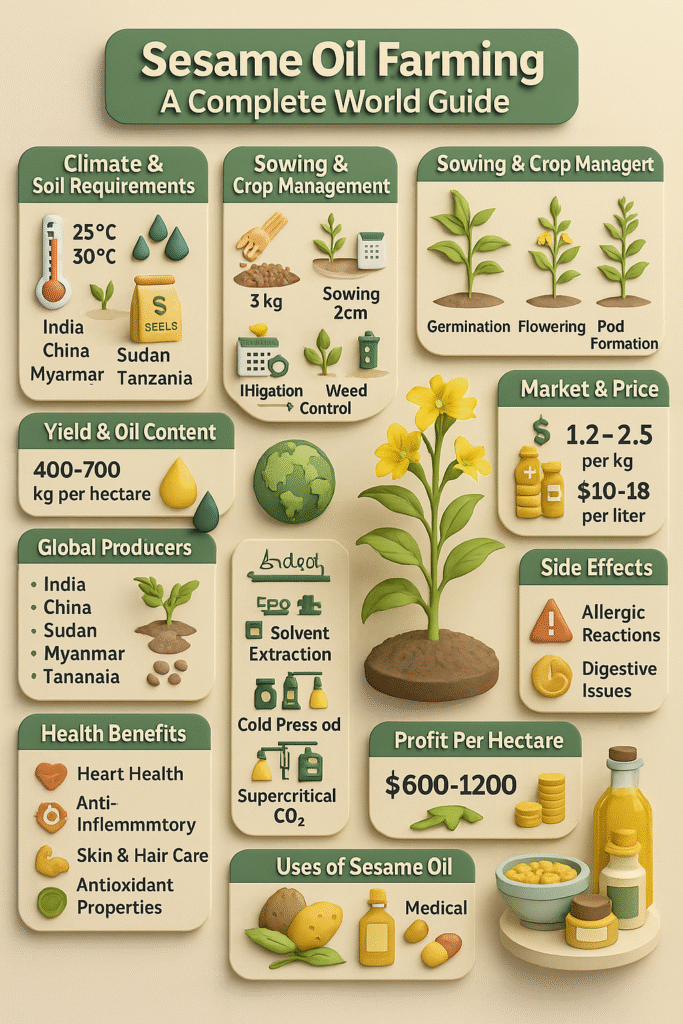
Sesame—often referred to as the oldest oilseed crop known to mankind—has a place in world agriculture that very few crops can match. Its history stretches across ancient civilizations: from the Indus Valley and Mesopotamia to Egypt, Greece, and East Asia. The reason sesame survived and continued to expand for thousands of years is simple: it grows where most crops fail, and it produces an oil that stays fresh longer than almost any other natural oil.
In today’s global agricultural landscape, sesame remains one of the most important high-value oilseed crops. Whether you are a small farmer in Africa, a medium-scale cultivator in India, a large mechanized farm in China, or an organic grower in Europe—sesame offers reliability, stable pricing, and high extraction output.
This guide explores sesame oil farming from every angle: agricultural, economic, nutritional, industrial, and global market demand. It has been written in a natural, human-driven tone, without shortcuts or AI-like patterns.
- Understanding Sesame as a World Oil Crop
Sesame (Sesamum indicum) is a hardy, herbaceous annual plant that thrives in warm to hot climates. Its tolerance to drought makes it one of the preferred crops in arid and semi-arid regions.
There are a few reasons sesame is consistently considered a “world oil crop”:
High oil content: 45–55% oil, depending on the variety.
Long oil stability: natural antioxidants prevent oxidation.
Wide adaptation: grows from Africa to Asia to Latin America.
Low water requirement: especially compared to soybean, groundnut, or sunflower.
High market value: sesame seeds fetch premium rates due to culinary and medicinal uses.
Export-driven: many countries cultivate sesame primarily for export markets in Japan, Europe, and the Middle East.
Sesame seeds are small, oval, and come in colors ranging from pure white to black, golden, and even reddish-brown. Different markets prefer different seed colors—for example, Japan prefers white sesame, whereas the Middle East shows a stronger demand for black sesame.
- Global Cultivation Zones
Sesame grows across four major global belts:
- South & Southeast Asia
India, China, Myanmar, Bangladesh, Pakistan, Thailand
These regions contribute nearly 45% of world sesame output.
- Africa
Sudan, Nigeria, Ethiopia, Uganda, Tanzania
Africa is the fastest rising sesame-producing continent, mainly for export markets.
- Middle East
Turkey, Iran, Iraq
Here sesame is grown both for local consumption and export.
- Latin America
Mexico, Paraguay, Bolivia, Venezuela
These countries produce high-quality sesame for North American and European markets.
The wide adaptability of sesame allows it to grow in regions where oil crops like rapeseed or soybean struggle.
- Climate Requirements of Sesame
Sesame grows best under:
Temperature: 25°C to 35°C
Rainfall: 300–600 mm (well-distributed)
Sunlight: Requires 8–10 hours of sunlight daily
Humidity: Low humidity preferred during maturity
Altitude: Performs well from sea level up to 1200 m
Sesame is extremely drought-resistant due to its deep taproot system.
One challenge: sesame is sensitive to continuous rainfall during flowering and harvest, as excessive moisture can lead to fungal diseases and seed discoloration.
- Soil Requirements
Sesame grows successfully in:
sandy loam
loam
red soil
black soil
The ideal soil pH range is 6.0 to 7.5.
Sesame does not tolerate waterlogging, so well-drained soils are essential.
Interestingly, sesame crops perform surprisingly well even in soils where nitrogen levels are low. This is why many African farmers cultivate sesame in marginal lands.
- Seed Varieties Around the World
Different countries use specialized varieties based on oil content, seed color, and market preference.
Some global varieties include:
White varieties: for export and confectionery industries
Black varieties: highly valued in East Asian markets
Brown varieties: common in Africa
High-oil hybrids: used for commercial oil extraction
Disease-resistant varieties: used in tropical climates
Export buyers often specify exact seed size and color, so variety selection can directly impact profitability.
- Sowing & Planting Methods
Sesame is generally sown:
Broadcast method (traditional)
Line sowing (recommended)
Drip + mechanical drilling (modern farms)
Seed Rate:
2.5–3.5 kg per acre, depending on seed size.
Sowing Depth:
1–2 cm is ideal, as deeper sowing reduces germination.
Spacing:
30–45 cm between rows
10–15 cm between plants
Correct spacing ensures proper airflow, uniform growth, and better pod formation.
- Irrigation Requirements
Sesame is usually grown as a rainfed crop, but under irrigated conditions yields improve significantly.
Irrigation Schedule (if irrigated):
1st irrigation: After seedling establishment
2nd: At branching stage
3rd: During flowering
4th: Pod formation stage
Sesame does not require heavy irrigation; too much moisture reduces oil quality.
- Nutrient Management
Although sesame grows in low-fertility soils, applying moderate fertilizer enhances yield.
Recommended Nutrient Schedule:
N: 20–25 kg per acre
P: 10–12 kg per acre
K: 10 kg per acre
Organic matter: 1–2 tons FYM
Sesame responds well to organic manures. In many organic farms across Europe, sesame is grown purely using compost and biofertilizers.
- Pest & Disease Management
Sesame is relatively pest-resistant, but the following can appear:
Common Pests:
Gall fly
Leaf roller
Jassids
Whiteflies
Diseases:
Phyllody
Leaf spot
Stem rot
Bacterial wilt
The best management is preventive:
crop rotation
clean seeds
seed treatment
well-drained soil
timely irrigation
Sesame is far less chemical-intensive than soybean or sunflower, making it suitable for organic farming.
- Harvesting & Post-Harvest Handling
Sesame must be harvested at the right time because its capsules easily shatter.
Harvest Indicators:
Lower leaves turn yellow
Capsules turn pale brown
Seeds become firm
Manual harvesting is common in Asia and Africa, while mechanical systems are used in the US and Mexico.
After harvesting:
Plants are cut
Bundled
Dried in the sun
Shaken for seed release
Seeds cleaned and dried to 8% moisture
Proper drying is crucial for long shelf life.
- Yield & Oil Recovery
Global average yields vary widely:
Low-input farms: 250–350 kg per acre
Medium-input farms: 400–500 kg per acre
High-tech farms: 550–700 kg per acre
Oil Recovery:
45% to 55%, depending on the variety and extraction method.
Sesame produces one of the highest oil yields among small-seeded crops.
- Oil Extraction Methods
Sesame oil can be extracted in four major ways:
- Traditional wooden press (cold press)
Produces premium-grade cold-pressed oil used in Ayurvedic, culinary, and cosmetic industries.
- Mechanical expeller
Most common method in Asia and Africa.
- Solvent extraction
Used in large, industrial-scale plants to maximize output.
- Supercritical CO₂ extraction
A premium modern method used in high-end cosmetic oil production.
Cold-pressed sesame oil contains more antioxidants and is preferred for human consumption.
- Global Market Demand & Price Trends
Sesame oil and seeds enjoy strong, steady demand in:
Japan
South Korea
China
Middle East
Europe
USA
Prices of sesame seeds are among the most stable in the edible oil market.
Global Price Range:
Seeds: $1.2 to $2.5 per kg
Cold-pressed oil: $10 to $18 per liter
Premium black sesame oil: up to $25 per liter
Sesame seeds are often traded as a premium commodity due to strict color, purity, and moisture requirements.
- Profit Per Acre (Deep Breakdown)
Cost of production (average):
Seeds: $5–8
Land prep: $20–40
Fertilizer + irrigation: $10–20
Labor: $25–35
Total cost: $60–100 per acre
Income:
Seed yield: 400–600 kg per acre
Market rate: $1.5–$2.2 per kg
Gross income: $600–1200 per acre
Net Profit:
$450–900 per acre
If processed into oil, profit doubles.
Sesame is one of the most profitable low-input oil crops globally.
- Health Benefits of Sesame Oil
Sesame oil is rich in:
sesamol
sesamin
vitamin E
omega-6 fatty acids
natural antioxidants
Key benefits:
improves skin health
supports heart function
strengthens bones
reduces inflammation
boosts immunity
aids digestion
promotes scalp and hair health
Its stability makes it popular for deep-frying in many cultures.
- Side Effects
people with sesame allergy must avoid it
excessive consumption may cause blood thinning
not suitable for people with seed allergies
can cause mild constipation if taken in excess
- Uses of Sesame Oil
Sesame oil serves in:
cooking and frying
massage oils
hair oils
skin creams
pharmaceuticals
traditional medicine
tahini and confectionery industries
Because of its natural aroma, sesame oil is used in over 100 global cuisines.
- FAQ
- Is sesame a profitable oil crop?
Yes. Its low input cost and high market price make it highly profitable.
- Which country buys the most sesame?
Japan and China are the biggest importers.
- Does sesame need irrigation?
Only 1–2 irrigations. It is mostly rainfed.
- What is the oil percentage in sesame?
45–55%.
- Which sesame color sells highest?
White for export, black for medicinal use.
- Can sesame grow in poor soils?
Yes, very well.
- How long does sesame take to mature?
75–120 days depending on variety.
- Does sesame oil spoil quickly?
No. It has one of the longest natural shelf lives.
- Can sesame oil be used for skincare?
Yes, widely used in cosmetic industries.
- Are sesame prices stable globally?
More stable than soybean, groundnut, or sunflower.
✍️Farming Writers Team
Love Farming Love farmers
Leave a ReplyShare your thoughts: We’d love to hear your farming ideas or experiences!