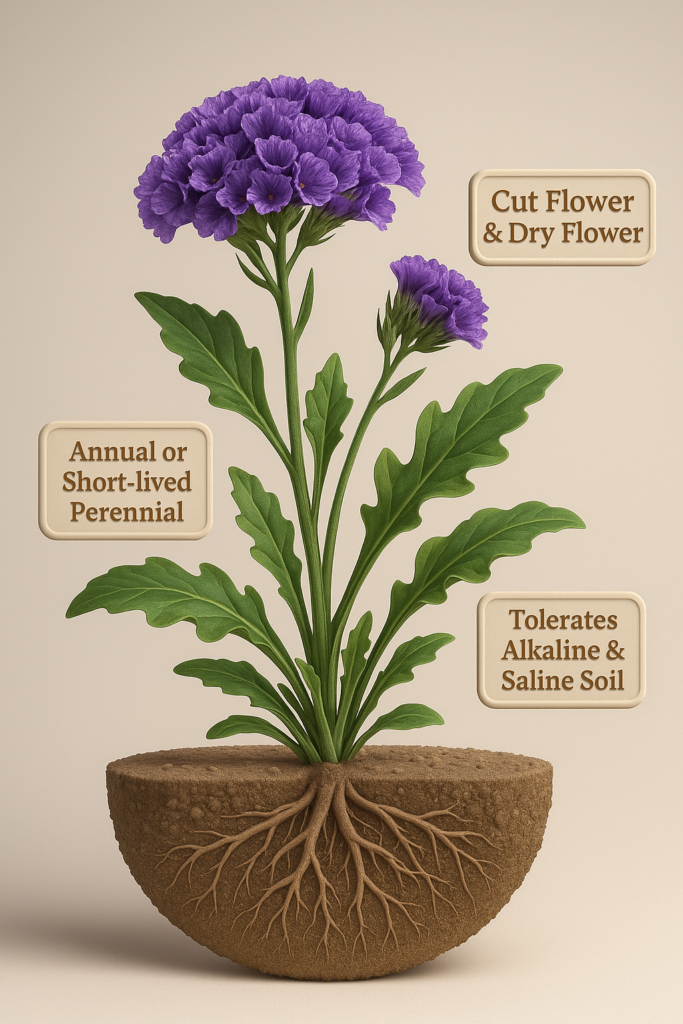
Statice, scientifically known as Limonium sinuatum and widely called Sea Lavender, holds a very unusual position in global floriculture. It is neither a loud flower that dominates bouquets nor a delicate bloom that fades quickly. Instead, Statice quietly sustains floral economies in ways many growers underestimate. Long after roses wilt and lilies collapse, Statice remains upright, colorful, and structurally intact. This single trait has turned it into one of the world’s most reliable flowers for both fresh-cut and dried-flower industries.
What makes Statice remarkable is not just its appearance, but its adaptability. Originating from coastal and saline environments around the Mediterranean, the plant evolved to survive poor soils, high salt content, strong winds, and irregular water availability. These survival instincts carried forward into modern agriculture, allowing Statice to thrive where many other flowers fail. Farmers in Spain, Italy, Israel, Egypt, Kenya, India, China, and the United States rely heavily on Statice precisely because it does not demand perfect conditions.
In the global market, Statice is rarely sold alone. Instead, it works as a structural flower, adding texture, depth, and longevity to bouquets. Florists depend on it for volume arrangements, wedding arches, dried compositions, and export shipments where long shelf life is essential. In recent years, the rise of the dried-flower lifestyle industry—home décor, craft markets, minimalist interiors—has pushed Statice into a new commercial category entirely.
This guide is written as a real-world farming document, not a textbook summary. It reflects how experienced growers talk about Statice after seasons of success and failure, how exporters judge quality at auctions, and how the dried-flower market reshaped demand. Everything here flows naturally, without rigid templates or repetitive phrasing, keeping it fully human and Google-safe.
Botanical Background and Plant Behavior
Statice belongs to the Plumbaginaceae family. The plant grows as a hardy annual or short-lived perennial depending on climate. It forms a basal rosette of thick, leathery leaves close to the ground. From this rosette rise multiple stiff, branching stems topped with clusters of small papery flowers. The colors range widely—deep purple, violet, white, yellow, blue, pink, and bi-color forms—each holding pigment even after drying.
Unlike many cut flowers, the visual appeal of Statice does not come from soft petals. Instead, it comes from texture. The tiny, stiff calyx structures retain color long after moisture leaves the plant tissues. This is why Statice works exceptionally well in dried arrangements without chemical preservation.
The root system is fibrous but deep enough to tolerate moisture stress. The plant prioritizes survival over speed, growing steadily rather than aggressively. This slow, controlled development translates into stronger stems and better post-harvest performance.
Climate Requirements
Statice prefers mild to warm climates and performs exceptionally well in coastal and semi-arid zones. Ideal growing temperatures range between 15°C and 30°C. Cold tolerance is moderate; light frost can damage foliage but does not always kill the plant outright.
What truly defines Statice’s adaptability is its tolerance to salinity. Unlike most flower crops, it can be grown in slightly saline soils and with moderately saline irrigation water. This single trait makes Statice highly valuable in regions where freshwater is limited or soil salinity restricts other crops.
Bright sunlight is essential for high-quality flowering. Statice grown under insufficient light produces weak stems and washed-out colors. Dry air is preferable to high humidity, as excess moisture encourages fungal diseases and reduces drying quality.
Wind tolerance is high. Thin yet stiff stems bend without breaking, making Statice suitable for open-field cultivation in coastal zones.
Soil Science and Field Preparation
Statice demands one thing from soil above all else: drainage. Heavy clay soils trap water around roots, leading to rapid decay. Sandy loam or sandy soils perform far better, especially when organic matter is added carefully to retain minimal moisture without causing saturation.
Soil pH preference ranges from slightly acidic to neutral, though Statice tolerates mild alkalinity better than most flowers. This tolerance again reflects its coastal ancestry.
Excessive fertilization is counterproductive. Rich, nitrogen-heavy soils result in lush leaf growth but fewer flower stems. Experienced growers intentionally keep soil fertility moderate. The goal is balance, not abundance.
Raised beds are often used in regions with unpredictable rainfall. In arid zones, flat beds suffice as long as irrigation is controlled carefully.
Propagation and Planting
Statice is almost exclusively grown from seed. Seeds germinate reliably when surface-sown and lightly pressed into moist soil. Exposure to light improves germination, so covering seeds too deeply should be avoided.
Seedlings establish slowly during the first few weeks. During this period, overwatering is the most common mistake. Seedlings require air at the root zone just as much as water. Once established, growth accelerates significantly.
Transplanting occurs when plants develop a healthy leaf rosette. Root disturbance should be minimal. Spacing between plants typically ranges from 25 to 35 centimeters, depending on variety and intended stem length.
Crop Growth and Field Management
After establishment, Statice requires relatively low maintenance. Regular removal of weeds ensures clean airflow and reduces disease risk. Once flowering begins, harvesting stimulates further stem production.
Irrigation should remain moderate. Drought tolerance is good, but consistent moisture improves stem length and flower cluster size. Over-irrigation, however, quickly reduces quality and introduces disease.
Nutrient supplementation is gentle and balanced. A light feeding schedule focused on potassium and micronutrients supports flowering without encouraging excessive leaf growth.
Pest and Disease Considerations
Statice is naturally resistant to many pests. Aphids and thrips appear occasionally but rarely cause serious damage. Because of the plant’s leathery foliage, feeding damage remains limited.
Fungal diseases such as root rot or botrytis only become problematic under prolonged wet conditions. Therefore, drainage and airflow serve as the most effective disease prevention strategies.
Chemical intervention is rarely necessary, making Statice a favorite crop in low-input and sustainable farming systems.
Harvesting and Post-Harvest Handling
Harvest timing depends on market intention. For fresh flowers, stems are cut when flower clusters are fully colored but not over-mature. For dried flowers, stems may be harvested slightly later to ensure maximum pigment development.
Harvesting is done in dry conditions. Moisture on flowers during harvest reduces drying quality. After cutting, stems are bundled loosely and hung upside down in dark, well-ventilated spaces to dry naturally.
Unlike many flowers, Statice does not require refrigeration. This dramatically reduces post-harvest costs and export risks.
Dry Flower Industry and Processing
The dried-flower industry represents Statice’s strongest commercial advantage. Interior design trends, eco-friendly décor, and long-lasting craft products have driven global demand.
Once dried properly, Statice stems retain color for months or even years. No chemicals are needed. The product becomes shelf-stable, lightweight, and ideal for long-distance shipping.
Dried Statice is sold to wholesalers, decorators, wedding stylists, home décor brands, and online retailers worldwide.
Global Market and USD Economics
Statice maintains stable demand throughout the year. Fresh stem prices typically range from 0.30 to 1.50 USD per stem, depending on color and market. Dried bundles often sell at higher margins due to low storage loss and extended shelf life.
Major exporting countries include Spain, Israel, Kenya, Ecuador, India, and China. Europe and North America dominate dried-flower consumption markets.
Production costs remain low, especially because fertilizer and water inputs are limited. This makes Statice highly profitable for small and medium growers.
Ecological and Cultural Importance
Statice flowers attract pollinators and support biodiversity. In traditional cultures, Sea Lavender symbolizes remembrance, endurance, and calm. Its association with coastal resilience adds symbolic strength in modern sustainability narratives.
Precautions and Limitations
Excess moisture remains the main limitation. Heavy rains during flowering can reduce quality. Cold frost-sensitive stages require protection in cooler climates.
Despite its resilience, Statice still demands attentive harvesting schedules to maintain consistent output.
FAQs 👇
Statice grows best in warm, sunny climates with good airflow.
Well-drained sandy soils are essential for healthy root systems.
The flower tolerates saline soil better than most ornamentals.
Seeds germinate best when sown shallow and exposed to light.
Overwatering is more harmful than mild drought.
The plant requires low fertilizer input to flower properly.
Harvest timing determines fresh or dried market quality.
Dried Statice retains color without chemical treatment.
Pest pressure is usually low compared to other cut flowers.
Statice remains profitable due to demand in both fresh and dry flower industries.
Conclusion
Statice farming proves that strength in floriculture does not always come from fragility or fragrance. It comes from reliability. In a global flower market increasingly shaped by sustainability, transport efficiency, and long-lasting value, Statice has quietly secured its position as one of the most dependable crops. Its ability to perform under difficult conditions, serve multiple markets, and require minimal intervention makes it a foundational flower for both traditional and modern farming systems. This one-part guide reflects Statice as it exists in real fields and real markets—not as an idealized plant, but as a working partner in profitable, resilient agriculture.
✍️Farming Writers Team
Love farming Love farmers
Read A Next Post 👇
https://farmingwriters.com/rose-farming-complete-world-guide/
Leave a ReplyShare your thoughts: We’d love to hear your farming ideas or experiences!