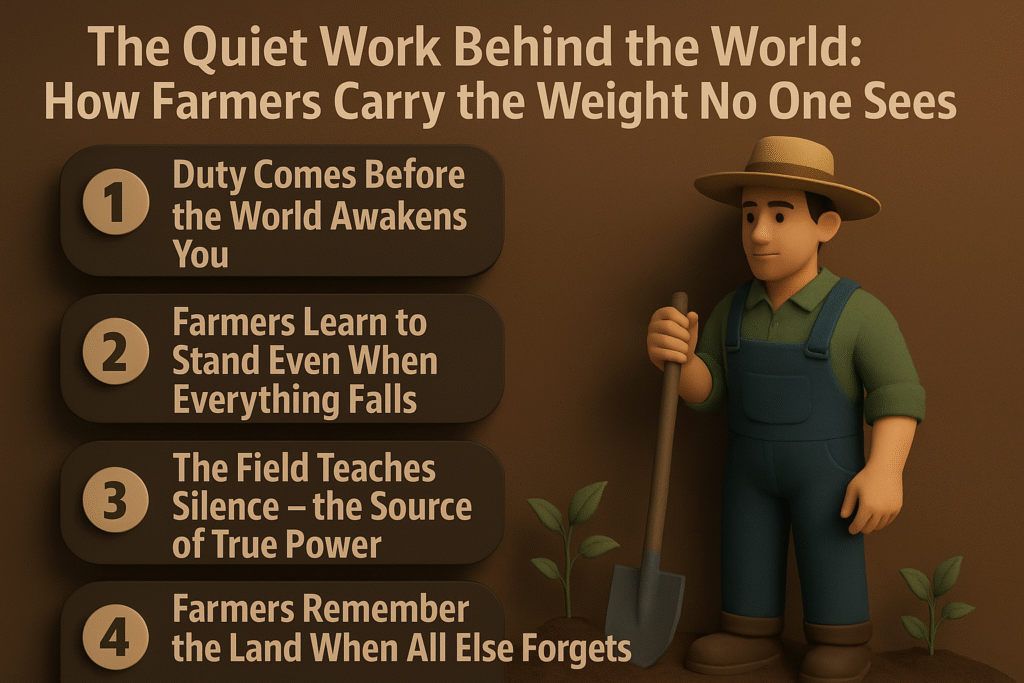
• The Quiet Work Behind the World: The Strength Farmers Carry Alone

    The Quiet Work Behind the World

    There are moments in life when the world feels loud, rushed, chaotic — but a farm never moves at the world’s speed. It moves at the speed of nature, the speed of responsibility, the speed of a heartbeat that refuses to lose rhythm even when everything else becomes uncertain. A farmer lives inside this rhythm, guided by a kind of discipline that does not come from rules or routines but from the simple truth that someone has to keep going.

    Long before the first door opens in any town, a farmer has already stepped outside. The light has not returned yet. The air is still half-asleep. Even the birds haven’t decided if they want to start their morning chorus. But the farmer walks toward his fields, not out of habit, but out of duty. The world depends on what he is about to do, even though the world rarely realizes it.

    There is a loneliness to farming that outsiders cannot understand. Not the loneliness of being alone — but the loneliness of carrying something that no one else can carry with you. A farmer stands between nature and survival. He negotiates with seasons, argues with rains, bargains with soil, pleads with sunlight, and accepts whatever answer nature chooses to give.

    Most people live in a world built by human decisions.
    Farmers live in a world shaped by forces they cannot control.

    And yet, they show up every day.

    There is a strength in farmers that does not roar. It does not announce itself. It does not need appreciation. It grows quietly, the same way roots grow beneath the soil — hidden, unnoticed, essential. A farmer is strong because he does not allow uncertainty to weaken him. He acknowledges fear but does not bow to it. He feels pressure but does not allow it to paralyze him. His courage is not dramatic; it is practical.

    He walks into the field with a mind full of unanswered questions but hands full of work that must be done anyway.

    Most people quit when effort begins to feel like suffering.
    Farmers continue even when suffering becomes part of the effort.

    There are days when crops fail for no reason.
    Days when rain falls too early or too late.
    Days when the market collapses because of issues thousands of miles away.
    Days when pests destroy what hands carefully protected for months.
    Days when life feels unfair in a way that words cannot capture.

    But farmers still wake up the next morning and repeat the cycle.

    It is not stubbornness.
    It is resilience built from generations of experience.

    Every field has witnessed victories it cannot repeat and losses it cannot forget.
    Every farmer has walked through seasons that tested more than skill — they tested faith.

    Faith not in luck,
    not in fate,
    not in miracles,
    but in effort.

    Farmers believe effort is a form of survival.
    Even when nothing is guaranteed, effort is still worth offering.

    When a farmer stands in his field after a hard season, he does not see failure.
    He sees information.
    Clues.
    Lessons.
    Patterns.
    Possibilities.

    The world may think he is simply staring at land.
    But he is actually rewriting the future inside his mind.

    He adjusts his approach without announcing it.
    He changes his timing without debating it.
    He shifts his expectations without complaining about it.

    This adaptability is what makes farmers some of the strongest people in the world.
    Not physically, but mentally — emotionally — spiritually.

    A farmer’s patience is not passive.
    It is active, alert, observant.
    He listens to the weather, studies the soil, reads the wind, interprets silence.
    He trusts signs that others ignore.
    He recognizes voices that others cannot hear — the warning of insects, the discomfort of leaves, the restlessness of air before a storm.

    His knowledge is not downloaded; it is inherited.
    Not memorized; it is lived.
    Not taught; it is absorbed.

    And he carries this knowledge into every decision he makes.

    People search for motivation through speeches and books.
    But farmers find motivation through necessity.
    If they stop, the world suffers.
    If they continue, life continues.

    That truth alone is enough to keep them moving.

    There is something deeply human about the way farmers handle disappointment.
    They do not pretend it doesn’t hurt.
    They do not deny their feelings.
    But they also do not let emotions stop them.

    When a crop dies, a farmer mourns — silently.
    When a storm destroys months of work, a farmer grieves — quietly.
    When yields shrink and debts rise, a farmer feels the pressure — intensely.

    But the land does not wait for him to recover emotionally.
    So he learns to recover while working.
    He learns to heal without stopping.
    He learns to rise without applause.

    This is the kind of strength the world rarely recognizes.

    A farmer’s life is a series of invisible victories.
    The world only sees the harvest.
    It never sees the nights he didn’t sleep.
    It never sees the moments when he doubted himself.
    It never sees the sacrifices he quietly endured.
    It never sees the pain he hid from his family.
    It never sees the calculations he made while pretending everything was fine.

    But the soil sees it.
    And that is enough.

    Farmers have a relationship with land that is older than language.
    The soil remembers every footprint.
    Every seed remembers the hand that planted it.
    Every harvest remembers the season that created it.
    Every farmer remembers the lesson life etched into him.

    This memory is what allows farmers to continue,
    even when everything else tells them to quit.

    Farming is not just a profession.
    It is a promise.

    A promise to the land.
    A promise to the future.
    A promise to the people who rely on the unseen work of farmers every day.

    Farmers are not heroes because they succeed.
    They are heroes because they continue.

    Even when the world looks away,
    the farmer looks toward the next sunrise.

    Because he knows the earth waits for him —
    and he refuses to let it stand alone.

    ✍️Farming Writers Team

    Love Farming Love Farmers

    Read A Next Post 👇

    https://farmingwriters.com/the-season-that-watches-you-back-farmer-courage/
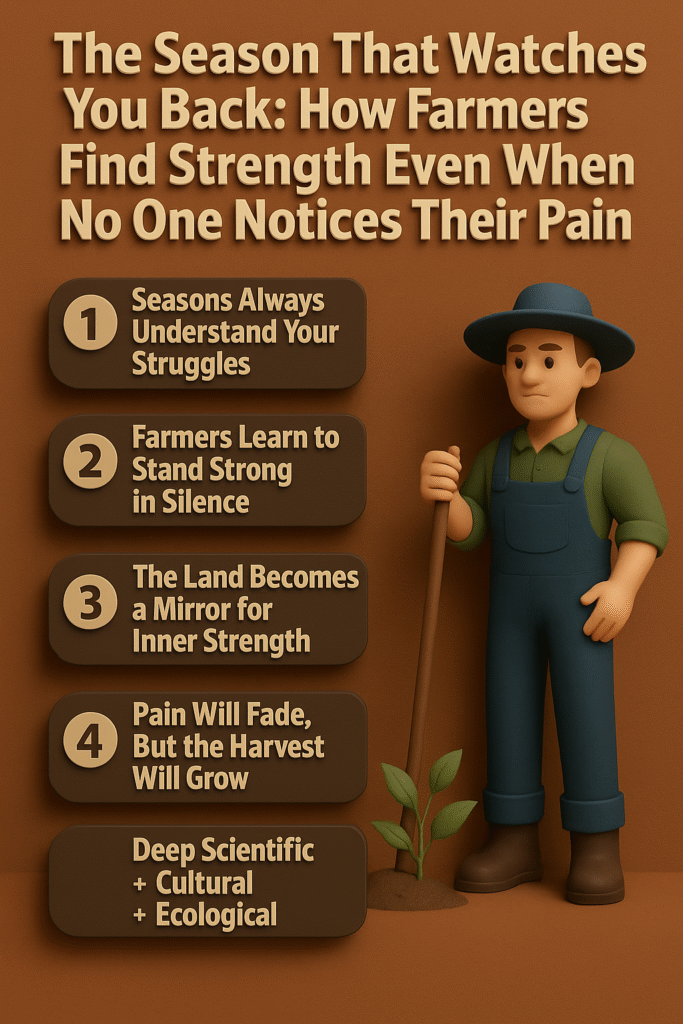
  • The Season That Watches You Back: The Hidden Courage of Farmers

    There are days in a farmer’s life when the field feels like the only place that understands him.
    Not because it answers his questions,
    but because it holds his silence without judgment.

    When a farmer stands alone among crops in the early morning,
    before the noise of the world begins,
    the land watches him the way an old friend watches someone who is hurting but trying to stay strong.
    There is something ancient, almost spiritual, in this exchange.
    The farmer does not speak; the land does not reply.
    Yet both understand each other perfectly.

    Most people think strength comes from confidence.
    Farmers know strength is born out of uncertainty.

    A farmer wakes up with a thousand unknowns.
    He does not know if the weather will honor his decisions.
    He does not know if the soil still remembers last season’s struggle.
    He does not know if the seeds will respond to care or choose their own fate.
    He does not know whether the market will respect his months of effort.
    But he moves forward anyway,
    and that movement is where his courage hides.

    There is a strange honesty in farming —
    life does not pretend to be fair here.
    If you make a mistake, the land shows it.
    If you skip a responsibility, the crop remembers it.
    If you delay effort, the season doesn’t wait for you to catch up.

    And still, farmers don’t hate the land for being honest.
    They trust it more because of that honesty.

    Every season becomes a teacher.
    Not through lectures or instructions,
    but through consequences.
    Farmers don’t learn from success; they learn from the things that go wrong.
    Failure on a farm isn’t the end;
    it is simply part of the conversation between a human being and nature.

    Farming does something to a person’s heart over time.
    It removes illusions.
    It strips away arrogance.
    It reveals the difference between what is important and what is noise.
    A farmer cannot afford emotional drama; the field does not tolerate it.
    So he becomes quieter, deeper, sharper —
    not because life is calm,
    but because calmness is the only way to survive a life so unpredictable.

    People often imagine farmers as strong because of their physical work.
    But their true strength is emotional.
    Imagine caring for something for months,
    giving it everything you have,
    and still knowing you may lose it all to a weather change that lasted less than an hour.

    Farmers live with this reality daily —
    yet they plant again.
    That is not just resilience.
    That is a form of faith the world rarely recognises.

    Standing in a recovering field after a damaging season teaches a farmer something profound:
    effort is not a guarantee,
    but surrender is a loss before the failure even arrives.

    So he chooses effort.

    Sometimes effort feels like hope.
    Sometimes effort feels like desperation.
    Sometimes effort feels like responsibility.
    Sometimes effort feels like the only thing left to hold on to.

    But effort always feels human.

    Farmers often carry burdens they don’t speak about.
    The health of their animals.
    The future of their children.
    The debts that don’t sleep at night.
    The soil that is slowly losing strength because the world demands more than it replenishes.
    The climate that shifts faster than their training ever prepared them for.
    And yet, they continue — one season at a time.

    A farmer’s relationship with time is different.
    He cannot rush it,
    cannot slow it,
    cannot suspend it.
    He works with it.
    He listens to it.
    He respects it.

    And in return, time teaches him patience the world envies.

    Farming also forces a person to see life without filters.
    A seed never lies.
    A plant never pretends.
    The soil never praises.
    The weather never negotiates.

    In a world full of noise,
    farming is brutal honesty —
    and that honesty shapes character.

    You can tell when a farmer has lived many seasons.
    There is a certain softness in his eyes,
    but beneath that softness lives a steel that life could not bend.
    He has walked through fears that city minds cannot picture.
    He has stood in fields that felt like graveyards of effort.
    He has experienced silence that feels heavier than any human voice.
    But he has also seen life return from places that once looked dead.

    That is why farmers carry something the world desperately needs —
    wisdom born from witnessing rebirth.

    Planting seeds in a field that failed last year is not optimism.
    It is bravery.
    It is belief in possibility.
    It is proof that humans can create hope with their own hands.

    When the world looks for motivation,
    it looks outward.
    Farmers look inward.
    Because everything they need to continue lies inside them —
    the memory of the last harvest,
    the discipline of routine,
    the responsibility of land,
    the faces of their families,
    and the silent promise that tomorrow deserves another attempt.

    The farmer knows something most people don’t:
    you cannot control life,
    but you can strengthen the person who faces it.

    A seed does not grow because conditions are perfect.
    It grows because it tries.
    Farmers are the same.

    When a farmer returns to his field after a season of pain,
    he is not returning to land.
    He is returning to possibility.

    And that possibility is what keeps humanity alive.

    Farming is the only profession where giving up is more painful than trying again.
    And that is why farmers continue —
    season after season,
    storm after storm,
    loss after loss,
    hope after hope.

    They don’t stand tall because life is kind.
    They stand tall because the earth refuses to let them fall.

    And somewhere in that quiet partnership
    between human effort and soil’s memory,
    the world finds its food,
    its lessons,
    its survival,
    and its meaning.

    ✍️Farming Writers
    Love farming Love Farmers

    Read A Next Post 👇

    https://farmingwriters.com/the-day-effort-became-a-prayer-farmer-strength/