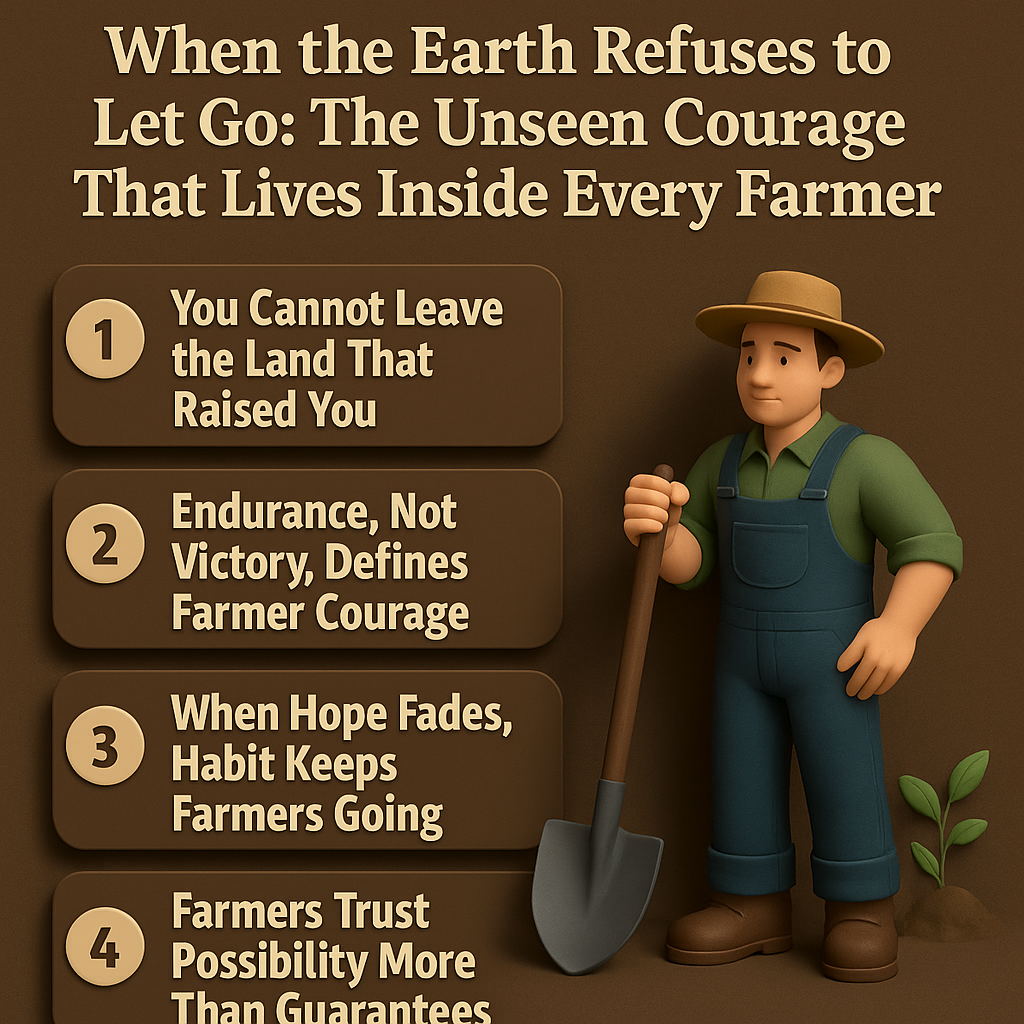
• When the Earth Refuses to Let Go: The Hidden Courage of Farmers

    When the Earth Refuses to Let Go

    There are places in this world where time moves differently.
    Not slowly, not quickly, but with a kind of patience that feels ancient.
    A farm is one of those places.

    A farmer walks through his field long before the sun rises, and long before the rest of the world decides what kind of day it wants to be. The air at this hour carries a weight that cannot be photographed or explained. It holds memories of yesterday’s work, predictions of tomorrow’s weather, and truths that farmers learn without words.

    People imagine farming as a profession.
    Farmers know it is an identity.

    A factory worker can leave the factory.
    A teacher can leave the classroom.
    A businessman can switch ventures.

    But you cannot leave the land that raised you.
    Not truly.
    Even if you travel far, the soil stays inside you like a stubborn heartbeat.

    Farmers carry this connection quietly.

    Not as a speech.
    Not as pride.
    Not as a statement of identity.
    But as a simple understanding:
    “I belong to this land, and this land belongs to me.”

    The courage of farmers is often misunderstood.
    It does not come from victory.
    It comes from endurance.
    Endurance built from years of uncertainty, loss, responsibility, and hope mixed together in unpredictable proportions.

    A farmer does not get stronger in the good years.
    He gets stronger in the bad ones.

    The years when rain played games.
    The years when markets betrayed expectations.
    The years when pests destroyed months of careful planning.
    The years when everything seemed to collapse at once.

    Those are the years that plant courage deeper than roots.

    Ask a farmer why he keeps going and he will rarely give a poetic answer.
    He’ll shrug.
    He’ll smile.
    He’ll say something simple like “What else can I do?”

    What he really means is:

    “Stopping would break me more than trying.”

    There are days when a farmer walks through his field and the silence feels heavier than the land itself. Not the peaceful silence of nature, but the silence of consequences — the silence that arrives after a season has gone wrong.

    A farmer stands there not as a defeated man, but as someone calculating the next step. His mind does not dwell on loss; it searches for solutions. This is not optimism. This is survival.

    Most people break when life becomes unpredictable.
    Farmers expect unpredictability.

    They don’t collapse when nature changes its mind.
    They adapt.
    They adjust the rhythm of their work.
    They change the direction of hope.
    They reimagine the coming weeks.
    They restart.

    Farming is a constant rehearsal for tomorrow.

    But it is also something deeper — a kind of agreement with the earth:

    “I will give you my effort.
    You will give me your possibility.”

    Not a guarantee.
    Not a promise.
    Just a possibility.

    And farmers accept that possibility is enough to keep going.

    There is a moment in the life of every farmer when he realises that land is not just soil — it is memory.
    Generational memory.
    Emotional memory.
    Survival memory.

    Every corner of a farm carries a story.
    Where his father planted his first crop.
    Where his grandfather stood during the monsoon of a legendary year.
    Where harvest once saved the entire household.
    Where failure taught the harshest lesson.
    Where an animal used to wait every morning.
    Where a child took its first steps.
    Where hope returned after it was almost lost.

    These memories do not fade.
    The earth doesn’t forget.

    Farmers often look like they are working the land.
    But the truth is the land is working on them too.

    It shapes their thinking.
    It teaches patience.
    It softens anger.
    It sharpens observation.
    It humbles ego.
    It deepens responsibility.
    It strengthens emotional endurance.

    Most people break under pressure because they are not used to living with the unknown.
    Farmers live with the unknown every day.

    People fear failure.
    Farmers plant in uncertainty.

    People expect comfort.
    Farmers expect challenge.

    People crumble when plans collapse.
    Farmers rebuild plans from the soil up.

    Farmers do not fear storms.
    They fear giving up.

    There is a difference between fear that stops you and fear that shapes you.
    Farmers carry the second kind.

    Stand with a farmer during sunset and you will hear the honesty of life in his voice — not bitterness, not complaint, not regret, but acceptance. Acceptance that life is unpredictable, but effort is not. The field does not need perfection; it needs participation. The land does not ask for guarantees; it asks for commitment.

    Farmers understand that you cannot control everything.
    But you can continue through anything.

    This is why the spirit of a farmer is almost unbreakable.
    Not because he has not faced suffering —
    but because suffering has taught him endurance.

    A crop may fail.
    A season may collapse.
    A storm may destroy what months built.
    But a farmer always finds a reason to return.

    Even when hope fades, habit remains.
    Even when clarity disappears, responsibility stays.
    Even when doubt grows louder, the soil remains patient.

    And that patience becomes the farmer’s motivation.

    People search for motivation in books, videos, speeches.
    Farmers find it in silence.
    In the sound of footsteps on dry soil.
    In the chill of morning air.
    In the emptiness of a field waiting to be planted.
    In the whisper of wind predicting the next change.
    In the memory of harvests that once felt impossible.

    Farming teaches a truth that the modern world forgets:

    You don’t become stronger by avoiding difficulty.
    You become stronger by walking through it.

    And farmers walk through difficulty every day.

    But the greatest strength of a farmer is not his hard work.
    It is his ability to hope again after hope has already broken.

    The world survives because farmers believe in tomorrow even when today feels like an enemy.
    They do not trust fate; they trust effort.
    They do not trust luck; they trust land.
    They do not trust guarantees; they trust possibility.

    Farmers carry humanity forward quietly, season after season, without applause, without spotlight, without reward — only responsibility.

    And perhaps that is why the earth refuses to let go of farmers.
    Because the earth knows who respects it the most.

    Farmers survive storms, losses, and impossible seasons.
    But they rise.
    They always rise.

    And when they rise, the world rises with them.

    Because farming is not the story of crops.
    It is the story of courage.

    ✍️Farming Writers Team

    Love farming Love Farmers

    Read A Next Post 👇

    https://farmingwriters.com/the-wind-remembers-everything-farmers-move-forward/

  • The Day the Soil Spoke Back: What Farming Teaches the World About True Strength

    The Day the Soil Spoke Back

    There is a moment on a farm that very few people outside agriculture will ever understand.
    It’s not sunrise.
    It’s not harvest.
    It’s not the first rain.

    It is the moment when a farmer realises he must continue, even when every part of his body, his land, and sometimes his life is asking him to stop.

    That moment shapes a farmer more than any successful season.

    People outside farming imagine strength as something dramatic — like lifting heavy weights or winning something important in front of a crowd. But a farmer’s strength is different. It grows quietly, in the hours when the world is asleep and he is awake, worrying about something that isn’t even visible yet.

    Sometimes strength grows on a night when he is not sure if the crop will survive.
    Sometimes strength grows in the hour after a storm destroys weeks of work.
    Sometimes strength grows in that strange silence when he walks through his field and doesn’t know what answer nature will give tomorrow.

    These moments are not recorded anywhere.
    There are no witnesses.
    No applause.
    No recognition.
    But these are the moments that turn farmers into the strongest people on earth.

    Most professions let you plan.
    Farming does not.
    Nature does not sign contracts.
    The sky does not ask permission before changing its mood.
    And the soil responds only to one thing — effort.

    A farmer once told me something simple and true:
    “You cannot argue with the land. You learn to listen.”

    Listening to land is a skill that takes a lifetime to understand.
    The soil speaks in moisture, in texture, in weight, in warmth.
    The plants speak in color, in droop, in silence, in scent.
    The sky speaks in winds before clouds.
    And the season speaks slowly, in hints.

    Farmers don’t develop this understanding because they want to.
    They develop it because their entire life depends on it.

    People ask why farmers wake up before dawn.
    Is it discipline? Habit? Responsibility?
    The truth is simpler:
    Dawn is the only time of day when the farmer can hear the world clearly.

    When machines are silent.
    When the village is asleep.
    When even thoughts feel softer.
    That is when the soil speaks.

    And in that early morning hour, something happens inside the farmer — a kind of grounding that modern life rarely offers. He understands something the world forgets:
    that the beginning of every day is a chance to grow, even if you failed yesterday.

    Farming is not about perfect days.
    It is about dangerous days, uncertain days, long days, days that test your bones and your patience.

    People assume farmers are used to hardship.
    But no one “gets used” to failure.
    No one “gets used” to fear.
    No one “gets used” to watching months of effort destroyed in a single afternoon.

    Farmers don’t overcome struggles because they are strong.
    They become strong because they overcome struggles.

    There’s a difference.
    A profound one.

    When a season collapses, the farmer doesn’t break.
    He bends — but bending is not the same as breaking.

    Bending is survival.
    Breaking is surrender.
    Farmers bend, because they know something storms can never destroy:
    the ability to start again.

    Starting again is not easy.
    It is painful.
    It is discouraging.
    It is exhausting in a way the world cannot measure.

    But starting again is the backbone of farming.
    Some restarts happen after droughts.
    Some after floods.
    Some after market crashes.
    Some after personal tragedy.
    Some after long nights of fear.
    But restarts always happen.

    This is why farming is more than agriculture.
    It is a study of human possibility.

    A farmer’s hope is not naive.
    It is not blind.
    It is not optimistic in the usual sense.

    It is practical hope — the kind needed to plant seeds in soil that failed last year.
    The kind needed to risk money that might not return.
    The kind needed to trust nature after nature betrayed you.
    The kind needed to walk a field alone and still believe in something better.

    Hope like that cannot be taught in schools.
    It grows in the fields.

    People often imagine farming as peaceful.
    But peace is not the same as quiet.
    Farming has quiet moments — but inside those moments live thousands of concerns.

    The level of awareness a farmer carries is almost scientific.
    He reads soil structure with accuracy.
    He studies weather patterns instinctively.
    He tracks plant health with microscopic observation.
    He calculates market risk with experience.
    He memorises patterns of pests, diseases, and seasons.

    Farmers are researchers without titles, scientists without laboratories, economists without charts, and philosophers without notebooks.

    Their work transforms them.

    Many people live their lives disconnected from nature.
    Farmers live inside nature.

    That closeness does something indescribable to the human heart —
    it makes you humble.

    You cannot control everything.
    You cannot plan everything.
    You cannot win every time.
    You cannot fight nature and expect victory.

    You learn to adapt.
    To bend.
    To adjust.
    To wait.
    To trust.
    To observe.
    To try again.

    That is strength.

    Not the strength of defiance — the strength of cooperation.
    Not the strength of ego — the strength of humility.
    Not the strength of power — the strength of survival.

    Every farmer carries scars the world doesn’t see —
    scars from the seasons that disappointed,
    from the rains that never came,
    from the rains that came at the wrong time,
    from the years when prices were unfair,
    from the days when nothing made sense.

    But there is something else a farmer carries — something the world desperately needs today:
    the ability to continue.

    Continuing is not glamorous.
    Continuing is not dramatic.
    Continuing is not celebrated.
    But continuing is everything.

    And that is what farmers do better than anyone.

    They continue when others would stop.
    They continue when the world is cruel.
    They continue when conditions are wrong.
    They continue when the burden is heavy.
    They continue because someone must continue.

    The world eats because farmers continue.
    The world survives because they refuse to stop.
    Humanity depends on people who work even when hope is thin.
    Farmers are those people.

    And maybe that is why the soil stands with them —
    because the soil understands their truth.

    When the world forgets,
    the soil remembers.

    When the world ignores,
    the soil listens.

    When the world abandons,
    the soil receives.

    And when the world doubts,
    the soil grows.

    Farmers and soil share a relationship the world cannot measure.
    A relationship built on effort, trust, and renewal.
    A relationship where failure is not the end — it is the beginning of wisdom.

    This is why farmers are strong.
    Not because life is easy,
    but because life is honest on the land.

    And honesty builds character.

    Conclusion

    If the world ever wants to learn what real strength looks like,
    it should watch a farmer walking through a field that betrayed him yesterday…
    and watch him prepare it again today.

    There is no deeper courage than that.

    Farmers don’t win because they are lucky.
    They win because they don’t give up.

    And farming teaches the same lesson to humanity:
    “Strength is not avoiding struggle.
    Strength is surviving it.”

    Farmers survive.
    Farmers continue.
    Farmers rise.
    And the world rises because of them.

    ✍️Farming Writers Team

    Love Farming Love Farmers

    Read A Next Post 👇

    https://farmingwriters.com/farmer-refuses-to-break-story-strength/

  • The Hands That Refuse to Give Up: Farming’s Deep Lesson on Endurance

    The Hands That Refuse to Give Up

    Some truths in life reveal themselves slowly, the way early morning light spreads across a field. You don’t notice the moment the darkness breaks; you simply begin to feel the world returning to itself. Farmers understand this better than anyone, because their entire lives unfold in these slow, quiet transitions that the world rarely pays attention to.

    A farmer stands at the edge of his field before sunrise not because the world is watching, not because success is guaranteed, not because life is easy, but because stopping is never an option. The weight of generations rests on his shoulders — not dramatically, not loudly, but with a steady pressure that becomes part of his bones.

    There is a kind of strength that forms only in people who wake up with uncertainty every day yet move toward their work with the same determination. Farming doesn’t offer the safety of predictability, the comfort of routines that always go the same way, or the luxury of controlled environments. Instead, farmers live in the rhythm of unpredictability — where the sky decides the mood of the day, where the soil speaks through texture and silence, where seasons return but never with the exact same face.

    This unpredictability would break most people, but it shapes farmers.

    Real endurance doesn’t come from success; it comes from surviving everything that tries to stop you. And farming is exactly that — a life built inside challenges that never follow rules.

    If you ask a farmer where his strength comes from, he may shrug or smile quietly. He won’t give you a philosophical explanation. But if you watch him long enough, you will understand. His strength comes from learning to move even when fear whispers louder than hope. It comes from accepting nature instead of fighting it. It comes from rebuilding what gets destroyed. It comes from understanding that failure is not the end — it’s the beginning of the next attempt.

    A city person often imagines farming as a simple cycle. You sow, you wait, you harvest. But a farmer’s mind is filled with questions that don’t belong to textbooks or manuals. Should the soil rest this year? Will the seed survive if night temperature drops unexpectedly? Is the color of the leaves a warning or just a shift in growth? Is the breeze carrying rainfall or carrying loss? These questions form an internal conversation that continues throughout the day, even when the farmer is silent.

    Silence in farming isn’t emptiness; it is analysis.

    A journalist once wrote that you can measure a farmer’s life not in years but in sunrises. Each sunrise carries a story, a responsibility, a possibility, and a risk. The farmer walks into each day without knowing which of those he will meet. Yet he walks anyway.

    The world admires confidence, but farming admires endurance.

    Confidence may rise and fall with circumstances, but endurance remains even when the mind is exhausted. A farmer’s endurance is not a choice — it is a requirement written into the landscape of his life.

    This endurance shows itself most clearly when things fall apart. A drought that arrives without warning. Rain that comes too early or too late. A market that collapses just when the harvest is ready. Pests that destroy weeks of patient waiting. Machinery that fails in crucial moments. These are the moments that would make most people question everything.

    Farmers don’t avoid these questions — but they don’t surrender to them either.

    When something breaks, a farmer doesn’t sit and wonder why it happened. He stands up and decides what must be done next. His mind does not dwell in emotion; it moves toward action. Not because he lacks feelings, but because feelings don’t plow the field. Action does.

    There is something deeply human about this, something the world often forgets: endurance is not loud. It is silent, patient, persistent. A farmer’s hands may look rough, but his endurance is gentle — the kind that bends without breaking, the kind that adapts without losing itself, the kind that survives without hatred.

    If you walk through a village at night, you may notice something unusual. While the rest of the world slows down, a farmer’s mind does not. He remembers what the land looked like that afternoon, imagines what it will need tomorrow, senses the coming season through winds others ignore. His connection to the earth is not scientific alone; it is instinctive. A deep, almost ancestral wisdom flows through farmers — not written in books but carried through generations of observation.

    This wisdom is different from knowledge. Knowledge can be learned; wisdom must be lived.

    Farmers live wisdom every day — in the way they read the soil, the way they feel the air, the way they hear the silence between winds, the way they hold seeds like memories of the future. A seed is more than a biological unit to a farmer; it is a promise, fragile but powerful. Planting a seed is one of the most courageous acts a human can perform. You are placing hope into the earth without any guarantee. Yet farmers do it season after season.

    Why?

    Because farming is not understood through reward. It is understood through purpose.

    A farmer does not work just for income. He works for continuity. For life. For family. For community. For a future he will not see. A farmer lives in the paradox of working for tomorrow but surviving in today. And strangely, this paradox gives him more grounding than most people living in cities with predictable schedules and controlled environments.

    If you ever sit with an old farmer during dusk, you will notice something profound. He does not talk about achievements. He talks about seasons — the difficult ones, the generous ones, the strange ones, the unforgettable ones. Seasons are the calendar of a farmer’s life. They leave marks on his heart the way years leave marks on a historian’s notebook.

    A season of struggle teaches a farmer humility.
    A season of abundance teaches him gratitude.
    A season of uncertainty teaches him patience.
    A season of loss teaches him resilience.

    This constant turning of seasons creates a character that cannot be manufactured anywhere else.

    Farmers also understand something the world has forgotten — that life cannot be controlled. Life can only be cooperated with. You cannot force rain. You cannot force growth. You cannot force timing. You can only work with what arrives, prepare for what may arrive, and survive what arrives without warning.

    This acceptance does not make farmers weak. It makes them realistic. And realism is a rare strength in a world full of illusions.

    Farmers are the most emotionally honest people on earth because they do not pretend to control what they cannot. Their pride does not come from defeating nature but from understanding it. Their dignity does not come from achievement but from effort. Their self-worth does not come from validation but from contribution.

    People often wonder why farmers rarely show despair even when life treats them unkindly. The answer is simple: the soil heals them. When a farmer steps into his land, something inside him settles. The soil does not question him. The soil does not judge him. The soil does not ask for perfection. It simply says, “Try again.”

    And that is enough.

    In a world that values performance, farmers value persistence.
    In a world that wants speed, farmers trust timing.
    In a world that fears failure, farmers restart without hesitation.
    In a world that chases success, farmers chase meaning.

    This is why farming is not just an occupation.
    It is a philosophy.
    A discipline.
    A way of seeing life that is raw, honest, and profoundly human.

    And the greatest truth farming teaches is this:

    Strength is not the ability to win.
    Strength is the ability to continue.

    Farmers continue.
    Through storms,
    through loss,
    through exhaustion,
    through doubt,
    through unfairness,
    through fear,
    through everything that tries to break them.

    The world survives because farmers refuse to give up.

    ✍️Farming Writers Team

    Love farming Love farmers

    Read A Next Post 👇

    https://farmingwriters.com/farmer-refuses-to-break-story-strength/