• Agribusiness and Agricultural Economics Education in the USA: Degrees, Careers, Salaries and Global Scope

    Agribusiness and Agricultural Economics

    Agribusiness & Agricultural Economics Education in the USA – Complete Deep Study

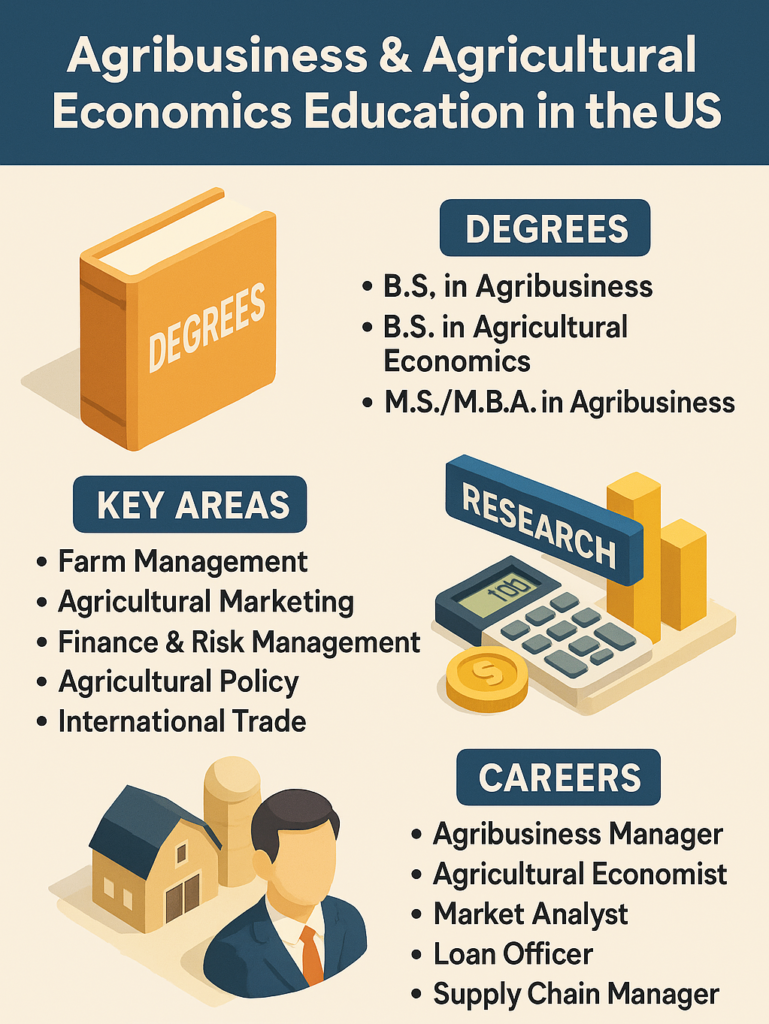
    Agriculture in the United States is not only about production; it is equally about business management, economics, supply chains, marketing, trade, finance and policy. Agribusiness and agricultural economics education form the backbone of how American farming systems remain profitable, competitive and globally connected.

    This discipline trains students to understand how farms operate as businesses, how food moves from fields to markets, how prices are formed, how risks are managed and how agricultural policies influence global trade. In the USA, agribusiness education is deeply integrated with real-world markets, corporations, cooperatives, banks and government agencies.

    This article provides a complete and original explanation of agribusiness and agricultural economics education in the United States, including degree structures, subjects, universities, research areas, careers and salary scope.

    1. What Is Agribusiness and Agricultural Economics?

    Agribusiness focuses on the management and operation of agriculture-related businesses such as:

    Farm enterprises

    Input supply companies

    Seed and fertilizer firms

    Food processing industries

    Storage and logistics companies

    Export–import firms

    Retail food systems

    Agricultural Economics focuses on:

    Farm economics

    Market price analysis

    Supply and demand

    Risk management

    Agricultural finance

    Trade policy

    Resource economics

    Rural development

    Together, these fields turn farming into a sustainable and profitable economic system.

    1. Importance of Agribusiness Education in the USA

    The USA is one of the world’s largest agricultural producers and exporters. Agribusiness education supports:

    Farm profitability

    Cost control and budgeting

    Market decision-making

    Commodity trading

    Agricultural finance systems

    Crop insurance models

    Food supply chain efficiency

    Export competitiveness

    Policy-based farming decisions

    Without agribusiness professionals, large-scale farming systems cannot function efficiently.

    1. Structure of Agribusiness Education in the USA

    Agribusiness education is offered at undergraduate, graduate and doctoral levels.

    Undergraduate Programs (BS Agribusiness / BS Agricultural Economics)

    Core subjects include:

    Principles of agribusiness management

    Farm accounting

    Agricultural marketing

    Microeconomics and macroeconomics

    Farm financial management

    Supply chain management

    Commodity markets

    Risk management and insurance

    Agricultural policy

    International agricultural trade

    Rural development economics

    Data analysis for agriculture

    Students also complete internships with agribusiness firms, banks, cooperatives and food companies.

    Graduate Programs (MS Agribusiness / MS Agricultural Economics / MBA in Agribusiness)

    Graduate programs focus on advanced specialization:

    Agricultural finance and credit systems

    Commodity price forecasting

    Trade economics

    Food system economics

    Agribusiness strategy

    Market analytics

    Econometrics

    Sustainability economics

    Policy analysis

    Corporate agribusiness management

    Many programs include case studies, industry projects and research theses.

    Doctoral Programs (PhD Agricultural Economics)

    PhD research areas include:

    Global food markets

    Climate impact economics

    Agricultural trade models

    Price volatility modeling

    Resource and environmental economics

    Food security economics

    Farm policy evaluation

    Rural development planning

    PhD graduates often work in research institutes, universities, government agencies and international organizations.

    1. Top Universities for Agribusiness Education in the USA

    Leading institutions include:

    Purdue University

    Texas A&M University

    Iowa State University

    University of California, Davis

    Cornell University

    Kansas State University

    University of Illinois Urbana-Champaign

    Michigan State University

    Ohio State University

    University of Florida

    These universities maintain strong industry linkages and research centers.

    1. Key Research Areas in Agribusiness & Economics

    Major research domains include:

    Farm profitability analysis

    Commodity price behavior

    Food supply chain resilience

    Agricultural finance systems

    Crop insurance models

    Climate-risk economics

    Export competitiveness

    Market integration

    Input cost economics

    Digital agriculture economics

    These studies directly influence policy and industry decisions.

    1. Practical Training and Industry Exposure

    Students gain hands-on exposure through:

    Agribusiness internships

    Commodity trading simulations

    Farm budget analysis projects

    Case-study competitions

    Cooperative management training

    Banking and finance internships

    Supply chain field visits

    This makes graduates industry-ready.

    1. Career Opportunities in Agribusiness

    Graduates work in:

    Agribusiness corporations

    Food processing companies

    Export–import firms

    Commodity trading houses

    Agricultural banks

    Insurance companies

    Government agencies

    Research organizations

    Cooperatives

    Consulting firms

    Common job roles include:

    Agribusiness manager

    Agricultural economist

    Farm business consultant

    Commodity analyst

    Market research analyst

    Supply chain manager

    Trade policy analyst

    Agricultural finance officer

    Risk management specialist

    1. Salary Scope in the USA

    Agribusiness careers offer strong earning potential:

    Agribusiness manager: high earning potential

    Agricultural economist: stable, high-value role

    Commodity analyst: competitive salaries

    Supply chain manager: strong growth

    Policy analyst: government-scale salaries

    Earnings increase significantly with experience and specialization.

    1. Opportunities for International Students

    International students benefit from:

    Global market exposure

    Strong internships

    Access to real agricultural markets

    High employability

    International trade knowledge

    Research funding (MS/PhD)

    Many graduates return to their countries to lead agribusiness development.

    1. Admission Requirements

    Science or commerce background (for BS)

    Bachelor’s degree (for MS/MBA)

    TOEFL/IELTS

    Academic transcripts

    Statement of Purpose

    Letters of recommendation

    Some programs may require quantitative aptitude background.

    Frequently Asked Questions (FAQs)

    1. Is agribusiness a good career in the USA?
      Yes. It is one of the highest-value agriculture careers.
    2. Do agribusiness jobs pay well?
      Yes, especially in finance, trade and management roles.
    3. Can non-farm students study agribusiness?
      Yes. No farming background is required.
    4. Is agricultural economics different from agronomy?
      Yes. Economics focuses on markets and finance, not crop science.
    5. Are internships compulsory?
      Most programs strongly encourage or require internships.
    6. Can international students work in agribusiness?
      Yes, depending on visa rules and employer policies.
    7. Which university is best for agribusiness?
      Purdue, Texas A&M and UC Davis are top choices.
    8. Does agribusiness include food companies?
      Yes. Food processing and retail are major parts.
    9. Is agribusiness linked to policy?
      Yes. Agricultural policy is a core subject.
    10. Is this field future-proof?
      Yes. Food systems and markets will always be essential.

    Conclusion

    Agribusiness and agricultural economics education in the USA transforms farming into a structured, profitable and globally competitive industry. By combining economics, management, finance and market analysis, this field supports sustainable food systems and long-term agricultural growth. Students trained in this discipline become decision-makers, strategists and leaders in the global agriculture economy.

    ✍️Farming Writers Team

    Love Farming Love Farmers

    Read A Next Post 👇

    https://farmingwriters.com/food-science-technology-education-usa/

  • United States Agriculture Education System: Full Study, Degrees, Colleges, Careers, Research and Scope

    Usa Agriculture Education

    Agriculture education in the United States is considered one of the strongest and most structured systems in the world. It is not limited to traditional farming; instead, it functions as an integrated science discipline supported by technology, research, agribusiness, policy studies and practical training. The United States established a farming-education model that later became a reference for many countries. Its institutions combine teaching, laboratory research, field experimentation and farmer-oriented outreach programs under one unified structure.

    This article provides a comprehensive overview of how agriculture is taught, researched and practiced in the United States. It explains every major component, including school-level programs, youth agriculture organizations, community college diplomas, bachelor’s and master’s degrees, doctoral research, extension education, land-grant universities, agriculture research networks and the wide range of career opportunities available across the nation.

    The aim is to provide students, farmers and youth worldwide with a complete picture of how agricultural education is built and delivered in the United States and why it is considered one of the most advanced systems globally.

    1. Foundation and Evolution of Agriculture Education in the USA

    Agriculture education in the United States began formally in the 19th century, when the country recognized the need to develop scientific farming practices to improve productivity and sustainability. The most significant step in this transformation was the Morrill Act of 1862, which established the land-grant university system. This system created institutions dedicated to agricultural and mechanical education, ensuring that agriculture became a core academic and research discipline.

    Over the next century, the agricultural education structure expanded with the development of experiment stations, extension education units, specialist departments and community-based farmer training centers. Each state established its own university with an agricultural college that offered education, conducted applied research and served the farming community directly.

    As a result, the United States developed a farming education model that combines formal study, practical training, industry collaboration, government support and continuous innovation.

    1. Structure of Agriculture Education: From Schools to Doctoral Programs

    Agricultural education in the United States operates through multiple levels, each designed to build foundational knowledge, technical competence and advanced research skills.

    a) School-Level Agriculture Programs (K–12)

    Some schools, particularly in rural and semi-urban states, include agriculture-related courses as part of their science, environment and vocational curriculum. Students may work in greenhouses, school gardens, aquaponics systems or livestock handling programs. These early exposures help students understand basic agricultural concepts such as plant growth, soil properties, food systems, water cycles and simple livestock management.

    b) Youth Agriculture Platforms (FFA and 4-H)

    Two major youth organizations play a critical role in shaping agricultural education:

    4-H: Supported by the USDA, 4-H engages children and teenagers in hands-on agriculture projects, including plant science, livestock care, food systems innovation, soil conservation, environment monitoring and community agriculture programs.

    FFA (Future Farmers of America): Focused on high-school students, FFA provides structured agricultural leadership training, supervised agricultural experience (SAE) programs, competitive skill events and vocational-level exposure to farming careers.

    Both programs strengthen agriculture literacy and motivate young learners to pursue careers in the agriculture sector.

    c) Community Colleges and Vocational Institutes

    Two-year community colleges offer Associate Degrees and certificates in agriculture. These programs are skill-oriented and designed to prepare students for immediate entry into farming operations, agribusiness firms, dairy units, crop production facilities, greenhouses and fisheries.

    Common vocational programs include:

    Agricultural technology

    Greenhouse operations

    Crop production and management

    Animal science technician

    Soil and water management

    Aquaculture and fish hatchery operations

    Small farm management

    Farm business planning

    These programs emphasize field training, industry internships and practical skill mastery.

    d) Undergraduate Degrees (Bachelor’s Programs)

    Bachelor’s programs are broad and research-informed. Universities offer specialized agriculture degrees such as:

    Agronomy

    Horticulture

    Plant Pathology

    Seed Science

    Soil Science

    Animal Science

    Dairy Science

    Poultry Production

    Fisheries and Aquaculture

    Agricultural and Biosystems Engineering

    Agricultural Economics

    Agribusiness Management

    Environmental and Natural Resource Management

    Students divide time between classroom study, laboratory experiments, research plots, internships, greenhouse work, technology labs and industry training.

    e) Graduate and Doctoral Studies (MS, MPS, PhD)

    Advanced degrees focus on specialization and innovation. Students enter research labs and work on experiments related to genetics, crop improvement, plant protection, soil health, water conservation, livestock improvement, aquaculture innovation and agriculture economics.

    Doctoral programs often contribute to scientific publications, patents, new crop varieties, disease-control methods, climate modeling and high-tech solutions for modern farming.

    1. Land-Grant University System: The Backbone of US Agricultural Development

    The land-grant system established universities in each state with the mission to teach agriculture, develop research technologies and support farmers through extension education.

    Its pillars include:

    Teaching agricultural sciences at the college level

    Conducting applied and fundamental research

    Providing training and knowledge to farmers through cooperative extension services

    Every state has an experiment station where scientists develop crop varieties, test soil amendments, analyze climate impacts, improve livestock genetics and evaluate farming technologies.

    The extension service connects directly with farmers. It organizes workshops, training sessions, soil testing programs, crop advisories, pest alerts, field demonstrations, disease diagnostics and farmer consultations.

    This system ensures that academic research reaches farmers without delay.

    1. Major Agricultural Universities in the United States

    The United States hosts several globally recognized agriculture universities. These institutions are known for their research programs, extension networks, advanced laboratories and strong industry partnerships.

    Some key universities include:

    University of California, Davis

    Cornell University

    Texas A&M University

    Iowa State University

    University of Florida (IFAS system)

    Purdue University

    Michigan State University

    Kansas State University

    North Carolina State University

    Ohio State University

    Each of these institutions hosts fully equipped research farms, cattle units, fisheries labs, seed laboratories, plant pathology units, precision agriculture facilities and controlled-environment agriculture systems.

    1. Specializations within USA Agriculture Education

    Agriculture education in the United States offers a wide range of specializations. The most prominent include:

    Plant Sciences

    Agronomy

    Crop breeding

    Plant biotechnology

    Horticulture

    Pomology

    Olericulture

    Soil and Water Sciences

    Soil chemistry

    Soil microbiology

    Irrigation engineering

    Watershed management

    Animal and Fisheries Sciences

    Dairy production

    Livestock nutrition

    Poultry management

    Fisheries and aquaculture

    Aquatic pathology

    Agriculture Engineering and Technology

    Drone-assisted farming

    Precision agriculture

    Sensor-based systems

    Robotics in farming

    GIS and remote sensing

    Agricultural Economics and Agribusiness

    Farm management

    Supply chain and logistics

    Food processing

    Agricultural finance

    The variety of fields ensures that students can pursue highly specialized careers.

    1. Career Opportunities in USA Agriculture

    The agricultural industry in the United States employs professionals across many roles. Some key career paths include:

    Agronomist

    Crop advisor

    Plant pathologist

    Animal nutritionist

    Dairy farm manager

    Poultry production supervisor

    Hatchery technician

    Aquaculture specialist

    Soil scientist

    Greenhouse supervisor

    Drone operator for precision farming

    Agricultural economist

    Supply chain manager

    USDA researcher

    Extension educator

    These jobs exist in production farms, research facilities, government agencies, private agribusiness firms, biotechnology companies and international organizations.

    1. Salary Overview in the USA Agriculture Sector

    Salaries vary by state, specialization, industry and experience. However, agriculture roles in the United States generally provide stable and competitive incomes.
    For example:

    Crop specialist positions typically provide a moderate to strong starting salary.

    Dairy and livestock supervisors receive dependable wages with growth potential.

    Research and technical roles often provide higher salary ranges due to advanced skill requirements.

    Agribusiness and agricultural economics roles usually offer strong income growth over time.

    These values change depending on location and employer, but agriculture in the United States is recognized as a viable and profitable career.

    1. Why the USA Farming Education System is Considered the Best

    The American agriculture education system is regarded worldwide as an ideal model because it combines education, research, innovation and practical training. Students gain access to advanced technology, well-equipped labs, industry-oriented internships and experienced faculty. Farmers benefit from extension education that provides direct access to new methods, tools, research findings and solutions.

    This integrated structure allows agriculture to grow sustainably, scientifically and economically.

    (FAQs)

    1. What makes the United States agriculture education system unique?

    The combination of land-grant universities, research stations, extension services and technology-based training makes it uniquely integrated and highly effective.

    1. Can international students study agriculture in the United States?

    Yes. Many universities accept international students for undergraduate, master’s and doctoral programs in various agricultural fields.

    1. Is agriculture a high-paying career in the USA?

    Agriculture careers offer competitive salaries, especially in agronomy, plant science, agribusiness, biotechnology and precision agriculture.

    1. What is the role of extension services?

    Extension services act as a bridge between university research and farmers, providing training, field support, crop advisories and farm solutions.

    1. Which universities are best for studying agriculture in the USA?

    UC Davis, Cornell, Texas A&M, Iowa State, University of Florida and Purdue are considered among the top institutions.

    1. Do US agriculture programs include practical training?

    Yes. Field labs, research farms, internships, greenhouse training and hands-on technology sessions are compulsory components.

    1. Can farmers access agriculture education without enrolling in university?

    Yes. Extension programs, online resources, community colleges and farmer workshops provide accessible education.

    1. Does the US focus on modern technologies in farming?

    The United States is a global leader in precision agriculture, drone use, AI-based farming systems and controlled-environment agriculture.

    1. What are the future trends in US agriculture education?

    Sustainability, climate-smart agriculture, automation, genomics, data-driven farming and environmental stewardship are key future priorities.

    1. Is agriculture still an important industry in the USA?

    Yes. Agriculture is a foundational industry that supports food production, exports, biotechnology, research and rural development.

    Conclusion

    The United States agriculture education system is one of the most complete, organized and innovation-driven structures in the world. Its foundation lies in a well-developed combination of academic programs, research centers, extension services and industry partnerships. This system builds future-ready professionals, supports farmers with modern science and contributes significantly to global agriculture development.

    ✍️Farming Writer Team
    Love farming Love farmers