INTRODUCTION
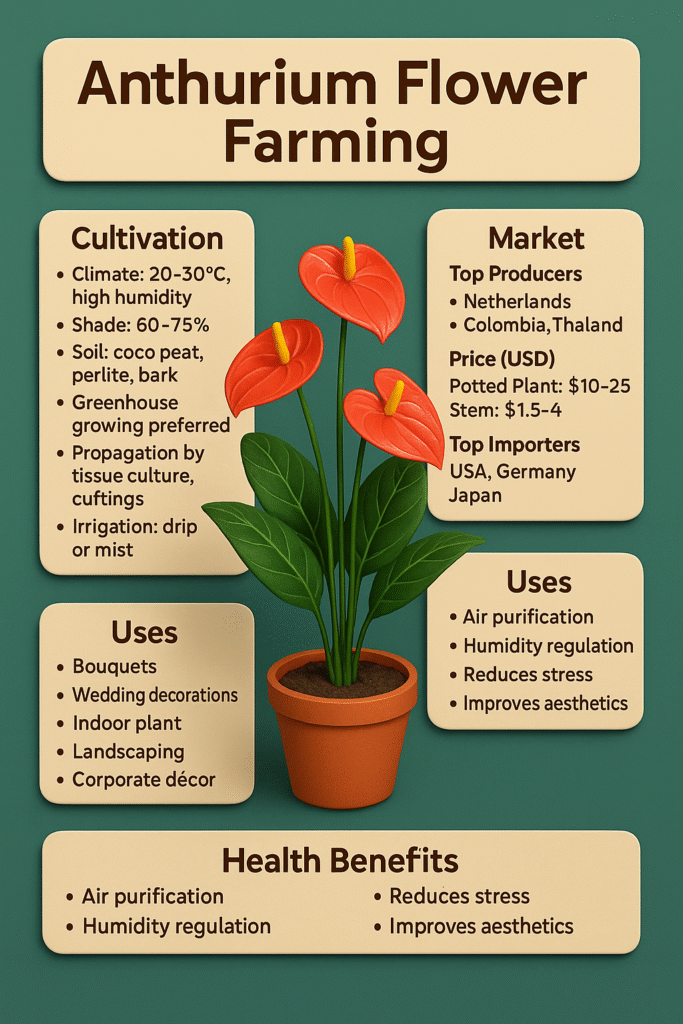
Anthurium (Anthurium andraeanum), also known as Flamingo Flower or Painter’s Palette, is one of the most commercially valuable exotic flowers cultivated worldwide for premium floral markets, high-end bouquets, hotel arrangements, corporate décor, landscaping, and international flower auctions. It is recognized for its glossy heart-shaped spathes, bright color variations, and extremely long vase life, making it a top choice for global floriculture traders.
Native to the humid tropical forests of Central and South America, Anthurium naturally grows as an epiphyte on trees, absorbing moisture and nutrients from the air and decomposed organic matter. This origin determines its modern cultivation requirements: high humidity, warm temperatures, excellent air circulation, and extremely loose growing media.
Today, the flower is commercially grown in countries such as the Netherlands, Colombia, Ecuador, Kenya, Thailand, Indonesia, India, Mauritius, and the Hawaiian Islands. These regions have strong export markets targeting Europe, North America, the Middle East, Japan, and Singapore.
The floriculture industry considers Anthurium a premium flower because it yields high-priced stems and maintains consistent demand throughout the year. A single greenhouse can generate year-round production, and mature plants continue producing flowers for 3–5 years. The global cut-flower market prices Anthurium stems between 1.5 and 4 USD depending on color, size, and grade.
This guide provides a comprehensive world-standard farming blueprint—covering growing media, greenhouse systems, temperature and humidity management, irrigation methods, planting techniques, nutrition models, pest control, harvesting systems, global market insights, trade data, value addition, profit calculations, and business scaling. Every segment is written to support ranking on Google for global searches.
SCIENTIFIC CLASSIFICATION AND ORIGIN
Common Name: Anthurium / Flamingo Flower / Tailflower
Scientific Name: Anthurium andraeanum
Family: Araceae
Origin: Colombia, Ecuador, Costa Rica, Panama
Plant Type: Evergreen perennial
Growth Habit: Epiphytic
Major Global Producers: Netherlands, Colombia, Ecuador, Kenya, Thailand, India, Indonesia, Hawaii
In nature, Anthuriums grow on tree trunks, capturing filtered sunlight, constant humidity, and freely circulating air. Their tolerance for organic, loose substrates and their sensitivity to drought or direct sunlight determine their commercial cultivation requirements.
By the mid-20th century, Hawaii became a major breeding center for premium varieties. Later, the Netherlands modernized greenhouse production, refined grading standards, and built a structured global export pipeline. Colombia and Kenya became major exporters due to favorable climates and low-cost greenhouse labor.
Countries like India have enormous potential due to climatic diversity, strong domestic markets, and increasing demand for exotic flowers in hotels, events, and urban decoration.
COMPLETE ANTHURIUM CULTIVATION GUIDE
CLIMATE REQUIREMENTS
Anthurium is a strict tropical and subtropical crop that performs best under controlled, consistent environmental conditions.
Ideal Climate Conditions:
Temperature: 20–30°C
Relative Humidity: 70–90 percent
Light: 60–75 percent shade
Air movement: Mild but continuous
Annual Rainfall (outdoor): 1500–2500 mm
Temperatures below 15°C affect growth, while temperatures above 32°C cause leaf burn, fading of spathes, and stunted development. Low humidity leads to brown margins, while direct sunlight bleaches the spathes.
This makes greenhouse or shade-net farming essential in most regions outside the deep tropics.
SOIL AND GROWING MEDIA
Anthurium does not grow in typical soil because it is semi-epiphytic. It requires an aerated, fibrous, organic-rich substrate that mimics rainforest floors.
Recommended Media Mix:
Coco peat: 40 percent
Orchid bark or pine bark: 20 percent
Perlite: 20 percent
Charcoal chips: 10 percent
Coconut husk chips: 10 percent
Ideal pH: 5.2–6.2
Ideal EC: 1.2–1.8
The media should retain moisture but drain quickly. Charcoal improves aeration and prevents fungal growth. Trichoderma-enriched media prevents root rot and sustains long-term plant health.
GREENHOUSE STRUCTURE AND REQUIREMENTS
A controlled environment maximizes flower yield and quality.
Recommended Greenhouse Type:
Naturally ventilated or fan-and-pad greenhouse
75 percent shade net above the crop
UV-stabilized polyfilm
Side curtains for ventilation
Foggers or misting systems
Drip irrigation lines
Environmental Controls:
Maintain humidity above 70 percent
Mist systems running 2–5 times daily
Ensure smooth air flow without strong winds
Keep light intensity moderate to avoid spathe discoloration
Raised beds or grow-bag systems are commonly used in modern setups.
PROPAGATION METHODS
Propagation is done through three methods:
1. Vegetative Suckers
A mature Anthurium produces side shoots. These are separated and replanted.
2. Stem Cuttings
Portions of the stem with aerial roots are planted into fresh media.
3. Tissue Culture (Commercial Standard)
Used for large-scale uniform planting. Tissue culture plants ensure:
Uniform growth
Disease-free stock
Faster yield
Consistent flower grade
Most exporters use TC plants.
PLANTING AND SPACING
Best time to plant: For tropical countries, year-round in greenhouse
Spacing: 30 x 45 cm
Plants per hectare: 35,000–40,000
Root zone depth: 20–30 cm
Plants must be handled gently to avoid damage to roots and stems.
IRRIGATION MANAGEMENT
Anthuriums require consistent moisture but cannot tolerate waterlogging.
Ideal System: Drip irrigation with low-flow emitters
Frequency:
Summer: Light irrigation daily
Winter: Every 2–3 days
Rainy season: According to humidity
Overwatering is the most common reason for crop failure.
FERTILIZER AND NUTRITION PROGRAM
Anthuriums need balanced nutrition for high-quality spathes and stems.
Basal Fertilizers:
FYM: 10–15 tons per hectare in beds
Neem cake: 500 kg per hectare
Fertigation Schedule:
NPK (19:19:19) weekly
Calcium nitrate fortnightly
Magnesium sulfate monthly
Micronutrient blend twice a month
Foliar Feeding:
Seaweed extract once a month
Silicon supplements to strengthen stems
Incorrect nutrition affects spathe size, thickness, and vase life.
PESTS AND DISEASE MANAGEMENT
Major Pests:
Thrips
Aphids
Mealybugs
Spider mites
Control methods:
Neem-based sprays
Systemic insecticides (as per export safety)
Yellow and blue sticky traps
Common Diseases:
Bacterial blight
Root rot
Anthracnose
Botrytis
Preventive measures:
Good air circulation
Trichoderma in media
Copper fungicides
Avoiding overwatering
FLOWERING AND HARVESTING
Flowering Cycle
First flowers appear in 8–10 months
Peak flowering from year 2 onward
Productive life: 3–5 years
Harvesting Technique
Cut stems at the base
Handle gently to avoid bruising
Harvest early morning
Immediately place stems in clean water
Post-Harvest Care
Store at 12–15°C
Grade by spathe size and stem length
Export packing in corrugated boxes with ventilation
Anthurium flowers have 14–28 days of vase life based on variety.
GLOBAL MARKET ANALYSIS (USD)
Market Value
Global Anthurium Market (2024): 650–800 million USD
Expected CAGR (2025–2030): 5.8 percent
Top Exporters:
Netherlands
Colombia
Kenya
Ecuador
Thailand
Indonesia
Top Importers:
Germany
France
UK
UAE
Saudi Arabia
Singapore
Japan
USA
Price Structure:
Wholesale stem: 1.5–4 USD
Retail stem: 3–8 USD
Potted plant: 10–25 USD
Tissue culture plant: 0.30–0.70 USD
Hotels, corporate offices, luxury homes, and weddings drive global demand.
USES OF ANTHURIUM
Premium bouquets
Wedding decorations
Hotel and resort arrangements
Indoor ornamental plant
Landscaping in tropical countries
Corporate décor
Gifting industry
Anthuriums also improve indoor air quality due to their natural ability to absorb pollutants.
HEALTH BENEFITS
Air purification
Humidity regulation indoors
Stress reduction due to calming appearance
Reduces airborne dust
Enhances indoor aesthetic quality
While not medicinal, Anthurium is used extensively in wellness architecture and green interiors.
PRECAUTIONS AND SIDE EFFECTS
All parts contain calcium oxalate crystals
Not edible
May irritate skin or eyes
Keep away from pets and children
COST AND PROFIT ANALYSIS (USD)
Investment per Hectare
Greenhouse setup: 40,000–60,000 USD
Planting material: 10,000–15,000 USD
Fertigation and irrigation: 3,000 USD
Labor and maintenance: 6,000–8,000 USD
Total Initial Investment: 60,000–90,000 USD
Annual Returns
Yield: 250,000–350,000 stems per hectare
Average price: 1.5–2.5 USD per stem
Gross Revenue: 375,000–875,000 USD
Net Annual Profit: 150,000–300,000 USD
Anthurium is one of the world’s highest-income floriculture crops.
20 SEO-OPTIMIZED FAQS
How long does Anthurium take to start flowering?
What climate is best for Anthurium cultivation?
Can Anthuriums grow in pots or containers?
What is the ideal soil mix for Anthuriums?
How profitable is Anthurium farming?
What is the global price of Anthurium flowers?
How many plants per hectare for commercial cultivation?
Can Anthurium be grown in open fields?
Which countries import Anthuriums the most?
What are the main diseases affecting Anthuriums?
How to stop Anthurium root rot?
What is the best greenhouse type for Anthuriums?
Which fertilizer is best for Anthurium flowering?
Do Anthuriums require full shade?
How long is the vase life of Anthurium flowers?
Can Anthurium be exported from developing countries?
Which Anthurium varieties are best for cut-flowers?
What is the shelf life of Anthuriums during transport?
How to grade Anthurium stems for export?
Are Anthurium flowers poisonous to humans?
CONCLUSION
Anthurium is one of the most commercially successful exotic flowers in the global floriculture market. With the right greenhouse environment, proper nutrition, humidity management, disease prevention, and an export-focused model, farmers can achieve extremely high profit margins per hectare. Anthurium’s long vase life, global demand, and year-round production capability make it ideal for modern floriculture entrepreneurs.
This complete guide is structured to support worldwide search traffic and rank for competitive keywords. It covers cultivation, market dynamics, global demand, use cases, USD pricing, export markets, and profit projections. For large-scale commercial production, Anthurium remains one of the most stable and profitable flower crops globally.
✍️Farming Writers