1. INTRODUCTION
Capsicum (Capsicum annuum) also known as bell pepper, sweet pepper, or Shimla Mirch, is one of the most commercially valuable vegetables worldwide. Grown in more than 160 countries, capsicum is considered a premium greenhouse vegetable due to its high demand, strong export market, excellent shelf life, and suitability for protected cultivation.
Capsicum farming is extremely profitable in North America, Europe, Middle East, Africa, South Asia, China, Mexico, and Southeast Asia because of:
continuous supermarket demand
huge hotel & restaurant consumption
processed food industry demand
strong export value
Due to various colors (green, red, yellow, orange), capsicum has a higher market price than most vegetables.
2. BOTANICAL & AGRONOMIC DETAILS
Botanical Name: Capsicum annuum
Family: Solanaceae
Chromosomes: 2n = 24
Plant Type: Annual/perennial depending on climate
Pollination: Mostly self-pollinated
Origin: Central & South America
3. NUTRITION PROFILE (per 100 g raw capsicum)
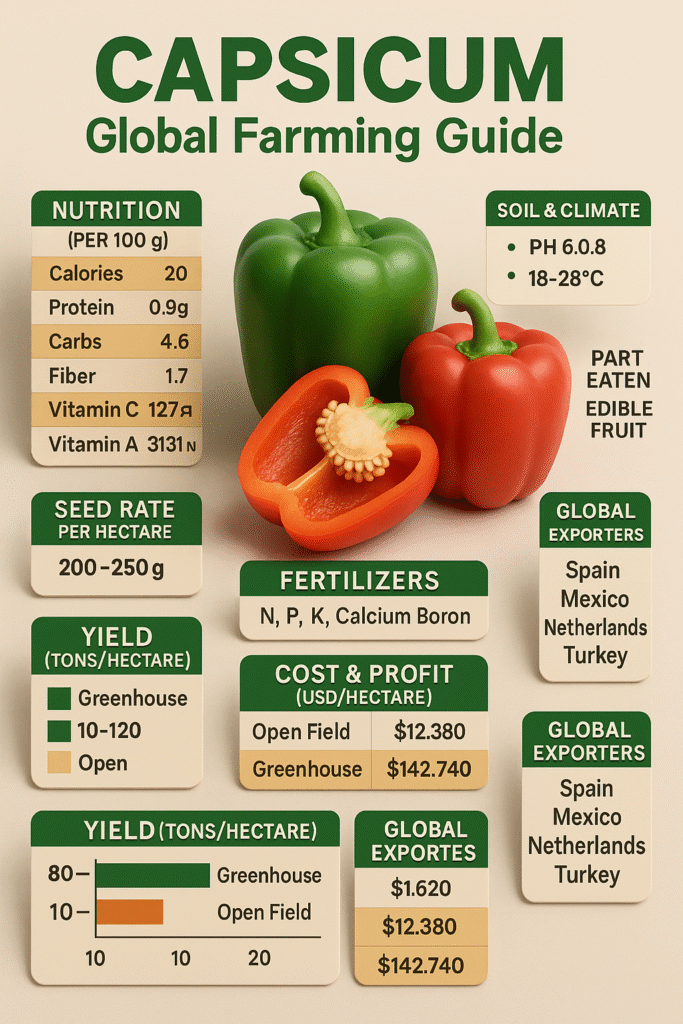
NutrientAmountBenefitCalories20 kcalIdeal for weight lossProtein0.9 gBody repairCarbs4.6 gEnergyFiber1.7 gImproves digestionVitamin C127 mgExtremely high immunity boosterVitamin A3131 IUEye healthVitamin B60.29 mgNerve healthPotassium211 mgHeart healthAntioxidantsVery HighAnti-inflammatory
Red capsicum contains lycopene • Yellow contains lutein • Green contains chlorophyll compounds.
4. GLOBAL CULINARY USES
Salads, pizza toppings, sauces
Stir-fried dishes (Chinese, Thai, Korean)
Stuffed capsicum, pasta, fajitas
Frozen mixed vegetables
Pickles and dips
Hotel, café & fast-food industry
Export quality peppers are used heavily in European & Middle Eastern cuisines.
5. SEED REQUIREMENT
Per Acre
80–100 grams hybrid seeds
Per Hectare
200–250 grams hybrid seeds
Protected farming uses premium seeds (Netherlands, Israel, Japan).
6. SOIL REQUIREMENT
Sandy-loam to clay-loam soil
pH 6.0–6.8
High organic matter
Proper drainage
Raised beds recommended
7. CLIMATE REQUIREMENT (COUNTRY-WISE)
India
20–30°C, best season: October–February
USA
California, Florida, Arizona
Ideal temperature: 18–26°C
Europe
Spain, Netherlands, Italy
Greenhouse production is dominant
Middle East
UAE, Saudi Arabia, Qatar
Mostly greenhouse / cooling pad systems
China
Largest producer with open + greenhouse farms
8. IRRIGATION SCHEDULE
Drip irrigation is mandatory for best results.
First irrigation after transplanting
Then every 3–4 days
Avoid waterlogging
Maintain 60–70% soil moisture
9. FERTILIZER SCHEDULE (GLOBAL STANDARD)
Basal Dose (Before planting)
FYM: 20–25 tons/ha
NPK: 60:40:40 kg/ha
Top Dressing via Drip (Fertigation)
Nitrogen weekly dose
Potassium during flowering
Calcium + Boron for fruit setting
Micronutrients
Magnesium
Sulfur
Zinc
10. PESTS & DISEASE MANAGEMENT
Major Pests
Whiteflies
Thrips
Aphids
Fruit borer
Diseases
Powdery mildew
Bacterial leaf spot
Damping-off
Mosaic virus
Controls
Neem oil sprays
Copper fungicide
Sticky traps
Disease-free nursery
Resistant hybrids
Proper ventilation in greenhouse
11. CROP DURATION (WORLDWIDE)
RegionDurationIndia (open field)100–120 daysIndia (greenhouse)150–200 daysEurope150–250 daysUSA120–150 daysMiddle East140–170 days
Greenhouse capsicum continues fruiting for 6 months.
12. GLOBAL YIELD DATA
Farming TypeYieldOpen Field10–15 tons/haHybrid15–25 tons/haGreenhouse80–120 tons/haDutch/Israeli high-techUp to 180 tons/ha
Greenhouse capsicum gives 10x yield compared to open farming.
13. COST OF CULTIVATION (USD ONLY)
Open Field Capsicum (Per Hectare)
ExpenseCost (USD)Seeds$80Land Prep$120Fertilizers$220Irrigation$120Labor$350Pesticides$140Mulching$200Harvesting + Packaging$180Transport$100Misc.$110Total Cost$1,620
Greenhouse Capsicum (Per Hectare)
ExpenseUSDHybrid Seeds$150Greenhouse Setup (share)$5,000Fertilizers$500Pesticides$260Drip + Cooling$350Labor$600Others$400Total Cost$7,260
14. PROFIT (USD ONLY)
Open Field Profit
Yield: 20,000 kg
Price: $0.70/kg
Revenue: $14,000
Cost: $1,620
Net Profit = $12,380 per hectare
Greenhouse Profit
Yield: 100,000 kg
Price: $1.50/kg
Revenue: $150,000
Cost: $7,260
Net Profit = $142,740 per hectare
Capsicum is one of the most profitable vegetables worldwide.
15. POST-HARVEST TECHNOLOGY
Pre-cooling: 7–10°C
Waxing for longer shelf life
Grading by size & color
Cold storage life: 3–5 weeks
Export uses ventilated crates
16. GLOBAL EXPORT MARKET
Top Exporters
Netherlands
Spain
Mexico
China
Turkey
Top Importers
USA
Germany
UAE
UK
Canada
Demand keeps rising due to supermarkets + fast food chains.
17. LOAN & INSURANCE WORLDWIDE
Available Loans
Greenhouse subsidy loans
Drip irrigation loans
Vegetable production loans
Cold storage loans
Insurance Coverage
Crop disease
Temperature stress
Drought
Storm
Market crash
18. FAQ
1. How many seeds needed per hectare?
200–250 grams hybrid seeds.
2. Which climate is best?
18–28°C cool climate.
3. Is capsicum profitable?
Yes, up to $140,000 profit in greenhouse farming.
4. What irrigation method is ideal?
Drip irrigation.
5. How long does capsicum take to mature?
100–200 days depending on climate.
6. Which fertilizers give best yield?
NPK + Calcium + Boron + Micronutrients.
7. Which pests affect capsicum?
Whitefly, thrips, fruit borer.
8. How many harvests per plant?
8–14 harvest cycles in greenhouse.
9. Best countries for capsicum export?
Netherlands, Spain, Turkey.
10. Best countries for capsicum import?
USA, Germany, UAE.
11. Can capsicum grow in heat?
Yes, with shade nets or greenhouse cooling.
12. Which varieties are best?
Indra, Bomby, Inspiration, California Wonder.
13. What is shelf life?
2–5 weeks in cold storage.
14. Can organic capsicum be grown?
Yes, with neem + compost + biofertilizers.
15. What marketing channels are best?
Supermarkets, exporters, restaurants, processors.
19. CONCLUSION
Capsicum is one of the highest-profit vegetables globally, especially in protected cultivation systems. With proper seed selection, climate control, drip irrigation, fertigation, pest management, and global market targeting, farmers can earn 10x to 50x profits in a single season.
For worldwide farmers, capsicum is a low-risk, high-return, export-friendly vegetable with strong year-round demand.
✍️Farming Writers