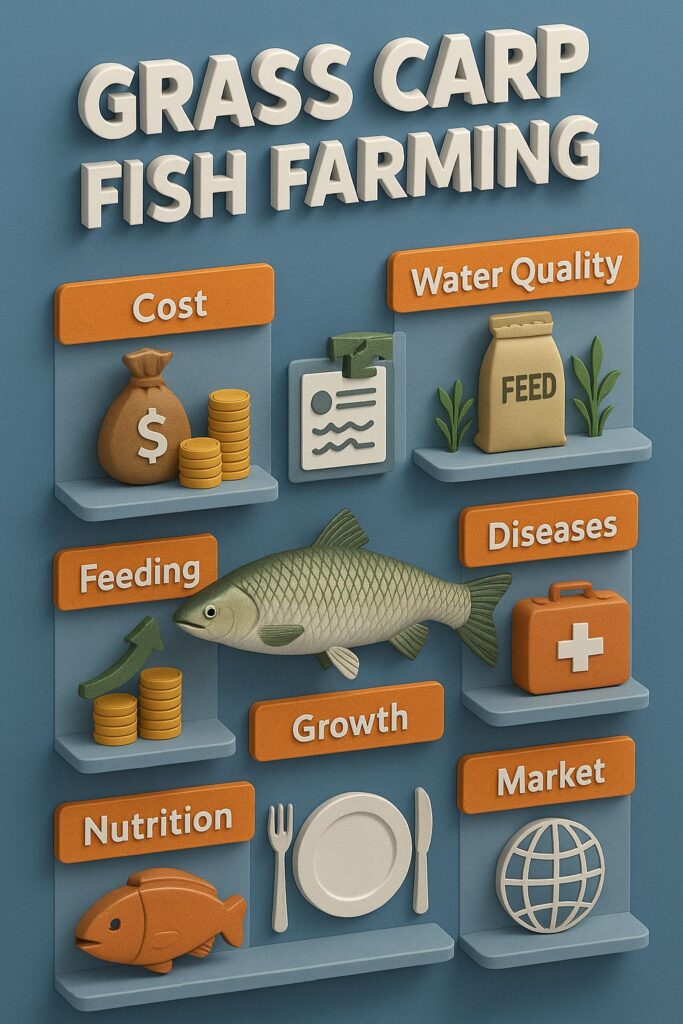
1. Introduction: The Global Rise of Grass Carp Farming
Grass Carp (Ctenopharyngodon idella) has become one of the most influential freshwater aquaculture species in the world due to its exceptional growth rate, herbivorous feeding habits, strong survival capability, and consistent global consumer demand. Over the last three decades, the species has expanded from its native regions in China and Russia to more than seventy countries where governments, private farms, landowners, and aquaculture corporations use it for food production, weed control, and commercial fishery enhancement.
The popularity of Grass Carp is not accidental. It is the direct outcome of three advantages that very few fish species offer:
Low production cost due to herbivorous feeding behavior
Grass Carp feeds primarily on aquatic vegetation, grasses, weeds, and low-cost floating feed. This makes it extremely economical to rear in countries where commercial feed is expensive.
High adaptability to large pond and reservoir culture
It grows efficiently in ponds, irrigation tanks, reservoirs, and cage systems, allowing both small farmers and large-scale aquaculture enterprises to participate.
Stable global market demand
Grass Carp has a mild flavor, white meat, low fat, and high protein—all qualities that appeal to consumers in Asia, Eastern Europe, and parts of North America. This wide acceptance stabilizes its price throughout the year.
Because of these advantages, Grass Carp farming has become an integral component of freshwater aquaculture systems in India, Bangladesh, Vietnam, Thailand, Myanmar, Israel, Romania, Ukraine, and many African nations. China remains the world leader, producing more Grass Carp than any other country produces any single freshwater species.
This article offers a complete, step-by-step global guide on Grass Carp aquaculture—from pond construction and seed selection to feeding management, disease prevention, market strategy, export analysis, and long-term business planning.
2. Species Overview and Biological Significance
Grass Carp belongs to the Cyprinidae family and is closely related to Chinese Major Carps. It is naturally found in fast-flowing rivers of China and Russia. Over the years, it has been successfully introduced to controlled environments across Asia, Europe, and North America, largely for weed control and commercial fish production.
Scientific and Biological Profile
Scientific Name: Ctenopharyngodon idella
Family: Cyprinidae
Common Names: White Amur, Grass Carp
Origin: Amur River Basin
Feeding Type: Herbivorous
Body Structure: Long torpedo-shaped, designed for swimming
Growth Potential: 6–12 kg, depending on conditions
Commercial Harvest Size: 1.5–3 kg
Lifespan: 10–15 years
The fish’s biology makes it ideal for stocking in large ponds, canals, and reservoirs. Since it feeds aggressively on submerged and floating vegetation, Grass Carp plays a dual role as both a farmed fish and an ecological weed controller.
3. Global Importance and Market Distribution
Grass Carp is among the most produced freshwater fish in the world in terms of total biomass. It holds a dominant position in the aquaculture industries of:
China
India
Bangladesh
Vietnam
Thailand
Indonesia
Russia
Romania
Ukraine
Israel
In these countries, Grass Carp serves two purposes:
Commercial fish farming for food markets.
Aquatic weed control in reservoirs, irrigation canals, drinking-water bodies, and aquaculture tanks.
Top International Grass Carp Markets
China (domestic consumption + processing export)
Europe (whole fish + fillets)
Middle East (fresh/chilled demand)
India & Bangladesh (fresh whole fish)
USA (white amur used for weed control and fisheries enhancement)
The global demand for Grass Carp is stable and reliable, with prices rising gradually due to increasing protein requirements, population growth, and lack of alternative low-cost white fish species.
4. Climate and Environmental Needs
Grass Carp adapts best to tropical and subtropical climates. This is why countries like India, Bangladesh, Vietnam, and Thailand excel in production.
Ideal Environmental Conditions
ParameterOptimal RangeTemperature20°C to 30°CDissolved OxygenMinimum 5–6 mg/LpH6.5 to 8.5SalinityFreshwater onlyPond Depth1.5–2.5 meters
Grass Carp cannot tolerate cold water for long periods. Temperatures below 12°C slow down metabolism, reduce feeding, and impact growth.
5. Water Quality Parameters
Water quality directly affects growth, feed consumption, and survival rates. Farmers in countries like China and Vietnam follow strict guidelines which have been adopted globally.
Recommended Water Standards
Hardness: 80–150 ppm
Alkalinity: 100–200 ppm
Ammonia: Below 0.02 ppm
Nitrate: Below 25 ppm
Flow Rate: Moderate water movement preferred
Maintaining these parameters reduces disease outbreaks and ensures efficient feed conversion.
6. Farming Systems Used Around the World
Grass Carp farming can be adapted to different environments and production volumes. Here are the most widely adopted systems:
1. Traditional Pond Culture
Used by small and medium-scale farmers.
2. Polyculture System
Widely practiced in Asia:
Grass Carp
Rohu
Catla
Silver Carp
Common Carp
Mrigal
Each fish utilizes a different layer of water and feed, resulting in efficient use of pond resources.
3. Cage Culture in Reservoirs
China, Russia, Vietnam, and Thailand use cages for high-density production.
4. Tank Culture
Suitable for regions with limited land availability.
5. Biofloc Farming
Possible but not ideal, as Grass Carp prefers vegetation.
6. Recirculating Aquaculture Systems (RAS)
Used for producing export-quality fish.
7. Pond Construction and Preparation
Pond Size and Design
1 acre is ideal for commercial operation
Depth 1.5–2.5 meters
Gentle slope to facilitate water flow
Proper inlet and outlet channels
Pond Preparation Steps
Sun-drying the bottom
Liming based on soil pH
Organic fertilization to promote plankton
Introducing aquatic plants
Installing aerators
Grass Carp requires substantial aquatic vegetation, so initial pond preparation must promote natural plant growth.
8. Fingerlings and Stocking Density
Seed Selection Guidelines
Fingerling size: 3–5 inches
Color: Natural silver-grey
Gills should be bright red
Must swim actively
Stocking Density
For 1 acre:
3000 to 4000 Grass Carp fingerlings
In polyculture, fewer Grass Carp are stocked as they feed aggressively on vegetation.
9. Feeding Management
Grass Carp’s herbivorous nature lowers farming cost drastically.
Natural Feed Sources
Napier grass
Para grass
Azolla
Duckweed
Hydrilla
Lettuce
Spinach
Aquatic weeds
Commercial Feed
20–25% protein floating pellets
Used primarily during lean vegetation seasons
Daily Feeding Rate
2–3% of body weight
Feed Conversion Ratio (FCR)
1.6:1 on average
(Highly efficient among freshwater species.)
10. Growth Cycle and Harvest Timeline
AgeExpected Weight1 month60–80g3 months300–400g6 months1–1.2 kg12 months2–2.5 kg18 months3–4 kg
Grass Carp grows rapidly when vegetation is abundant.
11. Disease Management and Biosecurity
Although hardy, Grass Carp can be affected by:
Gill rot
Fungal infections
Columnaris
Parasitic worms
Biosecurity Recommendations
Lime every 25–30 days
Maintain dissolved oxygen
Remove sludge regularly
Prevent overcrowding
Use potassium permanganate baths for seed treatment
12. Cost of Production (1 Acre World Model)
ComponentCost (INR)Cost (USD)Pond Prep₹30,000$360Fingerlings₹20,000$240Vegetation/Feed₹1,20,000$1,440Labour₹35,000$420Water/Electricity₹25,000$300Miscellaneous₹20,000$240Total Cost₹2,50,000$3,000
13. Global Market Price (USD)
RegionPrice per kgUSA$5–8Europe$4–7China$2–3India$2–3.5Middle East$4–8
Grass Carp fillets fetch higher rates in export markets.
14. Profitability Analysis
Production: 8–10 tons per acre
Revenue: $15,000–22,000
Net Profit: $10,800–15,600
Profit Margin: 50–60%
Grass Carp earns higher profits due to low feed cost and strong demand.
15. Nutrition Profile (per 100g)
Calories: 112
Protein: 17g
Fat: 5g
Omega-3: 200mg
Vitamin A, D, B12
Iron, Zinc, Potassium
16. Health Benefits
Grass Carp supports:
Heart health
Muscle growth
Immune function
Brain development
Recovery diets
Elderly nutrition
Its white meat is easy to digest and suitable for all age groups.
17. Medical and Industrial Uses
Used in patient recovery diets
Fish oil for supplements
Used in therapeutic nutrition
Low-fat protein source for metabolic patients
18. Risks and Challenges
Sensitive to polluted water
Cannot tolerate cold climate
Vegetation shortage slows growth
Overcrowding leads to stress
19. Popular Recipes Around the World
Steamed Grass Carp
Grass Carp Curry
Fried Carp Slices
Grilled Carp with herbs
Chinese Carp Soup
Romanian Carp Stew
20. Marketing and Export Opportunities
Strong markets include:
India
China
Vietnam
Eastern Europe
Middle East
USA (special permits required)
Export products:
Frozen whole fish
Fillets
Cleaned and gutted fish
IQF blocks
21. Business Expansion Models
Polyculture farms
Integrated farms
Large reservoir cage farming
Hatchery business
Processing and fillet plants
Export-oriented farms
22. Conclusion
Grass Carp fish farming is one of the most reliable and profitable aquaculture ventures in the world. Its rapid growth, herbivorous feeding nature, stable market demand, and minimal production cost make it a preferred species for both small-scale farmers and large commercial aquaculture enterprises. When managed professionally with proper water quality, vegetation supply, and disease control, Grass Carp provides strong returns, high sustainability, and long-term financial stability.
Grass Carp fish farming, Grass Carp cost and profit, Grass Carp aquaculture guide, Grass Carp feeding system, Freshwater carp business, global fish farming systems, weed-based fish culture, carp stocking density
✍️Farming Writers
Love farming Love farmers
Read A Next Post 👇
https://farmingwriters.com/pangasius-basa-fish-farming-complete-guide/