• One Acre Carrot Farming: Complete Global Human-Expert Guide to Cultivation, Yield, Irrigation & Profit

    One Acre Carrot Farming

    The first thing you notice when you step into a carrot field in the early morning is the smell—fresh, wet, cool, and earthy in a way that very few crops can create. Carrot leaves hold dew like a memory of the night, tiny droplets sitting on fine lace-like foliage. When the farmer walks between the rows, the fragrance of disturbed soil mixes with a scent that is unmistakably carrot, even though the root still stays hidden under the earth. Carrot farming is one of agriculture’s quiet arts. Unlike large leafy crops that announce their growth loudly, carrots develop in silence beneath the surface, revealing their success only when the time is right.

    The story of growing carrots on one acre is a story about trust—trust in soil, trust in timing, and trust in the invisible growth happening underground. Carrots are among the few vegetables where the most important part grows entirely hidden from the farmer’s eyes. This demands a different kind of skill, one where observation is done through leaves, soil texture, moisture feel, and climate rhythm. Farmers who master carrots develop a kind of intuitive eyesight—an ability to “see” underground without digging.

    Around the world, carrots behave differently in every region.
    In Europe, they grow slowly, forming firm, sweet, brightly coloured roots.
    In Japan, carrots grow with almost surgical perfection—uniform, smooth, long, and aesthetically flawless.
    In Africa, carrots grow rapidly but need constant moisture to avoid cracking.
    In India, carrots shift personality with seasons—the winter carrots grow deep, sweet, and flavourful; summer varieties grow shorter but faster.
    In the US and Canada, cold climates produce some of the best storage carrots on Earth.

    One acre of carrot farming begins with soil. Carrot soil must feel soft, airy, and forgiving. If you close your fist around perfect carrot soil, it should crumble gently like warm sand mixed with fine flour. Carrots hate stones, hard chunks, and compaction. Even a single small stone can cause a carrot to fork—splitting into two or three roots, reducing value instantly. This is why farmers sieve or deeply plough soil before sowing. A carrot’s shape is a reflection of soil freedom. The straighter the root, the better the soil.

    Climate decides carrot sweetness. Carrots grown in cooler temperatures store sugar, developing deeper flavour and better colour. Carrots grown in hotter climates grow faster but often less sweet. This is why the best carrot seasons worldwide align with winter or mild spring.

    Sowing carrots is not like transplanting seedlings. It is an act of precision. Seeds are tiny and lightweight, almost dust-like. They must be spaced carefully, either by hand, seed drill, or fine distribution methods. Too many seeds in one place create overcrowding, producing thin, weak roots. Too few seeds leave empty patches. The farmer walks slowly, lowering seeds into soft beds, knowing that the next three months of growth depend on this quiet moment.

    Once seeds sprout, the field enters its most delicate stage. Carrot seedlings look like thin green threads barely able to face the world. A single weed can overshadow them. A strong wind can uproot them. Too much water can bury them. Too little water can dry them. The farmer must maintain balance—soft moisture, clean soil, and gentle sun.

    As the plants grow, the first carrot leaves appear—feathery, bright green, and light in texture. The plant remains humble above the soil, giving little indication of what is happening beneath. Farmers rely on leaf density, leaf height, and soil rise near the root zone to judge underground growth. If leaves appear lush and upright, roots are usually forming well. If leaves remain too small or pale, the soil is either too hard or nutrient-deficient.

    Irrigation forms the true heartbeat of carrot farming.
    Carrots demand consistent moisture.
    Not flooding, not dryness—just a steady rhythm.
    Uneven watering causes roots to crack.
    Shallow watering causes short, stubby carrots.
    Overwatering causes rot.

    Farmers often test moisture by pressing fingers into the soil. If the soil feels cool and moist an inch below, the plants are happy. If the surface dries but the inner zone stays moist, the crop grows with confidence. Carrots never want sudden emotional watering—they want calm, predictable hydration.

    Nutrition for carrots is a dialogue between soil and plant. Too much nitrogen produces leafy plants but small roots. Too much potassium gives colour but reduces size if given early. Carrots respond well to organic-rich soils, where nutrients release slowly. Farmers who dump heavy fertilizers early often end up with patchy growth. Carrots ask for balance—not excess.

    As days pass, the field begins to thicken. Leaves sway with even the slightest wind. Farmers may pull a single plant occasionally—not for harvest, but for inspection. This tiny act tells everything: shape, colour, uniformity, moisture balance, soil softness, and potential yield.

    Pests rarely attack carrots aggressively above ground, but below ground, nematodes can distort roots terribly. Wireworms and root maggots also appear depending on region. Farmers who rotate crops and avoid planting carrots after solanaceous crops prevent most underground pest issues.

    Diseases start when humidity stays trapped between foliage. Alternaria leaf blight creates patchy brown spots. Powdery mildew appears when nights stay cool and dry. But in well-spaced fields with good airflow, disease pressure stays low.

    Carrots reach maturity differently in every climate. In cold regions, they mature slowly but beautifully. In warm environments, they grow fast but require closer attention. Farmers judge maturity by touching the crown—if the top of the carrot pokes slightly above soil and feels firm, it is nearly ready. Colour also deepens near harvest.

    Harvesting carrots feels like uncovering treasure. The farmer pulls the leaf bunch gently; if the root resists slightly and then slides out cleanly, the soil was just right. Each carrot comes out with a distinct earthy scent—sweet, damp, and alive. Some carrots emerge long and slender; others thick and bold. Every single root is a story of underground patience.

    The field after harvest looks like a textured landscape—small holes everywhere, traces of orange left behind, soil disturbed like memory. Farmers spread harvested carrots in shade, washing lightly and sorting based on size and shape. Premium roots go to supermarkets and export. Medium roots go to local markets. Small ones often go to processing units.

    Worldwide carrot prices depend heavily on season.
    USA: $0.8–3.0/kg
    Europe: $1.0–4.0/kg
    Middle East: $0.5–2.0/kg
    Asia: $0.2–1.0/kg
    Africa: $0.1–0.5/kg

    Carrots sell unbelievably well in winter across all climates.
    In summer, only strong storage varieties maintain supply.

    One acre yield varies widely:
    Low care: 6–8 tons
    Good management: 10–14 tons
    High performance: 15–20 tons
    Exceptional: 22–30 tons

    Profit from one acre reflects yield + season:
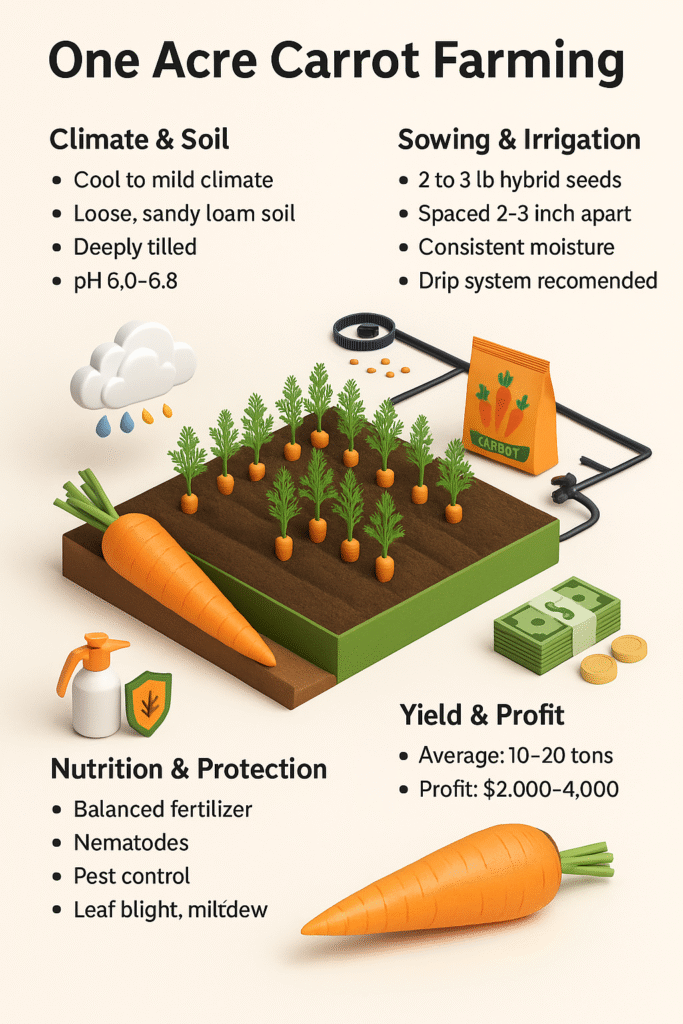
    Average profit: $2,000–$4,000
    High-season profit: $5,000–$7,000
    Off-season profit: $7,000–$10,000

    Carrot farming teaches humility.
    It hides progress underground.
    It tests patience without showing growth.
    It demands trust, balance, rhythm, and subtle observation.
    Carrots reward farmers who listen—listen to soil, water, climate, and silence.

    Standing in a mature carrot field before harvest feels like standing on a secret. Beneath the soil lie thousands of roots—each shaped by the quiet decisions the farmer has made for months. And when those roots finally emerge, the field reveals that no silent growth is ever wasted.

    One acre of carrots is a story of invisible growth, patient waiting, and final reward.

    ✍️Farming Writers Team

    Love Farming Love Farmers

    Read A Next Post 👇

    https://farmingwriters.com/1-acre-farming-model-motivation/

  • One Acre Carrot Farming: Complete Worldwide Cultivation, Yield and Export Profit Guide

    One Acre Carrot Farming p


    1. Introduction: Why Carrot Is a Profitable One-Acre Crop Worldwide

    Carrot (Daucus carota) is among the most widely cultivated vegetables globally.
    It is grown in:

    North America

    Europe

    Australia

    Asia

    Middle East

    Africa

    South America

    The global carrot market is worth $60+ billion, driven by:

    Daily household consumption

    Juice and beverage industry

    Processed carrot products

    Frozen vegetables

    Baby food companies

    Export markets

    Carrots are fast-growing, low-cost, and capable of very high yields per acre, making them an ideal profitable crop for farmers worldwide.

    2. Climate Requirements

    Carrot thrives in cool climate:

    Ideal temperature: 16–22°C

    Minimum: 8°C

    Maximum: 32°C

    Carrots need long sunshine for root development

    Leading Carrot-Growing Regions

    USA (California, Washington)

    China

    UK

    France

    Netherlands

    India (Punjab, Haryana)

    Australia

    Kenya

    Egypt

    Carrots are frost-tolerant but not heat-tolerant.

    3. Soil Requirements

    Carrot needs loose, deep, well-drained soil.
    Hard soil causes forked, deformed roots.

    Best Soil Type

    Sandy loam (best)

    Loam

    Organic-rich soil

    pH: 6.0–7.0

    One-Acre Soil Preparation

    Deep ploughing

    Remove stones (very important)

    Add 4–6 tons of compost

    Add 50 kg neem cake

    Make raised beds (3–4 ft width)

    Ensure soil depth > 12 inches

    Root vegetables require loose soil for straight, long roots.

    4. Seed Rate for One Acre

    Carrots are grown directly from seeds.

    Seed Requirement

    3–4 kg per acre (open pollinated)

    1.2–2 kg per acre (hybrid varieties)

    Seed Treatment

    Soak seeds in water for 6–8 hours

    Mix with Trichoderma powder

    Mix with sand for uniform sowing

    5. Global Varieties of Carrot

    Tropical / Asian Varieties

    Pusa Kesar

    Pusa Rudhira

    Hisar Gairic

    Nantes

    European Varieties

    Amsterdam Forcing

    Chantenay

    Berlicum

    Imperator 58

    Processing / Baby Carrot Varieties

    Sugarsnax

    Bolero

    Nantes Coreless

    Laguna

    6. One-Acre Sowing Layout

    Spacing

    Row spacing: 1 ft (30 cm)

    Plant spacing: 2–3 cm

    Plant Population

    250,000 – 400,000 plants
    Carrots are high-density crops.

    Depth

    Sow seeds 1–1.5 cm deep only.

    7. Irrigation Requirement

    Carrot requires consistent moisture.

    Schedule

    Germination stage: Light irrigation daily

    Vegetative stage: Every 3–4 days

    Root development: Every 5 days

    Maturity stage: Reduce water

    Drip Irrigation

    Best method for uniform roots

    Saves 40% water

    Supports fertigation

    8. Fertilizer Schedule (Month-by-Month)

    Basal Dose

    Compost: 4–6 tons

    NPK 10:26:26: 40 kg

    Neem cake: 50 kg

    Fertigation Program

    Month 1

    NPK 19:19:19 → 4 kg/week

    Month 2

    Urea → 4 kg/week

    Potassium nitrate → 3 kg/week

    Month 3

    SOP → 4 kg/week

    Magnesium sulphate → 3 kg/week

    Micronutrients

    Spray every 20 days:

    Boron 0.2%

    Zinc 0.5%

    Calcium 0.5%

    Boron deficiency causes split roots — very common in carrots.

    9. Weed Management

    Weeds reduce yield drastically.

    Use:

    Pendimethalin pre-emergence

    Manual weeding twice

    10. Thinning

    After 20–25 days:
    Reduce plants to 3–4 cm spacing for proper root growth.

    11. Pest Management (Global Standard)

    Major Pests

    Carrot Fly

    Control: Neem oil or Lambda-cyhalothrin

    Aphids

    Control: Imidacloprid

    Cutworms

    Control: Chlorpyrifos early drench

    12. Diseases

    Leaf Blight

    Control: Mancozeb

    Powdery Mildew

    Control: Sulphur spray

    Root Rot

    Control: Trichoderma soil treatment

    13. Harvesting Timeline

    Carrot matures in:

    80–110 days depending on variety

    Indicators:

    Uniform root size

    Colour fully developed

    Harvest carefully to avoid root breaking.

    14. Yield Per Acre

    Average

    10–14 tons (10,000–14,000 kg)

    High Yield

    16–20 tons

    Best Management

    22 tons per acre

    15. Global Market Price (USD)

    RegionPrice per kgUSA$0.70 – $1.20Europe$0.60 – $1.10Middle East$0.40 – $0.80Asia$0.20 – $0.60Africa$0.15 – $0.40

    Processing carrots

    $1.2 – $2.0 per kg

    16. Profit Calculation

    Revenue

    14,000 kg × $0.40 = $5,600
    20,000 kg × $0.60 = $12,000

    Cost of Cultivation

    $1,000–$1,800 per acre

    Net Profit

    $4,000 – $10,000 per acre

    17. Storage

    Carrots require:

    Temperature: 0–4°C

    Humidity: 85–90%

    Proper air flow

    Storage helps in getting higher off-season price.

    18. Export Market

    Top carrot importing countries:

    UAE

    Qatar

    Saudi Arabia

    Sri Lanka

    Malaysia

    Singapore

    European markets (processing carrots)

    Documents:

    Phytosanitary certificate

    Certificate of origin

    IEC

    Packing list & invoice

    19. Value Addition

    Carrot juice

    Carrot powder

    Frozen carrot

    Baby carrots

    Dehydrated carrot flakes

    Value addition increases returns 2–4×.

    20. FAQ

    1. How long does carrot take to grow?

    80–110 days.

    2. How many kg per acre?

    10–22 tons.

    3. Seed rate per acre?

    1.2–2 kg hybrid; 3–4 kg OP.

    4. What is the global price?

    $0.20–$1.20 per kg.

    5. Best irrigation method?

    Drip irrigation.

    6. Why forked carrots form?

    Hard soil, boron deficiency, irregular watering.


    21. Extended Detailed Conclusion (Complete)

    Carrot is one of the world’s most reliable, stable, and profitable crops for one-acre farming.
    Because carrots are consumed in over 160 countries and supply both fresh markets and processing industries, the crop guarantees consistent demand throughout the year.

    Carrot farming becomes especially profitable when:

    Soil is loose and stone-free

    Drip irrigation is used

    Balanced nutrients (especially potassium and boron) are applied

    Weeds are controlled early

    Storage and cold-chain practices are followed

    Seeds are selected based on climate


    With proper management, carrot farmers can achieve:

    10–22 tons per acre

    Net profits between $4,000 – $10,000 per acre

    Higher income through processing products

    Higher earnings in export markets

    Stable long-term income across the year


    Carrot is also a perfect crop for youth farming startups because:

    Low investment

    Fast maturity

    Guaranteed market

    Excellent export demand

    Great scope for value-added products


    Carrot farming under one acre can easily become a stable lifetime income business for farmers globally.

                           
    Read A Next Post👇

    https://farmingwriters.com/one-acre-potato-farming-complete-guide/

    ✍️Farming writers

    Love farming Love farmers

  • Carrot – Nutrition, Benefits, Farming, Cost, Profit and Uses  Farming Writers

    Carrot farming


    1. Introduction

    Carrot (Daucus carota) is one of the most widely cultivated root vegetables in the world, known for its bright orange color and high nutritional value. Originating from Central Asia, carrot is now grown across Europe, Asia, and North America.

    It is widely consumed in salads, juices, curries, pickles, soups, desserts, and snacks. Carrot is especially famous for being rich in beta-carotene, which supports eye health, immunity, and overall wellness. Its short maturity period and high market demand make it a profitable choice for farmers.

    2. Nutritional Value (per 100 g raw carrot)

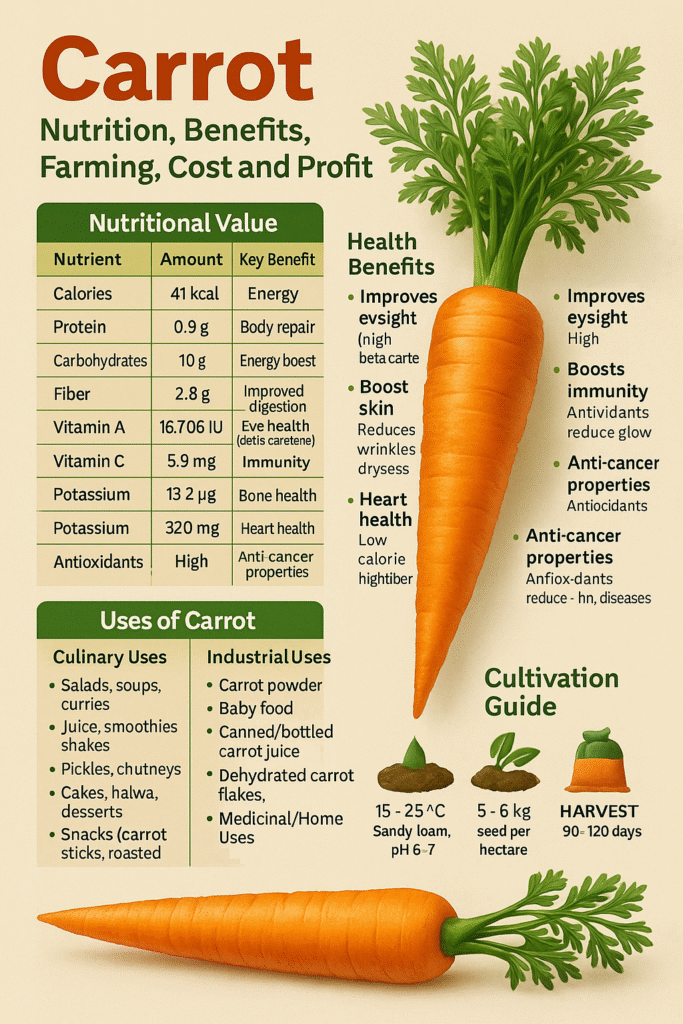
    NutrientAmountKey BenefitCalories41 kcalEnergy & low-fat dietProtein0.9 gBody repairCarbohydrates10 gEnergy boostFiber2.8 gImproved digestionVitamin A16,706 IUEye health (beta-carotene)Vitamin C5.9 mgImmunityVitamin K13.2 µgBone healthPotassium320 mgHeart healthAntioxidantsHighAnti-aging & disease protection

    3. Health Benefits of Carrot

    Improves eyesight – Extremely rich in beta-carotene (Vitamin A).

    Boosts immunity – Antioxidants and Vitamin C protect against infections.

    Good for skin – Reduces wrinkles, dryness, and improves glow.

    Heart health – Potassium regulates blood pressure.

    Supports weight loss – Low-calorie, high-fiber vegetable.

    Improves digestion – Fiber enhances bowel movement.

    Controls diabetes – Low glycemic index helps stabilize blood sugar.

    Anti-cancer properties – Antioxidants reduce risk of chronic diseases.

    4. Uses of Carrot

    Culinary Uses

    Salads, soups, curries

    Juice, smoothies, shakes

    Pickles, chutneys

    Cakes, halwa, desserts

    Snacks (carrot sticks, roasted carrots)

    Industrial Uses

    Carrot powder

    Baby food

    Canned/bottled carrot juice

    Dehydrated carrot flakes

    Medicinal/Home Uses

    Improves digestion

    Natural skin cleanser

    Strengthens vision

    5. Cultivation Guide

    Climate

    Cool-season crop

    Ideal temperature: 15–25°C

    Soil

    Deep sandy-loam soil

    pH: 6–7

    Soil must be stone-free for smooth carrot growth

    Land Preparation

    Fine tilth required

    2–3 ploughings, followed by leveling

    Seed Requirement

    5–6 kg per hectare

    Sowing Time

    North India: October–December

    South India: August–October

    Irrigation

    Light irrigation after sowing

    Then every 7–10 days

    Fertilizer Requirement

    FYM: 15–20 tons/ha

    NPK: 60:40:40 kg/ha

    Harvest

    90–120 days after sowing

    Hand harvesting recommended

    Average Yield

    25–30 tons per hectare

    6. Cost and Profit Analysis (INR & USD)

    Cost of Cultivation (per hectare)

    ItemCost (INR)Cost (USD approx.)Seeds₹6,000$72Fertilizers₹10,000$120Labor₹25,000$300Irrigation₹8,000$96Land preparation₹12,000$144Miscellaneous₹9,000$108Total Cost₹70,000$840

    Yield and Revenue

    Yield: 25,000–30,000 kg per hectare

    Average Market Price:

    India: ₹20–40 per kg

    International: $1.2–2.0 per kg

    Profit Calculation (India)

    At ₹25 per kg:

    Revenue = 25,000 kg × ₹25 = ₹6,25,000

    Profit = ₹6,25,000 – ₹70,000 = ₹5,55,000 per hectare

    Profit Calculation (Export)

    At $1.5 per kg:

    Revenue = 25,000 × $1.5 = $37,500

    Profit = $37,500 – $840 = $36,660 per hectare

    Carrot is one of the most profitable root vegetables for both domestic and export markets.

    7. Global Market Overview

    Major Producers

    China

    India

    Uzbekistan

    USA

    Russia

    Major Exporters

    Netherlands

    China

    Spain

    USA

    Mexico

    Demand Drivers

    Health-conscious consumers

    Juice and beverage industry

    Baby food industry

    Fast-growing salad market

    Global carrot demand increases every year due to its nutritional value and culinary versatility.

    8. Marketing and Selling Strategies

    Sell fresh in local markets

    Supply to restaurants & hotels

    Packaging for supermarkets

    Processing into juice/powder

    Export to Middle East & Europe

    Sell to online grocery chains (Blinkit, BigBasket, Amazon Fresh)

    9. Frequently Asked Questions (FAQs)

    Q1. Are carrots profitable to grow?
    Yes, extremely profitable with up to ₹5.5 lakh profit per hectare.

    Q2. How long does carrot take to mature?
    About 90–120 days.

    Q3. Which variety is best?

    Pusa Rudhira

    Nantes

    Pusa Kesar

    Imperator

    Q4. What climate is best for carrots?
    Cool climate with temperatures between 15°C–25°C.

    Q5. Can carrots be exported?
    Yes, India exports large quantities to UAE, Bangladesh, Sri Lanka, and Europe.

    10. Conclusion

    Carrot is a high-value vegetable that offers strong health benefits and excellent market potential. Its rich content of Vitamin A, fiber, and antioxidants makes it one of the most nutritious vegetables in the world.

    For farmers, carrot farming is profitable due to its low cost, short duration, and strong market demand. Its global presence ensures farmers receive consistent income throughout the year.

    Carrot farming is suitable for beginners and professionals alike, offering great returns in both local and export markets.


    ✍️Farming Writers


    Love farming Love farmers

    Read A Next Post 👇

    https://farmingwriters.com/caraway-seeds-farming-guide/