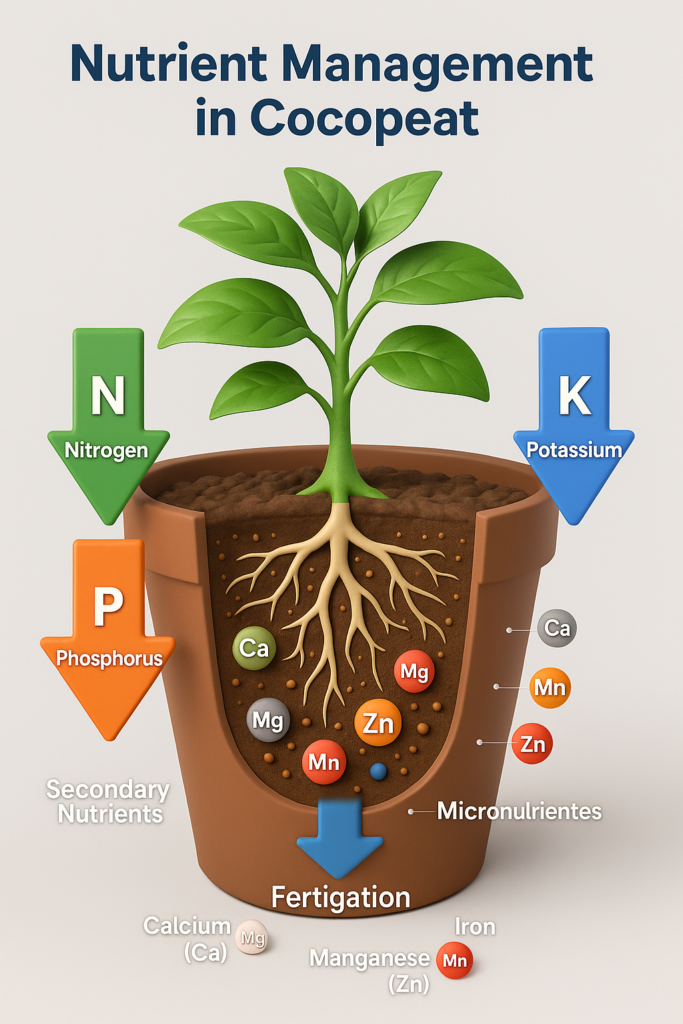
Cocopeat farming fails not because cocopeat is a poor medium, but because nutrient management is misunderstood or underestimated. Unlike soil, cocopeat does not supply nutrients on its own. It acts as a controlled root-support system, entirely dependent on what the grower provides.
In soil farming, nutrient errors are partially buffered by soil reserves. In cocopeat farming, every nutritional mistake appears directly and quickly in plant growth. This makes nutrient management in cocopeat both a challenge and an opportunity: mistakes are costly, but correct management delivers exceptional yield consistency.
This post explains complete nutrient science and practical application for cocopeat growers worldwide.
Understanding Cocopeat as a Nutrient Medium
Cocopeat is:
Structurally supportive
Chemically semi-inert
Nutrient-poor by nature
Key nutritional reality:
Almost zero nitrogen and phosphorus
Naturally high potassium
Requires continuous external feeding
Thus, cocopeat farming is essentially a fertigation-driven production system.
Difference Between Soil Nutrition and Cocopeat Nutrition
Soil-Based Feeding
Nutrients stored in soil particles
Slow release
High margin for error
Cocopeat-Based Feeding
Nutrients dissolved in irrigation water
Immediate root availability
Low margin for error
This difference explains why fertilizer formulas designed for soil often fail in cocopeat systems.
The Role of Fertigation in Cocopeat
Fertigation is the process of delivering nutrients through irrigation water. In cocopeat farming:
All nutrients are supplied via fertigation
Uniform distribution is essential
EC and pH must be monitored constantly
A stable fertigation program determines plant health, yield, and quality.
Essential Macronutrients in Cocopeat
Nitrogen (N)
Function:
Leaf growth
Chlorophyll production
Management:
Supplied continuously in small doses
Excess causes soft growth and disease sensitivity
Phosphorus (P)
Function:
Root development
Flower initiation
Management:
Moderate supply required
Overuse blocks micronutrients
Potassium (K)
Function:
Fruit quality
Water regulation
Special note:
Cocopeat already contains potassium
External potassium must be carefully balanced
Secondary Nutrients: Calcium and Magnesium
Calcium (Ca)
Role:
Cell wall strength
Root tip growth
In cocopeat:
Most critical nutrient
Deficiency common if buffering or supply is inadequate
Magnesium (Mg)
Role:
Chlorophyll center
Energy transfer
Importance:
Often suppressed by excess potassium
Balanced Ca:Mg ratio is essential for long-term success.
Micronutrients in Cocopeat
Although required in small amounts, micronutrients control crop performance.
Key micronutrients:
Iron
Manganese
Zinc
Copper
Boron
Molybdenum
In cocopeat systems:
Deficiencies appear faster
Overdosing causes toxicity quickly
Chelated forms are recommended for stability.
Ideal pH and EC for Nutrient Uptake
pH Range
Optimal: 5.8 – 6.5
Effects:
Low pH locks calcium and magnesium
High pH blocks iron and zinc
EC Range
Varies by crop and stage:
Seedling stage: Low EC
Vegetative growth: Moderate EC
Fruiting stage: Higher EC
Regular monitoring is mandatory.
Designing a Cocopeat Fertigation Schedule
Seedling Stage
Low EC
Balanced nutrients
Focus on root establishment
Vegetative Stage
Higher nitrogen supply
Stable calcium availability
Strong leaf development
Flowering and Fruiting Stage
Reduced nitrogen
Increased potassium
Stable calcium for fruit quality
Crop stage-specific feeding is non-negotiable.
Common Nutrient Deficiencies in Cocopeat
Calcium Deficiency
Symptoms:
Leaf tip burn
Blossom-end rot
Causes:
Skipping buffering
High potassium
Magnesium Deficiency
Symptoms:
Yellowing between leaf veins
Cause:
Excess calcium or potassium
Iron Deficiency
Symptoms:
Yellow new leaves
Cause:
High pH or poor chelation
Understanding symptom patterns prevents panic reactions.
Correcting Nutrient Problems
Principles:
Identify cause before applying fertilizer
Correct pH before adding nutrients
Reduce EC if stress symptoms appear
Blind fertilizer application worsens problems in cocopeat.
Organic Nutrient Management in Cocopeat
Possible but challenging:
Requires controlled liquid organic nutrients
Solid organic matter should be minimal
Microbial balance must be monitored
Organic cocopeat systems demand advanced management.
Reusing Cocopeat and Nutrient Considerations
When reusing:
Residual salts accumulate
Nutrient profile shifts
EC must be reset
Reused cocopeat requires revised nutrient strategy.
Economic Impact of Proper Nutrient Management
Correct nutrient management:
Maximizes fertilizer efficiency
Reduces waste
Improves uniformity
Increases market-grade yield
Poor management:
Creates unseen losses
Reduces crop lifespan
Nutrition is the largest controllable cost in cocopeat farming.
Global Best Practices
Professional growers:
Monitor EC and pH daily
Use crop-stage-specific formulations
Maintain detailed fertigation records
Consistency, not complexity, defines success.
Frequently Asked Questions
Is general NPK enough for cocopeat?
No. Balanced macro and micro nutrients are required.
Can soil fertilizers be used?
Only if fully soluble and correctly balanced.
How often should nutrients be applied?
With every irrigation in controlled systems.
Is nutrient burn possible?
Yes. Cocopeat systems react immediately to excess.
Does buffered cocopeat eliminate calcium need?
No. Buffering reduces loss, not supply requirement.
Final Conclusion
Nutrient management in cocopeat farming is not guesswork or shortcut-based agriculture. It is a precision-driven feeding system where success depends on understanding how nutrients interact with water, roots, and cocopeat chemistry.
Growers who master nutrient management unlock:
Higher yield
Better quality
Greater predictability
Long-term system sustainability
This post completes the nutritional foundation of cocopeat farming and prepares the ground for crop-specific and advanced system-level guides.
✍️Farming Writers Team
Love farming Love Farmers.
Read A Next Post 👇
https://farmingwriters.com/cocopeat-block-preparation-step-by-step-guide/