INTRODUCTION
Delphinium stands among the most iconic tall spike flowers in global floriculture—its towering spires packed with dozens of delicate florets are a signature of high-end bouquets, wedding installations, and luxury floral design. From Europe to Japan, from the U.S. to Australia, Delphinium commands a premium space in the market. Its rich blues, purples, whites, pinks, and bi-colors make it a centerpiece in floral art.
Unlike tropical floriculture crops, Delphinium thrives in cool climates. This makes it a specialty crop in high-altitude regions, cold temperate zones, and controlled greenhouses. Its dramatic height—sometimes exceeding 2 meters—requires strong support systems, meticulous irrigation, and a balanced nutrient profile. Farmers around the world prefer Delphinium for its predictable cycles, exceptional vase life, and reliable demand.
Though beautiful, Delphinium is sensitive to extreme temperatures, root disturbance, and waterlogging. Growing it successfully requires understanding the rhythm of its root system, the timing of vernalization (cold exposure), and precise staking methods. This guide explains everything required for successful world-class production.
SCIENTIFIC BACKGROUND
Delphinium belongs to the Ranunculaceae family.
Commonly known as Larkspur, though technically species differ slightly.
There are over 300 species, but commercial floriculture focuses on hybrid varieties developed for long spikes, uniform florets, and vibrant color density.
Delphinium produces deep root systems that prefer cool soil and moderate organic matter. Flowers form upward along a main central spike; side spikes form with strategic pinching and nutrient support.
The plant’s name originates from the word “Delphis,” meaning dolphin—because the flower bud resembles a dolphin nose.
CLIMATE REQUIREMENTS
Delphinium demands cool to moderately cool climates.
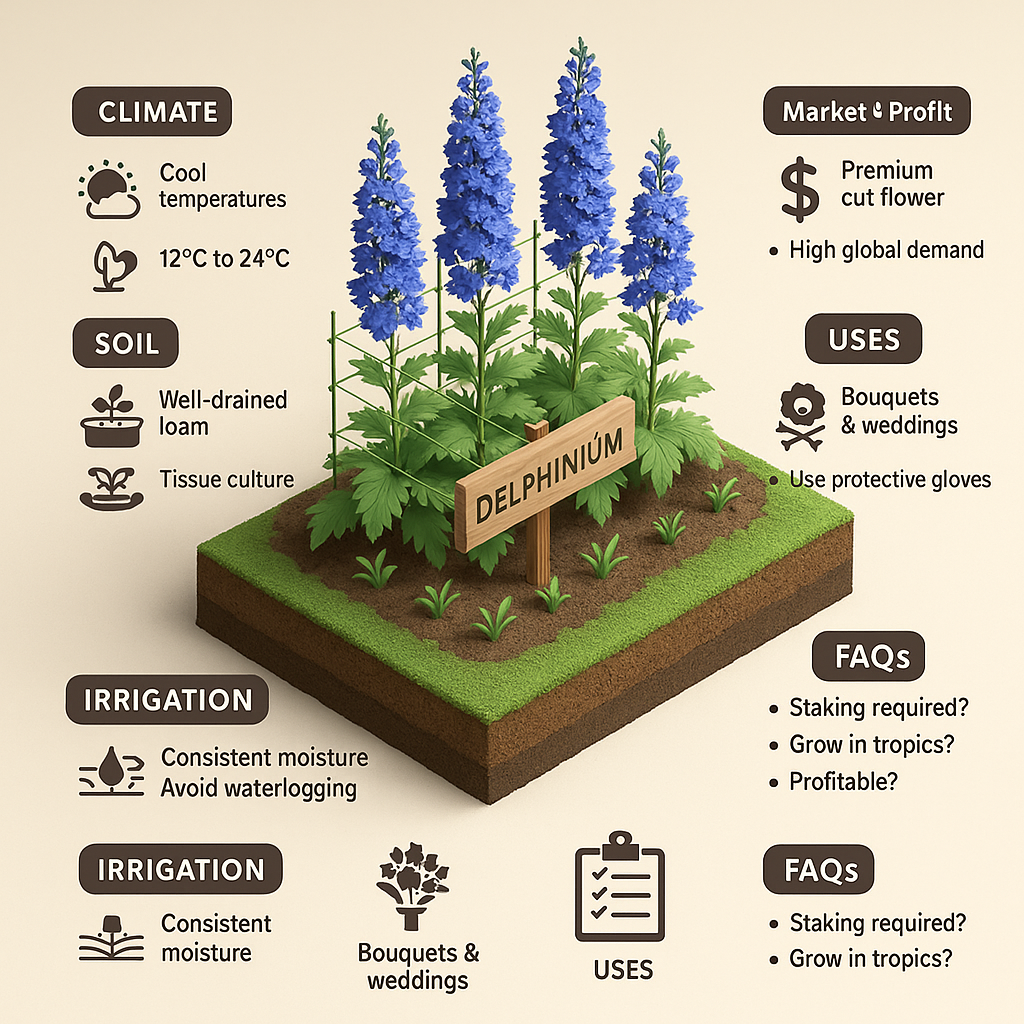
Ideal temperature range: 12°C to 24°C.
High heat stresses the plant, while warm nights reduce spike length and color strength.
Regions with natural cool cycles—like New Zealand, Japan, northern India hills, Europe—produce the world’s finest Delphinium stems.
Greenhouses allow tropical countries to cultivate Delphinium by maintaining cool root zones, shade-diffused light, and controlled temperature during nights.
Wind damage is common, as spikes are tall and slender.
Commercial farms always use windbreaks.
Humidity should be moderate—high humidity triggers botrytis (gray mold).
SOIL REQUIREMENTS
The crop thrives in fertile, well-drained loamy soil with moderate organic content.
Heavy clay kills roots; sandy soil dries too quickly.
Optimum soil pH: 6.2 to 7.0
Farmers often prepare raised beds with deep loosening to support the plant’s taproot system.
Organic matter helps, but excessive nitrogen causes weak stems that bend before harvest.
Soil must remain moist but never wet.
Mulching reduces heat stress.
PROPAGATION METHODS
Delphinium is propagated by seeds, tissue culture, and basal cuttings.
Seed-grown Delphinium:
Used for large-scale production, but color uniformity varies.
Basal cuttings:
Premium method for producing identical clones of high-value varieties.
Tissue culture stock:
Used by elite floriculture companies to ensure disease-free planting.
Seed germination needs low temperatures—many farmers pre-chill seeds.
PLANTING, SPACING & SUPPORT
Plants require spacing of 30–45 cm, depending on the cultivar.
Double-row beds help create dense canopy support.
Stake systems or netting are essential.
Commercial growers run multi-layer netting at 30, 60, and 90 cm heights.
Without proper staking, spikes bend or snap before blooming.
IRRIGATION MANAGEMENT
Delphinium is extremely sensitive to inconsistent watering.
Roots prefer cool, moist conditions.
Drip irrigation is ideal.
Overhead watering increases fungal disease.
Water stress leads to short spikes and fewer florets.
During spike formation, consistent moisture is essential.
During early growth, water is moderate, preventing shallow root development.
NUTRIENT MANAGEMENT
Delphinium demands balanced nutrition.
Farmers avoid excess nitrogen because it weakens stem strength.
A typical nutrient strategy includes:
Moderate nitrogen in early vegetative stage
High phosphorus for bud initiation
High potassium for spike formation
Calcium to strengthen stems
Magnesium for deep-coloured florets
Organic growers use compost teas and seaweed extract to improve spike uniformity.
PEST & DISEASE MANAGEMENT
Delphinium attracts pests such as aphids, thrips, mites, and leaf miners.
Botrytis and powdery mildew are major diseases in humid climates.
Ventilation, moderate humidity, and morning irrigation reduce risk.
Crop rotation prevents soil diseases.
Commercial farms sterilize soil with solarization or biofungicides.
FLOWERING & HARVESTING
Delphinium produces its first spikes in 90–120 days.
Harvest occurs when florets at the bottom third of the spike are open.
Early harvest results in poor opening.
Late harvest reduces vase life.
Stems must be cut early morning and hydrated immediately.
Grading depends on spike length:
60 cm – basic
80 cm – standard
100+ cm – premium
120–150 cm – export grade
Ice-water pre-cooling improves post-harvest life.
GLOBAL MARKET ANALYSIS (USD)
Delphinium is a premium cut-flower category, with strong demand in:
USA
Japan
Netherlands
Italy
Australia
UAE
Price ranges:
0.40–1.50 USD per stem wholesale
2–6 USD retail
High-end varieties fetch 8–10 USD in peak seasons
Greenhouse-grown premium spikes command highest rates due to uniformity.
BUSINESS OPPORTUNITIES
Delphinium supports multiple income streams:
Cut-flower export
Seed production
Basal cutting sales
Greenhouse contracts
Event & wedding floristry
Hybrid breeding programs
High-end bouquet supply
Farmers with cool climates or controlled greenhouses earn consistently high profits.
USES OF DELPHINIUM
Used in:
Luxury bouquets
Wedding arches
Church decorations
Hotel arrangements
Corporate events
Landscaping borders
Floral stage designs
Color variety makes it essential in premium floral studios.
HEALTH BENEFITS & PRECAUTIONS
Not edible; mildly toxic if ingested.
Handled with gloves in some countries due to skin sensitivity.
However, Delphinium contributes to psychological well-being through aesthetic impact.
COST & PROFIT ANALYSIS (USD)
Per-acre establishment cost: 1,500–4,000 USD
Returns: 8,000–20,000 USD, depending on market access
Greenhouse farms earn significantly more, especially in export categories.
10 FAQS WITH SHORT, CLEAR ANSWERS
What climate does Delphinium need?
Cool, mild temperatures between 12°C–24°C.
Does it require staking?
Yes, tall spikes collapse without support.
Can Delphinium grow in tropical regions?
Yes, only in greenhouses or high-altitude zones.
What soil is best?
Well-drained loam with moderate organic matter.
How long till it flowers?
Around 90–120 days.
Is seed propagation reliable?
Good for mass production, but color variation occurs.
How often should it be watered?
Keep soil consistently moist but never waterlogged.
Why do spikes bend?
Excess nitrogen, lack of staking, or poor light.
What is the export demand like?
Very high in Japan, USA, and Europe.
Is Delphinium profitable?
Yes, especially greenhouse-grown premium spikes.
CONCLUSION
Delphinium farming represents the perfect blend of beauty, science, and commercial opportunity. Its tall spikes and dramatic colors keep it permanently in demand within the global cut-flower industry. With careful climate control, proper nutrition, staking, and disease management, Delphinium becomes one of the most profitable premium flowers for farmers worldwide.
✍️Farming Writers Team
Love farmer Love farmings