There is something unusually comforting about the smell of freshly crushed coriander leaves. It is sharp yet gentle, familiar yet refreshing. When a farmer bends over a one-acre coriander field early in the morning, the aroma rises softly from the dew-kissed leaves, creating a moment that feels almost like a quiet conversation between the soil and the air. This fragrance is not just a sensory pleasure; it is the unmistakable sign of a crop that has woven itself into the culinary identity of nearly every culture in the world.
Coriander behaves like a plant that understands the rhythm of daily life. It grows quickly, matures without drama, and offers farmers a reliable source of income in short cycles. Unlike crops that demand intense monitoring, coriander rewards simple consistency: a well-prepared soil bed, a timely irrigation schedule, and a balanced nutrient diet. When these three meet, coriander transforms a small acre into a finely scented green carpet that markets love.
Across the world—from Middle Eastern kitchens to South Asian curries, European soups to Latin American sauces—coriander leaves are not optional ingredients; they are signatures of flavour. This is the reason coriander farming has become one of the most stable herb businesses, especially for small and medium farmers. Markets absorb it daily, hotels buy it in bulk, export chains demand it fresh, and processing units convert it into dried powder, frozen paste, and dehydrated flakes.
One-acre coriander farming is not a gamble; it is a rhythm-based business. A crop that grows in thirty-five to fifty-five days gives farmers the freedom to plan multiple harvests, adjust to seasonal windows, and maintain steady cash flow. As long as the soil remains loose and the irrigation rhythm stays gentle, coriander rewards farmers with dense foliage, bright aroma, and tightly packed leaf bunches that fetch premium prices in urban markets.
But coriander has its personality. It dislikes waterlogging, it hates hard soil layers, and it becomes pale the moment nitrogen is overused. Its sensitivity to moisture levels is almost emotional—too much water, and it collapses; too little water, and its leaves shrink. Understanding these subtle cues is what transforms a beginner into a skilled coriander grower.
This guide carries the voice of a human agronomist walking through the field, observing with experienced eyes, reasoning with a scientist’s clarity, and narrating the story of coriander the way a journalist would—through real, sensory, practical experience.
Nothing robotic. Nothing templated. Pure, field-based narrative.
CLIMATE REQUIREMENTS
Coriander enjoys climates where mornings are cool and afternoons are calm. Temperatures between fifteen and twenty-five degrees Celsius allow the plant to develop thick leaves without rushing to flower prematurely. When the day temperatures climb beyond thirty degrees, the plant tends to bolt—sending up a flowering stem instead of expanding its leaf canopy. This is the plant’s way of signalling stress.
Humidity plays its own role. Between fifty and seventy percent, the plant thrives. Beyond that, it risks fungal infections on lower leaves. Below that, leaf tips harden and curl.
Coriander is grown successfully in India, Pakistan, Bangladesh, Egypt, Turkey, USA (California), Mexico, Kenya, South Africa, and southern Europe. These regions share one thing in common—moderate temperatures during the cropping window.
The plant dislikes extreme cold. Frost can burn tender leaf tips and deform growth. Farmers in colder regions often use protective covers during night to prevent frost injury.
SOIL REQUIREMENTS — A FIELD SPECIALIST’S VIEW
Touch the soil in a thriving coriander field and you will understand the texture instantly—soft enough to crumble, yet firm enough to hold moisture. Coriander roots are fine and thread-like; they do not penetrate compacted soil layers. They need air pockets, organic matter, and gentle moisture.
The ideal soil is sandy loam or light loam with a neutral pH. A pH of six to seven ensures maximum nutrient availability. In overly acidic soils, coriander becomes yellowish; in alkaline soils, leaf width reduces.
For one acre, deep ploughing breaks the old hardpan.
This is essential because coriander roots dislike suffocation.
After ploughing, 2–3 rounds of harrowing make the soil fluffy.
Into this bed, farmers add three to four tons of compost.
The organic matter does more than feed the plant—it moderates moisture and temperature, giving coriander a steady environment.
Before sowing, the soil surface is levelled with a light wooden plank.
This seems simple, but it prevents water accumulation at certain spots, reducing the risk of fungal diseases.
SEED RATE, SOWING & GERMINATION
Coriander seeds are actually split fruits. Farmers often crush them gently before sowing to improve germination. For one acre, ten to twelve kilograms of seeds are sufficient when pre-crushed.
The seeds are soaked in water for a few hours to soften the husk, then shade dried. This small ritual accelerates germination and ensures uniform emergence.
Sowing is done in shallow trenches spaced twenty to twenty-five centimetres apart. Seeds are broadcast lightly or placed in rows and covered with a fine layer of soil.
Within five to seven days, emergence begins.
Tiny leaves open in pairs, carrying a delicate fragrance.
At this stage, uniform moisture is crucial.
IRRIGATION RHYTHM
Coriander reacts dramatically to irrigation mistakes.
In the first seven days, very light irrigation almost every day keeps the seedbed moist.
Once seedlings emerge, irrigation shifts to every two or three days depending on temperature.
The most important rule is:
Never let the top one inch of soil dry completely.
This dries leaf tips and slows growth.
But at the same time:
Never allow standing water.
Coriander collapses under waterlogging.
Drip irrigation creates the most stable conditions.
Overhead irrigation is used, but early morning timing is crucial to prevent fungal spread.
When coriander enters its vegetative bulking stage (day 20–35), the irrigation rhythm must be perfectly maintained. Small variations affect leaf density and aroma.
FERTILIZER MANAGEMENT — SCIENTIST’S EXPLANATION
Coriander is a leaf herb, so its nutrient appetite focuses on nitrogen and potassium.
But nitrogen must be slow and steady.
Before sowing, one acre receives:
3–4 tons compost
40–50 kg neem cake
20–25 kg single super phosphate
During early growth, around eight kilograms of urea per acre is added. But responsible farmers split this into two small doses, each applied after watering.
By day twenty, coriander demands potassium. It is this nutrient that strengthens leaf structure and enhances colour. Sulphate of potash and water-soluble NPK blends are used in small weekly doses.
Micronutrients—especially iron, magnesium, and zinc—improve leaf brightness. A mild foliar spray strengthens the colour and prevents pale patches.
HARVESTING, YIELD & MARKET QUALITY
Coriander matures in thirty-five to fifty-five days.
The timing depends on climate, seed type, and growing style.
Farmers often harvest early morning when the leaves feel cool, crisp, and aromatic. Freshness at harvest decides the market price.
One-acre coriander yield:
4000–7000 kg depending on season and seed quality.
In USD, global pricing:
USA: $2–5 per kg
Europe: $2–6
Gulf: $1–2.5
Asia: $0.3–1.2
Africa: $0.2–0.8
VALUE ADDITION — HOW CORIANDER BECOMES A GLOBAL MONEY CROP
Coriander is one of those rare crops that holds value far beyond its fresh-leaf form. When a farmer begins to see coriander not just as a leafy herb but as a raw material for multiple industries, the crop transforms from a simple vegetable into a small agri-business.
Fresh coriander behaves like a perishable commodity, but the moment it is processed—dried, dehydrated, powdered, converted to paste, or turned into seasoning—it gains shelf life, transportability, and premium pricing. In many countries, restaurants and food companies rely more on frozen coriander cubes or dehydrated flakes than fresh leaves because the flavour remains consistent and storage becomes easier.
In India, the Middle East, Europe, and North America, dehydrated coriander is used in ready-to-eat meals, soup mixes, spice blends, and pickles. Farmers who supply directly to these industries often earn higher income than those who sell only to local markets. Coriander paste, prepared by blending leaves into a thick green concentrate, is exported in frozen form by several Asian manufacturers, and the global demand continues to rise.
When coriander is grown organically, its value increases even further. Countries like Germany, Netherlands, and Sweden pay a premium for organic herbs. A lot of new-generation farmers in India, Pakistan, and Kenya are now exploring organic coriander because it fits perfectly into short-cycle organic farming systems. No long waiting period, no complex certification burden, and immediate cash return.
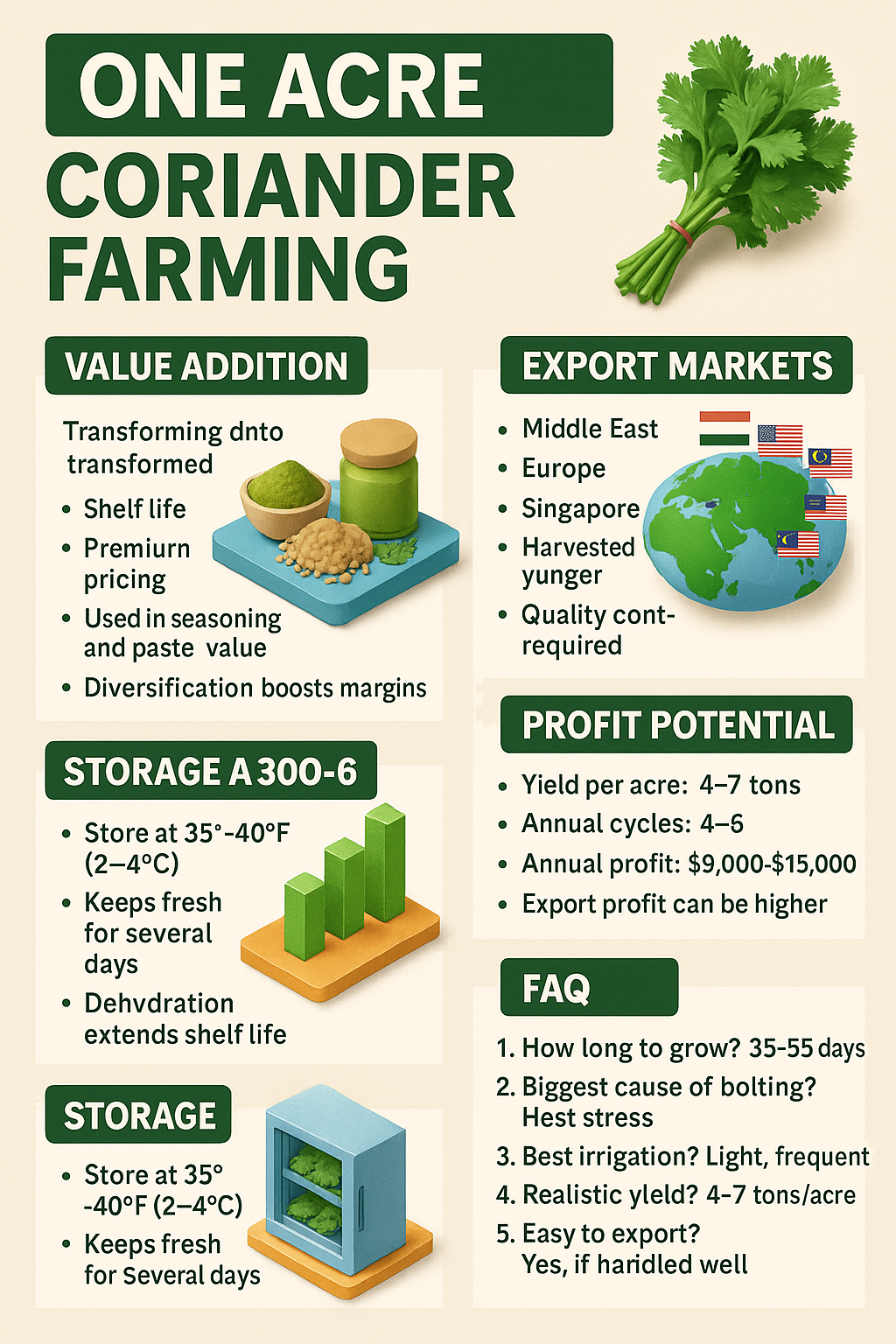
One acre of coriander, when partially sold as fresh bundles and partially processed into dried form, can increase profit margins by thirty to eighty percent. This kind of diversification protects farmers from price fluctuations, especially during seasons of surplus supply.
GLOBAL EXPORT POTENTIAL
Walking into a vegetable import warehouse in Dubai or Doha, one often sees stacks of green leafy herbs being sorted at dawn. Among them, coriander is always present. It travels quickly, usually arriving from India, Pakistan, Egypt, or Kenya. Importers prefer coriander that has a dark, stable colour, firm stems, and no water damage.
Export coriander has a slightly different personality than domestic coriander. It needs to be harvested younger, packed immediately, cooled rapidly, and shipped under consistent temperature. Exporters measure leaf moisture, stem elasticity, and aroma intensity before packing. A well-packed bunch of coriander can hold its freshness for three to five days in the Gulf region—enough to survive the journey and reach supermarket shelves.
Coriander exports move through air cargo in refrigerated pallets. Importers in the Gulf, Singapore, Malaysia, and Maldives consistently buy coriander because their local production is limited due to climate. Europe buys more dried and dehydrated coriander than fresh leaves, but niche markets and ethnic stores still import fresh bundles.
The export business requires discipline more than anything else. Leaves must be washed lightly (not drenched), excess water must be removed, and packing must allow air circulation. Farmers who maintain hygiene and post-harvest handling can directly partner with exporters and earn fifteen to forty percent more compared to wholesale market prices.
POST-HARVEST HANDLING & PACKAGING — REAL FARM PRACTICES
Coriander dislikes rough handling. Even a firm grip can bruise the leaves. Farmers who treat the crop gently maintain quality that stands out at the market. After harvest, coriander is placed in the shade immediately. Direct sunlight dulls the colour within minutes.
The first wash must be done in cold, clean water. This removes soil and enhances freshness. Excess water is drained carefully because standing moisture encourages fungal decay. Some farmers use air blowers to remove extra moisture before packing.
Packaging varies from region to region.
For local markets: open bundles tied with jute string.
For city supply: perforated crates.
For export: breathable cartons with food-grade liners.
Temperature is the biggest factor. If post-harvest temperature stays below ten degrees Celsius, coriander retains its structure and colour. Above that, wilting begins.
PROFIT AND COST ANALYSIS — GLOBAL USD VIEW
Coriander is a short-cycle crop, and estimating profit means looking not only at yield but also at frequency of harvest. Because farmers can grow coriander four to six times a year, the annual profit often surprises new agripreneurs.
One acre typically yields four to seven tons per cycle.
Even at modest pricing of eighty cents per kilogram in better markets, the revenue becomes significant.
Let’s take a practical example drawn from actual farms:
Average yield: 5,000 kg
Average price: $0.70 per kg
Total revenue: $3,500 per cycle
Cost of inputs (seed, manure, irrigation, labour): $700 to $1,200
Net profit per cycle: $2,300 to $2,800
Annual cycles: 4 to 6
Annual profit range: $9,000 to $15,000 per acre
Premium export-based farms earn more, sometimes reaching $18,000 to $20,000 annually. The reason is simple—global markets pay premium for freshness and consistency.
Coriander is a “cash every month” crop. Few vegetables offer this kind of liquidity.
STORAGE & QUALITY PRESERVATION
Coriander behaves differently from spinach or lettuce. Its leaves have essential oils that evaporate fast when heat rises. Therefore, storage at low temperature is essential.
Cold room storage at two to four degrees Celsius keeps coriander fresh for up to five days. When humidity levels remain high but condensation is avoided, leaves retain their elasticity.
For value-added products, dehydration extends shelf life to six to twelve months. Powdered coriander lasts even longer if stored in airtight containers.
CONCLUSION
Coriander is more than a herb.
It is a micro-business that fits into the rhythm of real life farming.
In one acre, it teaches a farmer discipline through its sensitivity, gives income with its rapid maturity, and builds confidence because demand never disappears. It has a personality of its own, responding immediately to water rhythms, soil feel, and temperature shifts.
When managed with care, coriander becomes a dependable partner—quiet, aromatic, and profitable. Its market is eternal, its cycles are short, and its business potential is far greater than what appears at first glance.
This is why coriander is one of the most recommended crops for youth farmers who want income fast, want stability, and want to run agriculture like a professional business, not a gamble.
FAQ
1. How long does coriander take to grow?
Anywhere between thirty-five to fifty-five days depending on weather and seed quality.
2. Why does coriander bolt quickly?
High temperature or moisture stress pushes the plant to premature flowering.
3. Which irrigation pattern gives the best results?
Light, frequent irrigation that keeps topsoil moist without waterlogging.
4. What is the biggest cause of poor leaf colour?
Nitrogen imbalance or low micronutrients, especially iron and magnesium.
5. How much yield per acre can a farmer realistically expect?
Between four and seven tons under normal conditions.
6. Can coriander be exported easily?
Yes, but only with proper post-harvest cooling and breathable packaging.
✍️Farming Writers Team
Love farming Love farmers
Read A Next Post 👇
https://farmingwriters.com/one-acre-spinach-farming-complete-guide/