For decades, urea has been treated as the backbone of crop productivity. Farmers across continents believe one simple idea: more urea means more yield. When crops look pale or weak, urea becomes the first response.
Yet the reality on farms worldwide is troubling. Despite rising urea consumption, crop yields have either stagnated or declined. Input costs increase, soil condition worsens, and plants become less responsive each season.
This is not coincidence. It is the result of a fundamental misunderstanding of how urea works in soil and how crops actually use nitrogen.
This article breaks the biggest fertilizer myth in modern agriculture and explains, in practical terms, why more urea is reducing yield instead of increasing it.
THE MYTH: UREA IS THE MOST EFFICIENT WAY TO FEED CROPS
Urea contains 46 percent nitrogen, making it the most concentrated nitrogen fertilizer. Because of this, it has been promoted aggressively worldwide. However, concentration does not equal efficiency.
Efficiency depends on:
soil ability to hold nitrogen
root capacity to absorb nitrogen
biological balance in soil
Ignoring these factors turns urea into a yield-destroying input.
HOW UREA ACTUALLY BEHAVES IN SOIL
Once applied, urea does not directly feed plants. It undergoes rapid chemical conversion:
Urea converts to ammonium
Ammonium converts to nitrate
Nitrate competes with soil water movement
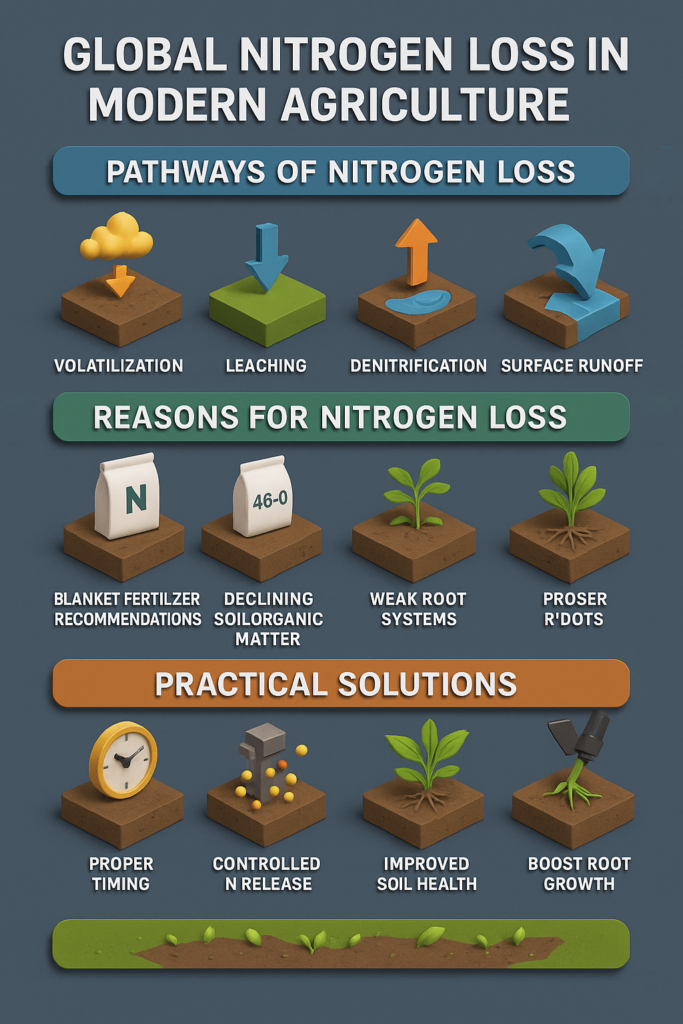
If this process happens faster than root uptake, nitrogen is lost.
In most modern soils, this conversion is too fast, creating nitrogen shock instead of sustained nutrition.
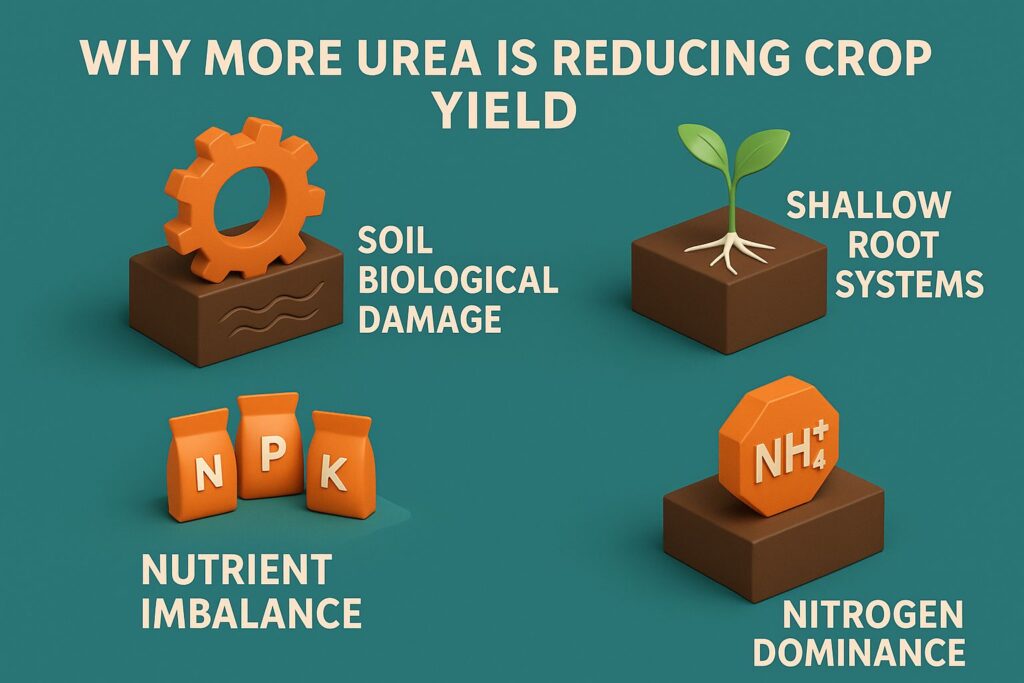
UREA OVERUSE AND SOIL BIOLOGICAL DAMAGE
Microbial Suppression
Excess urea disrupts soil microbial balance. Beneficial organisms decline, while harmful processes dominate.
Loss of Organic Matter
High nitrogen accelerates organic matter breakdown without replenishment, weakening soil structure.
Reduced Carbon Cycling
Healthy soil needs carbon–nitrogen balance. Urea-heavy systems push soils into carbon starvation.
ROOT DAMAGE CAUSED BY EXCESS UREA
Shallow Root Systems
Constant surface nitrogen discourages deep rooting. Plants stop exploring soil for nutrients.
Root Membrane Stress
High salt concentration from urea damages root cells, reducing nutrient absorption efficiency.
Poor Root–Microbe Interaction
Excess nitrogen suppresses mycorrhizal fungi essential for phosphorus and micronutrient uptake.
NUTRIENT IMBALANCE: THE HIDDEN YIELD KILLER
Urea-driven nitrogen dominance creates imbalance:
Nitrogen excess blocks potassium uptake
Calcium and magnesium availability drops
Micronutrient deficiencies appear
Crops may look green but remain physiologically weak and unproductive.
GLOBAL EVIDENCE OF THE UREA PROBLEM
Asia
Decades of urea dependence reduced soil carbon and yield response.
Europe
Strict fertilizer controls introduced after nitrate pollution crises.
North America
High nitrogen runoff zones show poor fertilizer efficiency.
Africa
Urea applied to low-carbon soils disappears rapidly, offering little yield benefit.
Different systems reveal the same truth: urea alone cannot sustain productivity.
WHY FARMERS KEEP APPLYING MORE UREA
Short-term visual greening effect
Low cost and easy availability
Lack of soil testing
Incomplete fertilizer education
The immediate green color misleads farmers into believing yield improvement, while damage continues underground.
THE REAL SOLUTION: BALANCED NUTRITION, NOT MORE UREA
Synchronize Nitrogen with Crop Demand
Split application and slow release reduce shock.
Rebuild Soil Organic Matter
Organic matter stabilizes nitrogen movement.
Strengthen Root Systems
Encourage deep rooting through balanced nutrients.
Restore Soil Biology
Microbial health determines nutrient efficiency.
Reduce Nitrogen Dominance
Urea must support crops, not control them.
LONG-TERM CONSEQUENCES OF CONTINUED UREA MISUSE
Rising fertilizer dependency
Declining soil fertility
Increased pest and disease pressure
Reduced climate resilience
Economic stress for farmers
Without correction, urea misuse locks farms into a cycle of rising cost and falling returns.
(FAQs)
FAQ 1: Is urea always harmful to crops?
No. Urea is harmful only when misused without soil balance.
FAQ 2: Why do crops turn green but yield remains low after urea application?
Greening reflects leaf nitrogen, not reproductive or root health.
FAQ 3: Does urea reduce soil fertility over time?
Yes, when overused without organic and biological balance.
FAQ 4: Can crops grow without urea?
Yes, with balanced nutrition and soil-based nitrogen management.
FAQ 5: Is urea use higher today than before?
Yes. Global urea consumption has increased faster than yield growth.
FAQ 6: Does urea affect root depth?
Excess urea promotes shallow root systems.
FAQ 7: Is nitrogen deficiency common or nitrogen mismanagement?
Most cases are mismanagement, not true deficiency.
FAQ 8: Does urea increase pest pressure?
Excess nitrogen produces soft tissues attractive to pests.
FAQ 9: Can reducing urea improve yield?
Yes, when combined with balanced nutrients and soil health restoration.
FAQ 10: What is the first step to reduce urea dependency?
Soil testing and understanding crop nitrogen demand.
CONCLUSION
Urea is not the enemy of agriculture, but blind dependence on it is. The belief that higher nitrogen equals higher yield has damaged soils, roots, and long-term productivity worldwide. Sustainable farming begins when nitrogen becomes a controlled input rather than a dominant force.
True yield improvement does not come from more urea, but from better soil, stronger roots, and balanced nutrition.
This post establishes the foundation of the Fertilizer Truth Series, exposing myths and replacing them with field-verified agricultural reality.
✍️ Farming Writers Team
Love farming Love Farmers.
Read A Next Post 👇
https://farmingwriters.com/root-system-failure-modern-soils-nutrient-uptake/