There is a particular sound you hear when you walk into a cucumber field just after sunrise. It is not silence, and it is not noise either. It is the soft brushing of broad leaves against each other, a kind of living whisper that tells you the field is growing fast. Cucumbers are impatient crops. They do not wait to announce themselves. Unlike carrots that hide underground or onions that mature slowly, cucumbers express everything on the surface leaf size, vine length, flower health, fruit load, water stress. For a farmer, cucumbers feel like farming in real time.
Across the world, cucumber behaves like a universal vegetable with local accents. In Europe, long straight cucumbers dominate shelves, glassy and uniform. In Asia, shorter, tender cucumbers sell daily in open markets. In the Middle East, crunchy thick varieties move fast in hotels and restaurants. In Africa, cucumbers grow aggressively in heat, demanding water discipline. In North America, both slicing and pickling cucumbers form their own powerful markets. This adaptability makes cucumber one of the most reliable one-acre vegetables for quick income, especially for young farmers who want to see results within weeks, not months.
One acre of cucumber farming begins with understanding speed. Cucumbers are fast by nature. They germinate quickly, spread rapidly, flower early, and fruit within a short window. This speed is both their strength and weakness. If irrigation slips for even a few days, fruit shape changes. If nutrition is delayed, flowers drop. If humidity stays trapped, disease overtakes the vine before the farmer notices. Successful cucumber farming is about staying one step ahead rather than reacting late.
Soil sets the temperament of the crop. Cucumbers love loose, warm, well-drained soil that allows roots to breathe and stretch. When a farmer presses cucumber soil in his palm, it should hold briefly and then fall apart softly. Heavy clay soils trap water, suffocate roots, and invite rot. Very sandy soils dry too fast, stressing vines. The best cucumber soils sit somewhere in between, rich with organic matter that holds moisture gently rather than aggressively. Compost mixed during land preparation does not just feed the crop; it stabilizes the entire soil ecosystem for rapid root expansion.
Climate plays a loud role in cucumber success. Cucumbers adore warmth but protest against extremes. In mild warm weather, vines grow with enthusiasm, leaves remain broad and healthy, and flowers convert smoothly into fruits. Excessive heat causes flower shedding. Cold nights slow growth and invite fungal trouble. This is why cucumber seasons across the world align with moderate warmth — spring, early summer, or winter in tropical regions. Farmers who choose the wrong season fight the climate continuously. Those who choose the right window ride along with it.
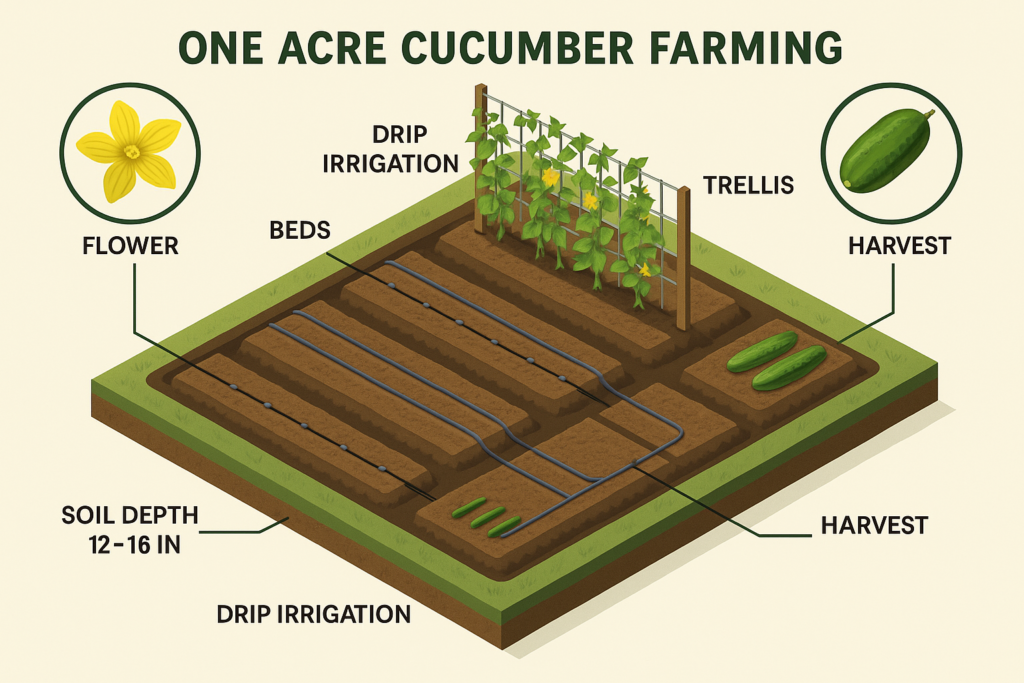
Sowing cucumbers is an act of optimism. The seeds are larger than most vegetables, firm between fingers, carrying visible energy. Whether planted directly or transplanted from nursery, cucumbers respond quickly to good placement. Direct seeding remains common because cucumbers dislike root disturbance. Farmers create raised beds, making sure drainage is perfect, especially in regions where sudden rains arrive. A seed placed at the correct depth emerges confidently, its cotyledons opening like two green hands greeting the world.
Within days, the field transforms from bare soil into lines of young vines. This stage demands discipline. Weeds grow faster than cucumber seedlings initially, and competition at this stage permanently reduces yield. Early field cleanliness decides the final fruit count. Farmers who maintain clean beds early enjoy smoother seasons later.
Irrigation becomes the pulse of cucumber farming almost immediately. Cucumbers are water-loving plants, but they hate waterlogging. Roots demand moisture, but leaves resent constant wetness. This balance makes drip irrigation ideal. Water delivered directly to the root zone keeps vines hydrated while leaves remain dry, reducing disease risk. In traditional irrigation systems, farmers water early morning, never late evening, allowing foliage to dry during daylight.
As vines stretch and leaves expand, the field begins to look alive in a very visible way. Leaves overlap, forming a canopy that shades soil and conserves moisture naturally. This canopy is both a blessing and a risk. While it helps retain moisture, it can trap humidity if airflow is poor. Farmers often guide vines gently, spacing them to allow breathing room. In trellised cucumber systems, vines climb upward, improving air movement and producing straighter fruits that fetch premium prices in supermarkets.
Flowering arrives early in cucumbers and continues relentlessly. Male flowers appear first, followed by female flowers identifiable by a tiny fruit already forming behind the bloom. This is one of cucumber’s miracles — the fruit announces itself before pollination even finishes. Pollination quality decides fruit shape. Poor pollination leads to curved or misshapen cucumbers. In open fields, bees play a major role. In protected systems, farmers encourage airflow or gentle vibration to assist pollination.
Nutrition in cucumbers demands balance. Excess nitrogen produces massive leaves but fewer fruits. Insufficient potassium weakens fruit firmness and shelf life. Cucumbers enjoy steady feeding rather than heavy doses. Farmers read the vines like text. Pale leaves signal hunger. Thick dark leaves with poor flowering signal imbalance. Fruits that taper sharply indicate stress. Everything shows on the surface.
Cucumber pests arrive quietly but spread fast. Aphids cluster under leaves, sucking energy. Whiteflies disturb vines and spread viruses. Thrips scar leaf surfaces and flowers. Fruit flies attack mature cucumbers in some regions. Farmers who walk their fields daily notice pest presence early, long before damage becomes visible to outsiders. The most effective pest management begins with observation, not spraying.
Disease pressure follows humidity. Powdery mildew coats leaves with white residue in dry yet humid conditions. Downy mildew strikes in cooler, damp weather, yellowing leaves rapidly. Angular leaf spot appears after rainstorms. These diseases thrive in stagnant air. Fields with open spacing, balanced irrigation, and healthy nutrition suffer far less. Cucumbers punish neglect but forgive quickly if conditions improve.
Harvesting cucumbers feels almost continuous. Unlike crops harvested once, cucumbers demand regular picking. Each harvest encourages new fruit set. Delayed harvesting slows vine productivity. Farmers harvest early morning when fruits are cool, crisp, and hydrated. A mature cucumber snaps cleanly from the vine, firm but not hard, glossy but not over-grown. Overgrown fruits steal energy from the plant and reduce overall yield.
The first harvest always excites farmers. The field suddenly turns profitable early in the season, offering immediate cash flow. This quick return is why cucumbers remain popular with small and youth farmers across continents. The plant gives back quickly to those who care consistently.
Yields vary with system and management.
Low-input fields produce around 8–10 tons per acre.
Well-managed open fields reach 12–18 tons.
Trellised or protected systems exceed 20–25 tons.
Exceptional commercial farms push even higher.
Global cucumber prices remain relatively stable because daily demand never disappears.
USA: $0.8–2.5/kg
Europe: $1.0–3.0/kg
Middle East: $0.6–2.0/kg
Asia: $0.2–1.0/kg
Africa: $0.1–0.5/kg
Profit per acre reflects season and market proximity.
Average profit ranges from $2,000 to $4,000.
Peak-season or off-season cucumber fetches $5,000–$7,000.
Protected cultivation pushes profits even further.
Cucumber farming teaches speed combined with sensitivity. It teaches farmers to react early, observe constantly, and respect rhythm. Miss a few days, and the crop shows disappointment. Stay attentive, and it rewards generously.
Standing in a healthy cucumber field during peak harvest feels energizing. The vines continue growing, flowers continue opening, fruits continue forming. The field does not pause. It asks for attention every day and promises return every day.
One acre of cucumbers is not a waiting game.
It is an active conversation between farmer, vine, soil, and weather.
And for those who listen carefully, it speaks the language of quick success.
✍️Farming Writers Team
Love Farming Love Farmers
Read A Next Post 👇
https://farmingwriters.com/one-acre-carrot-farming-complete-global-guide/