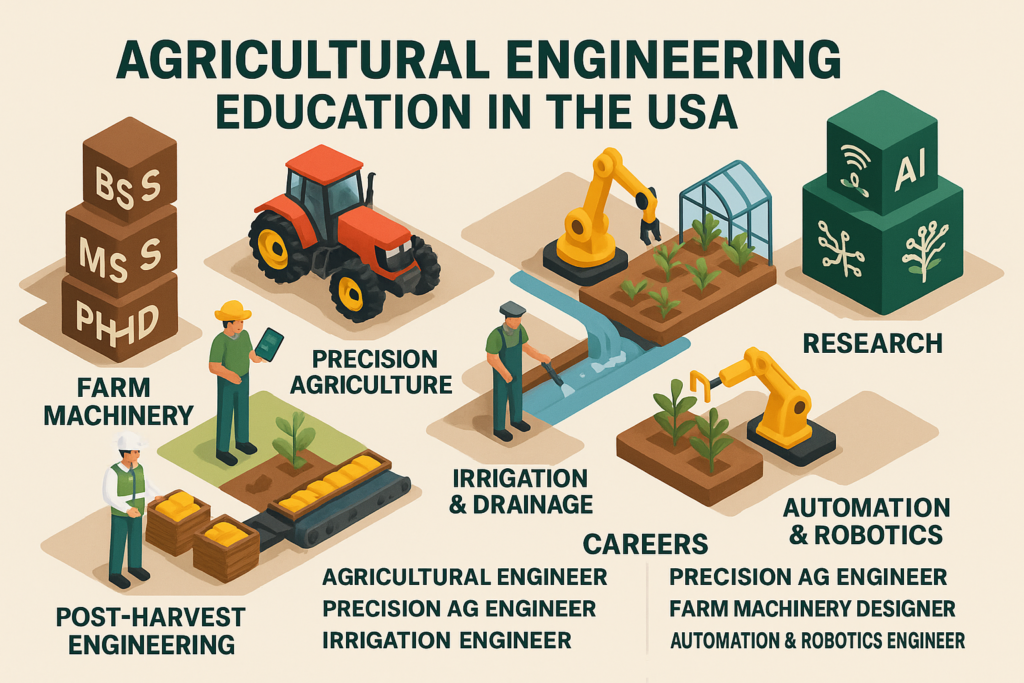
Agricultural Engineering is one of the most technology-intensive branches of farming education in the United States. It connects traditional agriculture with modern engineering disciplines such as mechanical engineering, electrical systems, data analytics, robotics, water engineering and environmental systems. The US agricultural sector relies heavily on advanced machinery, automation, sensors, irrigation engineering and precision technologies, making agricultural engineers indispensable.
Unlike basic farm mechanization training, agricultural engineering education in the USA focuses on designing, optimizing and managing complex agricultural systems. Students are trained to develop machines, build irrigation and drainage systems, apply digital technology to farming, improve energy efficiency and support environmentally sustainable food production.
This article provides a complete and original overview of agricultural engineering education in the United States, including degree pathways, university programs, research areas, farm machinery training, career scope, salary expectations and opportunities for international students.
- Role of Agricultural Engineering in US Agriculture
Agricultural Engineering supports almost every major farming activity in the United States, including:
Large-scale crop production
Precision farming and automation
Farm machinery design and testing
Irrigation and drainage systems
Greenhouse and controlled-environment agriculture
Post-harvest handling and storage
Renewable energy for farms
Environmental protection and waste management
Data-driven farm decision systems
Because US farms operate on large land holdings with advanced infrastructure, engineering knowledge is essential for efficiency and profitability.
- Structure of Agricultural Engineering Education
Agricultural engineering is typically offered as Agricultural and Biological Engineering (ABE) or Biosystems Engineering within engineering colleges.
Undergraduate Programs (BS Agricultural Engineering / BS Agricultural & Biological Engineering)
Core subjects usually include:
Engineering mathematics
Engineering mechanics
Thermodynamics
Fluid mechanics
Farm machinery and equipment
Tractor systems and power transmission
Irrigation and drainage engineering
Soil–machine interaction
Precision agriculture systems
Sensors and instrumentation
GPS, GIS and remote sensing
Agricultural robotics
Energy systems in agriculture
Post-harvest engineering
Environmental engineering basics
Undergraduates receive hands-on training in:
Farm machinery labs
Tractor testing units
Precision agriculture labs
Irrigation design labs
Greenhouse engineering systems
CAD and simulation software
Field demonstration farms
Graduate Programs (MS Agricultural Engineering / MS Biosystems Engineering)
Graduate-level programs emphasize specialization and applied research. Key tracks include:
Precision agriculture engineering
Farm automation and robotics
Irrigation and water resources engineering
Controlled-environment agriculture
Agricultural energy systems
Machine design and optimization
Sensor-based crop monitoring
Environmental and waste engineering
Students work on research projects, industry-linked designs and engineering simulations.
Doctoral Programs (PhD Agricultural Engineering)
Doctoral research focuses on innovation and system design, including:
Autonomous farm machinery
AI-based crop sensing
Robotics for harvesting
Smart irrigation algorithms
Energy-efficient farm systems
Climate-resilient engineering
Post-harvest loss reduction
Carbon-neutral farm technology
PhD graduates often lead advanced research programs or industry innovation teams.
- Top Universities for Agricultural Engineering in the USA
The United States has globally respected agricultural engineering departments:
Purdue University
Iowa State University
University of Illinois Urbana-Champaign
Texas A&M University
University of California, Davis
Ohio State University
North Carolina State University
University of Nebraska–Lincoln
Kansas State University
Michigan State University
These universities operate:
Advanced machinery labs
Precision farming test fields
Automation and robotics labs
Irrigation technology centers
Energy and biofuel units
Industry collaboration facilities
- Major Research Areas in Agricultural Engineering
Agricultural engineering research in the USA covers cutting-edge technology areas.
Farm Machinery and Automation
Design and testing of tractors, harvesters, planters and automated equipment.
Precision Agriculture
Use of sensors, GPS, drones, satellites and AI for input optimization.
Irrigation and Drainage Engineering
Designing efficient water-use systems and drainage networks.
Agricultural Robotics
Autonomous machines for planting, weeding and harvesting.
Controlled-Environment Engineering
Greenhouse design, climate control systems and vertical farming structures.
Post-Harvest Engineering
Storage, drying, cooling and handling of agricultural produce.
Renewable Energy Systems
Solar, biogas and biofuel solutions for farms.
Environmental and Waste Engineering
Manure management, waste recycling and pollution mitigation.
- Practical Training and Industry Exposure
Agricultural engineering students gain practical experience through:
Machinery operation and testing
CAD design projects
Precision agriculture software training
Field sensor calibration
Irrigation system installation
Automation demonstrations
Industry internships
Farm-scale engineering trials
This ensures graduates are capable of real-world system implementation.
- Careers After Studying Agricultural Engineering
Graduates work in technology-driven roles across agriculture.
Career Roles
Agricultural engineer
Precision agriculture engineer
Farm automation specialist
Irrigation systems designer
Farm machinery engineer
Greenhouse systems engineer
Post-harvest technology specialist
Renewable energy engineer
Environmental systems engineer
Agricultural equipment consultant
- Salary Scope in the USA (USD)
Salaries vary based on specialization and experience:
Agricultural engineer: strong mid-to-high salary
Precision agriculture engineer: high demand, high pay
Irrigation engineer: stable and well-paid
Farm machinery designer: competitive industry salary
Robotics and automation engineer: high earning potential
Agricultural engineering is among the highest-paying agriculture-related careers in the USA.
- Opportunities for International Students
International students choose agricultural engineering in the USA because of:
Advanced laboratories
Industry-linked research
Engineering accreditation standards
Internship opportunities
Global recognition of degrees
Strong employability worldwide
Graduates often contribute to farm mechanization and precision agriculture globally.
- Admission Requirements
Strong background in mathematics and physics
High school science (for BS programs)
Bachelor’s degree in engineering/agriculture (for MS)
TOEFL/IELTS for international students
Academic transcripts
Statement of Purpose
Letters of recommendation
Research interest (for PhD)
(FAQs)
- What is agricultural engineering?
It applies engineering principles to farming systems, machinery, irrigation and technology. - Is agricultural engineering a good career in the USA?
Yes. It offers high salaries, strong demand and growth potential. - Do agricultural engineers work on farms?
They work on farms, in labs, manufacturing units and technology firms. - Which university is best for agricultural engineering?
Purdue University and Iowa State University are global leaders. - Is programming used in agricultural engineering?
Yes. Data analysis, automation and AI tools are increasingly important. - Can international students study agricultural engineering?
Yes. Many US universities accept international engineering students. - Is agricultural engineering different from mechanical engineering?
Yes. It specializes in agriculture-specific systems and environments. - Are internships compulsory?
Most programs strongly recommend or require internships. - What industries hire agricultural engineers?
Machinery manufacturers, agritech firms, irrigation companies and research institutes. - What is the future of agricultural engineering?
Automation, robotics, AI and climate-smart farm systems.
Conclusion
Agricultural engineering education in the United States merges engineering excellence with modern farming needs. By combining machinery design, precision technology, data systems and sustainability principles, these programs prepare professionals who drive the future of agriculture. With strong industry demand, high salary potential and global relevance, agricultural engineering is a cornerstone of modern farming education in the USA.
✍️ Farming Writers Team
Love farming Love Farmers
Read A Next Post 👇
https://farmingwriters.com/fisheries-aquaculture-education-usa/