• Global Nitrogen Efficiency Complete Scientific Farming Guide to Reduce Loss & Increase Yields

    Global Nitrogen

    This article delivers a comprehensive world-level explanation of nitrogen efficiency, the science behind fertilizer loss, crop absorption physiology, soil nitrogen pathways, environmental risk factors, and advanced strategies for reducing nitrogen waste. It is written to serve researchers, agronomists, fertilizer companies, progressive farmers, and global agricultural policymakers. The central aim is to demonstrate how nitrogen transitions through soil systems, why traditional urea fails to achieve efficiency, how slow-release and controlled-release fertilizers can transform productivity, and how global agricultural systems can rebuild nutrient balance.

    INTRODUCTION

    Nitrogen is the primary determining nutrient of crop productivity across global agriculture. It influences crop color, vegetative development, grain filling, photosynthesis rate, biomass accumulation, and root expansion. Out of all essential nutrients, nitrogen is the most demanded and the most mismanaged. The majority of countries—whether developed or developing—face the same challenge: nitrogen loss far exceeds nitrogen uptake.

    Worldwide agricultural data shows that nitrogen-use efficiency (NUE) commonly ranges between 28% and 40%, meaning more than half of the nitrogen applied through fertilizers is lost before crops can absorb it. This loss creates a chain reaction:

    declining soil quality

    increased farmer input cost

    lower crop yield potential

    ecological imbalances

    water contamination

    greenhouse gas emissions

    This article provides a deep scientific breakdown that helps agriculture professionals understand how nitrogen behaves in soil, how plants absorb it, why efficiency is low, and what global solutions are now emerging.

    1. UNDERSTANDING THE GLOBAL NITROGEN PROBLEM

    1.1 The Nitrogen Paradox

    Nitrogen is abundant in the atmosphere, yet crops cannot use atmospheric nitrogen directly. They depend on reactive nitrogen forms:

    Ammonium (NH₄⁺)

    Nitrate (NO₃⁻)

    However, due to rapid conversion and soil limitations, these forms are unstable and escape the soil system.

    1.2 Global Nitrogen Loss Data

    Scientific estimates show:

    Volatilization: 20–35% loss

    Leaching: 15–30% loss

    Runoff: 5–10%

    Denitrification: 10–25%

    Combined, more than half the applied nitrogen never reaches crops.

    1.3 Why This Loss Occurs Everywhere

    Nitrogen is mobile. It escapes through water, air, microbes, or chemical reactions. Even rainfed African soils and irrigated American fields share similar patterns of inefficiency.

    1. THE SCIENCE OF NITROGEN IN SOIL

    2.1 Key Transformations

    When urea enters soil, it undergoes processes:

    Hydrolysis → Ammonium

    Nitrification → Nitrate

    Volatilization or leaching

    Root uptake or microbial immobilization

    Every stage has associated loss risks.

    2.2 Soil Texture & Nitrogen Movement

    Sandy soils allow deep leaching

    Clay soils immobilize nitrogen temporarily

    Loam soils provide balanced retention

    2.3 Microbial Influence

    Soil microbes determine the fate of nitrogen. When microbial populations decline due to excessive fertilizers, nitrogen-transforming processes become unstable.

    1. WHY FARMERS APPLY EXCESS NITROGEN

    3.1 Visual Response Misleads Yield Expectations

    Crops respond quickly to excess N by turning dark green. Farmers misinterpret this as better yield.

    3.2 Broadcasting Habit and Cultural Practices

    Decades of tradition have normalized over-application.

    3.3 Lack of Soil Testing

    Most regions still use blanket fertilizer recommendations regardless of organic matter, rooting depth, or soil microbial health.

    1. GLOBAL SOLUTIONS TO IMPROVE NITROGEN USE EFFICIENCY

    4.1 Controlled-Release Fertilizers

    These fertilizers deliver nitrogen at a controlled pace that synchronizes with plant demand.

    4.2 Nitrification Inhibitors

    Compounds that slow down the activity of Nitrosomonas bacteria, reducing nitrate formation and leaching.

    4.3 Split Application Techniques

    Instead of applying the full dose at once, nitrogen is added at critical crop stages.

    4.4 Integration with Organic Matter

    Organic matter improves nitrogen retention and reduces volatilization.

    4.5 Root Growth Enhancement

    Stronger roots = higher nitrogen absorption.

    1. GLOBAL CASE STUDIES

    USA — Corn Belt

    Farmers using slow-release N achieved 15–18% NUE improvement.

    Brazil — Soybean & Sugarcane

    Integrated nutrient management programs increased yield stability across regions.

    India — Mandatory neem coating improved national NUE at scale.

    Europe — Strict nitrogen regulations reduced environmental impact but demand precision application.

    1. ROLE OF TECHNOLOGY IN N-EFFICIENCY

    satellite-guided N-mapping

    digital soil analytics

    AI nitrogen prediction models

    real-time chlorophyll meters

    root-zone nutrient sensors

    1. FUTURE OF GLOBAL NITROGEN

    7.1 Climate-Smart Agriculture

    Better nitrogen management is essential for reducing global emissions.

    7.2 Regenerative Agriculture

    Soil biology restoration directly improves nitrogen retention.

    7.3 New Fertilizer Chemistry

    Polymer coatings, microbial N boosters, and bio-stimulant-supported N systems are rising.

    1. TEN PRACTICAL RECOMMENDATIONS

    Adopt slow-release nitrogen sources

    Increase soil organic matter

    Avoid unnecessary top-dress applications

    Irrigate immediately after applying N

    Use soil testing for dosage

    Promote deeper rooting

    Reduce urea dependency

    Monitor nitrogen via crop sensors

    Improve drainage in heavy soils

    Reduce chemical overload on microbial populations

    FAQ (10 QUESTIONS)

    1. Why is nitrogen loss so high worldwide?

    Because nitrogen is unstable in soil and reacts quickly with air, water, and microbes.

    1. Does more urea mean more yield?

    No. Excess nitrogen weakens crop structure and reduces efficiency.

    1. Can nitrogen efficiency reach above 70%?

    Yes, but only with controlled-release fertilizers and strong soil biology.

    1. Which crops suffer most from nitrogen loss?

    Cereals like rice, wheat, and maize.

    1. What is the safest nitrogen application method?

    Split dosing with soil incorporation.

    1. How does root depth affect nitrogen use?

    Deeper roots absorb more nitrogen and reduce leaching.

    1. Why do some soils lose nitrogen faster than others?

    Texture, rainfall, organic matter, and microbial activity cause differences.

    1. Can organic farming solve nitrogen loss?

    It reduces loss but cannot meet global nitrogen demand alone.

    1. Is nitrate harmful for water?

    Yes, high nitrate levels cause health risks and ecological damage.

    1. What is the fastest way to improve NUE?

    Switching to controlled-release or inhibitor-based fertilizers.

    CONCLUSION

    Nitrogen efficiency is not a localized issue; it is a global agricultural cornerstone. Without improving nitrogen management, farming systems will face declining productivity, rising costs, and severe ecological consequences. With scientific nitrogen strategies, modern agriculture can achieve sustainability and yield stability simultaneously.

    ✍️ Farming Writers Team
    Love farming Love Farmers.

    Read A Next Post 👇

    https://farmingwriters.com/why-more-urea-reduces-crop-yield-worldwide/
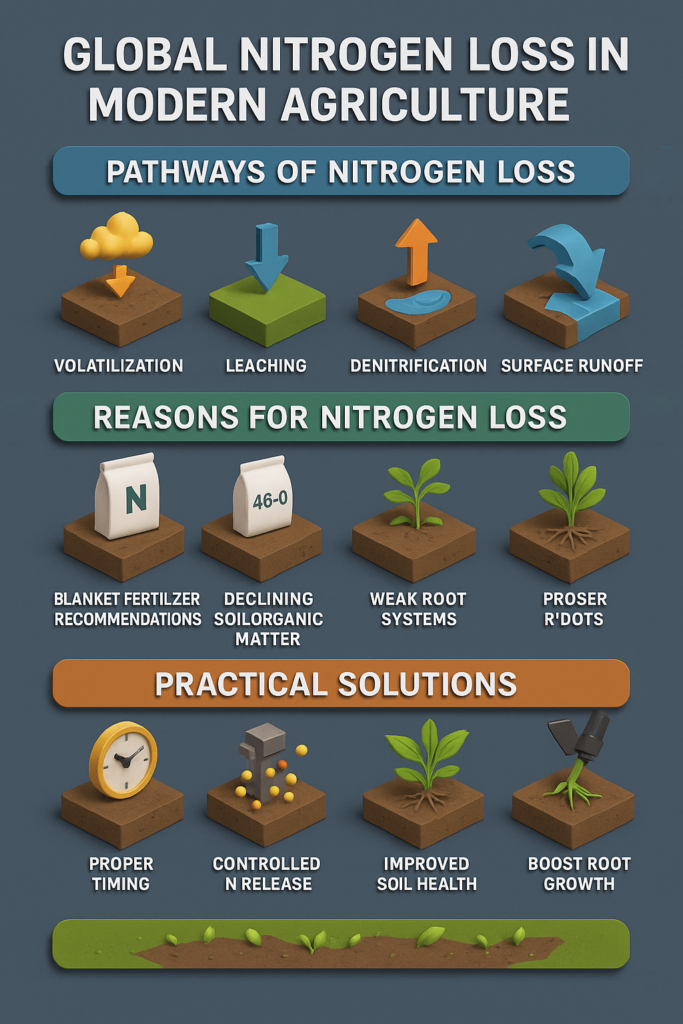
  • Global Nitrogen Loss Crisis in Modern Agriculture: Causes, Soil Science, Yield Impact & Practical Solutions

    Global Nitrogen Loss

    INTRODUCTION: THE INVISIBLE CRISIS DESTROYING FARM PROFITABILITY

    Across the world, farmers share a common experience. Fertilizer use has increased year after year, yet crop response has weakened. Yields no longer rise in proportion to input costs. Fields appear green at first, but productivity remains stagnant.

    This is not an isolated regional issue. It is a global nitrogen loss crisis affecting almost every farming system on the planet.

    Nitrogen is the most important nutrient for crop growth. It drives leaf development, photosynthesis, and biomass formation. For decades, nitrogen fertilizers helped agriculture achieve massive yield gains. However, the same nitrogen has now become inefficient, unstable, and economically damaging when mismanaged.

    This article explains why nitrogen is being lost before crops can use it, why applying more fertilizer worsens the problem, and how farmers worldwide can regain nitrogen efficiency through practical, soil-centered solutions.

    WHAT IS NITROGEN LOSS AND WHY IT MATTERS

    Nitrogen loss means nitrogen exits the soil-plant system without entering the crop. Studies across continents show that only 30–40 percent of applied nitrogen is actually absorbed by crops. The remaining portion is lost to air, water, or immobilized beyond root reach.

    This loss matters because:

    Farmers pay for fertilizer that crops never use

    Soils degrade over time

    Water and air pollution increase

    Yields stagnate despite higher investment

    Nitrogen loss is both an economic failure and an ecological failure.

    MAJOR PATHWAYS OF NITROGEN LOSS

    Volatilization

    Nitrogen converts into ammonia gas and escapes into the atmosphere, especially when urea is surface-applied in warm, alkaline conditions.

    Leaching

    Nitrate nitrogen dissolves easily in water and moves downward beyond root zones, common in sandy soils and high rainfall regions.

    Denitrification

    In waterlogged or compacted soils, microbes convert nitrate into nitrogen gases that escape into the air.

    Surface Runoff

    Nitrogen moves with irrigation or rainfall across the soil surface instead of entering the root zone.

    Each pathway is controlled by soil structure, moisture, temperature, and management practices.

    WHY MODERN AGRICULTURE FAILED TO CONTROL NITROGEN

    Blanket Fertilizer Recommendations

    Uniform fertilizer guidelines ignore site-specific soil conditions, crop histories, and climate variations. This leads to overuse in some areas and inefficiency in others.

    Overdependence on Soluble Nitrogen

    Fast-acting fertilizers release nitrogen rapidly, overwhelming soil systems that cannot retain or regulate nutrient flow.

    Declining Soil Organic Matter

    Organic matter acts as nitrogen storage. Globally, soil organic carbon levels are declining, leaving nitrogen vulnerable to loss.

    Mechanization Without Precision

    Mechanized agriculture increased speed but often reduced accuracy. Poor placement and timing increase nitrogen escape.

    THE ROLE OF SOIL IN THE NITROGEN CRISIS

    Soil is not an inert medium. It actively controls nitrogen behavior.

    Soil Texture

    Sandy soils lose nitrogen rapidly

    Clay soils lose nitrogen under poor aeration

    Balanced soils still suffer if organic matter is low

    Soil pH

    Alkaline soils increase volatilization

    Acidic soils reduce nitrogen uptake

    Neutral soils perform best

    Soil Compaction

    Compacted soils restrict oxygen, accelerate denitrification, and limit root access to nitrogen.

    Ignoring soil health converts nitrogen fertilizer into a short-lived input rather than a productive resource.

    ROOT SYSTEM FAILURE: THE MISSING LINK

    Modern farming often feeds soil without building roots.

    Shallow Root Development

    Excess surface nitrogen discourages deep root growth. Crops become dependent on topsoil nutrients only.

    Timing Mismatch

    Nitrogen release often peaks when roots are not fully developed, leading to loss instead of uptake.

    Biological Disconnection

    High nitrogen suppresses beneficial microbes that support nutrient transfer, weakening root-soil synergy.

    A weak root system guarantees nitrogen loss, regardless of fertilizer quantity.

    GLOBAL EXPRESSIONS OF THE NITROGEN LOSS CRISIS

    South Asia

    Heavy urea use, flood irrigation, and warm climates cause severe volatilization and leaching.

    Europe

    Groundwater nitrate contamination forced strict fertilizer regulations.

    North America

    Runoff from large farms pollutes rivers and lakes, reducing nitrogen efficiency.

    Africa

    Low organic matter and sandy soils allow nitrogen to disappear rapidly after application.

    Different regions, same underlying failure: nitrogen moves faster than roots can absorb it.

    WHY MORE FERTILIZER MAKES YIELDS WORSE

    When yields decline, farmers apply more nitrogen. This creates a destructive cycle:

    Excess nitrogen harms soil biology

    Roots weaken

    Nitrogen loss increases

    Yield response declines

    Fertilizer use rises again

    This cycle explains why fertilizer bills increase while productivity remains flat.

    PRACTICAL SOLUTIONS TO THE GLOBAL NITROGEN LOSS CRISIS

    Improve Application Timing

    Split applications aligned with crop growth stages improve absorption.

    Strengthen Soil Organic Matter

    Crop residues, compost, and cover crops stabilize nitrogen.

    Use Controlled Nitrogen Release

    Slowing nitrogen availability improves synchronization with root demand.

    Restore Root Health

    Balanced nutrition, aerated soils, and reduced compaction increase uptake.

    Make Soil-Based Decisions

    Soil testing and site-specific management replace guesswork with precision.

    LONG-TERM BENEFITS OF SOLVING NITROGEN LOSS

    Higher and stable yields

    Lower fertilizer costs

    Improved soil structure

    Cleaner water and air

    Greater climate resilience

    Nitrogen efficiency determines the future profitability of farming worldwide.

    FREQUENTLY ASKED QUESTIONS (FAQs)

    FAQ 1: Why do crops respond poorly even after applying recommended nitrogen doses?

    Because a large portion of nitrogen is lost through volatilization, leaching, or denitrification before roots can absorb it.

    FAQ 2: Is nitrogen loss higher today than in traditional farming systems?

    Yes. Traditional systems had higher organic matter and slower nutrient release, reducing losses naturally.

    FAQ 3: Does soil type really influence nitrogen efficiency?

    Yes. Sandy soils leach nitrogen quickly, while poorly drained soils lose nitrogen through denitrification.

    FAQ 4: Why does adding more urea sometimes reduce yield?

    Excess urea damages soil biology, weakens roots, and creates nutrient shock, lowering long-term productivity.

    FAQ 5: Is irrigation a major driver of nitrogen loss?

    Yes. Poor irrigation management accelerates both leaching and denitrification.

    FAQ 6: How does low organic matter increase nitrogen loss?

    Without organic carbon, soil cannot retain nitrogen, allowing it to move freely out of the root zone.

    FAQ 7: Can nitrogen loss be reduced without increasing fertilizer cost?

    Yes. Proper timing, soil health improvement, and root-focused management often reduce losses without extra expense.

    FAQ 8: Is nitrogen loss only an environmental issue?

    No. It directly reduces farm profitability by increasing input costs without yield gains.

    FAQ 9: Does climate affect nitrogen loss patterns?

    Yes. Heat, rainfall, and moisture conditions strongly control nitrogen behavior.

    FAQ 10: What is the first step to improving nitrogen efficiency?

    Understanding soil condition through testing and observation is the foundation of effective nitrogen management.

    CONCLUSION

    The global nitrogen loss crisis is not caused by insufficient fertilizer supply. It is caused by soil degradation, weak root systems, and careless nutrient management. Increasing fertilizer input without restoring soil function is unsustainable and economically damaging.

    Future yield improvement depends on controlling nitrogen behavior, synchronizing nutrient release with root demand, and rebuilding soil systems that retain nutrients instead of losing them.

    This post establishes the foundation for the Global Farming Problems → Practical Solutions series, where future articles will address soil recovery, root science, and fertilizer truth in depth.

    ✍️ Farming Writers Team
    Love farming Love Farmers.

    Read A Next Post 👇

    https://farmingwriters.com/neem-coated-urea-complete-guide/