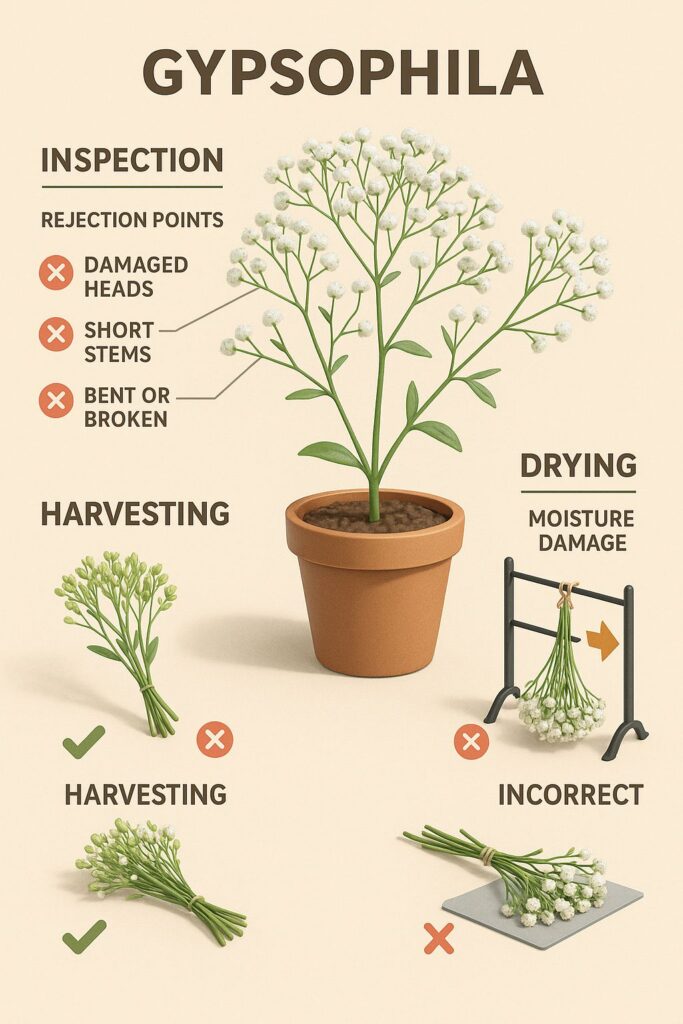
Gypsophila is often described as an “easy flower.” It grows fast, looks delicate, and sells everywhere. Florists use it as filler, exporters bundle it with roses, and wedding designers depend on it for softness and volume. From the outside, it appears almost risk-free. This perception is exactly why Gypsophila becomes a loss-making crop for many first-time growers.
The truth is not that Gypsophila is difficult to grow. The truth is that it is easy to grow and very hard to sell well.
Fields full of white clouds don’t guarantee income. In many regions, Gypsophila growers harvest healthy-looking stems only to see them rejected days later due to stem weakness, moisture damage, or poor post-harvest behavior. Loss doesn’t happen at planting. It happens at grading, transport, and buyer inspection. That’s why farmers often don’t realize where things went wrong.
Where Gypsophila actually belongs — and where it fails silently
Gypsophila’s natural strength is dry air with consistent sunlight. Regions with low humidity, cool nights, and good airflow allow the plant to form firm stems and stable flower clusters. This is why high-quality Gypsophila comes reliably from specific zones in Colombia (high altitudes), Kenya, parts of Ecuador, southern Spain, and controlled greenhouse systems in Europe.
In humid open-field environments, Gypsophila develops a hidden weakness. Flowers look fine during harvest but collapse quickly after cutting. Moisture trapped between tiny florets causes browning, fungal specks, and rapid wilting. These defects show up after packing, which is the worst possible time.
Many farmers misread this as a market issue. In reality, it is a climate–post-harvest mismatch.
Soil fertility helps growth, not market quality
Gypsophila reacts strongly to soil fertility, especially nitrogen. Rich soils produce lush foliage and fast height. This creates an illusion of success. But excessive nitrogen weakens stem walls and increases water content inside tissues. Stems bend during handling, and flowers bruise easily.
Experienced growers deliberately avoid aggressive fertilization. They aim for controlled stress. Strong Gypsophila comes from balanced soil, not rich soil. Yield-focused farming almost always clashes with quality-focused marketing in this crop.
The stem problem buyers don’t forgive
Buyers care about three things:
stem strength, uniformity, and post-harvest life.
Gypsophila loses value quickly when stems vary in thickness or collapse under their own flower mass. Even minor bending leads to grade reduction. Unlike focal flowers, filler flowers are not forgiven for small defects. They are replaced instantly.
This makes Gypsophila one of the most rejected flowers in mixed bouquets. Farmers who don’t understand this reality often assume lower prices are “normal.” They are not. They reflect rejection risk.
Harvest timing decides profit, not yield
Gypsophila harvested slightly too early looks green and unfinished. Harvested too late, it drops petals and browns internally. The correct window is narrow, and it changes with temperature and humidity.
This is where generic advice fails. “Harvest when flowers are open” is meaningless. What matters is how the flowers behave after hydration and transport. The only reliable way to learn this is by tracking post-harvest survival, not field appearance.
Farmers who never evaluate their flowers two days after shipping never see their real problem.
Fresh market vs dried market confusion
Gypsophila is used in both fresh and dried markets, but growing for both without clarity usually damages results.
Fresh-market Gypsophila requires firm stems and controlled moisture.
Dried Gypsophila demands low humidity during harvest and drying.
Trying to serve both from the same field often leads to compromise quality. Successful growers choose one path early. Mixed strategies increase rejection risk unless drying infrastructure is professional-grade.
The pricing illusion
Gypsophila looks profitable on paper because stem prices appear steady. What lists don’t show is how much volume never sells at full grade. Net profit depends on acceptance rate, not farm output.
Small farmers without direct buyers often sell through agents at reduced grades. This makes Gypsophila risky as a primary income crop unless market access is already secured.
Why experienced growers still plant it
Despite its risks, Gypsophila remains important. When grown in the right climate with strict harvest discipline, it offers steady demand and repeat buyers. Exporters value its versatility. Landscape and wedding markets rely on it consistently.
The difference is discipline. Not effort, not land size discipline.
10 FAQs
Why is Gypsophila rejected so often?
Because stem strength and moisture control are frequently overlooked.
Is Gypsophila suitable for humid regions?
Only with protected cultivation and strong post-harvest handling.
Does high yield mean good profit?
No. Acceptance rate matters more than volume.
Is it beginner-friendly?
Only if market access and climate suitability are already confirmed.
Why do flowers fail after packing, not in the field?
Internal moisture damage appears late, not during growth.
Can it be grown organically?
Yes, but disease control becomes more complex.
Is drying safer than fresh sales?
Only when humidity during harvest is low.
Why do buyers downgrade stems quickly?
Because filler flowers must support other blooms structurally.
Is greenhouse production better?
Yes, where climate control is reliable.
Who benefits most from this flower?
Growers with export links and strict quality control.
Final conclusion honest, not motivational
Gypsophila is not fragile, but it is unforgiving. It rewards growers who control moisture, respect harvest timing, and understand buyer behavior. It punishes those who measure success only by field appearance.
This article exists to prevent quiet losses the kind that don’t look like failure until accounting season arrives. That level of decision clarity, not optimistic advice, is what makes content genuinely useful and commercially trustworthy.
✍️ Farming Writers Team
Love Farming Love Farmers
Read A Next Post 👇
https://farmingwriters.com/statice-flower-farming-global-guide/