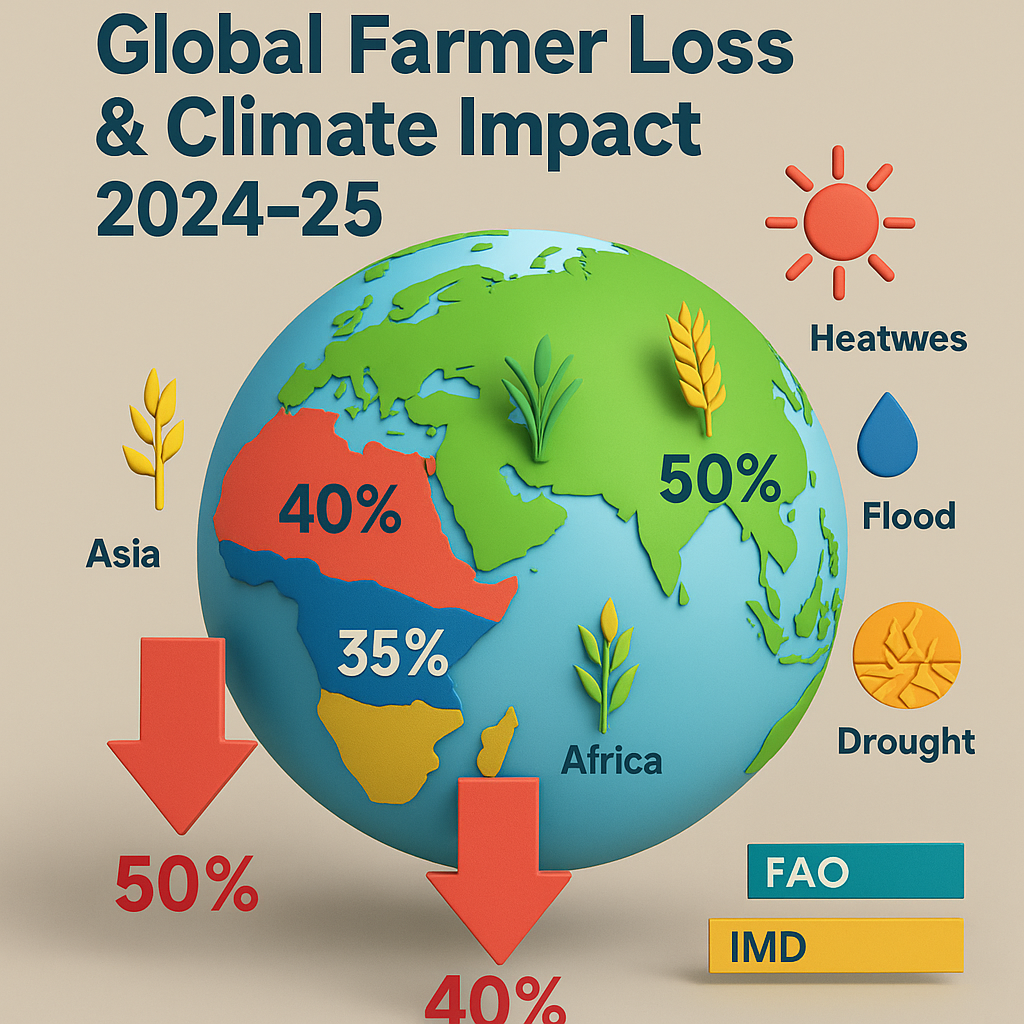
The latest global climate-risk assessment compiled by multiple agriculture authorities — including FAO, IMD, USDA and national weather agencies — indicates that 2024–25 has become one of the most damaging periods for farmers worldwide, with extreme heat, unexpected floods, prolonged droughts and rising input costs causing widespread crop losses, income decline and food-system stress.
1) Asia: Heatwaves, Dry Spells, and Groundwater Collapse
Asia 2024–25 me sabse zyada impact wala region raha. Authorities report:
North India, Pakistan & Bangladesh me winter dryness + heat spikes ne wheat aur mustard belts ko affect kiya.
Southeast Asia me El Niño ke effect ne paddy sowing delay ki.
China ke northern grain belts me groundwater depletion ne irrigation demand double kar diya.
Agriculture ministries ki field assessments ke mutabik, farmer income me 10–35% tak decline record hua.
2) Africa: Drought–Flood Cycle Destroying Crops
Africa me climate pattern unstable ho gaya hai:
East Africa me prolonged drought ne maize & sorghum yield ko damage kiya.
West Africa me sudden flooding ne groundnut, cassava aur millet fields ko wash-out kar diya.
Southern Africa me input cost inflation + dry spells ne small farmers ko heavy loss me dala.
FAO’s Africa desk ne warn kiya ke repeated climate shocks long-term food security ko risk me daal rahe hain.
Every sunrise paints the fields gold, whispering a truth the world often forgets — without farmers, life would collapse. Nations grow because farmers grow. Economies stand because fields stand. And humanity survives because farmers refuse to give up even when the world sleeps.
In the noise of modern life — offices, screens, traffic, deadlines — we sometimes fail to notice the hands that prepare the meal we eat, the grain we store, the fruits we enjoy, and the food that fuels our dreams.
Farmers are not ordinary people. They are Guardians of the Earth — the protectors of life, soil, culture, and the future.
This blog is for the entire world: for youth, for dreamers, for thinkers, and especially for those who believe agriculture is outdated. Farming is not behind; farming is ahead. It is the foundation of tomorrow’s prosperity.
1 The Future of Food Is the Future of the World
Every country, rich or poor, faces one universal truth: No food, no future.
Food security controls:
National strength
Global peace
Economic growth
Social stability
Human health
Politicians plan policies. Scientists invent technologies. Entrepreneurs build companies.
But none of them can survive without the farmer who produces food.
In the next 30 years, the global population will reach 9.7 billion. Who will feed them? Machines? No. Software? No. Apps? No.
Farmers modern, skilled, innovative farmers.
That’s why farming is the most future-proof profession on earth.
2Modern Farming Is Not Mud and Hardship It’s Smart, High-Tech, and Global
The farming of today is completely different from the farming of 30 years ago.
Modern agriculture uses:
Drones for field monitoring
Artificial intelligence for yield prediction
Mobile apps for soil testing
Satellite imagery for crop planning
Smart irrigation systems
Hydroponics and vertical farming
Bio-fertilizers
Climate-resistant seeds
Export-quality grading systems
Farming is no longer a low-income, labor-heavy job. It is a science. It is a startup opportunity. It is a global business.
Young people who love technology, business, and innovation can build empires in agriculture bigger than many tech companies.
3 Farmers Are the Strongest Problem-Solvers in the World
Every day, farmers solve problems that would overwhelm most people:
Weather uncertainty
Water scarcity
Soil challenges
Pest attacks
Market fluctuations
Rising input costs
Climate change shocks
Yet they continue to fight. A farmer’s courage is unmatched.
Where others see obstacles, farmers see possibilities.
A farmer is:
a scientist studying soil
an economist predicting markets
a meteorologist observing weather
a manager running operations
an engineer fixing equipment
a warrior facing uncertainty
This resilience makes farmers not only essential but extraordinary.
4Farmers Are the Earth’s First Environmentalists
Before the world started talking about “green living,” “sustainability,” and “climate responsibility,” farmers were already doing it.
Farmers:
save seeds
rejuvenate soil
conserve water
maintain biodiversity
plant trees
protect landscapes
grow life, not pollution
The planet survives because farmers care for it.
Climate change threatens the world — but it is farmers who hold the key to restoring balance. From regenerative farming to organic practices, the solutions to saving earth lie in the hands of farmers.
No climate summit can succeed without farmers. No environmental policy can function without agricultural support.
5Farming Teaches Lessons No School Can Teach
Schools teach subjects. Farming teaches life.
Farmers learn:
patience
timing
discipline
respect for nature
smart work
leadership
decision-making
responsibility
courage
faith
These are the values that build strong nations and strong generations.
When youth engage in farming, they don’t just grow crops — they grow character, resilience, and vision.
6 Why Youth Must Return to Agriculture
Farmers are aging. Global average farmer age:
Japan: 67
Europe: 57
USA: 58
India: 50+
If youth don’t return to farming, the world will face:
severe food shortages
dangerous inflation
increased imports
compromised food quality
unstable markets
But if youth choose agriculture, the world will see:
innovation
sustainability
high productivity
strong food security
new global farming leaders
The world doesn’t need more job seekers. It needs agri-entrepreneurs.
7Farming Is the Business of the Future — Not the Past
The biggest investors of the world are putting money into agriculture:
Organic supermarkets
Health food brands
Medicinal crops
Spices and herbs
Dry fruits
Aquaculture
Agri-tech apps
Farm automation
Global export platforms
Agriculture is the fastest growing business sector globally.
Why?
Because food demand never stops.
If you choose farming, you choose:
a stable market
rising demand
global customers
future-proof income
long-term wealth
land appreciation
There is no business more secure than feeding humanity.
8Farming Gives Peace, Freedom, and a Purposeful Life
In a world full of stress, pressure, and digital chaos, farming offers a lifestyle connected to nature, rhythm, and peace.
A farmer wakes up to the sound of birds, not office alarms. He works under open sky, not fluorescent lights. He grows real food, not virtual products. He contributes to society in the deepest way possible.
There is no greater peace than watching crops grow under your care. There is no greater purpose than feeding the world.
9 A Message to Every Farmer: You Are a Hero
To every farmer on this planet: You are a leader. You are a warrior. You are the past, the present, and the future of your nation.
You work when others rest. You take risks when others hesitate. You nourish the world through your sweat, strength, and faith.
The world stands because you stand.
10 A Message to Youth: Choose Farming, Choose Greatness
To the youth of every nation:
You can become a doctor, engineer, pilot, coder but if you become a farmer, you become a creator of life.
You don’t need permission to farm. You don’t need a degree to farm. You need courage, innovation, and the desire to make the world better.
Farming is not backward. Farming is not a last choice. Farming is the foundation of tomorrow’s world.
Those who control food will control the future. Be among them.
Conclusion
Farmers are more than workers — they are the backbone of civilization. They shape economies, protect the earth, and feed humanity.
The future will belong to those who respect the soil, understand nature, and grow life.
If the world needs heroes, it should look toward the fields. Because the real leaders of tomorrow will rise from the soil.
FAQs
Why are farmers important for the future? Because global food security, health, and environmental protection depend on strong farming systems.
Can farming be profitable for youth? Yes. Modern methods, organic farming, exports, and agritech have made farming extremely profitable.
Is agriculture still relevant today? More than ever. Rising population and climate change make farming crucial for all nations.
Can farming provide long-term financial stability? Yes. Land value increases, food demand rises, and agricultural businesses grow consistently.
Why should young people join farming? Because innovation, technology, and smart methods require fresh minds and new energy.
In today’s fast world, everyone talks about money, comfort, and luxury. People run behind careers, brands, success, and validation. But in this blind race, they forget the most important truth of life: money may help you live better, but food is what keeps you alive.
And food comes only from farming. Farming is not a low-status job. It is the foundation of human existence. Farmers do not just grow crops — they grow life, hope, and future.
A farmer wakes before sunrise, works under harsh weather, fights storms, droughts, and losses — yet continues without excuses. While the world sleeps comfortably, a farmer prepares food for millions. This silent strength is the greatest form of leadership.
Farming is built on faith, not guarantees. A farmer sows seeds without knowing if rain will come, if crops will survive, or if he will receive the right price. Yet he trusts the soil and works every day. This faith is something the world must learn.
Today’s society respects people with money, fame, and status. But the truth is simple: If farmers stop working for even 30 days, the world will collapse. Hospitals, schools, offices, markets — everything will stop because food will stop.
The real economy is not stock markets. The real economy is soil.
Most people think farming is backward or difficult, but modern agriculture is full of opportunities. Technologies like drones, sensors, AI-based irrigation, hydroponics, vertical farming, and organic cultivation are shaping a new world. Young people can build profitable, sustainable, and meaningful futures in farming.
In a world full of stress and anxiety, farming brings peace. Soil has healing power. Working with nature reduces mental pressure and increases emotional balance. Life in cities feels fast but empty; life in fields feels simple but meaningful.
The truth is clear: Farming is not the past — it is the future. Countries with strong agriculture will survive the next 50 years. Food security will decide the strength of nations. And farmers will become the heroes of the future.
Farmers do not ask for praise or fame. They ask only for respect and fairness.
Respect the hands that feed you. Support the people who give life to the world. And remember — The future belongs to farmers because the future belongs to food.
FAQ (Short)
Why is farming important today? Because food is the world’s greatest need and farming is its only source.
Why should youth join agriculture? Modern farming is profitable, tech-driven, and full of global opportunities.
What makes farmers inspirational? Their courage, patience, and ability to rise after every failure.
Is farming the future Yes food security will control the world in the coming decades.
In today’s world, people are running endlessly—behind money, luxury, status, and competition. Life has turned into a race where everyone is tired, stressed, and lost. But in this endless running, people forget one simple truth: money is important, but food is essential.
Food keeps the world alive. And food exists only because farmers exist.
Farming is not just work; it is a service to humanity. When a farmer wakes before sunrise, he does not work for himself—he works for millions who depend on him. Yet society often ignores him, undervalues him, and takes him for granted.
But the truth is clear: without farmers, modern life collapses in a single week.
A farmer sows seeds without any guarantee. He does not control the weather, the rain, or the market. Yet he continues with faith and courage. This silent faith is the greatest motivation the world can learn from.
People think strength is in power, fame, and wealth. But true strength is in a farmer’s ability to stand again after every failure—after drought, flood, storm, pests, or loss. Farmers fall, rise, and rebuild again. This is real courage.
Today’s youth sees farming as outdated or less rewarding. But the future says something else. As the world moves toward food shortages, climate crisis, and rising population, farming will become the most powerful industry.
What the world will need most in the coming years is not more apps or buildings, but more food and clean agriculture.
Modern farming is full of opportunities: organic farming, hydroponics, drones, agri-startups, smart irrigation, and vertical farming. Farming is no longer muscle work—it is brain work, innovation, and science.
In a world full of stress, farming offers peace. Soil heals the mind, reduces stress, and connects humans with nature. Farming is not a job; it is therapy.
The world must respect farmers—not with sympathy, but with dignity. They are not poor; they are powerful. They don’t ask for applause; they ask for fairness. Without them, there is no food, no economy, no life.
The future belongs to farmers, because the world’s survival depends on food, and food depends on farming.
FAQ (Short)
Why is farming important for the future?
Because food security will become the biggest global need in coming decades.
Why should youth join farming?
Modern farming offers high profit, innovation, technology, and sustainable career opportunities.
Why do farmers deserve more respect?
Because they feed the world, work without guarantees, and ensure humanity’s survival.
Is farming profitable today?
Yes, through organic farming, hydroponics, agri-business, and new technologies.
Why is farming better than a stressful city job?
farming motivation, importance of farming, why farming matters, future of farmers