This article delivers a comprehensive world-level explanation of nitrogen efficiency, the science behind fertilizer loss, crop absorption physiology, soil nitrogen pathways, environmental risk factors, and advanced strategies for reducing nitrogen waste. It is written to serve researchers, agronomists, fertilizer companies, progressive farmers, and global agricultural policymakers. The central aim is to demonstrate how nitrogen transitions through soil systems, why traditional urea fails to achieve efficiency, how slow-release and controlled-release fertilizers can transform productivity, and how global agricultural systems can rebuild nutrient balance.
INTRODUCTION
Nitrogen is the primary determining nutrient of crop productivity across global agriculture. It influences crop color, vegetative development, grain filling, photosynthesis rate, biomass accumulation, and root expansion. Out of all essential nutrients, nitrogen is the most demanded and the most mismanaged. The majority of countries—whether developed or developing—face the same challenge: nitrogen loss far exceeds nitrogen uptake.
Worldwide agricultural data shows that nitrogen-use efficiency (NUE) commonly ranges between 28% and 40%, meaning more than half of the nitrogen applied through fertilizers is lost before crops can absorb it. This loss creates a chain reaction:
declining soil quality
increased farmer input cost
lower crop yield potential
ecological imbalances
water contamination
greenhouse gas emissions
This article provides a deep scientific breakdown that helps agriculture professionals understand how nitrogen behaves in soil, how plants absorb it, why efficiency is low, and what global solutions are now emerging.
UNDERSTANDING THE GLOBAL NITROGEN PROBLEM
1.1 The Nitrogen Paradox
Nitrogen is abundant in the atmosphere, yet crops cannot use atmospheric nitrogen directly. They depend on reactive nitrogen forms:
Ammonium (NH₄⁺)
Nitrate (NO₃⁻)
However, due to rapid conversion and soil limitations, these forms are unstable and escape the soil system.
1.2 Global Nitrogen Loss Data
Scientific estimates show:
Volatilization: 20–35% loss
Leaching: 15–30% loss
Runoff: 5–10%
Denitrification: 10–25%
Combined, more than half the applied nitrogen never reaches crops.
1.3 Why This Loss Occurs Everywhere
Nitrogen is mobile. It escapes through water, air, microbes, or chemical reactions. Even rainfed African soils and irrigated American fields share similar patterns of inefficiency.
THE SCIENCE OF NITROGEN IN SOIL
2.1 Key Transformations
When urea enters soil, it undergoes processes:
Hydrolysis → Ammonium
Nitrification → Nitrate
Volatilization or leaching
Root uptake or microbial immobilization
Every stage has associated loss risks.
2.2 Soil Texture & Nitrogen Movement
Sandy soils allow deep leaching
Clay soils immobilize nitrogen temporarily
Loam soils provide balanced retention
2.3 Microbial Influence
Soil microbes determine the fate of nitrogen. When microbial populations decline due to excessive fertilizers, nitrogen-transforming processes become unstable.
WHY FARMERS APPLY EXCESS NITROGEN
3.1 Visual Response Misleads Yield Expectations
Crops respond quickly to excess N by turning dark green. Farmers misinterpret this as better yield.
3.2 Broadcasting Habit and Cultural Practices
Decades of tradition have normalized over-application.
3.3 Lack of Soil Testing
Most regions still use blanket fertilizer recommendations regardless of organic matter, rooting depth, or soil microbial health.
GLOBAL SOLUTIONS TO IMPROVE NITROGEN USE EFFICIENCY
4.1 Controlled-Release Fertilizers
These fertilizers deliver nitrogen at a controlled pace that synchronizes with plant demand.
4.2 Nitrification Inhibitors
Compounds that slow down the activity of Nitrosomonas bacteria, reducing nitrate formation and leaching.
4.3 Split Application Techniques
Instead of applying the full dose at once, nitrogen is added at critical crop stages.
4.4 Integration with Organic Matter
Organic matter improves nitrogen retention and reduces volatilization.
4.5 Root Growth Enhancement
Stronger roots = higher nitrogen absorption.
GLOBAL CASE STUDIES
USA — Corn Belt
Farmers using slow-release N achieved 15–18% NUE improvement.
Brazil — Soybean & Sugarcane
Integrated nutrient management programs increased yield stability across regions.
India — Mandatory neem coating improved national NUE at scale.
Europe — Strict nitrogen regulations reduced environmental impact but demand precision application.
ROLE OF TECHNOLOGY IN N-EFFICIENCY
satellite-guided N-mapping
digital soil analytics
AI nitrogen prediction models
real-time chlorophyll meters
root-zone nutrient sensors
FUTURE OF GLOBAL NITROGEN
7.1 Climate-Smart Agriculture
Better nitrogen management is essential for reducing global emissions.
Polymer coatings, microbial N boosters, and bio-stimulant-supported N systems are rising.
TEN PRACTICAL RECOMMENDATIONS
Adopt slow-release nitrogen sources
Increase soil organic matter
Avoid unnecessary top-dress applications
Irrigate immediately after applying N
Use soil testing for dosage
Promote deeper rooting
Reduce urea dependency
Monitor nitrogen via crop sensors
Improve drainage in heavy soils
Reduce chemical overload on microbial populations
FAQ (10 QUESTIONS)
Why is nitrogen loss so high worldwide?
Because nitrogen is unstable in soil and reacts quickly with air, water, and microbes.
Does more urea mean more yield?
No. Excess nitrogen weakens crop structure and reduces efficiency.
Can nitrogen efficiency reach above 70%?
Yes, but only with controlled-release fertilizers and strong soil biology.
Which crops suffer most from nitrogen loss?
Cereals like rice, wheat, and maize.
What is the safest nitrogen application method?
Split dosing with soil incorporation.
How does root depth affect nitrogen use?
Deeper roots absorb more nitrogen and reduce leaching.
Why do some soils lose nitrogen faster than others?
Texture, rainfall, organic matter, and microbial activity cause differences.
Can organic farming solve nitrogen loss?
It reduces loss but cannot meet global nitrogen demand alone.
Is nitrate harmful for water?
Yes, high nitrate levels cause health risks and ecological damage.
What is the fastest way to improve NUE?
Switching to controlled-release or inhibitor-based fertilizers.
CONCLUSION
Nitrogen efficiency is not a localized issue; it is a global agricultural cornerstone. Without improving nitrogen management, farming systems will face declining productivity, rising costs, and severe ecological consequences. With scientific nitrogen strategies, modern agriculture can achieve sustainability and yield stability simultaneously.
✍️ Farming Writers Team Love farming Love Farmers.
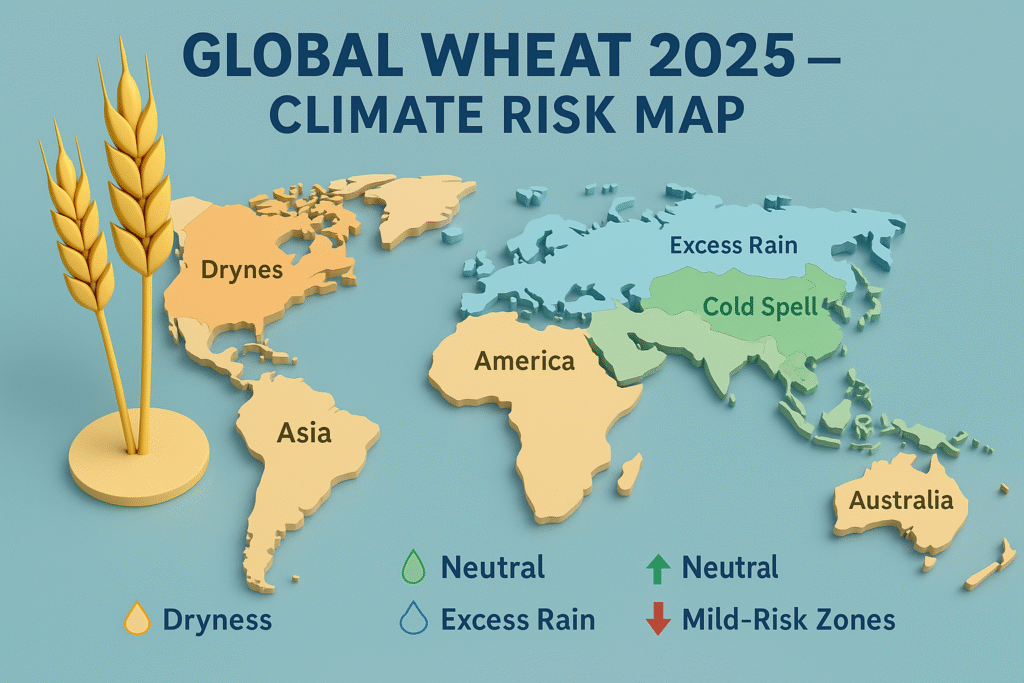
Global agricultural agencies monitoring crop conditions have warned that 2025 wheat production may face uncertainty, as several major producing regions report fluctuating temperatures, moisture stress and higher input costs. Early seasonal assessments indicate pressure on both output and farmer profitability.
North India, Pakistan and parts of Central Asia me winter sowing mostly stable rahi, lekin kuch regions me early dryness aur temperature swings se moisture stress dekha gaya.
Agriculture departments ka early estimate: timely sowing achchi rahi, par yield weather-dependent hogi.
Western Europe ke kai regions me heavy rain ne field access slow kiya.
Eastern Europe me cold spells ne growth tempo ko affect kiya.
Officials ka kehna hai: “Wheat crop ko stable conditions chahiye, warna output pressure aa sakta hai.”
North America: Temperature shifts affecting early-season projections
US Great Plains me temperature fluctuations record kiye gaye.
Moisture deficit kuch zones me concern create kar raha hai.
USDA-type trend monitoring ke mutabik: “Crop condition weather stabilization par depend karega.”
Australia: Low soil moisture remains a structural risk
Australia ke kai wheat-producing zones me water storage levels lower-than-normal condition me hain.
Agencies drought-resilient practices recommend kar rahi hain.
Market Insight:
Global traders cautious hai kyunki input cost (fertilizer, diesel, labour) high hai.
Agar 2025 me normal conditions nahi rahe, toh global wheat prices me mild-to-moderate volatility expected.
Ending / Outlook:
Agencies ek saath ye signal de rahi hain ki 2025 wheat output ka result climate stability par depend karega. Farmers ko advised kiya ja raha hai ki moisture management, seed variety selection aur risk-insurance coverage ko priority dein.
Sources Verified
Global Agriculture Monitoring Agencies – Seasonal wheat outlook
National Agriculture Departments – Sowing progress updates
FAO Crop Monitoring Units – Climate-linked risk indicators
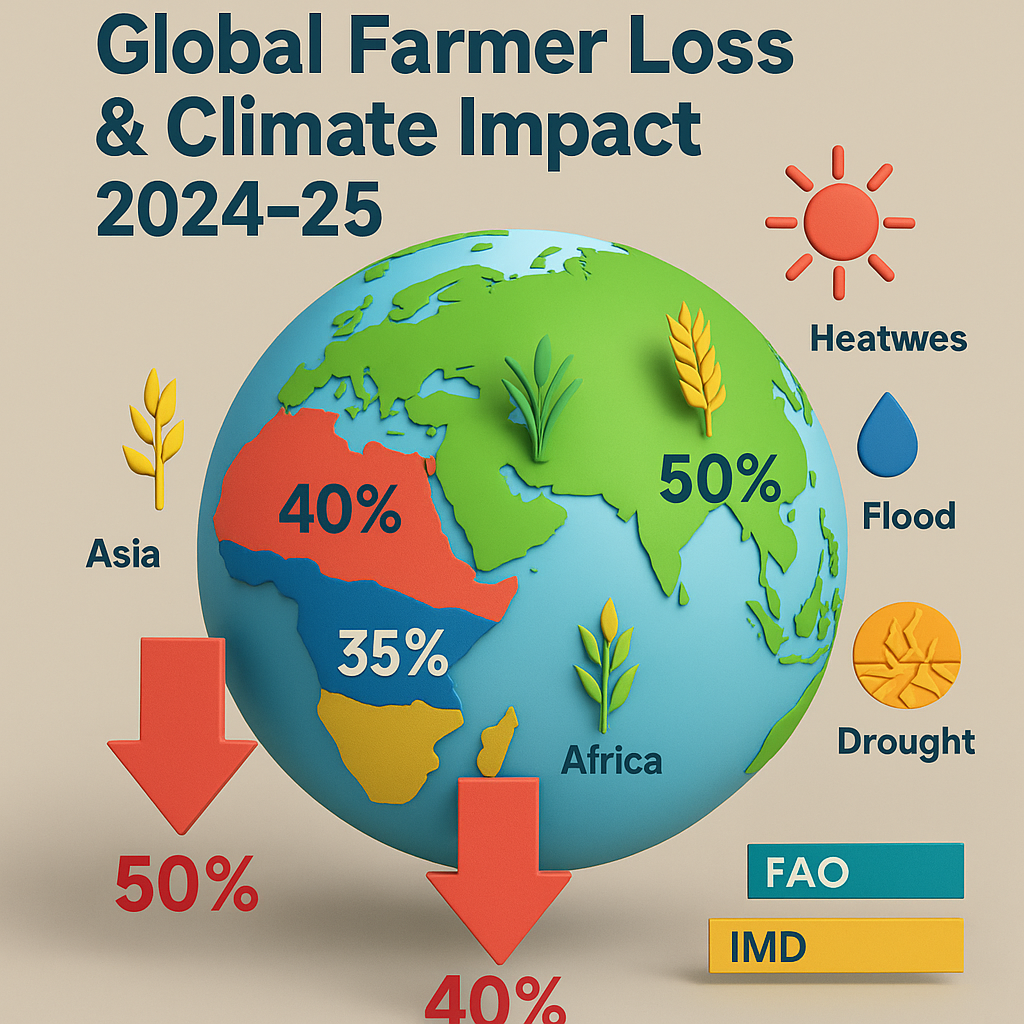
The latest global climate-risk assessment compiled by multiple agriculture authorities — including FAO, IMD, USDA and national weather agencies — indicates that 2024–25 has become one of the most damaging periods for farmers worldwide, with extreme heat, unexpected floods, prolonged droughts and rising input costs causing widespread crop losses, income decline and food-system stress.
1) Asia: Heatwaves, Dry Spells, and Groundwater Collapse
Asia 2024–25 me sabse zyada impact wala region raha. Authorities report:
North India, Pakistan & Bangladesh me winter dryness + heat spikes ne wheat aur mustard belts ko affect kiya.
Southeast Asia me El Niño ke effect ne paddy sowing delay ki.
China ke northern grain belts me groundwater depletion ne irrigation demand double kar diya.
Agriculture ministries ki field assessments ke mutabik, farmer income me 10–35% tak decline record hua.
2) Africa: Drought–Flood Cycle Destroying Crops
Africa me climate pattern unstable ho gaya hai:
East Africa me prolonged drought ne maize & sorghum yield ko damage kiya.
West Africa me sudden flooding ne groundnut, cassava aur millet fields ko wash-out kar diya.
Southern Africa me input cost inflation + dry spells ne small farmers ko heavy loss me dala.
FAO’s Africa desk ne warn kiya ke repeated climate shocks long-term food security ko risk me daal rahe hain.
Perilla is one of those plants that almost never appears in mainstream agricultural discussions, yet if you follow its trail through East Asian landscapes, mountain slopes, smallholder gardens, and ancient culinary traditions, you discover a world where this plant is far more than another oil crop. Perilla belongs to a very old cultural memory in several Asian regions, especially Korea, parts of Japan, inland China, and certain Himalayan communities. Its presence in fields is so understated that agricultural outsiders often overlook it. But when you begin to examine the seeds, the aroma, the oil purity, the botanical behavior of the plant, and the cultural rituals attached to it, you realize Perilla is one of the most layered oil crops in Asia — layered not only in chemistry but also in meaning.
Walking through Korean countryside during late summer, you may see Perilla plants standing quietly between more dominant crops like sesame and soybeans. They grow with a deceptive calmness, with soft, heart-shaped leaves and a fragrance that drifts across fields, hinting at its significance in traditional kitchens. Yet the story truly begins in the seeds. Perilla seeds hold one of the highest concentrations of plant Omega-3 fatty acids known in nature. This alone has caught the attention of modern nutritionists, but what many people fail to grasp is that the oil from these tiny seeds is not merely a nutritional product—it is a record of centuries of ecological adaptation.
To understand Perilla oil properly, one must step into the ecological world in which the plant evolved. Perilla prefers regions where summers are warm and humid, where monsoon cycles bring a sequence of moisture and sunlight, and where soils range from loamy to slightly acidic. The plant grows at altitudes that surprise agricultural scientists. In parts of the Himalayas, you find Perilla thriving on steep terraces carved by hand, receiving only partial sunlight as fog hangs above the valley. In these highlands, farmers rarely speak about Perilla as a commodity. For them, it is a household plant, one that provides both medicinal oils and culinary agents, something that stood beside them long before modern edible oils entered their diets.
What makes Perilla’s agricultural personality intriguing is its dual life. In the lowlands of China, it behaves like a fairly standard annual herb. In the Korean peninsula, it becomes a cultural symbol of autumn harvests. In mountainous terrain, it acts more like a survival plant capable of enduring cold nights and misty mornings. Such geographic diversity gives rise to a wide range of chemotypes. Some Perilla lines accumulate more aromatic compounds in their leaves; others send their biochemical energy into oil-rich seeds. There are communities in Japan that use versions of Perilla mainly for leaf flavoring, and others that cultivate special lines purely for oil extraction.
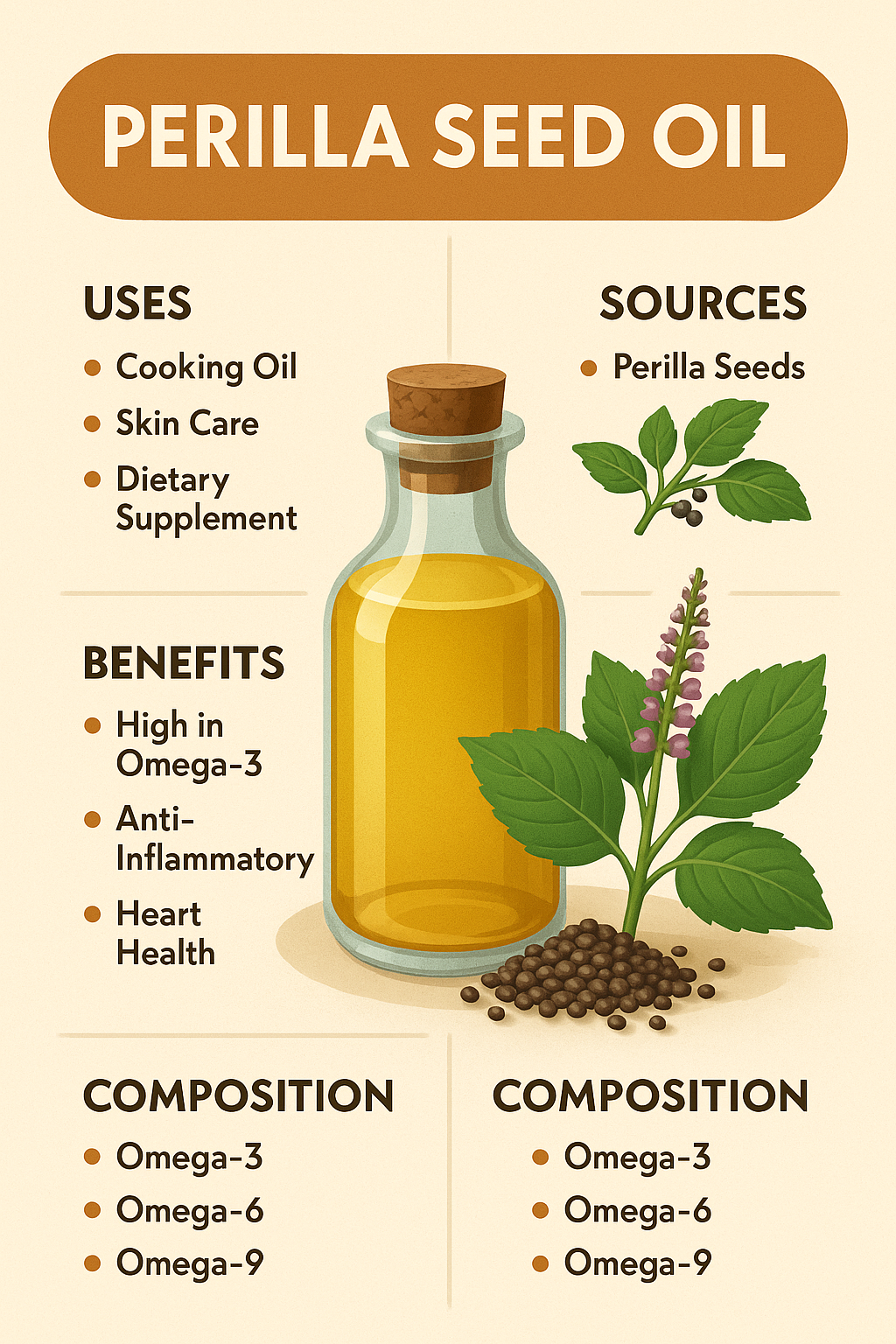
The oil itself carries stories that stretch far beyond laboratories. For centuries, Perilla oil was used as a cooking medium in households where animal fats were limited or expensive. Ancient documentation from East Asian medical texts describes Perilla oil as a protective agent for the lungs, a remedy for chronic chest discomfort, and a soothing substance for skin irritations. It makes sense scientifically when you observe the oil’s composition: high Omega-3 levels, balanced antioxidants, and a delicate viscosity that absorbs into the skin without leaving a heavy trace. But traditional communities arrived at these conclusions not through biochemical analysis but through generational observation — trial, error, and subtle wisdom shaped by lived experience.
When one visits a seed oil press in a rural Korean village, especially in the older regions of Gyeongsang or Jeolla provinces, you notice the extraction process is not merely mechanical. It is almost ceremonial. The seeds are harvested at precise moisture levels, dried under diffused sunlight, cleaned manually with sieves and hand fans, and then pressed slowly at low temperatures to preserve what Koreans call “ddeokddeokhan hyanggi,” a thick and dense aroma associated with high-quality Perilla oil. This aroma is not easy to describe. It is neither pungent like mustard oil nor neutral like refined olive oil. It carries an earthy, slightly sweet fragrance with a warm undertone that hints at its high fatty acid concentration.
Modern extraction facilities, especially in South Korea and certain Chinese provinces, use advanced cold-press systems that maintain the oil’s chemical integrity. Researchers studying Perilla have noted that the oil oxidizes more slowly than many other plant oils despite its high unsaturated fat content. This stability, they argue, is partly due to its inherent antioxidant profile. Even so, Perilla oil must be stored carefully because Omega-3-rich oils naturally degrade faster under light and heat. Traditional storage methods — dark clay jars, cool storage rooms, wooden shelves away from sunlight — were inadvertently ideal for protecting its quality.
Perilla cultivation varies depending on purpose. For leaf-type Perilla, farmers promote lush foliage through moderate nitrogen use. For seed-type Perilla, they manage spacing, sunlight distribution, and drainage differently to encourage seed head development. The plant responds uniquely to soil fertility. Too much fertility causes it to grow tall but reduces seed density. Too little fertility limits biomass but increases oil concentration in surviving seeds. This delicate balance is well understood by experienced growers but still puzzles new farmers.
Rainfall plays an interesting role in seed formation. Excessive rain during seed maturation dilutes lipid accumulation in the seed head. Too little rainfall before flowering stunts plant height. Hence, Perilla thrives best in regions with rhythmic rainfall — early moisture, stable midsummer, and dry autumns. These climatic rhythms coincide beautifully with Korea’s agricultural calendar, which may explain why Perilla oil has been culturally significant there for centuries.
When examining Perilla seed morphology, you notice seeds are tiny, round, and often carry faint patterns on the surface. These patterns are indicators of genetic lineage. Some seeds appear smooth and glossy, others carry a faint mosaic-like texture. Researchers associate these surface differences with variations in oil yield and fatty acid distribution. Seeds from cooler mountainous regions often show slightly darker pigmentation, which in turn correlates with higher antioxidant concentration in the oil.
Economically, Perilla oil occupies a hybrid position. It is not as industrially widespread as soybean or canola oil, but its value in the health food sector and premium culinary markets is rising rapidly. South Korea alone consumes thousands of tons of Perilla oil annually for cooking, seasoning, cosmetics, traditional medicine, and even religious rituals. Farmers in Nepal and Bhutan have begun exporting Perilla seeds to Korean companies, and Chinese agricultural businesses have expanded Perilla cultivation in Yunnan and Sichuan to meet growing export demand.
The global health industry’s fascination with Omega-3 fatty acids has opened a new path for Perilla oil. While flaxseed oil has historically dominated the plant-based Omega-3 market, Perilla oil is now considered a strong competitor because it has a more balanced aroma and tends to be more culturally integrated in Asian diets. The oil’s high alpha-linolenic acid (ALA) content makes it beneficial for heart health, inflammation reduction, and metabolic balance. Nutritionists studying cardiovascular patterns in traditional Korean diets often attribute their historical heart-health advantages partly to the consumption of Perilla oil.
From a cultural perspective, Perilla oil carries meanings that transcend nutrition. It represents seasonal transition in Korea, where families press oil after autumn seed harvest to prepare for winter dishes. Perilla oil is used in temple cuisine prepared by Buddhist monks, who avoid animal-based fats, making plant oils spiritually significant. In these monasteries, Perilla oil is valued for its purity and its subtle effect on the energy of food — not heavy, not overpowering, but nourishing in a calm, almost meditative way.
Perilla’s journey beyond Asia is relatively new. When American and European chefs discovered its culinary potential, they began experimenting with its nutty aroma in salads, marinades, artisan breads, and fusion dishes. Cosmetic companies, particularly those focusing on natural plant-based oils, have begun incorporating Perilla oil in formulations for sensitive skin, eczema management, and anti-inflammatory serums. This interest has transformed Perilla into a commodity with international potential.
But global expansion brings challenges. One challenge is maintaining seed purity. Perilla cross-pollinates easily, and when leaf varieties cross with seed varieties, the oil yield and aroma change. Another issue is the plant’s sensitivity to photoperiod. Perilla in northern latitudes may not flower at the correct time unless daylight hours align with its genetic rhythm. This restricts its cultivation outside certain warm-temperate regions unless breeders develop photoperiod-flexible varieties.
From an ecological standpoint, Perilla interacts smoothly with biodiversity. It attracts pollinators, particularly small bees, and its flowers support micro-habitats for beneficial insects. Unlike many commercial oil crops, Perilla rarely relies on heavy pesticide use. The plant has natural aromatic defenses and grows vigorously enough to outcompete many weeds. This makes it environmentally friendly and suitable for organic systems.
The economics of Perilla oil farming are not straightforward, however. Because seed yield varies widely by region, altitude, and genetic type, farmers must learn local cultivation knowledge rather than relying solely on general guidelines. In Korea, farmers often rotate Perilla with barley, sesame, and legumes. This cyclic pattern rejuvenates soil conditions and reduces pest buildup. In Himalayan regions, Perilla fits into mixed cropping systems with millet and buckwheat, where it thrives on residual moisture. The crop’s inherent adaptability to marginal soils makes it valuable for remote communities with limited agricultural inputs.
The question many economists ask is whether Perilla can scale. The answer depends on how we define scale. If the goal is to replace mass oils like soybean or palm, Perilla cannot compete. But if the goal is to create a premium oil market—nutrition-forward, culturally rich, environmentally low-impact—Perilla fits perfectly. Modern consumers increasingly value oils with heritage, traceability, and health benefits. Perilla matches all three criteria.
The extraction industry surrounding Perilla remains small compared to global edible oil giants, but that may be an advantage. Small-scale presses maintain quality. Local cooperatives keep profits within rural communities. When Perilla becomes too industrialized, its uniqueness risks dilution. Maintaining artisanal quality while expanding international availability is a delicate balance the industry must navigate.
As for the oil’s sensory profile, chefs often describe Perilla oil as warm, earthy, slightly citrusy at times, with a softness that lingers. Its aroma blooms when lightly heated, though overheating destroys its delicate compounds. This sensitivity explains why Perilla oil is traditionally drizzled over dishes rather than used for deep frying. It elevates flavors rather than competing with them.
In the realm of human health, Perilla oil is studied for its anti-inflammatory effects, its ability to support neurological function, and its potential role in metabolic health. Researchers are investigating how Perilla oil may influence lipid profiles and reduce chronic inflammation. These studies are still ongoing, but early findings are promising.
Side effects associated with Perilla oil are minimal, though individuals with seed allergies should exercise caution. Like all high-Omega-3 oils, it must be stored properly. When exposed to light, air, or heat, it loses potency. Traditional clay jars, dark glass bottles, and cool storage environments still offer the best preservation.
The future of Perilla oil seems to be moving toward greater global recognition. Climate change may ironically increase Perilla’s importance. As rainfall becomes unpredictable and temperatures rise, crops that tolerate stress while maintaining high nutritional output will become essential. Perilla fits that description. Its deep root system allows it to endure dry spells. Its flowering pattern adapts to varying altitudes. Its seeds concentrate valuable lipids even under environmental stress. This resilience positions it as a future-forward crop.
For farmers exploring diversification, Perilla presents an interesting opportunity. It does not demand heavy investment. It is compatible with organic farming. It fits into mixed cropping systems. It has strong cultural markets and emerging international demand. These layers make it more than a botanical product; they make it a socio-economic bridge between tradition and global modernity.
Perilla’s history is shaped not by mass agriculture but by everyday human experience. The plant’s fragrance in summer fields, the slow pressing of seeds in rural oil houses, the seasonal dishes flavored with its oil, the elders who describe how it kept families nourished in lean years — all of these form a narrative that is difficult to quantify but easy to feel once you step into its world.
Thus, Perilla oil is not simply extracted from seeds. It is extracted from landscapes, from memory, from centuries of adaptation, and from the intimate relationship between humans and a plant that never needed fame to prove its worth.
This is why Perilla seed oil deserves careful attention today — from farmers, scientists, nutritionists, policymakers, and anyone interested in how traditional plants can shape future food and health systems.
In today’s fast world, everyone talks about money, comfort, and luxury. People run behind careers, brands, success, and validation. But in this blind race, they forget the most important truth of life: money may help you live better, but food is what keeps you alive.
And food comes only from farming. Farming is not a low-status job. It is the foundation of human existence. Farmers do not just grow crops — they grow life, hope, and future.
A farmer wakes before sunrise, works under harsh weather, fights storms, droughts, and losses — yet continues without excuses. While the world sleeps comfortably, a farmer prepares food for millions. This silent strength is the greatest form of leadership.
Farming is built on faith, not guarantees. A farmer sows seeds without knowing if rain will come, if crops will survive, or if he will receive the right price. Yet he trusts the soil and works every day. This faith is something the world must learn.
Today’s society respects people with money, fame, and status. But the truth is simple: If farmers stop working for even 30 days, the world will collapse. Hospitals, schools, offices, markets — everything will stop because food will stop.
The real economy is not stock markets. The real economy is soil.
Most people think farming is backward or difficult, but modern agriculture is full of opportunities. Technologies like drones, sensors, AI-based irrigation, hydroponics, vertical farming, and organic cultivation are shaping a new world. Young people can build profitable, sustainable, and meaningful futures in farming.
In a world full of stress and anxiety, farming brings peace. Soil has healing power. Working with nature reduces mental pressure and increases emotional balance. Life in cities feels fast but empty; life in fields feels simple but meaningful.
The truth is clear: Farming is not the past — it is the future. Countries with strong agriculture will survive the next 50 years. Food security will decide the strength of nations. And farmers will become the heroes of the future.
Farmers do not ask for praise or fame. They ask only for respect and fairness.
Respect the hands that feed you. Support the people who give life to the world. And remember — The future belongs to farmers because the future belongs to food.
FAQ (Short)
Why is farming important today? Because food is the world’s greatest need and farming is its only source.
Why should youth join agriculture? Modern farming is profitable, tech-driven, and full of global opportunities.
What makes farmers inspirational? Their courage, patience, and ability to rise after every failure.
Is farming the future Yes food security will control the world in the coming decades.
Introduction: The Silent Strength of Those Who Feed the World
In today’s world, where people chase luxury, speed, and convenience, the strength that keeps humanity alive remains hidden in the fields. Farmers wake before sunrise, work under the harsh sun, and rest only after giving life to millions.
This is not just work. This is courage. This is purpose. This is farming.
When the world sleeps, farmers prepare fields. When the world eats, farmers sacrifice meals. When the world complains, farmers keep moving.
Farming is not just a profession; it is the bravery of the soul.
1. Farming Is Built on Faith and Patience
No other profession tests a person like farming. A farmer sows seeds with no guarantee — depending on rain, sun, soil, and time.
He cannot rush growth. He cannot control nature. He can only trust.
This trust is powerful. It teaches humanity that real success takes time. That growth is slow, silent, and steady.
Farmers believe in tomorrow even when today is hard. This is the purest form of motivation.
2. The Farmer’s Life Is a Lesson in Courage
Most people fear failure. Farmers face failure every season — droughts, floods, pests, low prices — yet they rise again.
Where others quit, farmers continue. Not because farming is easy, but because the world depends on them.
Leadership is not loud; it is consistent. A farmer is the most consistent leader humanity has ever seen.
3. Farming Teaches the World What Strength Really Means
Strength is not lifting weights — strength is lifting a community.
Strength is:
Working despite uncertainty
Feeding millions while staying hungry
Smiling even when crops fail
Hoping again when everything falls apart
Farmers carry a strength that is deeper than achievements — it is the strength of survival.
4. The Modern World Forgot the Roots That Feed It
Today, society values actors, influencers, athletes — but forgets the farmer who keeps them alive.
Countries celebrate technology, entertainment, and fashion — but hesitate to celebrate farming.
This imbalance is dangerous. Because the world can live without gadgets, but it cannot live without food.
True motivation is remembering the hands that make life possible.
5. Young People Must Not Fear Farming — They Must Lead It
Many youths think farming is old, outdated, or low-paying. This is a myth.
Modern farming is a high-growth industry:
Smart farming
Hydroponics
Vertical farming
Organic farming
Agri-tech startups
Drone-technology
Solar-powered irrigation
The next global revolution will not come from apps — it will come from agriculture.
Youth must return to soil — not as laborers, but as innovators, leaders, and creators.
6. Farming Gives What Money Cannot Buy
People chase money for comfort. But farming gives something greater:
Peace
Purpose
Fresh air
Healthy food
Connection to nature
Mental stability
A farmer may not be rich in currency, but he is rich in life.
Cities make people tired. Fields make people alive.
7. Farmers Are the True Protectors of the Earth
While industries pollute land, water, and air — farmers protect them.
Sustainable farming practices heal the planet:
Organic farming
Crop rotation
Natural fertilizers
Water conservation
Regenerative practices
Soil restoration
When a farmer works, the planet breathes.
Farmers are not just food providers — they are Earth’s guardians.
8. Farming Is the Ultimate Form of Hope
Every seed is a message: “Tomorrow will be better.”
Every harvest is a celebration: “Hard work pays off.”
Every failure teaches: “Stand up again.”
Farmers live life with hope — a hope that humanity desperately needs.
9. The World Must Give Farmers the Respect They Deserve
Farmers are not poor — they are made poor by society.
They deserve:
Better prices
Government support
Modern technology
Insurance protection
Global recognition
Respect in media & education
A nation grows when its farmers grow.
10. Farming Is the Foundation of the Future
In the next 20 years, the world will face:
Food shortages
Climate change
Soil degradation
Water scarcity
Population growth
The only solution is strong farming systems.
Future leaders will not be those who control markets — but those who control food security.
Farmers are the future. Farming is the future.
Conclusion: Farming Is the Courage That Never Fails
Farming Motivation is not only for farmers — it is for every person who wants to rise in life.
Because farming teaches the truth:
Believe
Work
Wait
Rise
Repeat
Farmers live this cycle every day. Their courage feeds the world. Their strength holds the planet. Their hope shapes the future.
To honor farmers is to honor life.
farming motivation, courage of farmers, global agriculture inspiration, farmer life motivation
By 2050, the world’s population will reach 9.7 billion. To feed the Earth, we must produce more food using fewer resources — less water, less land, fewer farmers, and unpredictable weather.
That’s why the world is shifting toward: Smart Farming — agriculture powered by technology.
From India to Israel, from the USA to Japan, countries are adopting digital solutions that make farming faster, smarter, and more efficient.
Drones: The Eyes of the Farmland
Drones have become one of the most powerful tools in agriculture. They help farmers:
Spray fertilizers and pesticides
Detect diseases early
Map farmland
Monitor crop health
In countries like Brazil and China, entire agricultural lands are sprayed by drone fleets in hours instead of days.
Precision Irrigation: Saving Every Drop of Water
Israel, a country with very little rainfall, turned desert into agricultural land using:
Drip irrigation
Soil-moisture sensors
Smart water distribution systems
Now the entire world is learning from this model to save water and grow more food with less.
Artificial Intelligence: The Farmer’s Digital Brain
AI technology can now:
Predict weather changes
Identify crop diseases
Recommend fertilizers
Analyze soil health
Estimate harvest yield
Farmers in India, the USA, and Europe use AI apps to decide what to grow, when to grow, and how to protect their crops.
Autonomous Tractors: Machines That Work Without Drivers
Self-driving tractors are changing agriculture forever. They can:
Work 24 hours continuously
Operate with perfect accuracy
Reduce labour cost
Cover large farmland quickly
John Deere (USA), Mahindra (India), and Kubota (Japan) are leaders in this revolution.
Soil-less Farming: Hydroponics & Vertical Farming
Countries with limited agricultural land like Singapore, Dubai, and Japan are growing crops:
Without soil
Using 90% less water
In controlled indoor environments
All year round
This is the future of farming in crowded cities.
Solar-Powered Farming in Africa
Solar-based agriculture is lifting millions of farmers out of poverty. Solar technology is used for:
Irrigation pumps
Sensors
Cooling and storage
Powering entire farms
This protects crops, reduces costs, and increases income.
Smart Farming: A Worldwide Revolution
Countries leading the global smart farming movement:
India → Drone spraying & AI tools
Japan → Robot farmers
Israel → Water technology
Netherlands → Smart greenhouses
USA → Big data & satellite farming
Together, these innovations are helping the Earth stay fed.
Conclusion: Technology Will Feed the Earth
With climate change, growing population, and shrinking farmland, the world needs smart farming more than ever.
The farmer of the future is not just a grower — he is a technologist, innovator, and Earth protector.
Smart farming is the key to feeding the Earth in the future. smart farming, agriculture technology, drones in agriculture, AI farming tools, global agriculture, precision farming, agricultural land innovations
When we think of innovation, we often imagine skyscrapers, satellites, and AI — but the true foundation of human survival remains farming. Every bite of food, every thread of cotton, every drop of milk — all come from the soil. Yet, today’s youth are drifting away from it. This post is a call — to the next generation — to see farming not as “old work,” but as the future’s most powerful profession.
1. The Global Need for Farmers
The United Nations predicts that by 2050, the world’s population will exceed 9.7 billion. Feeding this growing population requires at least 70% more food production than today. But here’s the crisis: the number of farmers is declining every year. In many countries, the average farmer’s age is above 55. Without young minds, agriculture risks collapsing under its own weight.
The world doesn’t just need farmers. It needs educated, tech-driven, climate-aware farmers. It needs dreamers who grow food as a mission, not as a burden.
2. Youth and the Power of Change
Today’s generation holds something older farmers never had — technology, global awareness, and connection. A farmer with a smartphone can access:
Real-time weather data
Crop disease detection via AI
Global market prices
Organic certification systems
Young people can blend ancient wisdom with modern tools — and make farming cool, sustainable, and profitable.
3. Farming: The New Tech Frontier
Agriculture is not just soil and seeds anymore it’s drones, robotics, data analytics, hydroponics, and biotechnology. Countries like Japan and Israel are leading with innovation — turning deserts into green fields through technology. Meanwhile, in India, Africa, and South America, young entrepreneurs are proving that farming startups can be as exciting as tech startups.
Imagine a youth from Kenya using drones to spray crops, or an Indian farmer using solar-powered irrigation. That’s the future — farming powered by innovation.
4. Why the World Needs You — The New Farmer
The modern farmer is not just a grower. He/She is a:
Scientist – testing new seeds and soil methods
Technologist – using IoT and AI for better yield
Entrepreneur – building farm brands and exports
Environmental hero – saving water, soil, and biodiversity
When a youth becomes a farmer, the world gains not only food, but sustainability, employment, and balance.
5. Reconnecting Humanity with Nature
Urbanization has created a gap — between humans and the soil. The new generation must rebuild that bridge. Farming reconnects us to nature’s rhythm — sunrise, seasons, rain, and renewal. It teaches patience, gratitude, and teamwork with the planet.
6. Farming as Freedom, Not Obligation
In many parts of the world, farming was once seen as a burden — something people did because they had no choice. But today, farming is a lifestyle of freedom:
Freedom to work with nature
Freedom to create your own food
Freedom to be self-reliant
Freedom to innovate and lead sustainability
Farming is not “backward.” It’s forward to roots.
7. Global Examples of Young Farmers
In Japan, young farmers use robots to harvest rice.
In Brazil, agro-entrepreneurs grow organic coffee for world markets.
In India, startups like KisanKonnect link farmers directly to urban consumers.
In Africa, young women are turning wastelands into solar farms with crop cultivation.
These stories show one truth farming belongs to the future, not the past.
8. Conclusion: The Future Is in Your Hands
The next 50 years will define whether humanity thrives or starves. We need youth who can feed the world wisely, sustainably, and passionately.
If you’re young and searching for meaning, look no further than the soil beneath your feet. Because the hands that touch the soil today will shape the future of the Earth tomorrow.
Farming is not just work — it’s world-building.
farming future, youth in agriculture, global farming, sustainable farming, modern agriculture, farmers motivation
Cubeb, commonly known as Tailed Pepper, is an ancient spice that once rivaled black pepper in global trade. Native to Indonesia (Java and Sumatra), Cubeb has been prized for centuries for its distinct aroma, medicinal uses, and culinary versatility. During the 14th and 15th centuries, Arab traders brought cubeb to Europe, where it became a luxury spice used in perfumes, medicine, and food preservation.
Today, cubeb is making a comeback due to rising global interest in natural remedies, Ayurvedic medicine, and exotic spice blends. Modern industries use it in pharmaceuticals, cosmetics, essential oils, and flavoring, particularly in gin and herbal beverages.
With its high export potential and growing global awareness, cubeb farming offers new opportunities for small and large-scale spice growers across Asia, Africa, and tropical America.
2. Scientific Name + Origin + Major Producers
Scientific Name: Piper cubeba
Family: Piperaceae (same as black pepper)
Common Names: Tailed Pepper, Java Pepper, Kabab Chini (in India)
Origin: Indonesia (Java and Sumatra islands)
Major Producing Countries: Indonesia ,India ,Sri Lanka ,Madagascar , and parts of Tanzania
Cubeb thrives in tropical climates with consistent humidity and well-drained soil. Indonesia remains the global hub for both cultivation and export, contributing over 80% of global supply. In India, it’s cultivated mainly in Kerala, Karnataka, and Tamil Nadu.
3. Farming Guide
Soil & Climate Requirements
Cubeb grows best in loamy, fertile soil rich in organic matter.
pH Range: 5.5 to 7.0
Temperature: 22°C – 32°C
Rainfall: 1500–2500 mm annually
Avoid waterlogging, as it causes root rot. Slight shade and high humidity are ideal.
Irrigation & Fertilization
Regular irrigation every 7–10 days during dry periods.
Organic manure and compost enhance yield and quality.
Propagation is done through cuttings or suckers rather than seeds.
Plants are spaced 2.5 x 2.5 meters apart and grown with supporting poles or trees (like betel nut or gliricidia).
Intercropping with black pepper, cardamom, or coffee is common in hill regions.
Harvesting
Fruiting begins 2–3 years after planting.
Harvest when berries turn greenish-gray and the tail (pedicel) is firm.
Yield improves after the third year, with vines remaining productive for 10–12 years.
Harvesting is followed by sun-drying for 4–6 days until berries are hard and brown.
4. Cost & Profit Analysis (USD)
ParameterDetailsInitial Investment per Acre$1,800 – $2,500Annual Maintenance Cost$600 – $800Average Yield per Acre800–1000 kg dry berriesMarket Price (per kg)$10 – $15 USDGross Income (per acre)$8,000 – $12,000Net Annual Profit$5,000 – $7,500 USDROI (Return on Investment)250–300% over 3 years
Cubeb farming, while moderately labor-intensive, offers high long-term returns, especially when sold in pharma-grade or export-quality form.
Indonesia dominates exports, but India, Sri Lanka, and Madagascar are fast emerging as alternative suppliers for niche organic markets.
6. Processing & Storage
Post-Harvest Handling
After harvesting, cubeb berries must be carefully dried to preserve their aromatic oils and medicinal compounds. The drying process is key to achieving high market quality.
Steps:
1. Cleaning: Remove stalks, leaves, and immature berries.
2. Drying: Sun-dry for 4–6 days or use mechanical dryers at 45–50°C.
3. Grading: Separate berries by size, color, and tail length.
4. Packaging: Use airtight containers or laminated bags to retain aroma.
Proper drying prevents mold and maintains oil content (8–10%), which determines the export value.
Value-Added Products
Cubeb can be transformed into several profitable derivatives:
Cubeb Oil: Used in perfumes, flavoring, and herbal medicine.
Cubeb Powder: Culinary spice and digestive aid.
Cubeb Extracts: Used in pharmaceuticals and aromatherapy.
Cubeb-Infused Gin & Bitters: Gaining traction in Western beverage industries.
These value additions can increase profits by 40–60%, especially for exporters and essential oil producers.
5. Global Market & Export Potential
Cubeb once dominated the spice trade but saw a decline with the rise of black pepper. However, in the last decade, global herbal and medicinal demand has revived its importance.
Top Importing Countries
Germany
France
United States
Japan
United Kingdom
Saudi Arabia
Market Size & Trends
The global cubeb market is valued at USD 250–300 million (2024 estimates).
Expected to grow by 5.6% CAGR till 2032.
Major growth sectors: Essential oils, pharma, organic spice blends, and natural beverages.
Export Leaders
Country Export Share Average Price (USD/kg)
Indonesia 80% $12 India 10% $14 Sri Lanka 5% $13 Madagascar 3% $10 Others 2% —
Exporters focusing on organic-certified cubeb command 20–25% higher prices in global markets.
6. Health Benefits
Cubeb has been valued for centuries in Ayurveda, Chinese medicine, and Unani systems for its healing properties.
Medicinal & Nutritional Value
1. Respiratory Health: Acts as a natural decongestant and expectorant.
2. Digestive Aid: Stimulates appetite and reduces bloating.
3. Antibacterial Properties: Helps fight infections and inflammation.
4. Sexual Health: Traditional aphrodisiac used in male vitality tonics.
5. Oral Hygiene: Used in natural tooth powders and mouth fresheners.
6. Liver Protection: Prevents toxin buildup and supports detoxification.
7. Antioxidant Power: Protects against free radicals and aging.
Cubeb’s essential oil contains compounds like cubebin and cubebol, which are effective in antimicrobial and anti-inflammatory functions.
7. Cons (Challenges in Farming)
While profitable, cubeb farming poses several challenges that need management:
Pests & Diseases
Root Rot (Fusarium spp.) due to poor drainage.
Leaf Spot from fungal infections during humid months.
Scale Insects and aphids attack young vines. Solution: Organic neem oil sprays and proper pruning for air circulation.
Climate Risks
Heavy rainfall or water stagnation damages roots.
Extreme drought affects flowering and berry size.
Market Volatility
Dependence on niche export markets can lead to price fluctuations.
Need for quality certification (ISO, Organic, GMP) to enter high-value markets.
Limited Awareness
Cubeb remains under-promoted, so farmers must connect with export agencies or spice boards to maximize reach.
8. FAQ Section (Common Questions)
Q1. How long does it take for cubeb plants to yield berries? Usually 2–3 years after planting, with peak production from the 4th year onward.
Q2. Can cubeb be intercropped with other spices? Yes, it grows well with black pepper, coffee, and cardamom under shade.
Q3. What is the main export form of cubeb? Dried whole berries and cubeb essential oil are most in demand.
Q4. How can I sell cubeb internationally? Partner with spice export companies or list on B2B platforms like Alibaba, Indiamart, or Spices Board of India Export Portal.
Q5. Is organic cubeb more profitable? Yes, organic-certified cubeb fetches up to 25% higher price in European and U.S. markets.
Q6. How long can dried cubeb be stored? Up to 2 years in airtight, moisture-free containers.
Q7. Does cubeb need shade or full sun? Partial shade is best — similar to black pepper conditions.
9. Conclusion
Cubeb (Tailed Pepper) is an ancient spice reborn in the modern herbal world. Its diverse uses in medicine, food, and essential oils make it a lucrative crop for tropical farmers.
With moderate investment, farmers can earn up to $7,000 USD per acre annually, especially by targeting export and pharmaceutical industries.
Future trends show growing interest in organic and functional spices, ensuring that cubeb farming has strong prospects worldwide.
Farming Tip:
Use organic compost and mulching techniques to retain soil moisture and enhance vine productivity. Regular pruning also improves yield and disease resistance.