• Where the Heart Learns to Work: The Invisible Strength of Farmers

    Farming Writers Motivation Quotes 

    If you wake before dawn in a farming village, before the sky has even chosen a color, you will notice something unusual about the silence. It is not empty. It is full of expectation. The land waits, the air waits, the morning waits — but the farmer never waits. He steps into the world at an hour when most people would still be dreaming, because his dreams are not made of imagination; they are made of responsibility.

    There is a rhythm in farming that does not follow the clock. It follows life. The beating of a farmer’s heart is often steadier than the movement of the seasons around him. And yet, he accepts that every day will test him in ways he cannot predict.

    The world believes strength is loud.
    Farmers know strength is quiet.

    A farmer does not wake with motivation.
    He wakes with purpose.

    The difference is subtle but powerful. Motivation rises and falls with emotion. Purpose rises even when emotion collapses. A farmer’s purpose is older than fear, deeper than exhaustion, and gentler than the storms that try to erase it.

    In cities, problems arrive through messages and meetings.
    On farms, problems arrive through silence.

    A leaf curling in the wrong direction.
    A patch of soil staying wet when it should be drying.
    An insect that appears earlier than it should.
    A wind that changes temperature at sunset.
    A bird that flies lower than usual.

    Farmers read these signs not because someone taught them, but because survival depends on seeing what others miss. Their intelligence is not written on certificates; it is written on the land itself.

    People say farming is simple.
    But nothing teaches complexity like a field where one mistake can rewrite the entire season.

    A farmer’s day is divided into moments that rarely gain attention. The world sees work; farmers see meaning. When a farmer bends to touch the soil, the world sees a posture. But the farmer is not just checking moisture — he is listening to the earth’s memory. Soil carries stories: of last year’s disappointment, of monsoons that came too early, of winds that shifted at the wrong hour, of hopes planted deeper than any root.

    Farmers live with the past beneath their feet and the future in their hands.

    There is something extraordinary about how they carry both without losing balance.

    Sometimes, standing in the middle of a field, a farmer feels the weight of everything he cannot control. Weather, pests, prices, global markets, government decisions, climate shifts — forces that are bigger than any individual. But he also feels something else: a stubborn belief that trying still matters.

    Trying is the only constant in a world where nothing else is promised.

    The truth is, a farmer gets stronger not by lifting loads but by lifting uncertainty. He carries doubts like the rest of us carry tools — close, necessary, familiar. But he does not let doubts define him. He lets discipline define him.

    When a season collapses, people imagine grief. Farmers imagine recovery.

    They do not ask, “Why did this happen to me?”
    They ask, “What do I do next?”

    That shift in thinking is the foundation of true resilience.

    The farmer walks the same land that has broken his heart before — but he walks it with new seeds in his hands. This ability to plant again after failure is not optimism; it is an act of courage deeper than anything the modern world understands.

    There is a moment every farmer experiences — the moment when the field looks back at him.
    The wind pauses.
    The soil seems still.
    The horizon stretches without hinting whether the future will be kind or cruel.
    And in that moment, the farmer realizes something profound: he is not working on the land — he is working with it.

    This partnership is older than civilization.
    Older than markets.
    Older than governments.
    Older than technology.

    Farming is the first story humanity ever lived.
    And farmers still carry that story.

    The world says farmers are poor.
    But they are rich in ways the world has forgotten.

    Rich in patience.
    Rich in awareness.
    Rich in endurance.
    Rich in emotional intelligence.
    Rich in the ability to remain steady in a life where nothing is steady.

    A farmer’s life is not built on guarantees.
    It is built on attempts.
    Repeated attempts.
    Exhausting attempts.
    Hopeful attempts.

    Attempts that shape character more than success ever could.

    There is beauty in the way farmers forgive nature.
    Storms destroy their work — but they do not hate the sky.
    Pests consume their fields — but they do not curse the land.
    Heat burns their crops — but they do not turn away from sunlight.

    They understand that life itself behaves like climate — unpredictable, uncontrollable, but still worth working with.

    Every harvest tells a story.
    Not of abundance, but of survival.
    Not of perfection, but of patience.
    Not of luck, but of labor.

    A farmer does not celebrate harvest because the crops look beautiful.
    He celebrates because he remembers the days when nothing seemed possible.

    He celebrates the mornings when rain betrayed him.
    The afternoons when soil felt tired.
    The evenings when doubt whispered loudly.
    The nights when fear sat beside him at the edge of the field.

    Harvest is not the reward for seeds.
    It is the reward for perseverance.

    In the quietest corners of farmland, a truth lives that the world often forgets:
    Human hope did not begin in temples or palaces or universities.
    It began in fields.

    It began the first time someone planted a seed and waited.
    It began in the uncertainty of that wait.
    It began in the courage to trust the unseen.

    Farmers still live that truth every day.

    When the world feels lost, it should look toward the people who continue even when everything tells them to stop. People who teach us that strength is not about never breaking, but about rebuilding yourself every time you do.

    Farmers do not rise because life is easy.
    They rise because life is necessary.

    They do not stand tall because seasons are kind.
    They stand tall because the earth belongs to those who refuse to give up on it.

    In the end, farming is not the act of growing crops.
    It is the act of growing courage.

    And the world survives because farmers practice courage when no one is watching.

    ✍️Farming Writers Team
    Love Farming Love Farmers

    Read A Next Post 👇

    https://farmingwriters.com/the-quiet-work-behind-the-world-farmer-strength/
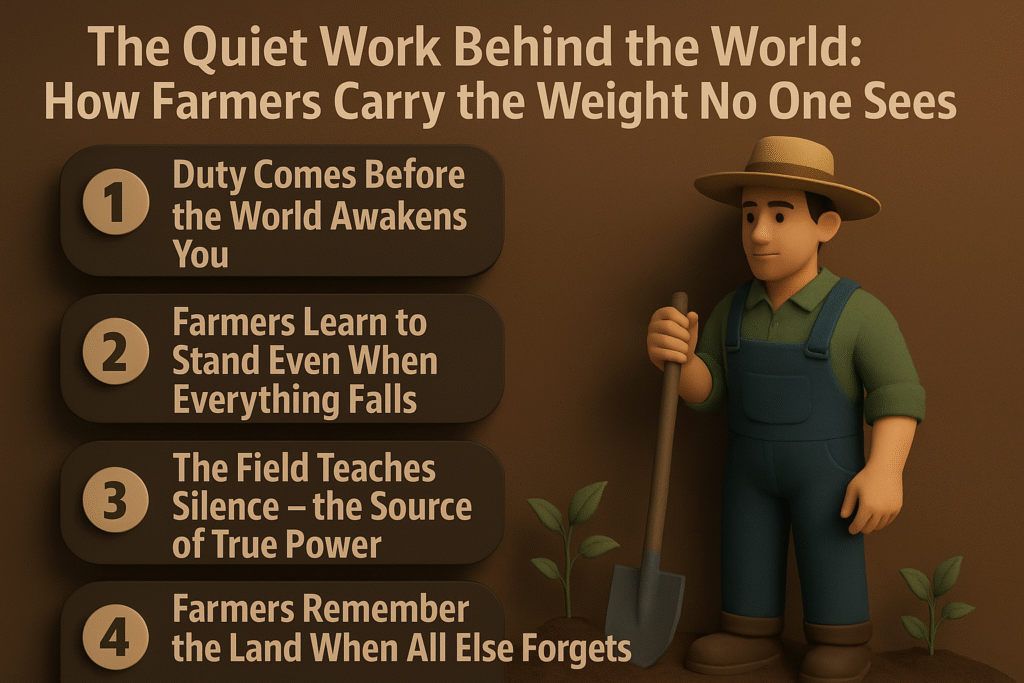
  • The Quiet Work Behind the World: The Strength Farmers Carry Alone

    The Quiet Work Behind the World

    There are moments in life when the world feels loud, rushed, chaotic — but a farm never moves at the world’s speed. It moves at the speed of nature, the speed of responsibility, the speed of a heartbeat that refuses to lose rhythm even when everything else becomes uncertain. A farmer lives inside this rhythm, guided by a kind of discipline that does not come from rules or routines but from the simple truth that someone has to keep going.

    Long before the first door opens in any town, a farmer has already stepped outside. The light has not returned yet. The air is still half-asleep. Even the birds haven’t decided if they want to start their morning chorus. But the farmer walks toward his fields, not out of habit, but out of duty. The world depends on what he is about to do, even though the world rarely realizes it.

    There is a loneliness to farming that outsiders cannot understand. Not the loneliness of being alone — but the loneliness of carrying something that no one else can carry with you. A farmer stands between nature and survival. He negotiates with seasons, argues with rains, bargains with soil, pleads with sunlight, and accepts whatever answer nature chooses to give.

    Most people live in a world built by human decisions.
    Farmers live in a world shaped by forces they cannot control.

    And yet, they show up every day.

    There is a strength in farmers that does not roar. It does not announce itself. It does not need appreciation. It grows quietly, the same way roots grow beneath the soil — hidden, unnoticed, essential. A farmer is strong because he does not allow uncertainty to weaken him. He acknowledges fear but does not bow to it. He feels pressure but does not allow it to paralyze him. His courage is not dramatic; it is practical.

    He walks into the field with a mind full of unanswered questions but hands full of work that must be done anyway.

    Most people quit when effort begins to feel like suffering.
    Farmers continue even when suffering becomes part of the effort.

    There are days when crops fail for no reason.
    Days when rain falls too early or too late.
    Days when the market collapses because of issues thousands of miles away.
    Days when pests destroy what hands carefully protected for months.
    Days when life feels unfair in a way that words cannot capture.

    But farmers still wake up the next morning and repeat the cycle.

    It is not stubbornness.
    It is resilience built from generations of experience.

    Every field has witnessed victories it cannot repeat and losses it cannot forget.
    Every farmer has walked through seasons that tested more than skill — they tested faith.

    Faith not in luck,
    not in fate,
    not in miracles,
    but in effort.

    Farmers believe effort is a form of survival.
    Even when nothing is guaranteed, effort is still worth offering.

    When a farmer stands in his field after a hard season, he does not see failure.
    He sees information.
    Clues.
    Lessons.
    Patterns.
    Possibilities.

    The world may think he is simply staring at land.
    But he is actually rewriting the future inside his mind.

    He adjusts his approach without announcing it.
    He changes his timing without debating it.
    He shifts his expectations without complaining about it.

    This adaptability is what makes farmers some of the strongest people in the world.
    Not physically, but mentally — emotionally — spiritually.

    A farmer’s patience is not passive.
    It is active, alert, observant.
    He listens to the weather, studies the soil, reads the wind, interprets silence.
    He trusts signs that others ignore.
    He recognizes voices that others cannot hear — the warning of insects, the discomfort of leaves, the restlessness of air before a storm.

    His knowledge is not downloaded; it is inherited.
    Not memorized; it is lived.
    Not taught; it is absorbed.

    And he carries this knowledge into every decision he makes.

    People search for motivation through speeches and books.
    But farmers find motivation through necessity.
    If they stop, the world suffers.
    If they continue, life continues.

    That truth alone is enough to keep them moving.

    There is something deeply human about the way farmers handle disappointment.
    They do not pretend it doesn’t hurt.
    They do not deny their feelings.
    But they also do not let emotions stop them.

    When a crop dies, a farmer mourns — silently.
    When a storm destroys months of work, a farmer grieves — quietly.
    When yields shrink and debts rise, a farmer feels the pressure — intensely.

    But the land does not wait for him to recover emotionally.
    So he learns to recover while working.
    He learns to heal without stopping.
    He learns to rise without applause.

    This is the kind of strength the world rarely recognizes.

    A farmer’s life is a series of invisible victories.
    The world only sees the harvest.
    It never sees the nights he didn’t sleep.
    It never sees the moments when he doubted himself.
    It never sees the sacrifices he quietly endured.
    It never sees the pain he hid from his family.
    It never sees the calculations he made while pretending everything was fine.

    But the soil sees it.
    And that is enough.

    Farmers have a relationship with land that is older than language.
    The soil remembers every footprint.
    Every seed remembers the hand that planted it.
    Every harvest remembers the season that created it.
    Every farmer remembers the lesson life etched into him.

    This memory is what allows farmers to continue,
    even when everything else tells them to quit.

    Farming is not just a profession.
    It is a promise.

    A promise to the land.
    A promise to the future.
    A promise to the people who rely on the unseen work of farmers every day.

    Farmers are not heroes because they succeed.
    They are heroes because they continue.

    Even when the world looks away,
    the farmer looks toward the next sunrise.

    Because he knows the earth waits for him —
    and he refuses to let it stand alone.

    ✍️Farming Writers Team

    Love Farming Love Farmers

    Read A Next Post 👇

    https://farmingwriters.com/the-season-that-watches-you-back-farmer-courage/

  • The Day Effort Became a Prayer: The Hidden Strength of Farmers

    The Day Effort Became a Prayer

    There comes a point in every farmer’s life when effort stops being an action and becomes something deeper — almost like a prayer. Not a religious one, but the kind of silent communication between a human being and the earth beneath him. A form of trust so ancient, so instinctive, that no modern world logic can fully explain it.

    A farmer wakes before sunrise not because he expects perfection from the day, but because the day expects effort from him.
    And effort, for farmers, is not optional.
    It is identity.

    The air before dawn feels different on farmland. It has a weight, a presence, a truth. A farmer walks through that dim light carrying concerns about soil moisture, last night’s temperature, the texture of the leaves, strange movements in the wind, the sound patterns of early insects. While the world sleeps, farmers are already in conversation with nature.

    It’s not a loud conversation.
    It’s not poetic.
    It’s not philosophical.
    It’s a conversation of survival.

    A farmer’s footsteps are not just physical movements — they are emotional commitments. Each step acknowledges one truth: nature does not wait.

    People often believe that farmers develop a strong heart from lifting heavy loads, working long hours, and tolerating climate extremes. But the truth is far more complex. What makes farmers strong is not the work they do, but the uncertainty they carry while doing it.

    Uncertainty is a storm that follows farmers silently.

    Will the rain come on time?
    Will the seedlings survive the night?
    Will pests appear without warning?
    Will the market behave fairly this year?
    Will the soil forgive last season’s mistakes?
    Will the crop understand the care it received?

    Every question is a weight.
    Every weight becomes a decision.
    And every decision becomes courage.

    Most people want clarity before they act.
    Farmers act to create clarity.

    They cannot wait for perfect conditions — because perfect conditions do not exist.
    They cannot wait for certainty — because certainty never visits their world.
    They cannot wait to feel strong — because strength is built while working, not before.

    Farmers learn this truth early:
    Life will not bend for them.
    They must bend for life — without breaking.

    This bending is what the world mistakes as simplicity or lack of ambition.
    But bending is not weakness.
    Bending is intelligence.
    Bending is adaptation.
    Bending is the only reason farming still exists.

    Every field has known farmers who bent but didn’t break.
    Every season has tested them.
    Every generation has survived only because someone continued despite every reason to stop.

    There is a story farmers rarely tell, but every farmer has lived it.
    The story of a season that took more than it gave.

    Sometimes it is a drought.
    Sometimes it is a flood.
    Sometimes it is a disease.
    Sometimes it is a market collapse.
    Sometimes it is a personal loss that arrived during the busiest week of the year.

    On such seasons, farming does not feel like work — it feels like heartbreak.

    A man standing in a field that failed him is one of the most powerful images in human history.
    He stands there not because he is defeated, but because he is gathering his scattered pieces.
    He is counting what is left.
    He is measuring the distance between what he hoped for and what reality allowed.

    But he does not abandon the field.

    He starts again.

    Starting again is not a strategy.
    Starting again is an instinct.
    It is the only way farmers know how to live — because restarts are built into their environment.

    The world sees a field as land.
    A farmer sees a field as memory.
    Memory of what worked, what failed, what surprised, what disappointed, what bloomed, what died, what healed, and what taught them something no book ever could.

    Farmers become scientists by necessity.
    They study pH values through experience, water retention through footsteps, soil fertility through smell, nutrient deficiency through leaf texture, pest activity through silence.
    They monitor humidity through the way clothes dry, wind patterns through dust movement, weather shifts through insect behavior.

    The land educates them more deeply than any institution.

    This education is relentless.
    It has no holidays, no weekends, no comfort zones.

    And yet, farmers do not complain.
    Not because their life is easy,
    but because complaining does not grow crops.

    Instead, farmers develop a kind of calmness that surprises anyone who has lived a predictable life.

    It is not a calmness of peace.
    It is a calmness of understanding.

    They understand that the earth gives and the earth takes.
    That seasons bless and seasons punish.
    That weather loves unpredictably.
    That effort does not guarantee reward.
    That life reveals itself slowly, one season at a time.

    This understanding gives farmers a wisdom that cannot be replaced by technology.

    Stand with a farmer during a difficult season and you will notice something profound.
    He does not break.
    He absorbs.
    He thinks quietly.
    He adjusts.
    He tries again.

    His strength is not visible in the arms.
    It is visible in the decisions.

    His courage is not loud.
    It is steady.

    His hope is not naive.
    It is practiced.

    Farmers do not expect miracles.
    They expect possibilities.

    Possibility is enough to keep them going.

    A seed teaches the farmer this message every year:
    “Everything important begins invisibly.”

    The world values visible achievement.
    Farmers value invisible beginnings.

    The world chases quick results.
    Farmers trust slow growth.

    The world wants perfection.
    Farmers depend on unpredictable nature.

    And yet, farmers thrive — not always financially, but emotionally, spiritually, and intellectually. Because they understand life at its rawest level.

    If the world ever wants to learn courage, it should learn from the farmer who returns to a field that broke him last year — with new seeds in his hand.

    If the world ever wants to learn patience, it should sit beside a farmer waiting for rain that refuses to come.

    If the world ever wants to learn responsibility, it should watch a farmer feeding his soil before feeding himself.

    And if the world ever wants to learn faith, it should witness a farmer planting seeds in a field where nothing grew the previous season.

    When farmers lift soil in their hands, they are not measuring moisture.
    They are measuring possibility.

    And possibility, in the hands of a farmer, becomes hope.

    Not blind hope.
    Not borrowed hope.
    Not forced hope.
    But human hope — earned through survival.

    And that is why farmers rise even when everything else falls.

    The earth refuses to let go of them.
    And they refuse to let go of the earth.

    It is the oldest partnership in the world.
    And the most unbreakable.

    ✍️Farming Writers Team
    Love Farming Love Farmers

    Read A Next Post 👇

    https://farmingwriters.com/when-the-earth-refuses-to-let-go-farmer-courage/

  • The Day the Soil Spoke Back: What Farming Teaches the World About True Strength

    The Day the Soil Spoke Back

    There is a moment on a farm that very few people outside agriculture will ever understand.
    It’s not sunrise.
    It’s not harvest.
    It’s not the first rain.

    It is the moment when a farmer realises he must continue, even when every part of his body, his land, and sometimes his life is asking him to stop.

    That moment shapes a farmer more than any successful season.

    People outside farming imagine strength as something dramatic — like lifting heavy weights or winning something important in front of a crowd. But a farmer’s strength is different. It grows quietly, in the hours when the world is asleep and he is awake, worrying about something that isn’t even visible yet.

    Sometimes strength grows on a night when he is not sure if the crop will survive.
    Sometimes strength grows in the hour after a storm destroys weeks of work.
    Sometimes strength grows in that strange silence when he walks through his field and doesn’t know what answer nature will give tomorrow.

    These moments are not recorded anywhere.
    There are no witnesses.
    No applause.
    No recognition.
    But these are the moments that turn farmers into the strongest people on earth.

    Most professions let you plan.
    Farming does not.
    Nature does not sign contracts.
    The sky does not ask permission before changing its mood.
    And the soil responds only to one thing — effort.

    A farmer once told me something simple and true:
    “You cannot argue with the land. You learn to listen.”

    Listening to land is a skill that takes a lifetime to understand.
    The soil speaks in moisture, in texture, in weight, in warmth.
    The plants speak in color, in droop, in silence, in scent.
    The sky speaks in winds before clouds.
    And the season speaks slowly, in hints.

    Farmers don’t develop this understanding because they want to.
    They develop it because their entire life depends on it.

    People ask why farmers wake up before dawn.
    Is it discipline? Habit? Responsibility?
    The truth is simpler:
    Dawn is the only time of day when the farmer can hear the world clearly.

    When machines are silent.
    When the village is asleep.
    When even thoughts feel softer.
    That is when the soil speaks.

    And in that early morning hour, something happens inside the farmer — a kind of grounding that modern life rarely offers. He understands something the world forgets:
    that the beginning of every day is a chance to grow, even if you failed yesterday.

    Farming is not about perfect days.
    It is about dangerous days, uncertain days, long days, days that test your bones and your patience.

    People assume farmers are used to hardship.
    But no one “gets used” to failure.
    No one “gets used” to fear.
    No one “gets used” to watching months of effort destroyed in a single afternoon.

    Farmers don’t overcome struggles because they are strong.
    They become strong because they overcome struggles.

    There’s a difference.
    A profound one.

    When a season collapses, the farmer doesn’t break.
    He bends — but bending is not the same as breaking.

    Bending is survival.
    Breaking is surrender.
    Farmers bend, because they know something storms can never destroy:
    the ability to start again.

    Starting again is not easy.
    It is painful.
    It is discouraging.
    It is exhausting in a way the world cannot measure.

    But starting again is the backbone of farming.
    Some restarts happen after droughts.
    Some after floods.
    Some after market crashes.
    Some after personal tragedy.
    Some after long nights of fear.
    But restarts always happen.

    This is why farming is more than agriculture.
    It is a study of human possibility.

    A farmer’s hope is not naive.
    It is not blind.
    It is not optimistic in the usual sense.

    It is practical hope — the kind needed to plant seeds in soil that failed last year.
    The kind needed to risk money that might not return.
    The kind needed to trust nature after nature betrayed you.
    The kind needed to walk a field alone and still believe in something better.

    Hope like that cannot be taught in schools.
    It grows in the fields.

    People often imagine farming as peaceful.
    But peace is not the same as quiet.
    Farming has quiet moments — but inside those moments live thousands of concerns.

    The level of awareness a farmer carries is almost scientific.
    He reads soil structure with accuracy.
    He studies weather patterns instinctively.
    He tracks plant health with microscopic observation.
    He calculates market risk with experience.
    He memorises patterns of pests, diseases, and seasons.

    Farmers are researchers without titles, scientists without laboratories, economists without charts, and philosophers without notebooks.

    Their work transforms them.

    Many people live their lives disconnected from nature.
    Farmers live inside nature.

    That closeness does something indescribable to the human heart —
    it makes you humble.

    You cannot control everything.
    You cannot plan everything.
    You cannot win every time.
    You cannot fight nature and expect victory.

    You learn to adapt.
    To bend.
    To adjust.
    To wait.
    To trust.
    To observe.
    To try again.

    That is strength.

    Not the strength of defiance — the strength of cooperation.
    Not the strength of ego — the strength of humility.
    Not the strength of power — the strength of survival.

    Every farmer carries scars the world doesn’t see —
    scars from the seasons that disappointed,
    from the rains that never came,
    from the rains that came at the wrong time,
    from the years when prices were unfair,
    from the days when nothing made sense.

    But there is something else a farmer carries — something the world desperately needs today:
    the ability to continue.

    Continuing is not glamorous.
    Continuing is not dramatic.
    Continuing is not celebrated.
    But continuing is everything.

    And that is what farmers do better than anyone.

    They continue when others would stop.
    They continue when the world is cruel.
    They continue when conditions are wrong.
    They continue when the burden is heavy.
    They continue because someone must continue.

    The world eats because farmers continue.
    The world survives because they refuse to stop.
    Humanity depends on people who work even when hope is thin.
    Farmers are those people.

    And maybe that is why the soil stands with them —
    because the soil understands their truth.

    When the world forgets,
    the soil remembers.

    When the world ignores,
    the soil listens.

    When the world abandons,
    the soil receives.

    And when the world doubts,
    the soil grows.

    Farmers and soil share a relationship the world cannot measure.
    A relationship built on effort, trust, and renewal.
    A relationship where failure is not the end — it is the beginning of wisdom.

    This is why farmers are strong.
    Not because life is easy,
    but because life is honest on the land.

    And honesty builds character.

    Conclusion

    If the world ever wants to learn what real strength looks like,
    it should watch a farmer walking through a field that betrayed him yesterday…
    and watch him prepare it again today.

    There is no deeper courage than that.

    Farmers don’t win because they are lucky.
    They win because they don’t give up.

    And farming teaches the same lesson to humanity:
    “Strength is not avoiding struggle.
    Strength is surviving it.”

    Farmers survive.
    Farmers continue.
    Farmers rise.
    And the world rises because of them.

    ✍️Farming Writers Team

    Love Farming Love Farmers

    Read A Next Post 👇

    https://farmingwriters.com/farmer-refuses-to-break-story-strength/